From Zoom Self-View Anxiety to Self-Trust: The One-Sentence Shift

The 9:47 a.m. Zoom Mirror
If “Cameras on if you can” instantly flips you into Zoom self-view anxiety—like your worth is about to be graded in HD—then you already understand why Taylor booked the session.
It was 9:47 a.m. her time in New York, and 10:47 p.m. mine in Tokyo. On my side of the screen, the planetarium’s after-hours quiet still clung to me—like velvet curtains and dim starlight. On hers: a pre-war apartment where the radiator clicked like an impatient metronome, the desk lamp had that faint electric buzz, and Zoom’s blue glow turned her cheekbones into something harsher than daylight.
Taylor perched at the edge of her chair with a mug that had gone lukewarm. She’d opened camera preview “just to check,” then tilted the lamp, then checked again. Her shoulders kept pulling inward, like her body was trying to fold itself into the smallest possible tile.
“I know it sounds dramatic,” she said, eyes flicking between my face and her own thumbnail. “But the camera button feels like a pass-fail test.”
I watched her swallow, like her throat had to negotiate every word. The anxiety wasn’t abstract—it was physical, specific: a tight chest and throat, shallow breaths that never quite reached the bottom of her lungs, the kind of self-consciousness that feels like trying to have a real conversation while filming a selfie video you didn’t consent to.
“It doesn’t sound dramatic,” I told her. “It sounds like you’re doing two jobs at once: you’re in the meeting, and you’re also watching yourself in a mirror. Let’s see if we can map the pattern—so you can find clarity without forcing yourself into some fake version of ‘fine.’”

Choosing the Compass: The Celtic Cross · Context Edition
I asked Taylor to take one breath with me—not as a mystical ritual, just a clean transition. “In through the nose,” I said, “and let the exhale be a little longer than the inhale.” Her shoulders dropped a millimeter. That was enough to start.
“Today I’m using a spread called the Celtic Cross · Context Edition,” I explained as I shuffled. “It’s basically how tarot works when you want something practical: we start with the visible symptom, trace it to the deeper root, and then come back up with next steps you can actually try in your next meeting.”
To you, the reader: I like this spread for modern anxiety loops because it’s structured like a good systems diagram. Card 1 shows the behavior you can point to (‘the camera-on freeze’). Card 2 reveals what crosses it—what turns a simple setting into a self-worth test. Card 3 drops underneath to the belonging wound that makes the trigger stick. Then we move forward into a near-term experiment (position 6), and finally we climb the “staff” toward integration (positions 7–10), like walking up a staircase out of the spiral.
“We’re not trying to predict your whole career,” I told Taylor. “We’re trying to understand one reflex—so it stops running your mornings.”
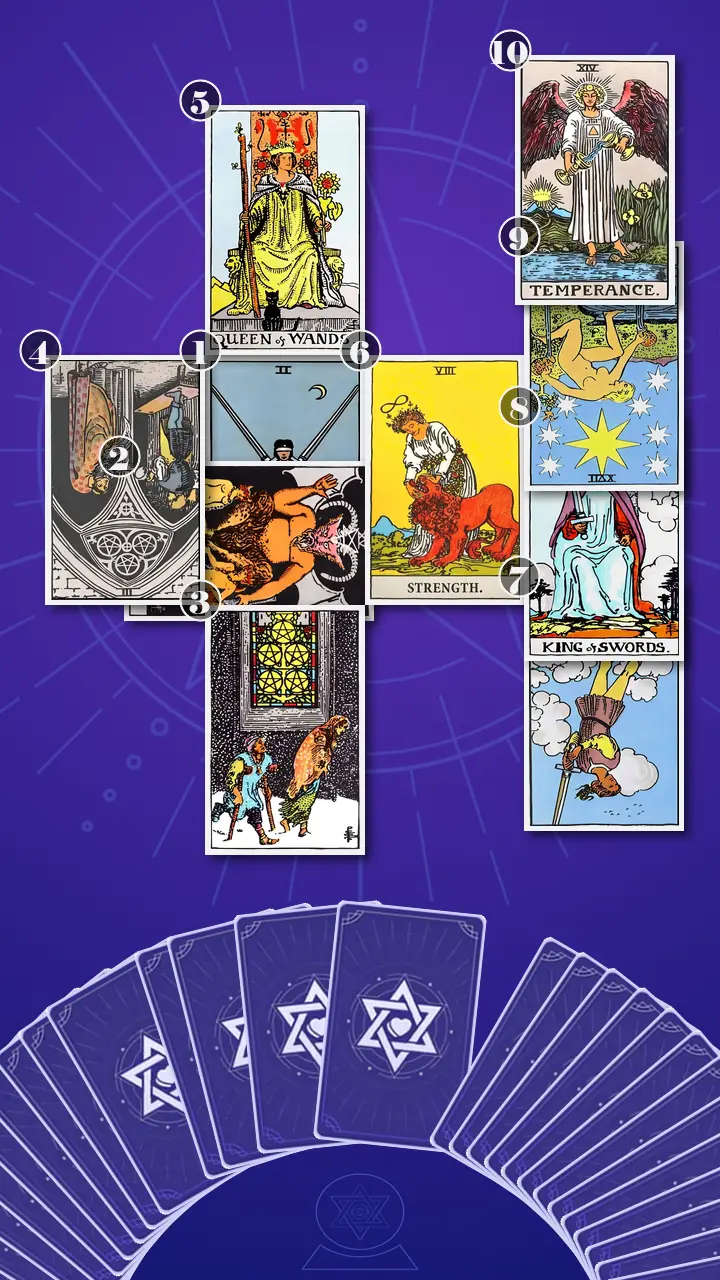
Two Screens, One Nervous System
Position 1: The exact “camera on?” freeze response (presenting behavior)
“Now revealed,” I said, “is the card representing the exact freeze response and what it protects in the moment.”
Two of Swords, upright.
I didn’t need to reach for anything dramatic. The image was already Taylor on a Monday morning: a blindfolded figure with crossed swords, holding still like movement itself might invite danger.
“This is that ten-second micro-moment,” I said, using the language of her actual life. “Cursor hovering over the camera icon. Your self-view thumbnail pops up. Your body folds inward. And your mind starts arguing in two tracks: ‘If I turn it on, they’ll see…’ and ‘If I keep it off, I’ll look disengaged…’”
I let the sentence hang, then named the third thing: “Underneath both thoughts, your mind is stalling—because no move feels like the only move that can’t be wrong.”
The Two of Swords energy here isn’t weakness; it’s protection. It’s a blockage state: your nervous system choosing stillness because visibility has been filed under “threat.”
Taylor gave a small laugh that didn’t reach her eyes. “That’s… mean,” she said, then softer: “But yeah. It’s exactly that moment.”
Position 2: What intensifies the trigger (the crossing pressure)
“Now revealed is the card representing what crosses you—the pressure that turns this into a self-worth test.”
The Devil, upright.
“Okay,” I said, and I heard my own voice go calm in that way it does when I’m guiding school groups through a planetarium show—steady, not theatrical. “This isn’t about a webcam. This is a chain.”
I translated the Devil’s loose chains into the exact modern loop: “It’s like a hidden performance review tab running in the background of your brain, eating all your RAM. You tweak, you check, you tweak again—lighting, posture, facial neutrality, background—because it feels like not checking is dangerous.”
The Devil is excess in the wrong place: too much external approval as fuel, too much fear-based perfectionism dressed up as ‘professionalism.’
Taylor’s mouth pulled to one side. A tense half-laugh escaped. “Ugh. Yes. It’s like… I’m keeping an engagement score algorithm updated. No one asked me to do that. But I’m doing it.”
“Your camera isn’t a verdict,” I said, and I meant it as a reframe, not a pep talk. “It’s a channel.”
Position 3: The deeper belonging/worth fear beneath it (subconscious root)
“Now revealed is the card representing the underlying belonging fear under the camera trigger.”
Five of Pentacles, upright.
The Five is winter. It’s the feeling of being outside something warm.
“This,” I said gently, “is the part of you that sees colleagues’ tidy Zoom tiles as a warm window—and your own messy, human reality as the cold street.”
I kept my tone soft, specific. “This isn’t about a webcam; it’s about not wanting to be the person the room quietly stops choosing.”
The Five of Pentacles energy is deficiency: not a lack of skill, but a lack of felt belonging. When that’s the root, any visibility can feel like a social sorting moment.
Taylor went still. Her fingers tightened around the mug, then loosened, like she’d realized she was gripping it too hard. “Yeah,” she said after a long beat. “If I look tired or awkward, it feels like… I’ll be discounted. Like I won’t be taken seriously anymore.”
I nodded. “That fear makes the Devil louder. And it makes the Two of Swords freeze feel like the only safe option.”
Position 4: Recent past conditioning (what fed the “I’m being evaluated” story)
“Now revealed is the card representing recent experiences that conditioned this reaction.”
Three of Pentacles, reversed.
“This is teamwork turning into comparison,” I said. “It’s unclear standards. Vague feedback that doesn’t land. Meetings that feel church-quiet in the worst way—like you’re being assessed instead of collaborating.”
In reversed energy, the Three of Pentacles becomes blockage in the collaboration circuit: you don’t know what the rubric is, so you start trying to be un-judgeable.
Taylor exhaled through her nose. “There’s this one person,” she admitted. “They fill every silence. And if I hesitate even a second, the moment’s gone.”
“That’s real context,” I said. “Your nervous system isn’t inventing pressure out of nowhere. It’s responding to ambiguity and speed.”
Position 5: The conscious goal for presence (what Taylor wants to embody)
“Now revealed is the card representing what you’re aiming for when you’re visible.”
Queen of Wands, upright.
“This is your true north,” I said. “Warmth. Ease. Taking up space without apologizing for existing. Not performative perfection—felt self-ownership.”
The Queen of Wands is balance in Fire: enough confidence to be seen, enough warmth to stay human. “Camera on,” in this card’s language, is an act of leadership—not a beauty check.
Taylor’s eyes softened. For the first time, she looked at the card instead of her own tile. “That’s who I want to be,” she said. “I don’t want to be the person who hides.”
Position 6 (Key Card): The next-meeting experiment (a workable pivot)
The air in the room changed the way it does when a planetarium show reaches the moment the lights go fully down—when you can sense everyone holding their breath before the stars appear.
“We’re turning over the most important card in this reading,” I told her. “The one that bridges where you are to what you can do next.”
Strength, upright.
Setup. Taylor was still trapped in that split second: host says, “Cameras on if you can,” self-view pops up, and suddenly she’s trying to fix her face before anyone can decide what she means. She keeps waiting to feel ‘ready,’ like readiness is permission.
Delivery.
Not “force confidence” but “practice gentle courage,” like Strength calmly holding the lion instead of letting the fear drive the meeting.
There was a quiet pause after I said it—the kind where even the radiator in the background seemed to click more softly, like it didn’t want to interrupt.
Reinforcement. Taylor’s reaction came in layers, a three-beat chain I’ve learned to trust: first a tiny physiological freeze—her breath caught, her eyes went wide for half a second. Then cognitive seep—her gaze unfocused, like she was replaying a dozen meetings at once, watching the moment she disappeared. Then emotion—her shoulders dropped, and she let out a shaky exhale that sounded like relief mixed with grief.
“But if I’m still nervous,” she said, and there was a flash of irritation under it, “doesn’t that mean I’m… still bad at this?”
“No,” I said, and I let myself be direct. “You don’t have to win the feeling to earn the right to speak. Strength is nervous system steadiness, not a personality makeover.”
In my work at the planetarium, I teach people that a pulsar isn’t ‘calm’—it’s rhythmic. It’s reliable. That’s what your breath can become. I call it Pulsar Breathing: syncing your exhale like a steady signal in cosmic noise.
“Here’s your 7-minute Strength rep before your next call,” I said, and I made it concrete—because vague reassurance doesn’t change behavior:
“(1) Set a timer for 60 seconds and sit the way you’ll sit on Zoom; notice where you tense (jaw/throat/shoulders). (2) Take 3 slower exhales than inhales (count 4 in, 6 out). (3) Decide one concrete contribution: one question, one clarification, or one 10-second summary. Write it on a sticky note. (4) On the call, turn camera on for the first 5 minutes only, then reassess—no forcing. If your body spikes (tight chest/throat), you’re allowed to turn it off again; the win is attempting one small contribution, not ‘being fearless.’”
Then I invited her in the exact way I always do at the turning point: “Now, with this new perspective, think back to last week—was there a moment this would’ve let you feel different?”
Taylor blinked fast, like she was keeping tears from turning into a whole situation. “Tuesday standup,” she said. “I had a question. It was good. But I watched my face while I was deciding whether to ask. And then someone else moved on.”
“That’s the pivot,” I said. “From managing your image to choosing one small, concrete contribution—even while feeling visible.”
And I named the deeper semantic shift out loud, so it wasn’t just a nice moment: “This is you moving from self-conscious tension toward grounded self-compassion. Not in theory—in a specific meeting, with a specific breath, with a specific sentence.”
Position 7: Your self-talk on camera (self-position in the pattern)
“Now revealed is the card representing your inner stance while you’re visible.”
Page of Swords, reversed.
“This is your inner commentator,” I said. “It’s not curiosity; it’s surveillance.”
I described it the way it shows up on a laptop: “You collect evidence—delayed reactions, someone’s neutral Zoom face, Slack punctuation later. Your mind turns it into a story: ‘They clocked it. They noticed I looked weird.’”
Reversed, the Page’s energy is excess mental vigilance with blockage
Taylor’s hand drifted toward her own webcam instinctively, as if to adjust it, then stopped. “I literally watch myself listening,” she admitted. “Like I’m trying to look like a person who’s listening.”
“If you’re in the meeting and in the mirror, you’re doing two jobs at once,” I said again, more softly this time.
Position 8: Contextual pressure (the standard-setter in the environment)
“Now revealed is the card representing the environment that shapes the perceived standard.”
King of Swords, upright.
“This workplace values clarity,” I said. “Concise thinking. Polished communication. That’s not evil. It’s just the culture.”
But then I drew the line Taylor needed: “And here’s the mix-up: Clarity is the standard—perfection is the tax you invented. The King of Swords is asking you to be clear. Your Page-of-Swords-reversed anxiety is asking you to be un-judgeable.”
The King’s energy is balance when you use it as a guide, and blockage when you worship it like a judge.
Taylor nodded once—small, decisive. “That… is extremely screenshot-able,” she said, and for the first time she sounded a little wry instead of cornered.
Position 9: The visibility hope/fear knot
“Now revealed is the card representing your hope for effortless confidence and the fear that you’ll never feel okay being seen.”
The Star, reversed.
“This is the wounded idealist,” I said. “You want the ‘effortless’ version—where your camera turns on and you don’t even think about it. And when you can’t access that immediately, hope collapses into comparison.”
Reversed, the Star is deficiency in faith—not faith in the universe, just faith in your own timing. The fear isn’t only ‘they’ll judge me.’ It’s ‘I’ll never grow out of this, so what does that mean about me?’
Taylor stared at the card, then at her desk. “I keep thinking other people are just… naturally fine,” she said. “And I’m behind.”
“Good enough on camera is a practice, not a personality trait,” I said, and I meant it as a measurement shift, not a mantra.
Position 10: Integration trajectory (how it softens if you practice)
“Now revealed is the card representing what integration looks like if you keep practicing the shift.”
Temperance, upright.
Temperance doesn’t do glow-ups. Temperance does routines. It pours a little from one cup to another until the system can hold it.
“This is the middle path,” I said. “You don’t force confidence, and you don’t disappear. You build a meeting preset that blends competence with being human: same seat, simple lighting, self-view off, one clear contribution.”
The Temperance energy is balance—and, importantly for Zoom anxiety, it’s time-based. Not a breakthrough. A rhythm.
The Strength Rep and the Temperance Meeting Preset
I looked at the whole spread again and spoke it back as a single, coherent story—because that’s where tarot becomes actionable advice, not just “card meanings in context.”
“Here’s the chain,” I said. “Your Two of Swords freeze is self-protection in the exact camera prompt moment. The Devil crosses it by turning ‘professionalism’ into a scorecard you keep updating in real time. Underneath, the Five of Pentacles is the fear of being quietly excluded if you’re imperfect. A recent Three of Pentacles reversed moment—unclear recognition, unclear rubric—trained your body to treat meetings like evaluation. But your conscious goal is Queen of Wands: warm, visible leadership. The bridge is Strength: regulate first, then contribute. And the long-term outcome is Temperance: a boring, repeatable preset that compounds.”
“Your cognitive blind spot,” I added, “is thinking the only two options are: look perfect, or be punished. The transformation direction is simpler and braver: stop managing your image as the main task, and choose one small, concrete contribution as your main task—even with discomfort still in the room.”
Then I gave her a tight set of next steps, built to work in an actual NYC workweek—no mystical homework, no ‘just be confident.’
- The One-Sentence Visibility RuleBefore one meeting this week, write ONE sentence you want the team to understand (a question, a clarification, or a 10-second summary). Put it at the top of your notes and commit to saying it once—on camera—even if your voice shakes.If your brain tries to add two more sentences, name it (“scorecard brain”) and go back to one. Don’t wait to feel ready. Pick one sentence and ship it.
- The 5-Minute Camera-On Trial (Consent-Based Exposure)In your next call where “cameras on if you can” comes up, turn the camera on for the first five minutes only—then decide again. Treat it like a dial, not a test. If possible, turn off self-view (or cover that area with a sticky note) so you’re not stuck in the mirror.Two minutes still counts. If anxiety spikes, you’re allowed to turn it off again—the win is one contribution attempted, not being fearless.
- The Temperance Meeting Preset (One Adjustment Only)Pick one default meeting spot. Set your lamp once. Your rule: after you open Zoom, you get only ONE adjustment—then you join. If you need a grounding background sound, let the mundane help: the washing machine cycle, the radiator hiss—anything steady becomes your “cosmic meditation” track.Make it boring on purpose. Temperance grows through consistency, not constant optimizing.

A Week Later: Ownership, Not Certainty
Six days later, Taylor sent me a message that was almost annoyingly short: “Did the five-minute thing. Camera on. Self-view off. Asked my one question. My chest still did the tight thing, but I didn’t disappear.”
She added, after a pause: “I slept through the night. Woke up and my first thought was still ‘What if I looked weird?’—but this time I laughed a little and got coffee anyway.”
I sat with that for a moment in the planetarium lobby, where the ceiling lights always make people look slightly washed out—like everyone is a little imperfect under bright scrutiny. The irony didn’t escape me.
“That’s the Journey to Clarity,” I wrote back. “Not certainty. Ownership. You related to visibility as a channel for connection and contribution—not a verdict on your worth.”
When the camera prompt hits and your chest tightens, it’s not that you “can’t handle a meeting”—it’s that you’re trying to earn proof you’re enough while also bracing for the moment being seen might take it away.
If you didn’t have to look confident first, what’s one small, specific thing you’d be willing to contribute on your next call—even with the discomfort still in the room?