The Sunscreen Smell Hit—And I Practiced Self-Trust Instead of Proof

Finding Clarity in the Union Square Scent-Flash
If you’ve ever smelled sunscreen on the subway and felt your mood drop so fast you opened Notes like you were about to solve a case—welcome to the ‘sensory trigger sadness’ club.
Taylor (name changed for privacy) said it like she was trying to make it a joke first, before it could hurt. “Why does this smell feel like a punchline I don’t get.”
She was 27, an early-career marketing coordinator in New York City—someone who could keep a project moving, keep her Slack tone upbeat, keep her body wedged politely into a packed commute. But when she described the trigger, I could practically see it.
“It was 8:41 on the Union Square platform,” she told me. “Weirdly warm for spring. Someone squeezed past me and—boom—coconut sunscreen. The fluorescent lights were doing that faint flicker thing. My phone felt hot in my palm. And my chest just… dropped. Like my breath got smaller.”
Her fingers mimed the reflex: thumb to screen, Notes app open. As if the next line she typed could subpoena the right childhood summer into existence.
“And then I’m like, what year is this? But I’m literally just trying to get to work,” she said. “I swear I’m fine until I’m suddenly not.”
What she wanted was simple and huge at the same time: to enjoy the present moment without bracing for a sensory trapdoor. The core contradiction was right there in her posture—shoulders slightly lifted, jaw held like a clasp. Wanting sunlight, weekends, rooftop season, ease… versus fearing that one random scent would yank her into a sadness she couldn’t name, control, or explain.
The sadness itself wasn’t a thought. It was a physical event: a quiet heaviness spreading through the ribs, like someone turned down the air in the room and forgot to tell her lungs.
“It’s embarrassing,” she admitted. “To be sad about something this random. And then I start Googling ‘why do smells trigger childhood sadness’ at like midnight and it somehow makes it worse.”
I nodded, letting her have the full truth of it without rushing to translate it into a neat lesson. “You’re not fragile for getting pulled by a scent,” I said. “You’re human with a nervous system. And today, we’re not here to force a breakthrough. We’re here to find clarity—enough clarity to give you a way back to yourself when it hits.”

Choosing the Compass: The Horseshoe Spread for Sensory Triggers
I host a radio show about music therapy, so my version of “ritual” is usually practical: a moment to shift from noise to signal. I asked Taylor to take one slow inhale—nothing dramatic, just the kind you can do on a train without anyone noticing. While she held the question in mind, I shuffled. The soft, papery sound of the deck is one of my favorite resets; it’s like metronome clicks for the attention.
“For this,” I said, “I’m using a classic Horseshoe spread.”
And for you, reading along: the Horseshoe is perfect when the question is basically, What is this pattern, where does it come from, and what do I do with it? It traces an arc—past imprint → present reaction → hidden influence → obstacle → outside influence → advice → integration direction. Minimal complexity, maximum usefulness. Exactly what you want when the mind is already doing too much.
I laid the cards in a shallow arc like a scent trail—dipping down into the subconscious at the lowest point, then lifting back up toward the surface. “We’ll start with the past imprint,” I told her, “then we’ll name what’s real in the present, touch what’s underneath, identify the exact loop that keeps you stuck, and finally get you actionable next steps.”
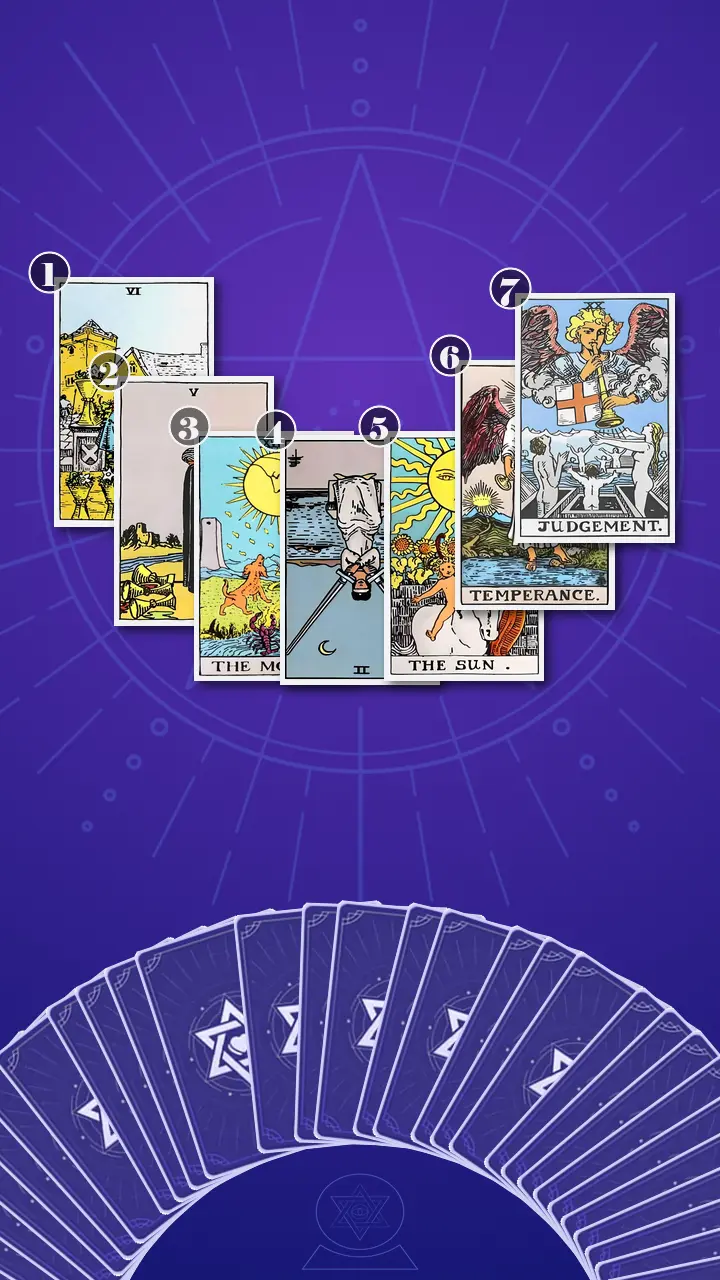
Reading the Arc: Card Meanings in Context
Position 1 — Past imprint: what childhood atmosphere your body time-travels to
“Now flipping,” I said, “is the card that represents your Past imprint: what kind of childhood era or emotional atmosphere the scent is linked to.”
Six of Cups, upright.
This card is childhood—yes—but not in the way people expect, like a crisp flashback with a timestamp. I told Taylor what I saw in modern terms: “You smell sunscreen and it’s not one clean memory. It’s like your whole nervous system gets smaller. You suddenly want something simple and safe—someone handling the logistics, someone noticing you, someone saying ‘you’re okay’—even while adult-you is standing in NYC trying to act normal and keep moving.”
Six of Cups energy is soft, tender, and relational. In balance, it’s sweet remembrance. But it can also carry that innocent vulnerability: the truth that when we were small, we needed care we couldn’t always name.
Taylor gave a short laugh that landed a little bitter. “That’s… almost mean,” she said. “Because it’s not even like my childhood was horrible. It’s just—when it hits, I feel five.”
“Exactly,” I said. “This card isn’t accusing your past. It’s pointing out that your body remembers an atmosphere—not a courtroom exhibit.”
Position 2 — Present reaction: what the scent is activating right now
“Now flipping,” I said, “is the card that represents your Present reaction: the specific emotional reality the scent is activating right now.”
Five of Cups, upright.
Five of Cups is one of the clearest images of grief that doesn’t announce itself. It’s the card of the bowed head and the spill—your attention zooming so hard on what hurts that you can’t access what’s still okay.
I translated it directly into her subway moment: “The scent hits and your mood drops into a quiet grief that doesn’t match the day. You fixate on what feels missing—ease, innocence, summer being uncomplicated—while your actual supports feel unreachable in that moment.”
In energy terms, this is contraction: an emotional narrowing. Not wrong. Not dramatic. Just real.
Taylor’s eyes didn’t water; it was subtler than that. Her gaze went slightly unfocused, like she was looking past the card into something behind it. “I hate how fast it happens,” she said. “Like—one second I’m drafting an email and the next I’m grieving something I can’t even name.”
“Five of Cups doesn’t require a justification,” I said. “It just asks you to notice where your attention goes. Your brain keeps doomscrolling the ‘missing’ column of your life while the ‘still here’ column is literally behind you.”
Position 3 — Hidden influence: what’s underneath conscious memory
“Now flipping,” I said, “is the card that represents your Hidden influence: what’s operating underneath conscious memory.”
The Moon, upright.
“Some childhood stuff comes back as a vibe, not a scene,” I said before she could even tense up. “That’s Moon language.”
Then I gave her the modern-life translation she’d been fighting against: “You can’t place the memory, so your brain assumes it’s invalid—yet your body insists it’s real. The sadness comes with a vibe: distance, nighttime, a sense of being slightly lost. It’s less ‘this happened on July 12th’ and more ‘this is the emotional climate I learned to live inside.’”
Moon energy isn’t a blockage; it’s a medium. It’s your psyche speaking in dream-language. Trying to force it into a spreadsheet breaks the message.
Taylor’s shoulders lowered a millimeter. Not a breakthrough—just a tiny loosening. “I keep trying to turn it into… receipts,” she said. “Like if I can’t cite the memory, it doesn’t count.”
“That’s the trap,” I said gently. “The Moon isn’t asking for event receipts. It’s offering atmosphere data.”
Position 4 — Obstacle: the pattern that keeps the sadness stuck
“Now flipping,” I said, “is the card that represents your Obstacle: the mental/emotional pattern that keeps the sadness stuck or confusing rather than integrated.”
Two of Swords, reversed.
This one landed like a truth you can’t unsee. Two of Swords is the blindfold and crossed blades—self-protection through not-feeling. Reversed, it’s the moment the guard slips but clarity doesn’t arrive. Instead, the mind floods.
I didn’t mystify it. I named it. “On the train, you catch the sunscreen smell and instantly start building a case file: which summer, which house, which photo, which ‘root cause.’ You toggle between possible explanations and trust none of them—so you end up scattered, mentally loud, emotionally numb, like your own inner world is a problem you’re failing to solve.”
And I used the contrast that always fits this card: “It’s your mind as a courtroom. Notes app, Google, therapy TikTok—tab-switching like you’re cross-examining yourself. Meanwhile your body is just trying to report weather.”
Taylor’s lips pressed together, then softened. She let out a quiet exhale. “Oh,” she said, almost to herself. “I do treat this like evidence.”
I watched her jaw unclench in real time—like her face was making room for the possibility that she didn’t have to win a case to be okay.
“A feeling can be true without being a verdict,” I said. And I saw that line land—not as inspiration, but as permission.
Position 5 — Outside influence: the summer pressure that amplifies everything
“Now flipping,” I said, “is the card that represents your Outside influence: the environmental/seasonal/social context that amplifies the trigger.”
The Sun, upright.
Taylor made a sound that was half laugh, half oh no.
“Yep,” I said. “This is the city flipping into rooftop season overnight. The first 75-degree day when the group chat suddenly becomes a logistics spreadsheet. Instagram Stories from Rockaway, Fire Island, the beach train. The sunscreen smell isn’t just a scent—it’s a social cue that says, ‘be fun now.’”
I let the montage play, because it matters: CVS displays stacked like a neon altar to SPF. Sidewalks smelling like hot pavement and perfume. People radiant in tank tops as if they were released from winter captivity. The outside world turning up the brightness so fast your inner weather has no time to adjust.
In energy terms, The Sun is exposure. Not just warmth. Being seen. Being expected to feel good about it.
“And when you’re carrying Five of Cups energy—real sadness—The Sun can make it feel louder,” I added. “Not because you’re broken. Because contrast is loud.”
When Temperance Spoke: Mixing Two Realities Instead of Choosing One
I could feel the room shift when we reached the next card—the way a studio goes quiet right before a live mic opens. It wasn’t spooky. It was focus. This was the hinge of the whole reading.
Position 6 — Advice: the most grounded way to work with the trigger
“Now flipping,” I said, “is the card that represents your Advice: the most grounded way to meet the trigger as self-exploration.”
Temperance, upright.
Temperance is the card of the steady pour between two cups. One foot on land, one in water. It’s integration without drama. Regulation without denial.
I gave her the translation that matched her life: “Instead of forcing the perfect childhood explanation, you build a tiny ‘blend’ response: notice the drop, name it, take a sip of water, breathe once slowly, keep your feet on the ground. The goal isn’t to delete the sadness—it’s to teach your system: ‘I can feel this and still be okay in my present life.’”
Then my own professional reflex kicked in—the part of me that has spent a decade studying sound and nervous systems, and years behind a mixing console. “Temperance is basically audio engineering,” I told her. “When two tracks clash, you don’t smash one of them. You adjust levels. You EQ. You blend. You let both be present without one distorting the whole mix.”
This is where I brought in my signature lens—what I call Space Tuning. “Your environment has an acoustic fingerprint,” I said. “Union Square platforms, fluorescent buzz, headphone leak, announcements, bodies packed close. Your system gets hit with the scent and the noise. You’re not only remembering—you’re being overstimulated.”
“So the advice isn’t ‘remember better.’ It’s ‘tune the moment.’ Even a micro-tuning: one slow exhale, one sip of water, one steady sound in your ears. Not to drown out the feeling—just to give it a container.”
The Aha Moment (Setup)
You know that moment on the subway when a sunscreen/coconut scent hits before you can think, and suddenly your chest drops—then your brain opens Notes like it’s about to solve the case in real time.
The Aha Moment (Delivery)
Stop treating the trigger like a case you must solve; start blending what you feel with what you know, like Temperance’s steady pour between the cups.
The Aha Moment (Reinforcement)
Taylor’s reaction came in layers, like a wave you can track if you know what to watch for.
First: a brief freeze—her breath paused at the top of her chest, fingers hovering over her phone as if muscle memory still wanted to open Notes.
Second: the cognitive shift—her eyes unfocused, then flicked down to the Temperance card, like she was seeing the image not as “tarot” but as a diagram. A steady pour. A blend. A way out that wasn’t a perfect explanation.
Third: the release—an exhale she didn’t fully control, shoulders dropping in a small, almost surprised surrender. Then the tricky part: a flicker of vulnerability, like the moment after you set down a heavy bag and your arms feel oddly empty.
“But if I stop solving it,” she said, voice a little sharp with fear, “doesn’t that mean I’ll never know what it is? Like… what if I’m missing something important?”
I didn’t rush to reassure her. I held the question the way Temperance holds two cups—steady, not dramatic. “What if knowing isn’t the only kind of safety?” I asked. “What if the important thing is that you can feel it and stay here?”
“Try this once,” I continued, keeping it consent-forward and small. “Next time the sunscreen smell hits—or even just thinking about it—set a 90-second timer.
1) Name three body sensations: ‘tight chest, warm face, heavy stomach.’
2) Name one emotion: sadness, longing, tenderness, unease.
3) Say—out loud or in Notes—‘This is a feeling, not a diagnosis.’
Then do one tiny regulating action: sip water, unclench your jaw, or plant both feet and press your toes into your shoes for 10 seconds. If it spikes your anxiety, you can stop early. This isn’t a test you have to pass.”
As I said it, I watched her try it in her body—jaw loosening, toes subtly pressing into the floor. Like she was learning a new keyboard shortcut for returning to the present.
“Now,” I asked her, “with this new lens—blending instead of proving—can you think of a moment last week when the scent hit and you went straight to evidence-gathering? What would have changed if you’d done the 90 seconds first?”
She swallowed once, deliberately. “On the Q train,” she said. “I would’ve… stayed on the train. I wouldn’t have felt like I had to solve it before I could answer my friends.”
And that was the real shift: not from sadness to happiness, but from trapdoor to choice. From self-doubt to a first, grounded strand of self-trust.
Position 7 — Integration direction: what becomes possible with consistency
“Now flipping,” I said, “is the card that represents your Integration direction: what clarity becomes possible when you apply the advice.”
Judgement, upright.
Judgement scares people because they hear the word like a sentence. But in tarot, it’s an awakening. A call. A re-storying.
I told her what it looked like in real life: “Over time, you stop treating the sunscreen sadness like proof you’re unstable. You start recognizing it as a signal that points toward compassion and honesty. The timeline matters less than the pattern: when this shows up, you respond with steadiness—and your self-story becomes ‘I can handle my inner weather,’ not ‘I’m fragile.’”
Judgement energy is clarity without cruelty. It’s you reviewing the past without putting yourself on trial.
Actionable Advice: The 90-Second Blend (and Two Other Tiny Exits)
I summarized the arc back to Taylor, because integration isn’t just insight—it’s storyline.
“Here’s what the spread is saying,” I said. “The sunscreen scent is a past atmosphere (Six of Cups) that opens into real present grief (Five of Cups). Underneath, your system speaks in symbols and vibes (The Moon). The loop that keeps it stuck is the mind-as-courtroom (Two of Swords reversed)—the belief that if you can’t explain it, something is wrong with you. And the city’s summer brightness (The Sun) turns the contrast up. Temperance is the bridge: stop building a timeline, start building a response. Judgement is the outcome: awakening, not verdict.”
The cognitive blind spot was gentle but specific: Taylor kept equating “unexplained” with “unsafe.” Her transformation direction wasn’t to excavate the perfect memory—it was to build a repeatable, present-tense way to meet the feeling so it could move through instead of turning into an interrogation.
I offered her next steps that were deliberately low-drama—because the goal isn’t to become a different person overnight. It’s to interrupt the spiral by 5% and prove to your body that you can come back.
- The 90-Second Blend (Temperance practice)When the sunscreen/coconut scent hits (on the train, in CVS, on the sidewalk), set a 90-second timer. Name 3 body sensations + 1 emotion. Then say: “This is a feeling, not a diagnosis.” Finish with one regulating action: take a sip of water, swallow deliberately once, or press your toes into your shoes for 10 seconds.Keep it tiny and private. If you’re in public, do the least noticeable version (toes + one slow exhale). You can stop early—this is care, not a performance.
- Close-the-Tabs Boundary (Mind-as-Courtroom interrupt)The moment you catch yourself tab-switching (Notes → Google → TikTok), label it: “I’m evidence-gathering.” Then choose one: close the apps immediately, or set a 3-minute limit to research and stop when the timer ends—no exceptions.You’re not banning curiosity; you’re reclaiming your afternoon. Treat the timer like a hard stop the way you would for a meeting.
- A 3-Song “Summer Undertow” Micro-Playlist (my music-therapy add-on)Make a playlist of exactly 3 songs that match the feeling (not the season). Next time you get hit, listen to one song straight through without analyzing. Let it be a container for the emotion—like giving it a room to move in.If lyrics pull you into stories, go instrumental. Your job isn’t to decode the past; it’s to let the feeling have motion without hijacking your day.
And because sound is my home language, I added one optional practice from my own toolkit—only if it felt supportive, not like homework: “If you want to train your system more steadily,” I told her, “try my 21-Day Sound Bath. Three minutes a day, same time if possible. It can be humming, a singing bowl track, or even a single sustained note you like. The point is consistency, not perfection—teaching your body a familiar ‘safe frequency’ it can access when The Sun turns the world up too fast.”

A Week Later: The Quiet Proof
Six days later, I got a message from Taylor. Not a long essay. Just a screenshot of her Notes app template:
“Sunscreen sadness = tender + heavy ribs. No timeline required.”
Under it she’d typed: “Did the 90 seconds on the Q train. Didn’t spiral. Answered my friend. Still felt sad, but it didn’t eat the whole commute.”
It wasn’t a movie ending. It was better: a small proof. Clear but still a little tender—she wrote that the next morning her first thought was still, “What if I’m missing the real reason?” and then, “Oh. That’s the courtroom again.”
That’s what a Journey to Clarity often looks like in real life: not certainty, but ownership. Not deleting the feeling, but learning you can hold it without turning it into a verdict.
When a single sunscreen scent can drop your chest like a trapdoor, it makes total sense that you start treating your own feelings like a case you have to solve just to feel safe again.
If you didn’t have to prove what summer it came from, what’s one small way you’d let that feeling be real—without letting it run the whole day?