When Apple Watch Rings Feel Like Grades: Rebuilding a Calibrated Week

Finding Clarity in the 9:47 p.m. Condo Laps
If you’ve ever done 9:47pm apartment laps because your Apple Watch Move ring was still open, welcome to quantified-self burnout.
Taylor (name changed for privacy) sat across from me with their sleeve tugged down over the watch like it was both a comfort object and a witness. They were 29, Toronto-hybrid-job tired—the kind of tired that doesn’t look dramatic, just… compressed.
They described a Wednesday night that felt like it had happened a hundred times: kitchen light too bright, condo quiet except for a faint streetcar bell outside, and their watch face glowing every time their wrist turned. They paced from the couch to the hallway, calves tight, jaw locked, as if their body had been hired to perform a small, endless task.
“I’m not even enjoying the workout,” they said, voice flat with a kind of disbelief. “I’m just trying to make the numbers shut up.”
Underneath every sentence was the same tug-of-war: wanting a steady sense of health and self-control—while fearing that missing a ring proves they’re slipping, not disciplined enough, not in control.
The pressure in them didn’t look like panic. It looked like shoulders held a centimeter too high all day. It sounded like micro-math in the background of every meeting. It felt—when I watched them exhale—like trying to sleep with a progress bar projected on the ceiling.
“You’re not broken,” I told them, keeping my voice warm and plain. “You’re over-audited. And we can work with that. Let’s make a map through the fog—something that leads to actual clarity, not just another rule.”

Choosing the Compass: The Four-Layer Insight Ladder Spread
I asked Taylor to take one slow breath—not as a mystical ritual, just as a transition. A way to step out of the day’s noise and into a clearer room inside their own mind. While they breathed, I shuffled slowly, letting the cards make that soft paper-thrum that always reminds me of wind against pine needles back home.
“Today we’ll use a spread I like for modern loops,” I said. “It’s called the Four-Layer Insight Ladder · Context Edition. It’s a 6-card grid.”
For you reading this: this spread is built for problems that aren’t really about prediction. It’s for patterns—self-reinforcing habit loops driven by perfectionism, control, and depleted recovery. It moves from the visible behavior (what you keep doing) to the underlying hook (why it feels compulsory), names the hidden cost, and then turns insight into a practical, realistic next step.
I pointed to where the cards would land. “The first card shows the surface loop. The second shows what’s driving it underneath. The fifth is our pivot—where the whole system can change. And the last card is your next step for this week, not a personality makeover.”
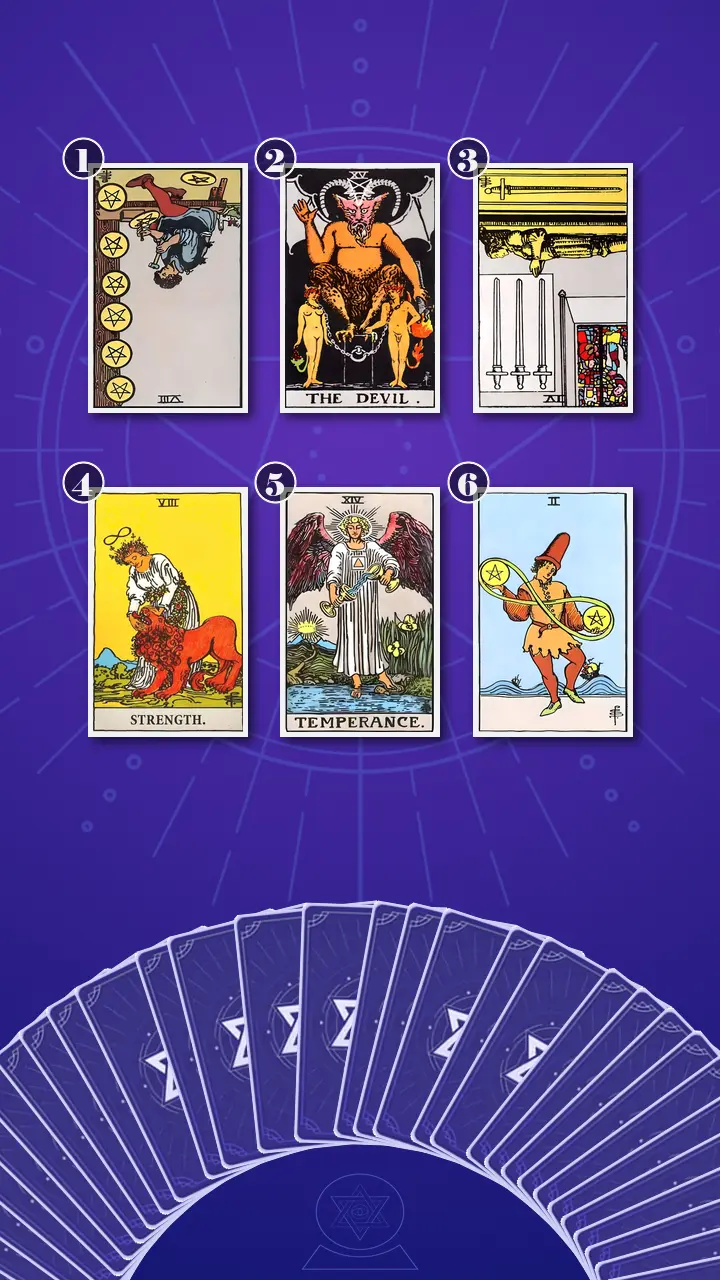
Reading the Map: When “Healthy” Starts to Feel Like Homework
Position 1 — Surface pattern: the repeatable rings loop
“Now we’re turning over the card that represents your surface pattern—the most visible, repeatable behavior loop around the Apple Watch rings that keeps the day feeling like eat-work-sleep.”
Eight of Pentacles, reversed.
I tapped the image lightly. “This is the card of practice and skill-building—until it flips. Reversed, it becomes repetition without nourishment. The craft turns into grind.”
And it landed exactly in Taylor’s life: It’s 3:12pm, you’ve been glued to your laptop for hours, and without thinking you tap the Activity rings the way you refresh an inbox. Seeing the ring ‘behind’ flips a switch—you reshuffle your calendar, squeeze in a brisk 20-minute walk, and come back not restored—just briefly reassured, like you turned off an alarm.
“From the outside, it looks like discipline,” I said. “From the inside, it feels like unpaid labor you’re scared to fail.”
Taylor let out a small laugh that had no humor in it—more like a lid loosening. “That’s… brutally accurate,” they said. “It makes it sound so—sad. Like I’m doing Jira tickets for my body.”
“Yes,” I said gently. “And I want you to hear this without shame: this isn’t laziness. This is a system that taught you to confuse proof with care.”
Position 2 — Underlying driver: what makes the rings feel non-optional
“Now we’re turning over the card that represents your underlying driver—the attachment or belief that makes the rings feel like law instead of support.”
The Devil, upright.
I didn’t dramatize it. I never do. The Devil card is most useful when we treat it like a flashlight, not a horror movie.
“This is attachment,” I said. “Compulsion dressed up as ‘consistency.’”
In modern life it looks like this: You’re standing in your kitchen staring at the rings like they’re a final grade. You know you could lower the Move goal, ignore the streak, or take the watch off for the night—but your stomach drops at the idea because the ring isn’t just a number anymore. It’s proof that you’re in control.
“It’s like a seductive boss app,” I continued, using the echo I’d been given by years of watching people try to outrun themselves. “It keeps sending ‘just one more task’ notifications. Not because the task matters. Because the completion ping gives you certainty.”
I pointed at the chains in the image. “And here’s the part people miss: the chain isn’t iron. It’s a soft band you keep tightening yourself—especially on hard work days. The watch doesn’t actually have hands. But it has authority because it speaks in numbers.”
Taylor’s reaction came in layers: their breath caught for half a second, their eyes flicked away like they wanted to argue, and then their shoulders dropped as if something in them admitted defeat. They exhaled sharply. “Oh… yeah,” they said. “That’s exactly it. The dread is immediate. Like if I don’t close it, I’m… not me.”
“That’s the hook,” I said. “Not fitness. Identity. A streak you didn’t mean to subscribe to.”
Position 3 — Hidden cost: what this system is draining
“Now we’re turning over the card that represents your hidden cost—what this rings system is quietly draining, and how it shows up day-to-day.”
Four of Swords, reversed.
I felt the air in the room go a little quieter. This card always does that. Even upside down, it’s a picture of a sanctuary—only the sanctuary isn’t working.
“This is rest that doesn’t restore,” I said. “And I want to use a phrase that’s blunt but kind: Rest that doesn’t land is still work.”
I brought the scene close, sensory and specific, because that’s where people feel seen: It’s 11:36pm. The room is dark, your duvet is pulled up, your phone is warm in your hand. The watch face lights up. Maybe there’s the tiny buzz of a notification. You’re lying down—but your nervous system is still braced, running reports: what you did, what you didn’t, what you need to ‘make up’ tomorrow.
“It’s recovery theater,” I said. “You look ‘off’ on the calendar, but your body doesn’t get the message that it’s safe.”
Taylor nodded so hard it was almost a flinch. “That is literally my nights,” they said. “I’m in bed, but I’m not off-duty. I hate it.”
In my own mind, a quiet flash of the Highlands came and went—winter fields where animals don’t apologize for conserving energy. Nature never calls rest a moral failure. It calls it a season.
The Kind of Strength That Doesn’t Need to Bully You
Position 4 — Inner resource: changing without swinging to extremes
“Now we’re turning over the card that represents your inner resource—the psychological strength you can access to change the pattern without going all-or-nothing.”
Strength, upright.
“People misunderstand this card,” I said. “Strength isn’t a clenched jaw. It’s a steady hand. It’s self-control without self-violence.”
In Taylor’s life, it’s the moment right before the late-night ‘ring-fix’ workout: You catch yourself about to do it and you pause—not with drama, but with steadiness. You talk to your body like a teammate: ‘We’re not proving anything tonight.’
“This card is the part of you that can say, ‘Gentle is not the same as optional,’” I told them. “You can be consistent without being punitive.”
Taylor swallowed, eyes on the card. Their fingers, which had been gripping the edge of their sleeve, loosened. “I don’t know how to do that without… letting everything slide,” they admitted.
“That fear makes sense,” I said. “But it’s also exactly what we’re going to challenge—with structure that respects your capacity, not a structure that shames it.”
When Temperance Spoke: The Two Cups That Changed the Rules
Position 5 — Key shift: the reframing that turns rings into feedback
“We’re turning over the card that represents your key shift—the integration point where the whole dynamic can change.”
For a moment, the room felt like it held its breath with us.
Temperance, upright.
In the picture, an angel pours water between two cups—measured, patient, deliberate. One foot is on land and one is in water. A path runs toward a distant sun. No frenzy. No verdicts. Just calibration.
Taylor was stuck in the 9:47pm trap: pacing between couch and kitchen because the Move ring was still open. Not craving movement—craving the numbers to stop judging them.
Stop treating the rings like a verdict and start treating them like two cups you can rebalance—small pours, not all-or-nothing floods.
I let the sentence sit there, the way you let a bell’s last note fade instead of rushing to fill the air.
The reaction came as a chain of small, honest things: first, Taylor went still—breath paused, eyes fixed on the cup-pouring like their brain had to re-render the image. Then their gaze softened and unfocused, as if a week of late-night pacing played back behind their eyes. Finally, their shoulders dropped in a slow, heavy release, and their mouth opened on a quiet, shaky laugh that turned into something like relief. “So… I don’t have to win the day,” they said, almost testing the words. “I just have to set it up so I can live in it.”
“Exactly,” I said. “If you grew up in the Highlands, you learn early: you don’t demand summer output in winter. You adjust how you gather heat, how you eat, how you move. Temperance is that wisdom in modern clothes. This is season-based calibration, not cheating.”
I offered them a simple practice, my own family’s way of building intuition without mysticism—listening to signals the way you listen for weather. “Tonight, do a Ten-Minute ‘Two-Cups Rebalance.’ Put the watch on the charger in another room for ten minutes—if that spikes anxiety, start with two. In your Notes app, write two headings: ‘Body’ and ‘Life.’ Under ‘Body,’ write one honest signal—jaw tight, wired, heavy, okay. Under ‘Life,’ write one constraint—late meeting, commute, low sleep. Then choose one tiny adjustment for tomorrow: lower Move by 10–20%, or keep it but schedule a fifteen-minute walk at lunch instead of a 9:47pm scramble. If you feel bargaining—‘but the streak…’—pause. No arguing needed. Just notice it and stop.”
Then I asked the question that makes insight real: “Now—with this new lens—can you think of one moment last week when this would’ve changed how you treated yourself? A moment you were about to pace the condo, or reopen Activity in bed?”
Taylor stared at the edge of the table and nodded once. “Sunday,” they said. “Someone posted a streak screenshot. I literally felt it in my stomach. I could’ve… poured less. Instead I punished myself in advance.”
“That’s the pivot,” I told them, naming the deeper arc. “This isn’t just about a watch. This is you moving from quantified-self pressure and guilt-driven self-surveillance toward grounded self-trust—capacity-based consistency. Your body gets a vote again.”
A Calibrated Week Beats a Perfect Day
Position 6 — Next step: the practice you can implement this week
“Now we’re turning over the card that represents your next step—a concrete practice you can implement this week so your routine supports your life instead of consuming it.”
Two of Pentacles, upright.
“This card is logistics with compassion,” I said. “It’s juggling on purpose instead of pretending every day has to look identical.”
And the modern translation was immediate: You build a week that can flex—some days are meeting-heavy, some days are movement-heavy—and you stop trying to make every day match just to protect a streak. You choose two versions of the day—high-energy and low-energy—and decide which one you’re in by morning.
“Think of it like Toronto transit,” I added, and Taylor cracked a real smile. “Some days are rush hour. Some days are light traffic. You don’t take the same route out of morality. You take it based on reality.”
Taylor nodded, more animated now. “That actually feels doable,” they said. “Not inspiring. Just… doable.”
From Rings-as-Verdicts to Rings-as-Feedback: Actionable Next Steps
I gathered the thread of the whole reading for them, like braiding hair: Eight of Pentacles reversed showed the rings-as-homework loop—healthy-looking routines turned into a production line. The Devil named the real engine underneath: the metric had become a judge, offering certainty in exchange for freedom. Four of Swords reversed showed the cost: recovery theater, rest that doesn’t land. Strength brought the antidote—calm, non-punitive self-leadership. Temperance taught the new operating system: adjust the pour based on the season you’re actually in. And Two of Pentacles grounded it into a weekly rhythm that can flex.
“Here’s the cognitive blind spot,” I said, carefully. “You’ve been treating adjustment as failure. Like if you lower a goal, it means you’re making excuses and you’ll lose control. But Temperance is telling us the opposite: the ability to calibrate is what mature control looks like.”
Taylor hesitated, then offered the most real-world obstacle. “But I can’t even guarantee a 30-minute wind-down,” they said. “Work stuff leaks. People ping. And then it’s 11:30 and I’m already behind.”
“Good,” I said, not because it was good news, but because it was honest data. “Then we don’t build a plan that depends on perfect evenings. We build one that survives imperfect ones.”
- The 7-Day Downshift (One Ring Only)For the next 7 days, intentionally downshift ONE ring (e.g., Move goal -10% to -20%). Replace the missing ‘proof’ with one human metric: at 3 p.m., rate your energy 1–10 in your Notes app.Expect the mental protest (“If I lower it, I’ll lose control”). Treat that as a signal, not a command. Set a calendar reminder to review in 7 days so your brain knows it’s an experiment—not a forever decision.
- The Sanctuary Block (30 Minutes, or the 2-Minute Version)For 7 nights, create a watch-free wind-down window: put the watch on the charger out of reach, dim the lights, and do one low-stimulation thing (paper book, gentle stretching, shower, simple skincare). If 30 minutes is unrealistic, start with 2 minutes.Make it frictional on purpose: place the charger somewhere mildly annoying to reach from bed. Then add my “3-minute bedtime energy review”: ask, “What’s one thing my body did well today?” and “What’s one place I’m still braced?” Write one sentence—no fixing.
- The Two-Template Day (High-Energy vs Low-Energy)Make two calendar templates: a “High-energy day” and a “Low-energy day.” By 10 a.m., choose which day you’re in. On low-energy days, pick a maintenance move (10–20 minutes walking/mobility/steps during a call) and call it done. On high-energy days, do a real workout earlier (lunch or right after work) so nights aren’t used for ring-fixing.Keep it messy on purpose. Your brain may try to turn this into a new performance system. If you miss a day, don’t “make up” by doubling—just return to the template the next morning. A calibrated week beats a perfect day.
“And one more tiny protection,” I added, offering something practical from my own toolkit. “If you need to move but don’t want to feed the scoreboard, try a walking meditation using environmental sounds—two blocks only. Listen for one streetcar bell, one set of footsteps, one gust of wind between buildings. Let your body notice it’s in a city, not a courtroom.”

A Week Later: The Quiet Proof
Six days later, Taylor messaged me. Not a long update. Just: “I lowered Move by 15%. I thought I’d feel like a fraud. Instead I slept. Also—I did the 2-minute sanctuary thing. Two minutes turned into twelve on its own.”
I pictured them in that same condo, still living real life, still having work spill over sometimes—but now, when the day ended, their body got a small signal of safety. The change wasn’t fireworks; it was a jaw unclenching while the phone stayed facedown.
They didn’t feel perfectly confident. They woke up after a full night’s sleep and their first thought was still, “What if I’m cheating?”—but this time, they exhaled and adjusted the day like a thermostat, not a verdict. Then they made coffee, quietly proud and a little tender.
That’s the Journey to Clarity I trust: not a total life overhaul, but a return of agency. Rings becoming data again. Rest becoming a human need again. Consistency becoming something your nervous system can actually live inside.
When your day is measured in rings, rest starts to feel like something you have to earn—and your body stays braced, even when you’re finally in bed.
If you let the rings be feedback—not a verdict—what’s one tiny way you’d rebalance tomorrow so your nervous system can actually feel ‘off-duty’ again?