From Startle-Shutdown to Self-Led Response: The Buzzer Protocol Path

Finding Clarity in the Door Buzzer Freeze Response at Home
If you work from home in a city flat and your building intercom goes off, and your whole body does a full freeze response before you’ve even had a thought—this is for you.
Taylor (name changed for privacy) slid into the chair across from me in the back room of my café, the one I keep for quiet conversations after the lunch rush. They were 28, a junior product designer, the kind of person who can juggle Figma and Slack like it’s second nature—and yet their hands were wrapped around a paper cup like it was an anchor.
“It’s literally just a buzzer,” they said, and the way their voice tightened on literally told me they’d been arguing with themselves for a while. “But my body acts like it’s a threat. I hate that my first instinct is to disappear.”
They described 8:47 PM on a Tuesday in their London flat: laptop balanced on a cushion, the big light off, only the blue glow of a screen and a radiator clicking like impatient fingers. The intercom buzz slicing through their headphones. The hallway sounds leaking under the door—somebody’s keys, a neighbour’s door, the building settling. And then: the body-lock. Chest tightening like a drawstring pulled too fast. Throat going dry. Limbs turning heavy, as if stillness were chosen for them.
“I mute everything,” they admitted. “Even if I’m alone. Like… if the flat is quiet, maybe I’m safer. And if I answer—” They swallowed. “If I answer, I can’t un-answer.”
I heard the contradiction underneath the words, clear as the first bitter note in an espresso shot: you want to feel safe and at ease in your own home versus you fear that responding to the buzzer means losing control of your safety and boundaries.
The feeling itself wasn’t “anxiety” in some abstract way. It was more like a laptop that suddenly freezes: cursor stuck, options gone, your body waiting for the screen to respond even though it won’t. And afterward—shame, irritation, loneliness. All that noise, inside you, in a place that’s supposed to be a sanctuary.
“We can look at this without making it weird,” I told them, gentle and direct. “No forced backstory. No ‘you should be over it.’ Let’s just get you some clarity. We’ll map what happens, what your system thinks it means, and what a safer next step could look like—small enough that your body will actually try it.”

Choosing the Compass: The Four-Layer Insight Ladder Tarot Spread for Triggers
I asked Taylor to take one slow breath—not to calm down, just to arrive. I shuffled the deck the way I do every morning before the café opens: steady, practical, like wiping down a counter before you start cooking. It’s not a mystical performance. It’s a transition. A way of saying: we’re here now, and we’re looking at this on purpose.
“For your question—why does my door buzzer trigger a freeze, what past is this?—I’m using a spread I call the Four-Layer Insight Ladder · Context Edition.”
For anyone reading who’s ever googled how tarot works for a freeze response: this is exactly the kind of moment tarot is good for. Not as a crystal-ball prediction, but as a structured way to separate tangled experiences into readable layers—like pulling apart a knot instead of yanking harder.
This spread is built for triggers and nervous system responses because it doesn’t collapse everything into one story. It lays out: what’s happening right now (surface symptom), what the trigger means to your body (alarm label), what older boundary rules might be echoing (root imprint), what fear keeps the loop running (root fear), then—crucially—what inner capacity unlocks choice (medicine), and what routine makes it stick (integration).
“We’ll read it like a ladder,” I said, tapping the table where the cards would go. “Top row is the moment you freeze and the meaning your system assigns. Middle row is the older rule and the fear underneath. Bottom row is the key that softens it, and the routine that makes it real in daily life.”
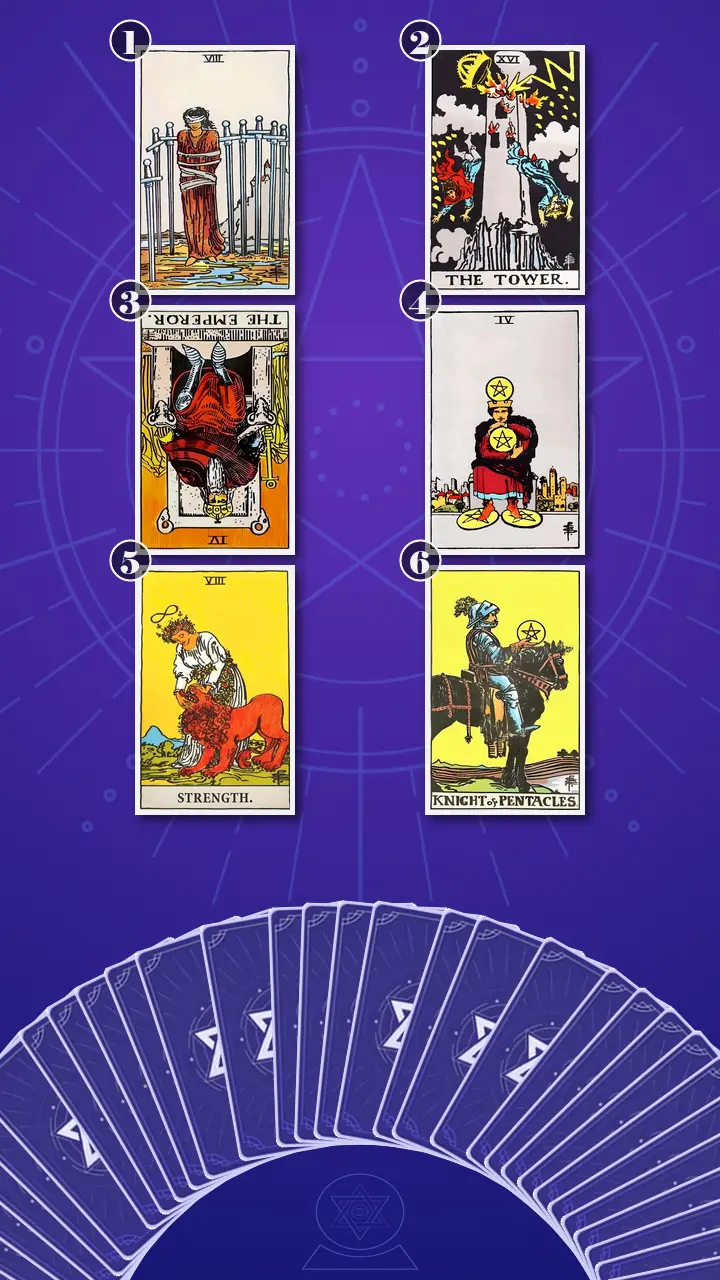
Reading the Ladder: The Freeze, the Alarm, the Old Rule, the Clamp
Position 1: Surface symptom — what the freeze looks like
“Now flipped over,” I said, “is the card that represents the exact freeze response pattern that happens when the buzzer sounds—the observable behavior and the felt restriction.”
Eight of Swords, upright.
In the image, a figure stands blindfolded, arms bound, surrounded by swords like a perimeter. But the bindings are loose. The ground isn’t a prison. It’s a moment where the mind says, no options, and the body obeys.
I used the most modern translation because Taylor needed it in plain language, not poetry: “This is you in your London flat on a work-from-home day. Headphones nearby. The intercom buzz goes and—without deciding—you mute everything and go perfectly still. Your brain either runs worst-case scripts or blanks completely. In that blindfolded moment, it feels like the only safe option is silence.”
Taylor let out a small laugh—sharp at the edges, like it hurt their mouth. “That’s… yeah,” they said. “That’s too accurate. It’s kind of cruel.”
“It can feel cruel to see it on paper,” I agreed. “But this card isn’t blaming you. It’s naming a pattern. The Eight of Swords is what happens when your nervous system narrows perception so fast you can’t reach your choices. That’s not a character flaw. That’s a state.”
I watched their shoulders. Even now, sitting safely in a warm room that smelled faintly of toasted hazelnut and ground coffee, their posture shifted into that guarded stillness—like their body was practising the freeze out of habit.
Position 2: Surface meaning — what your system thinks the buzzer signals
“Now we’re looking at what your system believes the buzzer signals in the moment—your internal alarm label.”
The Tower, upright.
I didn’t soften this one. The Tower is a shock card, and Taylor’s experience is shock-like. “This is the buzzer as a system crash,” I told them. “You can be mid-email, mid-anything, and the buzz hits like a sudden power cut. Your body reacts as if stability just got removed.”
Outside, a bus groaned past, and a cup clinked in the front room—small noises, normal noises. But the Tower isn’t about the noise itself. It’s about what your body does with it. Lightning strikes, the crown falls: control feels knocked off the top.
“It doesn’t mean danger is real,” I said, keeping my voice steady. “It means your nervous system is treating the sound like an intrusion alarm.”
Taylor’s eyes went a little distant, like they were replaying the exact second the intercom buzz hits. “It’s like my brain blue-screens,” they whispered. “I’m not even thinking. I’m just… gone.”
“Exactly,” I said. “That’s Tower energy. The jolt before the story.”
Position 3: Root imprint — the older boundary/authority rule this echoes
“Now flipped over is the root imprint—an older boundary or authority pattern this trigger is echoing. We’re not forcing a literal memory. We’re looking at the rule-set your body learned.”
The Emperor, reversed.
The Emperor upright is structure: gates, walls, rules that protect you. Reversed, it often shows where structure became something you had to survive—where access wasn’t negotiated, it was demanded. Where “not right now” wasn’t safe to say.
“Under the buzzer trigger,” I said, “is an old gatekeeper rule: access to you or your space isn’t something you get to decide in real time. It’s something you must manage perfectly to stay safe. So even a normal buzz can wake up that older power dynamic—the feeling that responding equals being overruled, pressured, or pulled into conflict.”
I leaned back slightly, giving them room. Then I tried the technique I use when I read coffee grounds—Grounds Divination, the old Venetian way of noticing patterns in what’s left behind. You don’t force a picture. You let a shape suggest itself.
“Sometimes when we look at the ‘sediment’ of a trigger,” I said, “we don’t see a single event. We see a habit of reality. So let’s ask: what did you learn about someone else getting access to you? Your space. Your attention.”
Taylor didn’t answer quickly. Their fingers tightened around the cup, then loosened, then tightened again—a tiny three-step loop: clamp, test, clamp. “I don’t have… a big story,” they said cautiously. “But I do have this feeling like… if I say no, I’m inviting an argument. Like I’ll be punished for not being available.”
“That,” I said softly, “tracks with Emperor reversed. The wounded gatekeeper. You learned that safety requires perfect control—or silence.”
Position 4: Root fear — the belief that keeps the loop running
“Now we look at the root fear: the core belief that keeps your freeze loop running.”
Four of Pentacles, upright.
In the image, someone clutches a coin to their chest, pins coins under their feet. It’s a body posture of bracing, not resting. The city behind them looks close and loud—very London, very “privacy is precious.”
“This is fortress mode,” I said. “Your safest move starts to feel like: don’t answer, don’t engage, don’t let anything in. It’s protective. But it keeps your body on guard—because you never get new evidence that you can interact and still stay safe.”
I gave Taylor the split-screen contrast, because this is where people finally feel seen instead of judged.
(A) The tunnel-vision moment: intercom buzz, you mute the laptop, you hold your breath, you stare at nothing, because movement feels like being perceived.
(B) The after-moment: when it’s quiet again, you do the lock-chain-peephole safety sweep like you’re confirming reality. Not because you’re irrational—because your body needs proof the perimeter is intact.
Taylor nodded once, tight. A quiet “oh” without sound.
“And here’s the inner monologue template this card carries,” I said, not as a diagnosis but as an offering: “If I stay silent, I keep control. If I respond, I lose it.”
They swallowed. “Yeah. And then I miss the delivery. Again.”
“Silence can feel like control—until it costs you ease,” I said, letting the sentence land gently but firmly. “Missed parcels. Missed connection. And then shame shows up and tells you you’re ‘dramatic,’ which makes you even less likely to ask for what you need.”
At this point in the ladder, the pattern was clear: Eight of Swords paralysis feeding Four of Pentacles clenching. Air locked down, then Earth gripping tight. The Tower’s Fire lighting the whole thing up like an alarm. No wonder the buzzer felt bigger than it “should.”
When Strength Took the Intercom Back
Position 5: Transformation key — the inner capacity that restores choice
I paused before turning the next card. Not for drama—because the room actually went quiet in that particular way it does after the espresso machine shuts off. Even the street noise felt a bit further away.
“We’re flipping the most important card in this reading,” I said. “This is the medicine: the inner capacity that directly softens the freeze response and gives you your options back.”
Strength, upright.
The image is famous: a calm figure with relaxed hands, gently holding a lion. Not wrestling. Not dominating. Just steady presence. That’s why I love this card for triggers. Freeze responses don’t thaw because you shout at yourself. They thaw because you bring yourself back online.
Before I even explained, Taylor’s face did something I’ve seen a hundred times at my tables—coffee tables and tarot tables both. Their jaw unclenched by a millimetre, as if their body recognised the concept before their mind did.
And still, the setup was real: they were stuck in that internal test—I have to know who it is. I have to be sure. I have to get it right. In their flat, that urgency arrives as a blank-out: no scripts available, just stillness.
Stop treating the buzzer like a test you must pass, and start treating it like the lion you can calmly soothe—one breath, one choice, Strength in your hands.
I let a small silence follow. Not awkward—intentional. Like the second you wait after pouring espresso, when the aroma peaks and you can actually taste what you made.
Taylor’s reaction came in a chain—three clear beats.
1) Physiological freeze: their breath stopped mid-chest. Their fingers hovered over the cup lid as if they’d been caught doing something wrong. Their eyes widened just slightly.
2) Cognitive seep-in: their gaze unfocused, not spacing out, more like rewinding. I could almost see the scene playing behind their eyes: sofa, laptop, harsh buzz, the decision disappearing.
3) Emotional release: a long exhale slipped out, shaky at first and then steadier. Their shoulders dropped, not all the way—just enough to prove movement existed. Then, unexpectedly, irritation flashed. “But… if I do that,” they said, voice sharper, “doesn’t it mean I’ve been doing it wrong? Like I’ve been… failing at something basic?”
It was the kind of anger that’s really grief in a blazer.
“No,” I said, calm as a closing shift. “It means your body has been protecting you with the tools it had. Eight of Swords and Four of Pentacles aren’t ‘wrong.’ They’re strategies. They just have a cost.”
I leaned in slightly. “Strength is not ‘be fearless.’ Strength is: regulate first. Decide second. You don’t owe the buzzer your speed.”
Then I brought in my own way of seeing time—my Sacred Timing, the way I track the tiny windows when something is most responsive. “You know how coffee has a peak moment?” I asked, gesturing toward the café behind the door. “If you wait too long, it tastes flat. If you rush, it’s harsh. Your nervous system has a window too—just a few seconds. Strength is about claiming that window. Not to force a decision. Just to get your choice back.”
“Now,” I said, “use this new lens and think of last week. A moment when the buzzer went. What if, instead of trying to identify the person, you’d done one regulating action first?”
Taylor stared at the Strength card, then nodded slowly. “I can take one step without taking all the steps,” they murmured, like they were trying on new shoes. “Like… I can ask who it is without… letting them in.”
“Information isn’t commitment,” I said. “That’s the whole hinge.”
And I named the transformation out loud, because naming turns fog into map: “This is you moving from startle-driven shutdown and self-blame to grounded calm, boundary-led choice, and embodied self-trust. Not overnight. But in reps.”
Position 6: Action integration — the routine that makes it repeatable
“Now we flip the last card,” I said, “the one that shows how to apply this in real life—a routine you can repeat even on bad days.”
Knight of Pentacles, upright.
“This is the part of you that doesn’t rely on motivation,” I said. “It relies on a protocol. A checklist that still runs when your brain blanks.”
I used the modern scenario straight, because this card is pragmatic: “You create a simple buzzer protocol you can repeat: exhale once, orient in the room, say one sentence, decide. No dramatic breakthroughs—just consistency. Over time, your body trusts the routine more than the fear story.”
Taylor made a face, half amused, half doubtful. “Okay, but—realistically—what if I can’t even find two minutes? Like, I’m in the middle of a deadline, Slack is going off, I’m already at capacity.”
I nodded. “Good. That’s a real obstacle. And this is why we keep it tiny. The goal isn’t a perfect response. It’s a one-breath buffer. A boundary-first micro-step is still a response.”
From Insight to Action: A Boundary-First Micro-Step You Can Actually Do
I gathered the whole ladder into one story, the way I’d explain a blend to a customer who only knows they’re tired and need something that won’t wreck their stomach.
“Here’s what the cards showed,” I said. “The buzzer hits (Tower) and your system labels it as a sudden loss of control. That alarm drops you into a narrow, blindfolded moment where choices disappear (Eight of Swords). Underneath, there’s an older rule about access—like responding means being overruled or pushed into conflict (Emperor reversed). So you protect yourself by clenching down and holding your ground through silence (Four of Pentacles). The way out isn’t more control. It’s Strength: gentle regulation that restores choice. And then Knight of Pentacles: a repeatable routine that teaches your body safety through consistency.”
“Your cognitive blind spot,” I added carefully, “is that you’ve been treating the buzzer like an all-or-nothing door: either total silence or full engagement. But the transformation direction is different: respond without committing. Boundary first. Information second. Decision after.”
Then I offered next steps—practical, low-drama, London-flat compatible. I kept them small enough that even a frozen body could attempt them.
- The One-Breath BufferWhen the buzzer goes, do only this first: place one hand on your chest and take one slow exhale (longer out-breath than in-breath). No decision yet. No rushing to the door.If your brain says “this is stupid,” treat that as background noise. Your only win condition is noticing what happens in your body—not pushing through.
- Information Isn’t CommitmentMake your Step 2 a single, neutral intercom question: “Hi—who is it?” Ask for information first, not engagement. If you still don’t want contact, use one closing line: “I’m not available—please leave it with reception / call back tomorrow.”Write the two sentences in Apple Notes now. When your mind blanks, read it like a script. Clarity is kinder than freezing.
- The 3-Step Buzzer Protocol (Knight of Pentacles Reps)Keep it the same every time: (1) Exhale once. (2) Put both feet on the floor and look at one fixed point in the room (a mug, a lamp, the edge of the counter). (3) Say one sentence through the intercom.Lower the bar: if speaking is too much, your “rep” can be just Step 1 + Step 2 (feet + fixed point). Consistency beats intensity.
Before Taylor left, I added one optional layer from my own toolkit—because sometimes the body needs a friendly shortcut.
“If you want,” I said, “use Aroma Anchoring. Pick a scent you already associate with ‘I’m okay’—coffee, citrus hand soap, your shampoo. When you do the One-Breath Buffer, notice that scent on purpose. You’re giving your nervous system a familiar signal: this is home, not an emergency.”
And because I’ve closed this café thousands of times, I offered something I know works for boundaries: “At night, do a two-minute ‘closing ritual’ like I do here—locks checked once, lights off, a final wipe down. Then say out loud: ‘We’re closed.’ It’s not superstition. It’s a cue. Your body likes endings.”

A Week Later: Ownership, Not Certainty
A week later, Taylor messaged me. No long explanation—just a screenshot of their Notes app with two lines saved, and a short text: “Buzzer went off. Did the exhale. Asked who it was. It was DPD. I didn’t die. Also—didn’t do the lock-check loop after.”
Their follow-up, in smaller text: “Still felt shaky. But it felt like I was doing it, not something happening to me.”
That’s the real Journey to Clarity, at least in my experience: not certainty, not perfection—just the quiet proof that you can stay in your body for three seconds longer than last time, and that those three seconds change what’s possible.
Clear boundaries don’t have to be a fortress. They can be a steady hand on a lion. One breath. One choice.
When you want your home to feel like a sanctuary but the buzzer makes your chest lock up, it’s not that you’re being dramatic—it’s that some part of you still believes responding means surrendering control of your own space.
If you didn’t have to figure out everything at the door, what’s one boundary-first micro-step you’d be willing to try the next time the buzzer goes—just to prove to your body that you still get to decide?