The Brunch Hot Take That Made Me Freeze—Then I Drew a Boundary

The King West Brunch Loyalty Test
If you’re the kind of Toronto marketing girl who gets to brunch early, picks the seat with the best read on everyone’s faces, and still freezes when the table turns into a group gossip session—yeah, this is that moment.
Maya (name changed for privacy) sat down across from me in my little consultation studio—white walls, a shelf of blotter strips, and a faint clean-wood smell that always makes people breathe a fraction deeper without realizing it. She kept her phone face-down on her thigh like it was a safety device. Even here, even safe, her shoulders hovered a touch too high.
“It’s always brunch,” she said, and the way she exhaled made it sound like a weather pattern. “Like… King West. Bright windows. Everyone’s caffeinated and cute. And then someone says our mutual friend’s name with that so anyway tone. And I just—” She swallowed. Her throat moved like it had to push past something. “I half-laugh. Or I go quiet. And then I spend the rest of the meal monitoring my face like I’m on camera.”
I could picture it instantly: the sweaty iced latte glass, cutlery clinking, a playlist just loud enough to force everyone to perform their reactions. The moment the table tries to recruit you into the negativity toast.
“What’s the part that hurts the most?” I asked.
“After,” she said, quickly. “Right after. I’ll see her post something on Instagram and my stomach drops. Like I accidentally signed my name under their comments by not saying anything. But in the moment… I’m scared I’ll be labeled too sensitive. Or dramatic. Like I’ll be the one who made it weird.”
Her jaw tightened as she said it—tight enough that I could almost hear her molars press. The tension in her body wasn’t vague; it was specific: tight throat and jaw, a stomach knot, and that hot flush that comes when the comments get sharper.
That feeling—tight and hot and watchful—was like trying to speak through a scarf pulled too high: you can breathe, but you can’t quite project. And in group dynamics, projection is survival.
“Freezing doesn’t mean you’re weak—it means your nervous system is trying to keep you in the group,” I told her. “We’re going to make this practical. Not a perfect speech. Just clarity. Today, let’s draw a map for that brunch moment—so you can leave the table feeling aligned with yourself, even if the vibe does a tiny wobble.”

Choosing the Compass: The Horseshoe Spread for Gossip Boundaries
I asked Maya to put both feet on the floor and take one slow inhale through her nose—nothing mystical, just a nervous system reset. While she breathed, I shuffled slowly, the way I do when the question is about real-time communication: the kind of situation where your brain wants a script, but your body wants safety.
“We’re using the Horseshoe Spread today,” I said. “It’s one of my favorites for relationship communication—especially messy, layered group moments.”
For you reading: the Horseshoe works because it traces the arc of a social scene the way it actually unfolds. It names what’s carrying over from history (why this hits so hard), what’s happening on the surface (the brunch vibe), what’s driving it underneath (the social engine), where you get stuck internally (the freeze), what pressures the room is enforcing (unspoken rules), then it gives advice you can actually say out loud—and finally, it shows how things can settle if you follow through.
I gestured to the half-moon layout as I placed the cards in a gentle curve, like seats around a table. “Card one is the emotional history that loads this moment. Card four is your internal block—why your voice gets stuck. And card six is the advice: the exact communication posture that gets you out without escalating.”
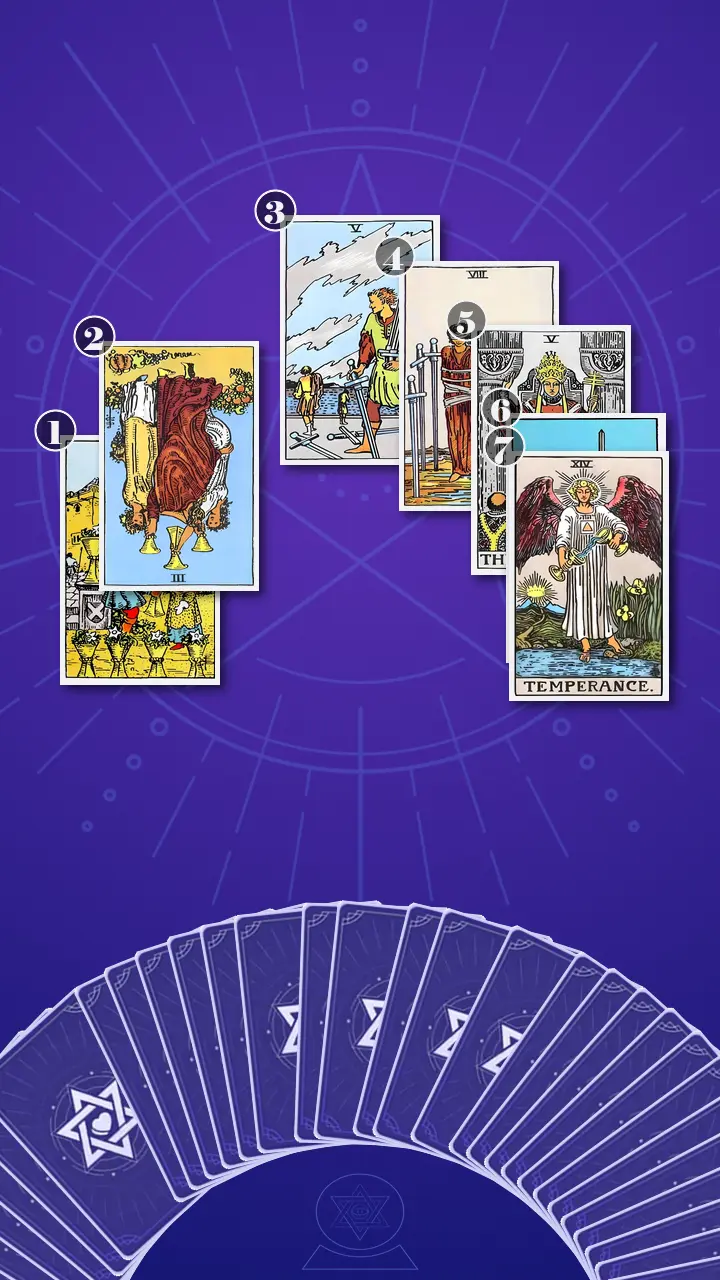
Reading the Map: How Tarot Works in a Friend-Group Gossip Moment
Position 1: The friendship contract you still believe in
“Now flipped over,” I said, “is the card representing what your history with this friend-group makes emotionally loaded about this moment.”
The Six of Cups, upright.
I watched Maya’s face soften before she even spoke—like her body recognized something sweet and old. And that made sense, because this card is memory and loyalty, the original blueprint of how you thought friendship was supposed to feel.
“You’re not reacting like this is random brunch chatter—you’re reacting like a friendship rule just got broken,” I told her, using the simplest modern translation. “The trash-talk hits harder because you remember the earlier version of this group: supportive check-ins, inside jokes that didn’t cost anyone dignity, the unspoken assumption that you speak well of each other when someone’s not there.”
The Six of Cups energy is balanced warmth—until it turns into an excess of nostalgia, where your body tries to preserve an old contract even when the room has quietly rewritten it.
Maya let out a small laugh that surprised even her—short, sharp, with a little bitterness. “That’s… kind of brutal,” she said. “Because it’s true. It feels like betrayal. And then I’m like, why am I reacting so strongly? It’s just comments.”
“It’s not just comments,” I said gently. “It’s a values violation.”
Position 2: The brunch vibe recruiting you to co-sign
“Now flipped over,” I said, “is the card representing the observable vibe at the brunch—how the conversation is behaving right now and what it’s asking you to participate in.”
Three of Cups, reversed.
This one always feels like a camera pulls back to a wide shot: the table, the laughter, the synchronized half-laugh after a sharp comment, the way a group can bond by building an ‘us’ out of someone else’s ‘them.’
“The table energy turns into a mini-ritual,” I said, grounding it in real life. “Someone says something cutting, people trade glances, laughter seals it, and you can feel the social pressure to co-sign fast so you don’t look out of the loop. It’s friendship-as-performance, where closeness is created by having a shared target.”
Reversed, the Three of Cups is a blockage of healthy connection—water energy that curdles into cliquey bonding. It’s not that they’re evil; it’s that the room has learned an easy shortcut to intimacy, and it’s a mean one.
I used the tight, cinematic cut I’ve seen a hundred times: “Laughter swells → your smile freezes → your hand hovers over your phone.”
Then I gave her the inner monologue structure out loud, exactly as it runs:
“I want to say ‘That’s not fair.’ / If I say that, they’ll think I’m uptight. / So I do the polite half-laugh and change the subject.”
Maya went still. Her fingers, without permission, tapped the edge of her phone even though it was sitting safely in her bag. It was that physical ‘oof’ moment—recognition in the body, not just the mind.
Position 3: The status game under the trash-talk
“Now flipped over,” I said, “is the card representing the hidden motive under the trash-talk—what needs, insecurities, or dynamics are steering the group.”
Five of Swords, upright.
The image is almost too on-the-nose for Toronto brunch hot takes: someone collecting swords like trophies while two people walk away, shoulders slumped, the sky windy and gray.
“Under the gossip is a status game,” I said. “One person ‘wins’ the table by being the sharpest, and everyone else half-laughs to avoid becoming the next joke. It’s less about your mutual friend’s actual behavior and more about who gets to control the vibe with cruelty.”
Five of Swords is an excess of mental sharpness without care. A win at a social cost.
Maya’s eyes flicked up. “There’s always one person driving it,” she admitted. “And everyone… reinforces it. Like a reflex.”
“Exactly,” I said. “And your fear of becoming the next target isn’t irrational. Your nervous system is reading the room accurately.”
Position 4: The moment your voice goes on airplane mode
“Now flipped over,” I said, “is the card representing your main internal block in the moment—why your voice gets stuck and what thought-loop tightens the situation.”
Eight of Swords, upright.
I’ve always thought of this card as the body’s version of a dropdown menu glitch: your brain opens options, none feel safe, so you hit Cancel and sit there.
“You can literally feel your voice get stuck behind glass,” I said, using the translation that fit Maya perfectly. “Three decent responses exist, but your brain runs a worst-case simulation on all of them—awkward silence, eye-rolls, being labeled ‘dramatic’—so you do the safest thing: nothing. Then you pay for it later with guilt and obsessive replay.”
Eight of Swords is a blockage: not a lack of words, but a mental corridor that feels narrower than it is.
Maya stared at the card, then looked away like she didn’t want to be caught. “Why am I only brave in my Notes app?” she whispered.
“Because at 2 a.m., you’re not managing other people’s reactions in real time,” I said. “Your nervous system isn’t being asked to gamble your belonging.”
Then I offered the reframe I wanted her to carry into the rest of the spread: “Your win condition isn’t ‘no awkwardness’—it’s ‘I can recognize myself afterward.’”
Position 5: The brunch rulebook you’ve mistaken for law
“Now flipped over,” I said, “is the card representing external pressure—what the group norms, social rules, and other people’s expectations are quietly enforcing.”
The Hierophant, upright.
“This is the unspoken brunch rulebook,” I said, and Maya’s mouth tightened like she’d been waiting for someone to name it. “Keep it light. Don’t correct. Don’t be intense. Don’t disrupt the vibe. You mistake that social script for a moral obligation, so your standards of kindness get outvoted by etiquette.”
The Hierophant energy is structure—which can be supportive. But here it’s a rigid structure: a rule that benefits the loudest person, because it tells everyone else to stay polite instead of honest.
I asked her, “In the exact second you froze, what was the scariest label you imagined getting if you spoke?”
“Too sensitive,” she said immediately. Then, softer: “And… like I don’t belong.”
I nodded. “Good. We can work with something specific.”
When the Queen of Swords Spoke
I turned the next card slowly. The room felt quieter—not because the city outside stopped being Toronto, but because Maya’s attention narrowed into one point. This was the pivot.
Position 6: The one sentence that changes the whole table
“Now flipped over,” I said, “is the card representing your best in-the-moment response—a boundary phrase and communication posture you can embody without escalating.”
Queen of Swords, upright.
“You don’t go mean,” I said. “You go clear. You set a boundary that protects the absent person and protects your integrity, without turning brunch into a trial: one calm sentence, steady eye contact, then a pivot. You’re not asking permission—you’re choosing what kind of conversation you’ll be in.”
Queen of Swords is balance in air energy: truth with restraint. It’s the antidote to Five of Swords cruelty and Eight of Swords paralysis.
And this is where my own work as a perfumer always slips in, because I’ve spent fifteen years watching how invisible things change rooms. A scent. A tone. A pause.
“Maya,” I said, “I want to use my Social Pattern Analysis lens for a second. In groups like this, there’s usually a hidden interaction barrier: people think the only way to belong is to match the sharpness. That’s the barrier. And your freeze is your body trying to avoid crossing it.”
“So how do I cross it without… getting cut?” she asked, and there was a flash of irritation in her voice—an unexpected, honest edge. “Like, why do I have to be the one to make it better?”
“You don’t have to make it better,” I said, and I kept my tone steady on purpose. “You just have to stop co-signing it. That’s a smaller job. And it’s powerful.”
In my head, I flashed to Paris—training rooms where we talked about sillage, the trail a fragrance leaves behind. Too much and it overwhelms. Too little and it disappears. The Queen of Swords is perfect sillage: noticeable, clean, impossible to misread.
“This is also Personal Brand Management,” I added, because she would understand that language. “Not in an influencer way—in a consistency way. Your ‘brand’ is: I don’t bond by tearing someone down. The Queen says you communicate that with one clean line, not a speech.”
You don’t need a perfect speech—one calm sentence that names your boundary and redirects is enough.
That was the setup of her whole struggle: the bright table, the comment landing, everyone laughing, her throat tightening while her brain scrambles for the perfect response she’ll only find later in bed.
Not ‘stay nice so no one’s uncomfortable’—say the clean truth with a steady edge, like the Queen of Swords who protects the room by setting a boundary.
I let the sentence hang for a beat, the way you let the top note evaporate so the heart notes can show themselves.
Maya’s reaction came in a clear three-step chain.
First: her body froze—breath held, eyes fixed on the card, shoulders lifted like she was bracing for impact.
Second: her gaze unfocused, like her mind was replaying a specific brunch clip. I could almost see the scene in her pupils: a cutting comment, the chorus laugh, her own face performing neutrality.
Third: the release—her jaw loosened in tiny increments, and she exhaled through her nose like she’d been underwater. Her eyes went shiny, not in a dramatic way, but in the way people look when something finally makes sense and it’s both relieving and annoying.
“But… if I say it,” she said, voice thinner than before, “won’t they think I’m judging them?”
“Maybe,” I said honestly. “And that’s where your power is: you can tolerate two seconds of them thinking something about you, so you don’t have to tolerate hours of you thinking something about you.”
I slid her a practical micro-anchor. “Touch your water glass. Feet on the floor. Slow your voice down so you’re not matching their speed. Then: one sentence. Then a redirect.”
And I asked her exactly what I always ask at this turning point: “Now, with this new lens—can you think of a moment last week when this would’ve changed how you felt?”
She swallowed—this time without as much tightness. “Saturday. Someone said, ‘She’s always trying so hard.’ And I laughed. Like a reflex.” Her face pinched. “If I’d said, ‘I’m not comfortable talking about her like that—can we switch topics?’… I think I would’ve felt… cleaner.”
“That’s the shift,” I said. “From trying to manage everyone’s comfort to using one clear, neutral boundary line that protects the absent person—and protects your integrity. That’s you moving from being stuck to being steady.”
Temperance and the New Normal
Position 7: What happens when you regulate the temperature instead of performing
“Now flipped over,” I said, “is the card representing the likely near-term outcome if you follow the advice—how the energy can settle and what kind of relationship climate you cultivate.”
Temperance, upright.
I smiled, because Temperance is literally my professional language: blending. Not compromising yourself—integrating elements so something becomes wearable, livable, true.
“If you follow through with that one sentence,” I said, “the vibe doesn’t have to explode. It can soften into something more livable: people either respect the lane change and the conversation becomes more real, or you learn who can’t do friendship without a target. Either way, you leave feeling steadier and less gross afterward.”
Temperance is balance—measured tone, not suppressed truth. It’s the angel pouring between cups: the same social container (cups) that became a negativity toast can become an intentional, regulated conversation.
Maya’s shoulders dropped. It wasn’t happiness exactly. It was relief with a little edge of grief—like realizing you can stop performing, but also realizing some people might prefer the performance.
From Insight to Action: The No-Co-Sign Brunch Protocol
I leaned back and did what I always do after a spread: I told her the story the cards were telling in one clean thread.
“Here’s the arc,” I said. “You come in carrying an old friendship contract (Six of Cups): kindness, loyalty, speaking well of each other. The present vibe has gotten cliquey (Three of Cups reversed), and underneath is a status game (Five of Swords) where being sharp gets rewarded. Your nervous system reads that and shuts your voice down (Eight of Swords), especially because the room has a strict rulebook—keep it light, don’t disrupt (Hierophant). The antidote is Queen of Swords: one calm boundary sentence plus an immediate redirect. And the outcome is Temperance: not scorched-earth, not people-pleasing—just aligned.”
“Your cognitive blind spot,” I continued, “is the false binary: join in or start drama. That’s Eight of Swords. But you have a third option: a clean boundary that doesn’t debate.”
“And the transformation direction is simple,” I said. “Shift from managing everyone’s comfort to protecting your integrity with one neutral line.”
Then I gave her the practical plan—actionable advice for what to say when friends are gossiping about a mutual friend—so it wouldn’t stay theoretical.
- Build your “Brunch Script” (30 seconds)Open your Notes app and save a note titled Brunch Script. Paste 3 options, then choose ONE as your default: (1) “I’m not comfortable talking about her when she’s not here.” (2) “I’m gonna pass on this convo—what are you up to this week?” (3) “That’s not my read of her, so I’d rather switch topics.”If your brain starts drafting a TED Talk, that’s your cue to go shorter, not smarter. One calm sentence. Then a redirect. That’s enough.
- Calibrate your delivery (20 seconds, outside the café)Before you walk in, do one slow inhale and exhale, then say your chosen line quietly once—yes, in the elevator or on the sidewalk. Put both feet on the ground as you say it.Make your voice slower than the room. Your steadiness is the boundary (Temperance tone control).
- Use “sillage control” in the moment (one sip + one pivot)When the gossip hits, take one intentional sip of water (pacing tool), say your line once, then immediately redirect one person with a specific neutral question: “Anyway—how did your presentation go on Thursday?” or “Wait, where did you get that jacket?”This is my first-impression calibration strategy in disguise: keep the message clear, let it travel just far enough, then move the room. If they push back (“Relax, it’s just a joke”), repeat once: “Totally—still not my vibe,” then look down at the menu to signal you’re done.
As a final support—because bodies remember—আমি offered something from my scent toolkit that fits the same principle: presence without overwhelm.
“If you want a physical cue,” I told her, “wear something with a soft woody accord—cedar, vetiver, something grounded. Not heavy. Just enough to remind your body: I’m here. I take up space. And if the table spikes your heat, a quick cleansing citrus spray on your wrists in the bathroom can be a reset. It’s not magic. It’s a sensory anchor.”

A Week Later: The Quiet Proof
A week later, Maya messaged me a screenshot: a Notes app titled Brunch Script. Under it, one line was starred.
Then another message: “They started in on her again. I took a sip of water. Said, ‘I’m not comfortable talking about her like that—can we switch topics?’ And then I asked Jenna about her new role. It got… quiet for two seconds. And then Jenna answered. And the conversation moved.”
There was no grand victory speech. No group-wide apology. Just a small, real proof: she could leave a table feeling recognizable to herself. She told me later she still had a tiny wobble that night—one quick “what if they think I’m dramatic?” thought—but it didn’t spiral into a two-hour replay. She slept.
That’s the Journey to Clarity I trust: not perfection, not control—just one aligned choice that your body can repeat.
And if you’re reading this because you’ve been searching for scripts to shut down gossip without making it awkward, I want to anchor something for you: When the table gets mean and your throat tightens, it’s not that you don’t know what’s right—you’re just trying to belong without becoming the next target.
If you didn’t have to deliver a perfect speech—what’s the one calm sentence you’d be willing to try next time, just to stay aligned with yourself?
Every reading at AceTarot is a Journey to connect with inner wisdom and empower next step.
Learn more about our Journey to Clarity.