The One-Breath Pause That Helped Me Say My Name Without Apologizing

Finding Clarity in the 8:36 a.m. Café Line
“You’re 27, good at your job, and still your throat locks up when a barista asks your name—like you’ve time-traveled back to middle school in a Toronto café line.”
I said it gently, not as a diagnosis—more like offering the exact sentence that had been sitting in the room with us the whole time.
Taylor (name changed for privacy) gave me a look that was half relief, half “how did you know?” She was calling in from Toronto, the kind of neighborhood where there are three coffee shops in a four-block radius and every morning feels like a soft competition to look unbothered. I was in Tokyo, on my night schedule—planetarium hours and all—my desk lamp dimmed, a small star projector throwing slow-moving constellations across the wall like a patient metronome.
She described Monday at 8:36 a.m.: wet coats pressed close in line, the espresso machine hissing like a steam vent, her phone warm in her palm with the mobile-order screen open “just in case.” The barista looked up, bright and neutral, and said, “Name?”
“It’s just my name,” Taylor told me, swallowing hard. “But my throat locks like I’m twelve again. I can feel my face get hot before I even answer.”
I could almost feel the moment in my own body—like your internal Wi‑Fi drops the second you’re perceived, even though the signal is actually fine. And then the worst part: the line behind you. People shifting their weight. That tiny percussion of imagined impatience.
“Why do I freeze when someone asks my name?” she asked, and the question landed with that specific kind of irritation—because it’s so small, and it hijacks everything anyway.
I nodded. “We’re not here to make you into someone who never flinches. We’re here to help you find clarity inside the flinch—so you can get your voice back in the moment, and stop carrying a two-second exchange like it’s court evidence for the rest of the day.”

Choosing the Compass: A Six-Card Tarot Ladder for Shame Triggers
I asked Taylor to take one slow inhale—not as a mystical ritual, but as a threshold. A way to tell her nervous system: We’re looking at this now, on purpose, safely.
I shuffled while she held the question in mind: that specific public micro-moment shame surge when a barista asks her name. The cards made that soft papery sound I’ve come to associate with transitions—like turning a page in a story that’s been stuck on the same paragraph for years.
“Today I’m using my own spread,” I said, “called the Four-Layer Insight Ladder · Context Edition.”
For you reading along: this isn’t a predictive spread. It’s a pattern spread—built for situations where the problem isn’t a decision or a forecast, but a rapid inner takeover. It moves in layers: what happens on the surface, what happens in the first few seconds in the body, what old imprint is being replayed, what belief keeps it looping, and then—crucially—the one high-leverage shift and the smallest possible next step you can repeat.
“We’ll start with what you do in the exact moment you’re put on the spot,” I told Taylor. “Then we’ll go down to the middle-school imprint underneath it. Then we cross over to the belief that keeps re-triggering it. And the last two cards—those are our way out: the key transformation, and the grounded practice you can actually do this week.”
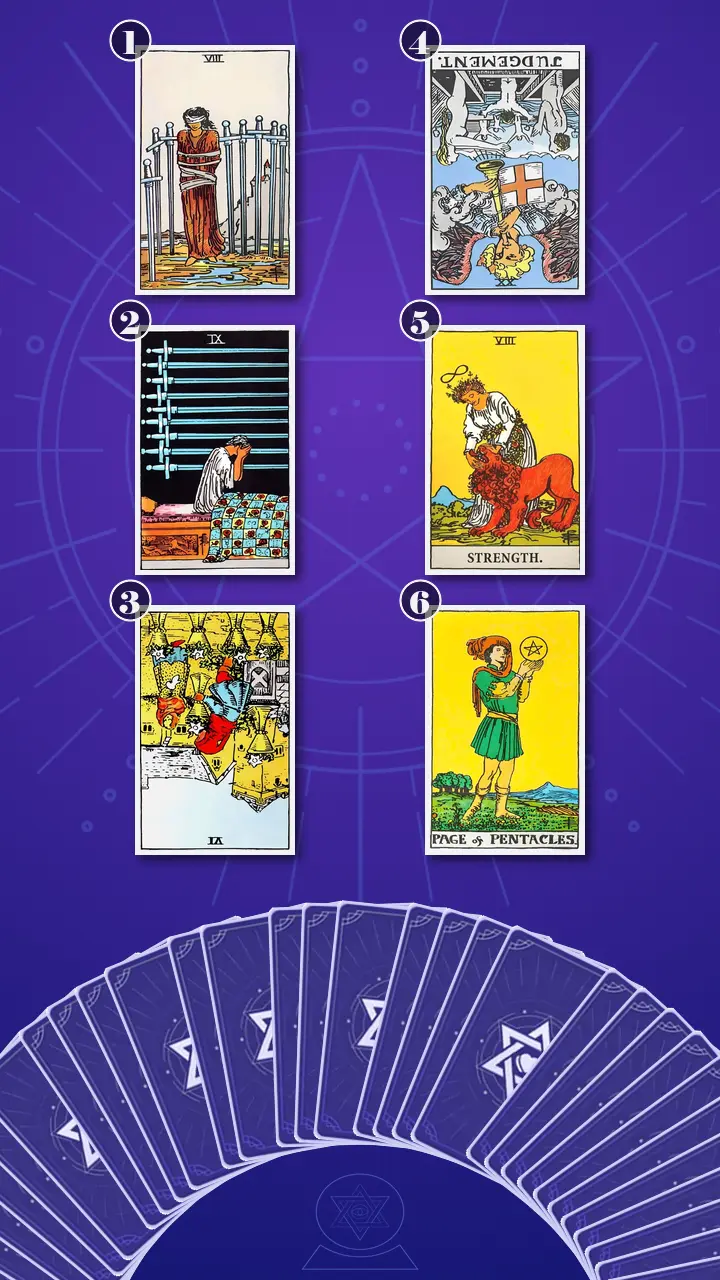
Reading the Map: From Freeze, to Replay, to the Inner Jury
Position 1 — The present-day symptom: the exact café-line freeze
“Now we turn over the card that represents the present-day symptom—what you do in the exact moment the barista asks your name,” I said.
Eight of Swords, upright.
“This is so literal it’s almost rude,” I added, and Taylor let out a small, bitter laugh.
“Yeah,” she said. “It’s… too accurate. Like, it’s kind of brutal.”
I kept my voice calm. “That reaction makes sense. The Eight of Swords is the ‘I can’t’ feeling that’s real in your body even when the situation is actually flexible.”
I pointed to the blindfold and the bindings. “In modern life, this is the exact second the barista says ‘Name?’ and your whole system constricts. You’re standing there with Apple Pay ready, and yet your mind goes blank like someone hit mute on your voice. You can feel options—say it slowly, repeat it, spell it—but your body behaves like there’s only one acceptable outcome: say it instantly, perfectly, and never look awkward.”
“The trap isn’t the café,” I said, “it’s how your attention narrows until you can’t access your normal adult self.”
Energy-wise, this card is Air in excess: thoughts tightening into a cage. Not because you’re dramatic—because your system is trying to prevent humiliation. It’s a protection strategy that happens to be outdated.
Taylor’s shoulders rose toward her ears, then dropped a millimeter, like her body had been waiting for permission to call this a real thing.
Position 2 — The immediate trigger response: the first 3–10 seconds
“Now we turn over the card for the immediate trigger response—what your mind and body do in the first 3–10 seconds,” I said.
Nine of Swords, upright.
“This is the mental replay loop,” I told her. “Three seconds after you answer, your brain starts a rapid audit: Was my voice weird? Did my mouth do something awkward? Did they pause because they think I’m stupid?”
“It’s like you’re already watching a replay before the receipt even prints,” I continued. “Your face stays warm, your stomach drops, and you start collecting ‘evidence’ from the barista’s expression—even though they’ve already moved on to the next order.”
Energy-wise, this is Air in overdrive—the mind trying to regain control through analysis. The Nine of Swords isn’t the moment itself. It’s what happens when your brain opens 27 tabs and every tab is titled: Did I sound weird?
Taylor’s eyes flicked down and to the side the way people do when they’re rewatching something internally. Her thumb worried the edge of her phone case.
“And then you scroll,” I said, not accusing—just naming the pattern. “Not because you don’t have discipline. Because you’re trying to escape the feeling.”
She nodded once. Tight. Accurate.
Position 3 — The origin layer: the middle-school imprint underneath
“Now we turn over the card for the origin layer—the middle-school imprint your nervous system is replaying,” I said.
Six of Cups, reversed.
“Adult setting, adolescent shame response,” I murmured, and I felt my own chest tighten with recognition. I’ve watched thousands of people in my planetarium dome—grown adults—go quiet and small when the lights go down, as if darkness equals danger even when it’s safe and curated. The body keeps old associations on file.
“In modern terms,” I told Taylor, “your adult self is at the counter in a normal Toronto morning rush—but internally it’s like a middle-school version of you steps forward and takes the mic.”
“The memory doesn’t have to be a clear flashback,” I said. “It can be a body feeling: If I get this wrong, they’ll laugh. You smile too hard, rush your name, and then feel that familiar hallway humiliation even though nothing objectively happened.”
Energy-wise, this is Water blocked: old vulnerability trying to move, but it shows up sideways—as heat, tightness, and an urge to disappear behind your phone.
Taylor swallowed. “It literally feels… younger. Like my face does the thing it used to do.”
“Your body isn’t being dramatic,” I said, letting the sentence land, “it’s being consistent with an old lesson.”
Position 4 — The hidden belief: the Inner Jury rule that keeps it repeating
“Now we turn over the card that represents the hidden belief—the internal rule about being seen and ‘getting it wrong’,” I said.
Judgement, reversed.
This one always changes the temperature in the room. Even over Zoom, I felt it: that click from “awkward moment” to “system-level pattern.”
“Okay,” I said softly. “Here’s the engine.”
I leaned in. “This is the hidden rule running in the background: being seen equals being graded.”
And I described it the way it actually operates—fast, theatrical, unfair.
The café counter becomes a witness stand. The line behind you becomes an imaginary jury. The barista’s neutral face becomes a verdict screen.
Say it right. Say it fast. Don’t be weird.
Don’t hesitate.
If they mishear you, you’re done.
That trumpet on the Judgement card? Reversed, it’s not intuition. It’s an internal alarm bell that says: Evaluation happening now.
Taylor’s reaction came in a chain—exactly the way shame hits:
First, a tiny freeze: her breath caught, like her body had been tapped on the shoulder.
Second, a faraway look: her eyes unfocused for a beat, as if replaying a dozen old scenes at once.
Third, a release she didn’t seem to expect: her shoulders dropped, and she exhaled through her nose like, “Oh. Yeah.”
Then she said, very quietly, “That’s it. It feels like a verdict.”
I gave her the interrupting sentence—simple enough to carry into a noisy café line:
“A barista asked my name; that is not a grade.”
Judgement reversed is the major blockage because it keeps the Eight and Nine of Swords alive. If the moment is a courtroom, your mind will keep trying to win it through perfect performance. And perfect performance is a losing game—because the Inner Jury never stops moving the goalposts.
When Strength Spoke: The Calm Hand on the Lion
Position 5 — The key transformation: the antidote that restores choice
“We’re turning over the key transformation now,” I said. “This is the card that interrupts the shame script and gives you choice back in the moment.”
The room felt unusually quiet. Even my building’s usual night sounds—pipes settling, distant traffic—seemed to step back, like an audience that finally stopped shuffling.
Strength, upright.
“Oh,” Taylor whispered, and her voice did something different—lower, steadier, like it had more room in her throat just seeing the image.
I didn’t rush. “In modern life,” I told her, “instead of trying to bulldoze the shame with performance, you treat the surge like a startled animal: real, loud, and workable. You notice the tight throat, take one breath, and say your name anyway—without rushing to prove you’re fine.”
Energy-wise, this is Fire in balance: courage that doesn’t burn you up. Strength isn’t hype. It’s steadiness.
Setup: You’re in line with people behind you, the espresso machine is loud, and the barista says “Name?”—and suddenly your throat tightens like you’re twelve again. Your brain tries to solve it the old way: perform perfectly, immediately, so you can escape the spotlight. You can feel the Inner Jury reaching for the gavel.
Delivery:
Stop trying to ‘beat’ the shame with perfect performance, and practice gentle bravery—like Strength’s calm hand on the lion—so your name can simply be said, not defended.
I let a small pause sit after it. Like waiting for a planet to clear the edge of the horizon.
Reinforcement: Taylor’s face shifted in layers. Her eyebrows lifted first—surprise. Then her jaw unclenched, like she’d been holding tension there for years without noticing. Her eyes went shiny, not in a dramatic way—more like the nervous system version of a pressure valve releasing.
She looked down at her hands. One of them was clenched into a fist without her realizing. She opened it slowly, fingers unfurling as if she’d been gripping an invisible railing. Her shoulders softened, then she sat up straighter—still cautious, but less braced.
“But if I’m not trying to sound normal…” she said, and there was a flicker of anger under the vulnerability, “doesn’t that mean I’ve just been failing at this? For years?”
I nodded, honoring the feeling. “That’s the Inner Jury trying to turn insight into a new charge.”
I shifted into the language I use at the planetarium when someone’s afraid of the dark: practical, embodied, non-shaming. “Strength doesn’t accuse the lion for being loud. It doesn’t argue with it. It just stays present.”
Then I brought in my own framework—the one that’s become my signature because it makes self-regulation feel less like self-help and more like physics.
“I call this Pulsar Breathing,” I said. “In space, pulsars are these incredibly steady stars that pulse like clocks. When everything feels chaotic, that rhythm is something you can sync to. In your body, one quiet inhale is your pulse. Not a big dramatic breath—just one steady beat. It’s you telling your nervous system: we’re here, we’re safe enough, we can speak.”
I watched her try it—just once. Her ribs expanded subtly. Her breath lowered from her chest into something steadier.
“Now,” I said, “use this new angle and think about last week. Was there a moment where this would have changed the outcome—not the barista’s behavior, but your internal experience?”
She blinked, eyes unfocused, then nodded. “Thursday. They asked me to repeat it. And I… apologized like five times.”
“Right,” I said. “Strength would do it differently. Repeat once. No apology unless you genuinely want to. Your name can be said, not defended.”
This was the shift in motion: from ‘being seen feels like a public verdict’ to ‘being seen feels tolerably human and manageable’. Not perfect. Not painless. But workable.
Position 6 — The grounded next step: practice reps that build self-trust
“Now we turn over the card for the grounded next step—a small, realistic practice you can try this week,” I said.
Page of Pentacles, upright.
“This is the beginner who isn’t ashamed to be a beginner,” I told her. “In modern life, you treat the ‘name moment’ like a trainable micro-skill, not a personality defect.”
Energy-wise, this is Earth in balance: repetition, steadiness, measurable progress. Less ‘personality makeover,’ more Duolingo—tiny reps that add up.
“It’s boring on purpose,” I said, and Taylor’s mouth twitched into the first real smile of the session.
“Good,” she said. “I need boring.”
From Insight to Action: Actionable Advice for the Next 48 Hours
I zoomed out and told her the story the spread had drawn—clean and connected.
“Here’s what I see,” I said. “In the present, you freeze (Eight of Swords) because your mind narrows your options down to one demand: be instantly perfect. Then, the moment you speak, your brain launches the replay (Nine of Swords) to try to regain control. Underneath, the nervous system age-shifts—adult body, middle-school vulnerability (Six of Cups reversed). And the belief holding it all together is Judgement reversed: that being seen equals being evaluated.”
“That’s the cognitive blind spot,” I added. “You think you’re reacting to your name. But you’re reacting to an internal grading system that turns visibility into a verdict.”
I let that sink in, then gave her the transformation direction in one line: “We’re moving from performance-based safety—‘I must sound perfect’—to regulation-based safety—‘I can breathe, be seen, and still be okay.’”
Then I made it practical. Small enough to actually do. The Page of Pentacles demands reps, not speeches.
- The “Not a Grade” Reframe (10 seconds)Before you enter the café, open your Notes app and read one line: “A barista asked my name; that is not a grade.” Then put the phone away and step into line.If your brain says “this is cringe,” label it: “Inner Jury.” You don’t have to believe the sentence for it to work—just read it once.
- One-Breath Name (the whole rep)In real life, do one rep: inhale quietly (Pulsar Breathing—one steady beat), then say “Taylor” slower than your panic prefers. If they ask again, repeat it once, calmly—no apology unless you truly want to.Make success tiny: “I took one breath.” Not “I sounded cool.” One breath. Then your name. That’s the whole rep.
- Neutral Recap Reset (30 seconds)After one interaction this week, write a 3-line note: (1) what happened (facts), (2) what you did (facts), (3) one neutral sentence: “That was a normal human moment.”If your nervous system is still loud, try my “Washing Machine Cosmos” trick: do the recap at home with any steady background sound (laundry, fan, white noise) to give your brain something non-judgmental to sync to. Neutral recap beats self-cross-examination.
Taylor hesitated, then voiced the most honest obstacle: “But I feel like I don’t even have five minutes. My mornings are… chaos.”
“Then we keep it honest,” I said. “We’re not building a new you. We’re building a new response. The whole practice can be under a minute total.”
“And if you skip it,” I added, “that’s not a moral failure. That’s just data. The Page of Pentacles doesn’t shame you for missing a rep. It just asks you to come back.”

A Week Later: The Quiet Proof
Six days later, I got a message from Taylor while I was walking into the planetarium for an afternoon show. The lobby smelled like rain on coats—always—and a school group was buzzing like static before the dome lights dim.
Her text was short: “Did the One-Breath Name today. They misheard me. I repeated it once. No apology. My face still got hot, but it didn’t ruin my whole morning.”
I imagined her afterward—maybe sitting alone for a minute with her coffee, not euphoric, not magically transformed… just a little more present in her own skin. Clear, but still tender. That’s how real nervous system change looks: small, specific, quietly brave.
This is what a Journey to Clarity often is. Not a sudden personality rewrite—but a shift in rhythm. From fighting yourself to syncing with yourself. From trying to win the moment to staying with your breath long enough to have a choice.
And if you’re reading this because a simple “Name?” makes your throat go tight and your face go hot, it’s not because you’re incapable—it’s because some part of you still thinks being seen comes with a verdict.
If you didn’t have to win the moment—just stay with yourself for one breath—what would your ‘name moment’ look like this week?
(If you want to explore your own pattern, you can try the Four-Layer Insight Ladder · Context Edition tarot spread for shame triggers in everyday social micro-moments—six cards, layered honestly, focused on actionable next steps rather than prediction.)