From Typing-Bubble Panic to Steadier Texting: A Self-Soothing Shift

Finding Clarity in the 8:53 p.m. “Typing…” Pulse
If you’re a 20-something in a city like Toronto and an iMessage “typing…” bubble can wreck your nervous system in under ten seconds, you’re not imagining it—you’re living a micro-trigger loop.
Maya (name changed for privacy) arrived at my café with her scarf still damp from late-winter slush, cheeks pinked by the wind off College Street. She chose the chair closest to the radiator like her body already knew it needed warmth. When she set her phone on the table, it landed with that too-careful gentleness people use when they’re trying not to show how much something matters.
“It’s stupid,” she said, but her voice didn’t match the word. “It’s literally… an iMessage bubble. But when it says typing… I stop breathing. Like—tight chest, hot face, everything. And when it disappears? I’m instantly rewriting my last text like I’m editing a legal document.”
Outside, a streetcar bell rang and a car splashed through a puddle. Inside, the espresso machine hissed and the air smelled like toasted sugar and dark roast. Maya kept her thumb hovering near the edge of her phone, not touching it, like it could bite.
“It feels like a test,” she added, eyes fixed on the blank screen. “If they’re typing and stop, I feel like I failed a test I didn’t know I was taking.”
I’d heard versions of this so many times—read receipts anxiety, “double texting discourse,” the shame that comes with wanting connection while trying to look effortless. But Maya’s panic had a specific texture: the kind that turns a normal pause into a verdict. The typing bubble turns a conversation into a performance review.
I watched her shoulders creep upward as she talked, as if bracing for impact. Her panic wasn’t an idea—it was physical, like trying to swallow with your throat halfway closed.
“Nothing about this is stupid,” I told her. “Your body is responding to uncertainty like it’s danger. Let’s make it less mysterious. We’re going to map the pattern—then we’ll find the exit. This is a Journey to Clarity, not a trial you have to pass.”

Choosing the Compass: The Transformation Path Grid (6)
I poured Maya a small cappuccino and kept mine as a straight espresso—my usual. The first sip is always a threshold: the moment the day narrows into something you can actually hold. I invited her to take one slow inhale through her nose, like she was smelling the coffee on purpose, not just drinking it while scrolling.
Then I shuffled my well-worn deck on the marble counter. Not as a performance—more like clearing a workspace. “We’re not here to predict what they will text,” I said. “We’re here to understand what happens in you when the screen gives you missing data.”
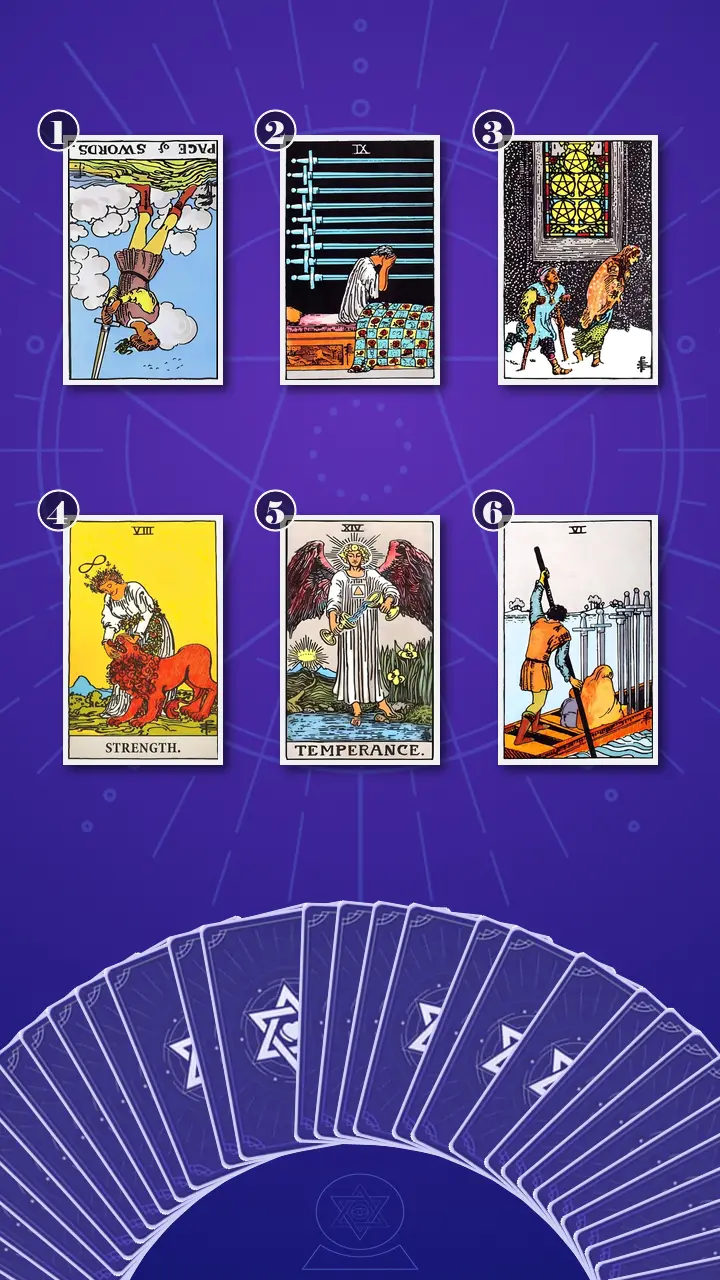
Today, we used a spread I call the Transformation Path Grid (6) · Context Edition. It’s a clean 2x3 grid—six cards that separate a fast loop into readable parts: the trigger, the mental script, the deeper wound… then the pivot, the practice, and the integrated outcome.
For a pattern as quick as “typing…” panic—cue → story → body spike → control attempt—six positions is the smallest structure that still gives clarity. It keeps us grounded in what you can actually change, without drifting into fortune-telling about someone else’s behavior.
“Here’s what to watch for,” I explained, more to you reading than to Maya. “Position 1 will show what the typing bubble activates in the first ten seconds. Position 3 touches the old rejection wound underneath. And Position 4—our turning point—shows the inner capacity that interrupts the loop in real time.”
Reading the Map: Card Meanings in Context
Position 1 — The trigger in real life: what the “typing…” bubble activates in you in the first 10 seconds.
“Now turning over,” I said, “is the card that represents the trigger in real life—what the typing bubble activates in you almost instantly.”
Page of Swords, reversed.
This Page is the Scout—curious, quick, mentally sharp. Reversed, that sharpness becomes a threat-detector. I told Maya, “This is like you’re at your desk with a half-cold iced coffee and seventeen tabs open, and the second you see ‘typing…’ you stop being a person and become a monitor. You reread your last text, hover, scan—like you’re trying to intercept danger.”
In reversed form, the Page’s energy is blocked and excessive at the same time: too much vigilance, not enough true information. It’s the impulse to A/B test your own personality in real time—Should I sound witty? Softer? Cooler? Less available?—as if the “right wording” can guarantee safety.
Maya let out a small laugh that surprised even her—dry, a little bitter. “Okay,” she said. “That’s… too accurate. Like, kind of brutal?”
I nodded. “Brutal is often just clarity without padding. If your nervous system is sprinting, you’re going to treat a chat thread like a live security camera feed. It’s not because you’re ‘bad at dating.’ It’s because your brain thinks constant monitoring prevents pain.”
Her fingers tightened around her cup, then loosened. The tiniest sign of recognition—like a lock clicking half open.
Position 2 — Your immediate mental response: the rumination script that escalates the moment into panic.
“Now turning over,” I said, “is the card for your immediate mental response—the script that turns ambiguity into panic.”
Nine of Swords, upright.
“This is the part where it gets loud in your head,” I told her. “It’s late, you’re alone, and the moment the bubble disappears your mind builds a whole narrative arc—rejection, embarrassment, them telling a friend about you, you being ‘too much.’”
The Nine is not a single worry. It’s a wall. A wall of swords like intrusive push notifications—each one louder than the last.
In this card, the energy is excess Air: too much interpretation, too little grounding. You refresh the chat like it’s going to change reality. You draft a follow-up, delete it, draft again. Nothing has happened—yet your body is already reacting like it has.
I mirrored the thoughts the way they actually arrive—short, sharp, relentless:
What did I say?
Did I say too much?
Should I fix it?
Maya’s eyes flicked to her phone despite herself, like her attention had a magnet in it. Her jaw clenched, then she forced it loose. “It’s like I can’t stop,” she whispered.
“Because the Nine of Swords believes the pain can be prevented if you just think hard enough,” I said. “But here’s the reframe that starts to cut through it: A pause isn’t proof. It’s just missing data. The Nine treats missing data like a verdict.”
Her shoulders dropped a millimeter—an almost-invisible exhale. Deep emotional synchronization: seen, not shamed.
Position 3 — The rejection wound underneath: what you’re afraid the moment will prove about your worth or belonging.
“Now turning over,” I said, “is the card for the wound underneath—what you’re afraid this moment will prove about you.”
Five of Pentacles, upright.
The café windows were fogged from the heat inside, and for a second the card felt like it was borrowing that exact imagery: warmth behind glass, cold on the street.
“The real pain under the panic isn’t ‘what will they say,’” I told her. “It’s ‘what if this proves I’m outside again.’ A delayed reply feels like standing in the cold looking at warmth through glass—even if you have friends, even if you’re busy, one thread can make belonging feel conditional and scarce.”
The Five’s energy is deficiency: not enough felt-sense of safety and inclusion. That’s why the Page of Swords goes into surveillance mode. That’s why the Nine of Swords turns a pause into catastrophe. The stakes feel ancient, even when the trigger is modern.
Maya looked down at the table, then back up. “I hate how fast I assume I’m not chosen,” she said. The words landed heavy—but honest.
“That honesty,” I said gently, “is already a doorway back inside.”
When Strength Spoke: Soft Hands, Steady Breath
Position 4 — The key inner pivot: the capacity you can access that interrupts the rejection pattern in real time.
As I reached for the fourth card, the café noise seemed to shift. Not quieter, exactly—just farther away, like the room gave us a little more space. “We’re turning over the most important card in this reading,” I said. “This is the pivot point.”
“Now turning over,” I continued, “is the card that represents the key inner pivot—the capacity you can access that interrupts the pattern in real time.”
Strength, upright.
I showed Maya the image: the woman with calm eyes, soft hands on the lion. No wrestling. No domination. Just steadiness. “This is the moment you feel the spike and decide your next move is for you, not for the thread,” I said. “You put the phone down. You exhale on purpose. Your shoulders drop a fraction. You don’t try to outsmart the conversation—you steady your body first.”
Setup: You know that exact second: the bubble pops up, your breath freezes, and suddenly your whole evening is about decoding what a stranger’s thumbs mean. Your brain thinks if you solve it fast enough, you won’t feel the drop. Your body thinks you’re only safe when you know.
Delivery:
Stop treating the typing bubble as a verdict and start meeting the moment with Strength—soft hands, steady breath, and self-trust that doesn’t require instant reassurance.
I let the sentence sit between us like a warm cup you don’t rush. Maya went still in a three-part chain I’ve come to recognize as “truth landing”: first, a tiny freeze—her breath paused, fingers hovering above the phone without touching it. Second, her focus softened—eyes unfixed, like she was replaying a moment from last week in her mind. Third, release—her shoulders lowered and a shaky exhale escaped, more relief than sadness.
“I keep acting like I’m being graded,” she said, voice suddenly sharper with frustration. “But… I’m not. It’s just… silence. Missing data.”
“Exactly,” I said. “Strength doesn’t argue with the alarm. It turns down the volume. It’s nervous-system regulation disguised as courage.”
This is where my own craft always comes in—not as superstition, but as a practical metaphor I trust. “In my café,” I told her, “I read patterns in coffee grounds—Grounds Divination. When the cup is shaken, everything looks chaotic and you can ‘interpret’ anything. But when you let the grounds settle, the true pattern appears. Your mind right now is like a cup that keeps getting swirled by the typing bubble.”
“Strength,” I continued, “is choosing to let the grounds settle before you read the story.”
Then I asked the question that turns insight into a lived memory: “Now, with this new lens—can you remember a moment last week when the typing bubble showed up, and you could’ve met it with soft hands instead of surveillance?”
Maya blinked hard. “Wednesday,” she said. “I was in a meeting. My Apple Watch buzzed and I basically blacked out mentally. I drafted three replies in Notes. I didn’t hear half of what my manager said.”
“That’s the moment,” I said. “And this is the shift: from negotiating your worth through response timing to building steadiness inside your body first. Not perfection—capacity.”
In that breath, you could feel the emotional transformation beginning: from catastrophic forecasting to grounded self-trust; from feeling stuck in a digital spiral to finding clarity through embodied choice.
Position 5 — The practice that builds security: a balancing action you can repeat to change the communication rhythm.
“Now turning over,” I said, “is the card for the practice—what you can repeat to build a healthier rhythm.”
Temperance, upright.
Temperance always looks like an ordinary miracle: two cups, water moving between them, one foot on land and one in water. “This is ‘two-cup pacing,’” I told her. “You stop swinging between ‘fix it now’ and ‘act like you don’t care.’ You reply when you’re regulated, not when you’re panicking. And you let pauses exist without chasing them.”
The energy here is balance—not numbness, not overexposure. Measured vulnerability beats flooding or freezing.
Maya nodded, but then her brow tightened. “Okay, but… I genuinely don’t have time to do a whole mindfulness thing every time,” she said. “Like I’m at work. Or on the subway. Or with friends. I can’t disappear for ten minutes to breathe.”
That objection was real—and useful. “Good,” I said. “Then we won’t make it big. Temperance is small adjustments. Espresso shots, not gallon jugs.”
Position 6 — Integration: what a steadier texting/attachment experience looks like when the skill is applied.
“Now turning over,” I said, “is the card for integration—what a steadier experience actually feels like in your body and your evening.”
Six of Swords, upright.
“This is calmer waters texting,” I said. “Not ‘you never notice the bubble again.’ You still notice. You still have thoughts. But you’re not trapped inside them.”
The Six is the mind relocating. The energy is directed movement: Air that’s no longer storming, but steering. “It’s like you can see a typing pause and think, ‘I don’t know yet,’ and then return to your night without performing for certainty,” I said. “You carry your thoughts with you, but you don’t let them drive the route.”
Maya’s posture changed subtly—less hunched over the phone, more in her chair. As if she could imagine, for the first time in a while, closing the app without needing closure.
The One-Week “Screen-Isn’t-a-Verdict” Reset (Actionable Advice)
I pulled the whole grid together for her, like laying out the story the cards had been telling all along.
“Here’s the arc,” I said. “The Page of Swords reversed shows your trigger: hypervigilance—monitoring the thread for micro-signals. The Nine of Swords shows the escalation: your mind opens twelve tabs of worst-case scenarios and calls it ‘preparing.’ The Five of Pentacles shows why it hooks so hard: an old ‘outside looking in’ wound. Then Strength offers the pivot—meeting the adrenaline spike with soft hands. Temperance turns that pivot into a repeatable rhythm. And the Six of Swords is the lived outcome: calmer waters, not because the other person behaves perfectly, but because you do.”
Her cognitive blind spot was clear: she’d been trying to solve a body problem with a wording solution. “You’ve been treating uncertainty like something you must eliminate,” I said, “instead of something you can hold. The transformation direction is simple, but not easy: self-soothe first, then text. Shift from decoding digital cues for safety to practicing regulation before you respond.”
“And for the record,” I added, “this isn’t about tolerating genuinely unsafe behavior. It’s about not letting the spike drive your thumbs.” Don’t let urgency write your texts for you.
I offered her small, concrete experiments—because clarity without next steps is just a nice moment.
- Phone Face-Down + 5 BreathsFor one week, when you see “typing…,” place your phone screen-down and take 5 slow breaths (yes, even if they’re imperfect). Then look again and decide what you want to do.Set a 30-second timer so it stays realistic. If your brain says, “This is stupid, I need to know now,” that’s the cue the practice is working.
- A Neutral Alternate StoryRight after the breaths, name one neutral story: “They got interrupted,” “They’re thinking,” or “They’re multitasking.” Treat it like missing data, not a verdict.If it helps, use my Aroma Anchoring trick: inhale the smell of your coffee (or even your sleeve) on breath one, so your body links a scent to steadiness.
- Reply-From-Regulation Window (20–60 Minutes)When you’re triggered, choose a “middle rhythm” window: reply sometime within 20–60 minutes—neither instantly nor as a power move. If you reply, keep it to one clean sentence.Pre-plan the rule when you’re calm, not mid-spiral. Twenty minutes counts even if you still feel activated—Temperance is about consistency, not perfection.
She stared at the list like it was permission. “This feels… doable,” she said, and her voice had a different tone—less bargaining, more choice.

A Week Later: Calmer Waters, Not Perfect Certainty
Six days later, Maya sent me a message—short, like someone trying not to jinx progress.
“Saw the typing bubble. Put my phone face-down. Did the five breaths. Told myself ‘missing data.’ I still wanted to check like ten times, but I checked twice. Didn’t double-text. Also I could actually taste my coffee instead of just holding it.”
That’s the real proof: not a perfect relationship timeline, not suddenly becoming “chill,” but a measurable shift in agency. Clarity, in this kind of work, is often the quiet moment your shoulders soften and you realize you’re still in your own life.
It was light, and also a little bittersweet—the kind of change where you feel steadier, then notice how much you’d been carrying. She told me later she celebrated by sitting alone in a café for an hour, phone in her bag, just letting the world be loud without making it about her.
This was her Journey to Clarity: learning that the typing bubble is a cue, not a verdict—and that Strength isn’t force. It’s soft hands. It’s breath. It’s self-trust that doesn’t require instant reassurance.
We’ve all had that moment where a pulsing “typing…” bubble turns your chest tight and your mind loud—because you want closeness so badly, and you’re terrified a single pause will prove you weren’t chosen.
If you didn’t have to earn certainty from the screen tonight, what’s one tiny way you’d let your body lead first—one breath, one pause, one softer pace—before you decide what to text?