Opening Up, Getting Advice, Then Asking for Listening First

The 6:18 p.m. Advice Hangover
If you are the late-20s city friend who can write the perfect Slack message but still goes quiet the second a 'Have you tried...' text lands on the TTC, I know that very specific loneliness. Maya (name changed for privacy) brought it into my café on a wet Toronto evening, shoulders lifted around her ears, both hands around a cappuccino she had stopped drinking before the foam had fully settled.
She told me about 6:18 p.m. on the 504 King streetcar: the windows rattling, cold air slipping in every time the doors opened, her phone warm in her palm, her thumb hovering over the line 'I feel lonely tonight.' She deleted it, replaced it with 'work has just been a lot lately lol,' watched the typing bubble appear, and felt her jaw lock before the reply had even landed.
'I know they were trying to help,' she said, looking at the cup instead of me. 'So why do I feel worse?'
I had heard this question in a hundred modern forms: why advice makes me feel worse, why do I feel lonely after opening up to friends, need to vent not advice. It always arrived in the body before it arrived in language. Her throat had narrowed to a straw. Her chest sounded hollow, like a paper cup after the heat has gone out of it. Being given solutions is not the same as being accompanied.
I told her what I tell people when they arrive with that kind of advice hangover: 'You are not ungrateful, and you are not broken at opening up. Helpful replies can still leave you emotionally unseen. Tonight, let me help you make a map for the moment where reaching for connection keeps ending in feeling more alone.'

Choosing the Shadow Spread for Feeling More Alone After Opening Up
I asked her to take one slow breath with both hands around the warm ceramic, not as some theatrical ritual but as a handoff from reflex to attention. Then I shuffled slowly, letting the soft drag of cardstock and the low sigh of the espresso machine do what good ritual does: give the nervous system a doorway.
For this question, I chose the Shadow Spread. When people ask me how tarot works in a situation like this, my answer is simple: I am not using the cards to predict whether a friend means well. I am using them to show the structure of a repeating relationship pattern. This spread is small on purpose: surface symptom, hidden root, corrective medicine, embodied next step. The issue here is not choosing between external options. It is understanding why the same emotional script keeps replaying inside supportive conversations.
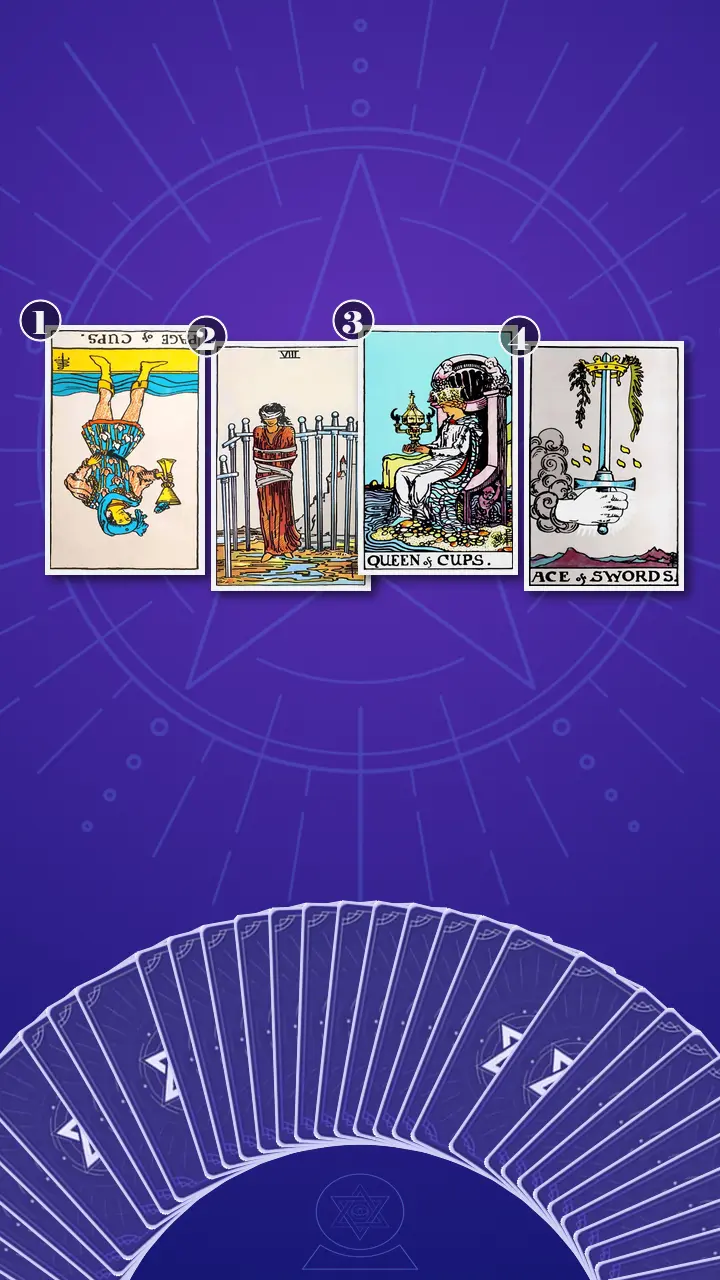
I told Maya I would read the line from left to right like moving through a tunnel and back into open air. The first card would show the visible pattern: how she opens up carefully and still leaves the exchange feeling more alone. The second would reveal the shadow belief underneath it. The third, our bridge card, would name the inner quality that supports the shift from indirect testing to clear self-attunement. The fourth would turn that insight into something usable in a text, a voice note, or an overlit kitchen conversation at the end of a draining day.
Reading the Left Side of the Line
The Message That Gets Cleaned Up
I turned the first card and said, 'This is the card that shows the visible conversation pattern you are acting out right now.' It was the Page of Cups, reversed.
In modern life, this is the Notes-app draft that never survives copy-paste into iMessage. After a draining hybrid workday, you write the line that actually says 'I feel lonely,' then you smooth it into something lighter, funnier, more manageable. The other person responds to the manageable version, and suddenly you are being helped around the feeling instead of met inside it.
Reversed here, the Page carries blocked water. The emotion is real, immediate, and sincere, but it does not trust itself enough to arrive plain. The fish jumps from the cup, then the inner editor grabs it midair. That is why the exchange feels so strange afterward. You did open up, technically. But you opened up in a way that protected the most tender sentence from being fully seen. Wanting comfort got translated into wanting control.
Maya let out one short laugh, the kind with a bruise under it. 'Wow,' she said. 'That is accurate enough to be rude.'
'Good,' I said gently. 'That means we are standing near the real thing.' She nodded, but her fingers kept circling the rim of the cup as if she could polish the feeling smooth on contact.
The Rule Under the Polite Reply
I turned the second card. 'This one reveals the hidden fear and limiting belief that turns advice into proof of disconnection.' It was the Eight of Swords, upright.
This is what it looks like when a vulnerable conversation becomes an internal performance review. Advice comes in, and instead of hearing only care, you hear eight tabs opening at once: I was too vague. Too much. Too dramatic. Not clear enough. Next time make it cleaner. Or stop sharing. It is like being trapped in edit mode on a Google Doc of your own emotions while the real sentence never ships.
Upright in this position, the card shows air in excess and water under arrest. The blindfold is the old fear that if your feelings are messy, people will not stay. The ropes are loose, but the body believes they are steel. So the moment someone says 'Have you tried...', you stop seeing options. You only see two: explain yourself better, or disappear. You can explain it perfectly and still not feel met.
As I said that, I had one of those small professional flashbacks I get from living half my life behind an espresso bar. If I force too much water through the grounds, hoping for a deeper shot, I do not get more truth. I get bitterness. The fridge hummed from the back kitchen like a held note, and the whole café seemed to lean into the silence with us.
Maya stopped touching her phone. First her breath stalled. Then her eyes went slightly unfocused, as if she were replaying three old chats at once. Finally she exhaled through her nose and said, very softly, 'So when they start fixing it, my body hears: make yourself easier to handle.' I nodded. That was the shadow finally speaking out loud.
When the Queen of Cups Held the Cup Steady
The Medicine of the Closed Cup
Before I turned the third card, the grinder in the front room went silent and the café settled into that rare pocket of evening hush where even porcelain sounds louder than conversation. 'This is the bridge card,' I told her. 'It names the corrective inner quality—the medicine.'
The card was the Queen of Cups, upright.
I asked her to picture the streetcar again: fluorescent light in the window, thumb hovering over the sentence she actually meant, body already bracing before the typing bubble appeared. The hard week was real, yes. But the deeper ache was the habit of making the ache easier to manage before anyone could meet it.
Stop turning your heart into a problem pitch. Hold the cup steady, name the kind of support you want, and let being understood matter as much as being helped.
I let the words sit there with the smell of coffee and rain-damp coats. Then I said, 'You do not need to make your pain easier to solve in order to deserve company inside it.'
In my café, I call this a Stress Flavor Profile. When a shot is over-extracted, we keep forcing water through the grounds because we think more pressure will produce something better. Instead, the cup turns harsh. You have been over-extracting your feelings in the same way—adding context, disclaimers, humor, precision, all the language-heavy brilliance of your UX-writing brain—until the tender note gets buried under what sounds actionable. The Queen of Cups is the opposite of that. She does not spill. She does not pitch. She holds the cup long enough to ask a cleaner question: do I want ideas right now, or do I want company inside this feeling?
Maya went very still. First her fingers froze on the handle. Then her gaze slipped past me toward the fogged front window, like she was seeing every cleaned-up message side by side. When she looked back, her eyes had gone bright. Her jaw loosened. Her shoulders dropped a full inch. Then came the complicated part—a shaky laugh, immediately followed by a flash of resistance. 'But if I say that out loud,' she asked, 'doesn't that mean I've been doing this wrong the whole time?'
'No,' I said. 'It means you learned to ask for comfort in the language of strategy, because strategy felt safer. This is not a verdict. It is a shift.' I invited her back into the card. 'Now, with this new angle, think about last week. Was there a moment when one sentence about the kind of support you wanted would have changed the atmosphere?' She pressed her lips together, nodded once, and whispered, 'The kitchen. I could have said I wanted her to stay with me for a minute.' That was the step I wanted her to feel in her body: not perfection, but movement from guarded loneliness toward awkward honesty, from self-blame toward steadier self-attunement.
One Honest Sentence Under a Gray Sky
I turned the last card. 'This one translates the insight into practice so future conversations do not default to silent disappointment.' It was the Ace of Swords, upright.
In real life, this is one clean sentence that reroutes the whole thread before it becomes the wrong workflow: 'I do not need solutions yet. I mostly need you to hear me out for a minute.' The crowned sword is focused air in balance. After the Eight of Swords filled the room with competing inner voices, this Ace gives you one deliberate line. Not a speech. Not a perfect explanation. One support-format sentence.
This is why the spread moves from eight voices in your head to one honest sentence. The work is not opening up more dramatically. It is naming the support format, not just the problem. Listening, comfort, ideas later. Once that structure is clear, the other person has a real chance to meet the actual need instead of guessing from the polished version.
Maya repeated the sentence under her breath, testing it like a new key in an old lock. The second time she said it, her voice steadied. The room felt brighter in the practical way it does when clouds thin but do not fully clear.
From Eight Voices to One Honest Sentence
When I laid the four cards out together, the story was clean. First, the Page of Cups reversed: the honest feeling appears but gets edited into something manageable. Then the Eight of Swords: the mind turns the conversation into a test of worth, as if belonging depends on perfect clarity. Then the Queen of Cups: the inner container that treats emotion as something worth witnessing before fixing. Finally, the Ace of Swords: one clear sentence that gives the relationship better instructions.
The blind spot was not that Maya lacked emotional intelligence. It was almost the opposite. She had been confusing being articulate with being known. Her story kept getting clearer while her need stayed hidden. The transformation direction was simpler and harder than more analysis: shift from indirectly testing whether people will understand to directly naming whether she wants listening, comfort, or ideas.
'But what if I do not catch it in time?' she asked. 'Some days I have already sent the polished version before I even realize I did it. And honestly, I do not always have five extra minutes.'
'Then we make the practice smaller,' I told her. 'Clarity does not require a perfect mood. It only requires one interruption in the old script.'
- Choose the support word before the storyOn one commute or late-night text this week, pause for 20 seconds before sending. In Notes or in the message box, choose one word first—listening, comfort, or ideas—then build your opening line around it: 'I am feeling hurt, and I mostly need listening tonight.'If that feels too exposed, send the line to yourself first. Awkward usually means unfamiliar, not wrong.
- Use the support-format sentenceWith one trusted friend, roommate, or partner, start the next real conversation with: 'I do not need solutions yet. I mostly need you to hear me out for a minute.' Save it in pinned notes or a text shortcut so emotional you does not have to invent it mid-spiral.Lowest-bar version: 'No fixes yet, please.' If they cannot do that in the moment, that is information, not failure.
- Try the 5-Minute Coffee ResetBefore a vulnerable voice note or text, make coffee or tea, inhale the grind or steam for one minute, then write three lines: 'What I feel,' 'What I need right now,' and 'What can wait until later.' This is my Café Therapy version of self-attunement before self-explanation.Stop after the draft if your throat tightens more. The practice is naming the need, not forcing the conversation.
I also taught her my Cup Temperature Scan. If she was in a kitchen chat or on a call holding a mug, the moment the drink went lukewarm and her jaw clenched was her cue. That was not drama. It was data. Warmth was leaving the conversation, and that was the moment to redirect instead of over-explain.

A Week Later, the Quiet Proof
Four days later, after the breakfast rush, I got a text from Maya. She had used the sentence with her roommate in that same bright kitchen: 'Can this be listening first before we problem-solve?' Her roommate put the dish towel down, turned fully toward her, and said, 'Yeah. Start again.' Maya told me the strangest part was how small the moment looked from the outside. No cinematic breakthrough. Just one cleaner ask, and a completely different kind of company.
She said she slept a full night afterward, but woke with the old thought—was that too needy?—and then laughed because the thought no longer got the final say.
That is what this kind of journey to clarity looks like when it is real. Not becoming perfectly vulnerable. Not never feeling awkward again. Just moving from advice hangover and self-blame toward clearer support requests and steadier trust in connection. The cards did not teach her how to be less needy. They reminded her that needing presence is valid.
If tonight you recognize that familiar moment when your throat tightens and you realize the conversation happened but your heart still was not joined, remember this: being witnessed before being helped is not a luxury need. It is part of how closeness works, and noticing that need already means you are no longer at the very start.
So the next time you reach for your phone—on the TTC, in the kitchen, or under that 12:57 a.m. screen glow—if you did not have to earn care by making your pain easier to solve, what kind of support would you want to name first: listening, comfort, quiet company, or ideas later?