Night-bus Notes drafts—until a one-sentence boundary finally gets said

The Night-Bus Replay You Can’t Delete
You’re 28, living in London, and you can handle a tough week at work—but one ‘joke’ your partner makes at the pub has you replaying it on the night bus like it’s a voicemail you can’t delete.
Jordan (name changed for privacy) sat across from me with their coat still on, like they hadn’t fully decided they were allowed to take up space. They told me it happened again last Friday—10:41 PM in a noisy East London pub, wedged into a sticky leather booth. Pints sweated onto coasters. Someone’s laugh ricocheted off the low ceiling. Their partner was mid-story, charismatic, doing that thing where the whole table leans in.
“Then the joke pivoted to me,” Jordan said. They didn’t call it cruelty. They didn’t call it humiliation. They called it “banter,” the way you do when you’re trying to keep your own feelings from making a scene.
I watched their hand move unconsciously to their throat as they described it: heat crawling up their neck, a tightness that made words feel stuck, and then—almost worse—a half-laugh that escaped anyway. “I don’t want to be the person who can’t take a joke,” they said, eyes flicking away like the sentence itself was embarrassing.
They described what happened after, too—the part nobody sees. Top deck of the night bus. City lights streaking across the window. Phone warm in their palm from being clenched. Notes app open like an unofficial therapy room: draft the perfect text, delete it, draft it again, send nothing. Their jaw felt locked, their shoulders up near their ears. “It’s not even that bad,” Jordan said, and their voice went smaller. “But it sticks to me for days.”
The embarrassment in the moment had already curdled into something quieter: resentment, self-doubt, that low-grade sadness that shows up as a private bruise. The core tension was loud even when Jordan spoke softly: wanting public respect and emotional safety, while being terrified that setting a boundary in front of friends would make them look humorless—and risk their social belonging.
“Laughing along doesn’t mean it didn’t hurt,” I said gently. “It just means you were trying to survive the room.”
I let that land, then added, “We’re going to treat this like a Journey to Clarity. Not a dramatic confrontation. A map. Something you can actually use the next time you feel that throat-tightening freeze.”

Choosing the Compass: A Relationship Spread for Group-Dynamic Boundaries
I’m Alison Melody, and most people know me from radio—ten years of talking about how sound changes the nervous system. In sessions like this, I do tarot the same way I build a playlist: not for vibes, but for outcomes. We’re looking for what’s happening, what keeps repeating, and what small, specific next step will change the pattern.
I asked Jordan to take one slow inhale and exhale—not as a mystical ritual, but as a switch. A way to move from performing “I’m fine” into actually noticing what’s true. While they breathed, I shuffled, letting the cards make that soft papery hush that always reminds me of cueing a record: you don’t force the song; you set the needle and listen.
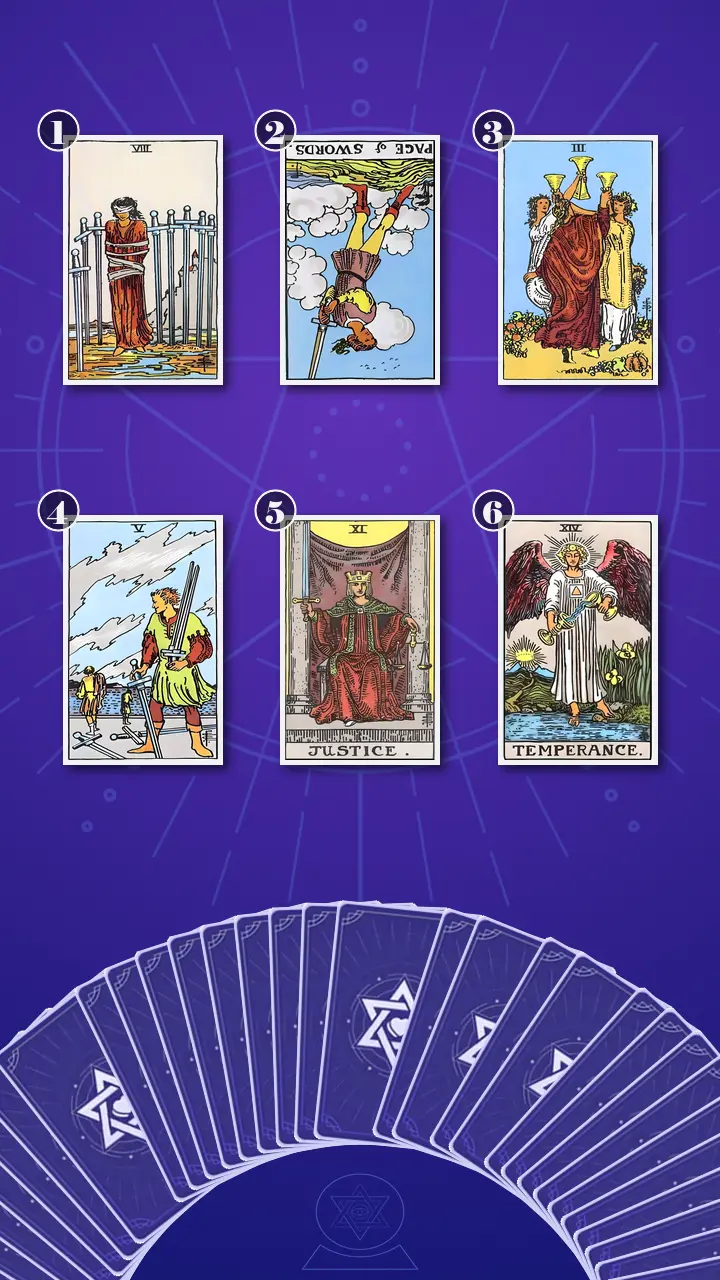
“Today we’ll use a six-card layout called the Relationship Spread,” I told them.
For you reading: this spread works especially well when the question is interpersonal and public-facing—partner jokes in front of friends, group dynamics, communication scripts, and boundary-setting without escalating the room. It’s a clean 2×3 grid: the top row is the public stage (what everyone sees in real time), and the bottom row is the hidden engine (what makes it repeat) and the way forward (the boundary and the repair).
“The first card will show what you do in the exact three seconds after the joke lands,” I said. “The middle of the top row will show what your partner is doing socially with humor. And this third card—your friend group—matters more than you think. Then we drop down to the pattern underneath, the boundary you set, and the follow-up that makes it stick.”
Reading the Map: What Happens in the Exact Three Seconds
Position 1: The Freeze You Call ‘Being Chill’
“Now turning over, is the card that represents what you feel and do in the moment of being teased—the observable freeze/silence response,” I said.
Eight of Swords, upright.
I didn’t have to reach for abstraction. This card already spoke Jordan’s language: It’s 11:38 PM, you’re upstairs on the night bus after a pub birthday. Your partner drops a ‘harmless’ joke about you and the table laughs. You do the half-laugh too—automatic, like muscle memory—while your throat tightens and you feel your face go hot. You tell yourself you’ll address it later… then on the ride home, you open Notes and start drafting the perfect text, delete it, draft it again, and end up sending nothing.
“Eight of Swords is restriction,” I told them, “but notice the detail: the bindings are loose. This isn’t ‘you can’t speak.’ It’s your body hitting mute to protect you from the spotlight. Like your voice goes into airplane mode—the second the joke lands, everything is ‘on’ inside, but nothing sends.”
In energy terms, this is a blockage: your self-protection strategy works short-term (no awkward moment), but it traps you long-term (you carry it home, alone).
Jordan gave a small, bitter laugh—the kind that’s almost a flinch. “That’s… yeah,” they said. “It’s weirdly accurate. Like, too accurate. Even a bit harsh.”
“Accurate isn’t the same as harsh,” I said. “It just means we’re finally naming what’s actually happening.”
Position 2: The Performer With a Sharp Tongue (Even When They Love You)
“Now turning over, is the card that represents how your partner uses humor and words in group settings, and what that behavior is trying to achieve socially,” I said.
Page of Swords, reversed.
The modern translation snapped into place immediately: In groups, your partner becomes the quick-fire commentator: scanning faces, timing punchlines, feeding off the laugh like it’s fuel. When your expression flickers, they tack on ‘I’m only joking’ and keep moving—as if the disclaimer resets everything.
“This isn’t me calling them evil,” I said, because I could feel Jordan bracing. “Reversed Page of Swords is sharp communication without tact—fast words, mis-aimed. The punchline becomes the raised sword. The disclaimer is the exit strategy.”
In energy terms, it’s an excess of Air—speed, commentary, social leverage—without the balancing care of impact. And when someone is rewarded for that speed, they do it more.
Jordan’s shoulders lifted, then dropped. A tiny nod. The kind you do when you’re relieved someone else sees the pattern without making you feel foolish for loving the person.
Position 3: The Audience Effect (Why the Room Makes It Worse)
“Now turning over, is the card that represents the role of the friend group and the public stage in amplifying the teasing dynamic,” I said.
Three of Cups, upright.
I could almost hear the pub in the card: Your friend group has a ‘roasting is bonding’ culture: clinking pints, inside jokes, everyone piling on the same story. When the joke hits, the room rewards it instantly—laughter, eye contact, the whole ‘we’re having such a good night’ glow. Your body reads that reward as a rule: don’t interrupt.
“Here’s the turning point,” I told Jordan. “You’re not ‘too sensitive.’ You’re reacting to being made public entertainment. Three of Cups is belonging—but it’s also reinforcement. Laughter is feedback. Like a live audience laugh track that teaches what’s allowed without anyone saying it out loud.”
Jordan exhaled, slow. Their eyes unfocused for a second, like they were replaying the last dinner. Then their jaw unclenched. That little shift mattered: self-blame loosening into clarity.
The Scoreboard Nobody Agreed to Keep
Position 4: The Win/Lose Script Under the Jokes
“Now turning over, is the card that represents the underlying mechanism that keeps the teasing going and makes it hard to interrupt,” I said.
Five of Swords, upright.
The modern scenario landed with a bitter kind of precision: The pattern underneath is a win/lose script: your partner gets the laugh (the ‘win’), you go quieter (the cost), and nobody names the emotional fallout because the night is supposed to stay fun. Later… you feel the distance creep in—tiny, but real.
“This is the card of hollow victories,” I said. “Points on a scoreboard nobody agreed to keep. It’s like someone ‘wins’ the room the way people win Twitter—by being sharp, not by being kind.”
Then I used the line I’ve learned to say when people keep blaming themselves for a social loop: “If the room rewards it and you stay silent, the joke becomes a rule.”
I watched Jordan’s reaction chain happen in three beats: their breath paused (a brief freeze), their gaze slid sideways like they were watching the moment on a screen (cognitive penetration), and then they swallowed hard and nodded once (emotional release). “Yeah,” they said quietly. “That’s exactly it. I laugh and then I hate that I laughed.”
When Justice Cut Through the Laugh Track
Position 5 (Key Card): The Boundary That Restores Fairness
“We’re turning over the most important card in this reading,” I said, and even the room felt like it adjusted—traffic outside, then a brief quiet between sounds, like a studio before a live segment goes on air.
“Now turning over, is the card that represents the next boundary you need to set—stated as a principle and a practical line in the sand,” I said.
Justice, upright.
The modern-life translation was almost a script waiting to be spoken: The next boundary isn’t a speech or a clapback—it’s a standard you set in clean language. Imagine the exact moment the joke starts to tilt toward you: you look at your partner (not the whole table) and say, calmly, ‘Not about me, please.’ Or: ‘Don’t make me the joke.’ No apology smile. No long explanation.
Justice is the antidote to Five of Swords. Where Five keeps a scoreboard, Justice changes the rules of the game. In energy terms, this isn’t excess or deficiency—it’s balance: clear standards, consistent consequences, clean language.
Setup: The “Perfect Message” Trap
You know that moment on the night bus when your phone glow hits your face and you’re rewriting the same message in Notes, trying to make it impossible for anyone to think you’re ‘dramatic.’ That’s where you’ve been living—trying to earn the right to speak by crafting the perfect explanation.
Stop treating respect like a vibe you have to earn, and start treating it like a clear standard you set—Justice doesn’t negotiate with the crowd, it holds the line.
I let the sentence hang for a beat, like a clean chord ringing out after noise.
Respect isn’t a vibe you have to earn from the room—it’s a clear standard you’re allowed to set, even when others are laughing.
Reinforcement: The Body Learns the Sentence
Jordan’s first reaction wasn’t instant relief. It was resistance—hot, protective. Their eyebrows pulled together. Their fingers tightened around their sleeve. “But if I say it like that,” they said, voice sharper than before, “doesn’t that make me the awkward one? Like… everyone will stare. And then I’m the problem.”
I nodded, because that fear is real. “Your nervous system is predicting an audience penalty,” I said. “That’s not drama. That’s data.”
Then I brought in my signature tool—the way I read stress through sound. “Can I ask you something a little weird?” I said. “On those bus rides home, what do you actually listen to? What was your most-played song this week?”
Jordan blinked. The question surprised them out of their spiral. “Um… honestly? A lot of aggressive stuff. Like fast BPM. I just… need noise.”
“That’s your Music Pulse Diagnosis right there,” I told them. “Fast, sharp, high-energy tracks after a night like this usually mean your body is still in fight-or-flight, even if your face was smiling. Justice isn’t asking you to become a different person overnight. It’s asking you to give your body one steady beat to come back to in the moment.”
I watched the shift happen in layers: their eyes widened slightly, then softened; their shoulders lowered like they’d been holding them up for hours; and when they exhaled, it sounded shaky—like the first breath you take after realizing you’ve been bracing.
“Here’s the practice,” I said, keeping my voice calm and no-drama. “Set a 2-minute timer. Out loud (quietly, alone), say your chosen one-liner three times: once neutral, once softer, once firmer. Then stop. If it makes you feel exposed or shaky, you can pause—no forcing. The goal is to make the sentence feel physically available, not perfect. Optional: text yourself the line so it’s on your lock screen before the next hangout.”
I leaned in a touch. “Now, with this new lens, think back to last week. Was there a second—right after the joke landed—where one calm sentence would have changed how you felt walking to the tube?”
Jordan stared at the Justice card, then nodded once, slow. “Yeah,” they said. “There was a moment. It was tiny. And I still didn’t take it.”
“That’s the key shift,” I said. “Not from ‘conflict-avoidant’ to ‘confrontational.’ From embarrassed freeze-and-fawn in public to calm self-respect and socially steady boundary-setting.”
Temperance and the Repair That Makes It Stick
Position 6: Firm in Public, Calm in Private
“Now turning over, is the card that represents how you can communicate and reinforce the boundary in a way that supports repair and consistency,” I said.
Temperance, upright.
The modern translation was exactly what Jordan needed to hear: After the hangout—on a quiet walk home, or the next morning over coffee—you do the repair step: calm, specific, team-focused. ‘When you joke about me in front of people, I feel exposed. I need you to stop. If you want to be funny, be funny without using me.’ Then you make it practical: agree on a signal…
“Temperance is tone management,” I said. “You’re not diluting the boundary. You’re delivering it in a form your relationship can actually live with. Like a two-step rollout: quick patch in the moment, proper fix in private.”
And because I work with sound for a living, I added, “Think of it as sound design. The pub is fast banter—clipped beats, laugh spikes. Justice is one quiet, steady sentence. Temperance is the slower mix afterward: not more words, just the right ones.”
From Insight to Action: The One-Line Justice Rule
I tied the whole spread together for Jordan in one clear story: in public, their body freezes (Eight of Swords) while their partner performs sharp humor (Page of Swords reversed). The friend group’s laughter acts like a reinforcement loop (Three of Cups), which slides the relationship into a win/lose script (Five of Swords). Justice interrupts by setting a consistent standard, and Temperance makes it sustainable through a private agreement and repair.
The cognitive blind spot wasn’t that Jordan “didn’t have the words.” It was that they were treating respect like something earned through being chill—case-by-case, mood-by-mood—rather than a baseline rule. The transformation direction was simple and brave: shift from performing “I’m fine” to stating one sentence in the moment, then following up privately to turn it into a shared protocol.
I also gave Jordan a sound-based way to support their nervous system, because boundaries don’t land if your body feels like it’s about to be put onstage.
- Write the one-liner (and stop there)In your Notes app, write only this: “Not about me, please.” Then practice saying it out loud once in your flat in a neutral tone—like you’re ordering coffee.If your throat tightens, pair it with a simple Breath Soundtrack: inhale 4 counts, exhale 6 counts, then say the line on the exhale. One rep is enough.
- Do the 3-minute pre-brief before the next hangoutRight before you meet friends, tell your partner: “I’m excited to see everyone. One thing: no jokes at my expense tonight. If it starts happening, I’ll say ‘Not about me.’ I need you to back me up and pivot.”Keep it under three minutes. The goal is a protocol, not a debate.
- Use a ‘White Noise First Aid’ reset if your body spikesIf you feel the face-heat and throat-clench at the table, take one sip of water, press your tongue to the roof of your mouth, and focus on a steady sound (pub HVAC, street noise, even your own breath) for one breath before you speak.This isn’t avoidance—it’s buying yourself one second of regulation so Justice can come out clean.
To make it memorable, I offered a tiny BGM Prescription—three tracks Jordan could use as anchors: one steady, low-BPM song for the walk to the pub; one neutral ambient/white-noise track for bedtime when the replay starts; and one 528 Hz-style “frequency cleansing” track if they wanted a ritual that feels like closing the night instead of re-living it. Not magic—just a way to stop their nervous system from treating the joke like an emergency broadcast.

A Week Later: Ownership, Not Certainty
A week later, Jordan messaged me on a Monday morning: “Went out on Friday. He started to do it. I looked at him—not the whole table—and I said, ‘Not about me, please.’ My voice shook a bit but I did it.”
They added, “Nobody exploded. Nobody stared for ages. The moment was… weird for like two seconds. Then it passed. Later we did the debrief and agreed on a signal.”
It wasn’t a Hollywood transformation. It was clearer, and therefore steadier: one sentence in public, one calm agreement in private. A relationship starting to feel like a team in social settings—without Jordan having to earn dignity by being endlessly chill.
That’s what I love about tarot when it’s done well: it doesn’t tell you to become fearless. It shows you where the rules are hidden—and how to rewrite them with something you can actually say out loud.
When you’re smiling at the table with your throat tight and your heart sinking, it’s not that you “can’t take a joke”—it’s that you’re trying to belong and protect your dignity at the same time.
If you didn’t have to earn the right to be respected in public, what would your one-line boundary sound like in your own voice?