From Post-Send Dread to Steadier Self-Trust: Letting Emails Land

The 9:58 a.m. Whoosh That Wouldn’t Let Her Go
You hit send, and within two minutes you’re back in your Sent folder like you’re trying to time-travel—classic post-send perfectionism spiral.
Taylor said it like a confession, but her hands gave her away first: restless, hovering, as if her thumbs were still looking for an “Undo Send” button that didn’t exist.
She’d come into my café on a Monday that looked like every Toronto Monday—glassy towers outside, winter light flattened into silver, the street still damp from old slush. Inside, the espresso machine hissed and sighed. A spoon clinked against porcelain somewhere behind her, too bright for how tight her face looked.
“I sent a routine coordination email at work,” she told me, voice low. “And the moment it’s gone, I start rereading it. One line. One word. Like… what if that one sentence reads passive-aggressive?”
Her jaw was clenched hard enough that I could see the muscle jump. The dread wasn’t a concept; it was physical—like her chest had been shrink-wrapped, and her stomach was running on that wired-but-tired battery that never fully charges.
I set down her cappuccino and watched how quickly the steam disappeared. “Okay,” I said gently. “We’re not here to tell you to ‘just stop’ thinking. We’re here to map the pattern so you can get your day back. Let’s use the cards the way I use coffee: not as magic, but as a mirror with a handle. A Journey to Clarity.”

Choosing the Compass: The Celtic Cross · Context Edition
I asked Taylor to take one slow breath, then another—nothing mystical, just a nervous-system handoff from the inbox to the present moment. While I shuffled, the cards made that soft papery whisper I’ve heard for two decades, the same way I’ve heard a grinder bite into beans: a sound that means we’re about to make something usable out of something raw.
“Today,” I said, “we’ll use the Celtic Cross · Context Edition.”
For anyone wondering how tarot works in a situation like this: a spread is basically a structured conversation. The classic Celtic Cross is good for perfectionism spirals because it tracks a chain—what’s happening right now, what blocks relief, the deeper rule driving it, and then the shift that helps you close the loop without needing reassurance.
In this Context Edition, two positions are tuned for modern life: the ‘above’ card becomes your ideal standard (the voice in your head that says you must sound a certain way), and the final card is framed as an integration mindset—not a prediction, but the healthiest way forward.
“Here’s what we’re listening for,” I added, laying the cross. “Card one will show what the spiral looks like in your body and behavior right after you hit send. Card two will show the friction point that keeps relief blocked. And the last card—position ten—will show the most sustainable way to find clarity and move on.”
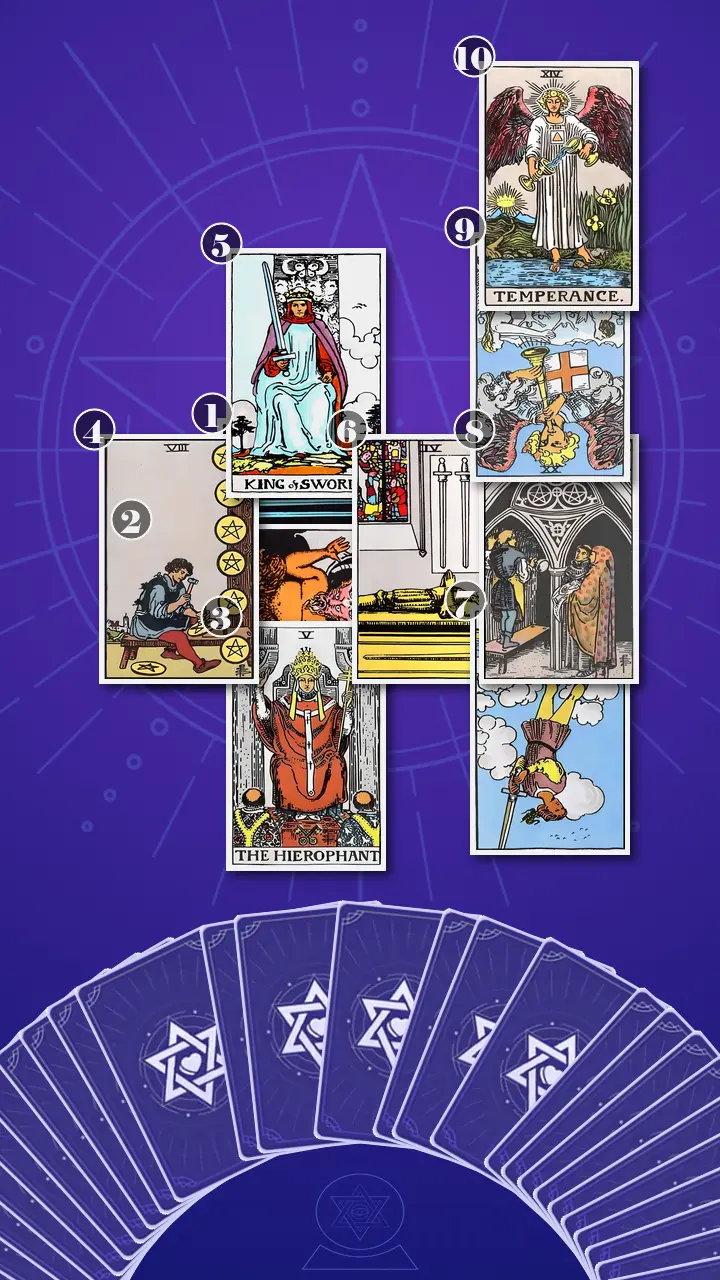
Reading the Map: Card Meanings in Context (When the Inbox Becomes a Courtroom)
Position 1 — The Loop That Starts Two Minutes After Send
“Now flipped over,” I told her, “is the card that represents what the spiral looks like right now: the immediate mental/behavioral loop after hitting send.”
Nine of Swords, upright.
“It’s 2 minutes after you hit send,” I said, keeping my voice plain. “You reopen the email on your phone in the elevator or at a red light, and every sentence becomes a scoreboard for whether you’re ‘competent.’ Your body is already bracing—tight jaw, tight chest—while your mind replays the thread like a late-night interrogation.”
This card’s energy is excess Air—thinking that’s gone past ‘useful’ and into ‘self-prosecution.’ The Nine of Swords doesn’t ask, ‘Is there a real problem?’ It asks, ‘Can I punish myself into safety?’
Taylor let out a small, bitter laugh. “That’s… too accurate. Like, almost rude.”
I nodded. “That reaction makes sense. This card can feel like a camera catching you mid-flinch. And I want to name something clearly: This isn’t “caring too much.” It’s reassurance-seeking dressed up as professionalism.”
She stared at the card, then at her cup, as if the foam might offer a loophole.
Position 2 — What Blocks Relief (The Hook)
“Now flipped over,” I said, “is the card that represents what blocks relief: the friction point that keeps you re-checking instead of returning to your day.”
The Devil, upright.
“You know checking won’t change anything,” I told her, “but the urge feels stronger than logic. You keep reopening Sent and refreshing Slack because it buys a momentary illusion of control—like if you monitor hard enough, you can prevent being judged.”
The Devil’s energy is a blockage powered by shame. Not loud, not dramatic—more like an autopilot you don’t remember turning on. The chains in the image are loose, which matters: it means the compulsion feels mandatory, but it isn’t.
“Checking isn’t clarity if it costs you your day,” I said, and watched her shoulders twitch, as if a truth landed a little too close.
“It really does cost me,” she admitted. “My Notion list is open, and I’m just… in the Sent folder doom-scroll.”
Position 3 — The Rule Beneath the Rule (Root Driver)
“Now flipped over,” I said, “is the card that represents the root driver beneath the spiral: the internal rule or learned standard feeding perfectionism.”
The Hierophant, upright.
“Inside your head is a strict ‘professional rulebook’ that says there’s one correct tone and one correct script for competence,” I said. “You write emails like you’re being graded, not like you’re coordinating work with humans.”
This is structured energy—and it’s not evil. The Hierophant can be mentorship, learning, standards. But here, it’s over-rigid. It turns normal ambiguity into a threat. It’s the inner voice that says: A real professional wouldn’t be misunderstood.
Taylor’s eyes shifted away from me for a second, like she was replaying a moment in her own head. Her fingers pinched the napkin, tightened, then smoothed it flat again.
“I’m early-career,” she said. “But I talk to myself like I’m supposed to already be… executive-level unbothered.”
“Exactly,” I said. “That’s the Hierophant speaking in a voice it didn’t earn.”
Position 4 — The Strength You’ve Been Overusing (Recent Pattern)
“Now flipped over,” I said, “is the card that represents the recent pattern leading here: what you’ve been practicing (or overusing) before this email moment.”
Eight of Pentacles, upright.
“You’ve been genuinely trying to get better: refining, learning, polishing,” I said. “But the craft mindset keeps running past the finish line—so even after a routine email is done, your brain treats it like an unfinished workshop piece you should keep improving.”
This energy is balanced Earth trying to do its job—mastery through repetition. The problem is the handoff. Craft is supposed to end in release. Here, it ends in rumination.
“I can see why you’re hard on yourself,” I added. “Your checking started as skill-building. It’s just been hijacked by fear.”
Taylor swallowed, and something in her face softened—like being seen as diligent, not defective, gave her a millimeter of room to breathe.
Position 5 — The ‘Ideal You’ Voice in Emails (Conscious Standard)
“Now flipped over,” I said, “is the card that represents your conscious ideal standard: what you think you must be in writing to feel safe and respected.”
King of Swords, upright.
“Your ideal is ‘crisp, confident, unimpeachable,’” I said. “You try to write every message as if a senior leader could audit it, so you pressure yourself to sound perfectly authoritative—even when the email is just logistics.”
This is excess control disguised as professionalism. The King of Swords is brilliant at clarity. But when he becomes the only acceptable voice, he makes normal human tone feel like a liability.
“Let me ask you something,” I said. “When you picture that perfect voice—short, decisive, totally calm—what do you believe it protects you from?”
She answered fast, like she’d been waiting for someone to ask it. “Looking sloppy. Being dismissed. Not getting bigger responsibilities.”
“So the email isn’t just an email,” I said quietly. “It’s a resume you feel like you’re writing in real time.”
Position 6 — The Next Stabilizing Movement (A Pause That Works)
“Now flipped over,” I said, “is the card that represents the next stabilizing movement: what helps the energy de-escalate in the near term.”
Four of Swords, upright.
“The moment after sending becomes a planned decompression instead of a panic window,” I said. “You close the laptop, stand up, refill water, and give yourself 2–5 minutes with no inbox. Your nervous system settles just enough that the email stops feeling like an emergency.”
The writing of my own thoughts slowed, the way the café soundscape does when the lunch rush thins. Outside, a streetcar bell rang once, clean and distant.
Four of Swords is recovery. Not self-improvement. Not productivity theater. It’s the pause that keeps your mind from turning into a blade you point at yourself.
I felt my own inner flashback—a morning years ago when I overfilled the portafilter and chased “perfect” extraction until every shot turned bitter. I’d stood there, exhausted, until my old mentor said, Sophia, stop. Let the machine breathe. Let yourself breathe.
“In my café,” I told Taylor, “we have a word: riposo. A small rest. Espresso tastes better when you respect pacing. Minds do too.”
She exhaled—visible, like her ribs finally dropped a notch. “Okay,” she said. “I could try that.”
Position 7 — Your Stance Toward Uncertainty (Mentally Armed)
“Now flipped over,” I said, “is the card that represents your stance in the moment: how you’re relating to uncertainty and feedback when you can’t control the outcome.”
Page of Swords, reversed.
“You relate to uncertainty by staying mentally armed,” I said. “You refresh, scan, and pre-write defenses against criticism that hasn’t happened. Your attention treats the inbox like a threat dashboard, so silence becomes ‘evidence.’”
This is blocked vigilance—alertness with nowhere to go. Reversed, the Page turns curiosity into suspicion and preparation into spiraling.
I leaned in slightly. “This is where your body shows up,” I said. “Right before you reopen Sent—where do you tighten first? Jaw? Chest? Stomach?”
Her hand moved to her collarbone without thinking. “Chest,” she said.
“Good data,” I said. “Not a flaw. Data.”
Position 8 — The Context Around You (The Collaboration Reality)
“Now flipped over,” I said, “is the card that represents the context around you: how workplace norms, responsiveness, and perceived scrutiny influence the spiral.”
Three of Pentacles, upright.
“Your workplace is a collaboration machine—emails are bricks in shared projects,” I said. “Tone and clarity get refined through normal back-and-forth, not through one flawless message.”
This card’s energy is grounding. It reminds you that communication is a shared build, not a solo performance.
Taylor’s mouth twisted. “It doesn’t feel like that when I’m alone at my desk.”
“Of course,” I said. “Because the spiral makes it feel like you’re on stage. But this card is your reality check: most people are building, not grading.”
Position 9 — Hope and Fear (Waiting-as-Verdict)
“Now flipped over,” I said, “is the card that represents hope and fear: what you secretly wish the email proves, and what you fear it proves about you.”
Judgement, reversed.
“Waiting for a reply feels like waiting for a grade,” I said. “A delayed response triggers an inner trial: you replay the email as if the outcome will prove you’re competent or sloppy, and you try to influence that verdict retroactively by checking again.”
This is deficiency of release. Judgement reversed can’t adjourn the court. It keeps you in the hallway outside the principal’s office, even when nobody called your name.
I let the montage come in—quick cuts, like her mind does it: Outlook Sent folder opened, the same sentence highlighted in her brain, Grammarly suggestions she didn’t ask for but now can’t unsee, Slack/Teams notifications watched like a heart monitor, a screenshot hovering over a group chat message: Does this sound passive-aggressive? The quiet inbox getting louder, not quieter.
“No new data?” I said, and held her gaze. “No new story.”
Her face tightened, then flickered—breath paused, eyes unfocused like she’d just watched herself do it, then a small, tired nod. “Yeah,” she said. “I do that. I hate that I do that.”
When Temperance Spoke: Two Cups, One Nervous System
The café felt suddenly quieter—not silent, just… held. I could hear the low hum of the fridge and the far-off scrape of a chair. “We’re turning over the core integration card now,” I said. “This is the one that shows the healthiest way to close the loop.”
Position 10 — Integration Outcome (Not Prediction)
“Now flipped over,” I said, “is the card that represents integration outcome (not prediction): the healthiest way to close the loop and carry the lesson forward.”
Temperance, upright.
“You build a balanced communications process you can trust: draft, one proofread, one factual check, send, pause, then only correct if reality shows a need,” I said. “The goal isn’t to never be misunderstood; it’s to stop treating each email like a verdict and start treating it like part of a steady workflow.”
I pointed to the angel’s hands. “Look at the difference,” I said. “Nine of Swords: hands covering the face. Page reversed: hands gripping the sword, scanning the horizon. Temperance: steady hands pouring. Same hands. Different job.”
And because I’m me—because coffee is how I translate systems into bodies—I reached for my own method.
“In my café, I call this a Stress Flavor Profile,” I told her. “When you over-extract coffee—too fine a grind, too long under pressure—you don’t get ‘more clarity.’ You get bitterness. Your spiral is mental over-extraction. You keep running the same sentence through the machine of your fear, trying to get certainty out of it. But certainty isn’t in the bean.”
I tapped the rim of her cup. “And this—how fast your drink cools? I do a Cup Temperature Scan with clients. If it cools fast, your attention is bleeding out fast. You’re losing energy to monitoring. Temperance isn’t telling you to care less. It’s telling you to pace the process so your body stops paying interest on a message that’s already gone.”
The Aha Setup
You hit send, and suddenly you’re back in Sent again—reading the same line like it can still be changed, while your shoulders tighten and your day stalls.
The Aha Delivery
Stop treating one email like a final verdict; practice measured pacing and gentle mixing of clarity and kindness, like Temperance pouring one cup into another.
The Aha Reinforcement (What I Saw in Her Face)
Taylor froze first—like her breath caught on a hook. Her fingers stopped fidgeting mid-air, hovering above the table, motion suspended. Then her eyes went slightly unfocused, not blank—more like she was replaying last Thursday on Line 1, phone warm from checking, stomach dropping at silence that didn’t mean anything.
Her mouth opened, closed. A flicker of irritation came through. “But if I stop treating it like a verdict,” she said, voice sharper, “doesn’t that mean I was wrong this whole time? Like I made it a bigger deal than it was?”
“That’s an honest reaction,” I said. “And no—you weren’t ‘wrong.’ You were trying to feel safe. Your brain picked a strategy. It just has a high cost.”
She blinked, and the sharpness softened into something raw. Her shoulders dropped a fraction. The jaw unclenched slowly, like she was testing whether it was allowed. “I don’t need certainty,” she whispered, almost surprised by her own words. “I need… a process I trust.”
“Exactly,” I said. “This is the shift: from ‘I must pre-empt every possible misread’ to ‘I can communicate clearly, then correct only if reality shows a need.’”
I let a beat of quiet settle, the way you let crema settle before you taste. Then I invited her back to the real world. “Now, with this new lens,” I said, “think about last week—was there a moment when the urge to re-check hit, and this could’ve changed how you felt?”
She nodded slowly, like the memory had weight. “Friday,” she said. “I drafted a follow-up I didn’t even send. I just… needed it to exist.”
“Temperance would call that: your system asking for pacing,” I said. “Not more words.”
And right there, in plain language, I named the emotional transformation that matters most: “This isn’t only about one email. It’s a step from tight dread and mind-reading toward steadier self-trust—your ability to let a message land without monitoring it like a threat.”
From Insight to Action: A Send + Pause Ritual You Can Actually Do
I gathered the spread into one story, so it wouldn’t stay as ten separate insights.
“Here’s the arc,” I said. “You’ve got strong craft (Eight of Pentacles) and a high standard for clear communication (King of Swords). But an internal rulebook (Hierophant) makes every email feel like an exam. The moment you lose control—because it’s sent—compulsion steps in (Devil), your vigilance spikes (Page reversed), and waiting becomes a verdict (Judgement reversed). The medicine isn’t more thinking. It’s a pause that de-escalates you (Four of Swords) and a balanced workflow you can repeat (Temperance).”
“So what’s my blind spot?” Taylor asked.
“That you’re treating tone uncertainty like a solvable math problem,” I said. “You believe if you check enough, you can remove ambiguity. But checking is trying to edit how you’ll be perceived. That’s not information—it’s anxiety bargaining.”
Then I gave her next steps the way I’d give a new barista steps at the machine: small, repeatable, and built for real life.
Try these for one week. Not perfectly—just consistently.
- Single Factual Check (Then Stop)After you hit Send, allow one re-open for facts only: names, dates, attachments, links. No tone-checking. Then close the tab/app.If your mind argues “but what if the tone is wrong,” say: I’m allowed to correct if reality shows a need—not because my anxiety demands a rerun.
- The “No Re-Open” Timer + Hands TaskSet a 10–20 minute timer labeled “No Re-Open.” During it, do one concrete task that uses your hands (update a tracker, format one slide, schedule one post) so your brain can’t keep looping in mid-air.Lower the difficulty: start with 7–10 minutes if 20 feels impossible; put your phone face-down or in your bag pocket.
- 5-Minute Coffee Meditation (Riposo, Not Performance)Right after sending, step away. If you have coffee or tea, hold the cup and take three slow exhales while noticing the aroma—then return to your next task without opening the inbox.If five minutes feels impossible, do the 60-second version: one sip + one exhale + one posture reset (feet flat, shoulders down).
Taylor winced. “But I honestly don’t know if I can even take five minutes. My team is so fast. If I’m not responsive, I feel like I’ll look lazy.”
“That’s real,” I said, not arguing with her reality. “So we calibrate. Temperance isn’t all-or-nothing. It’s measured pacing.”
“If your job truly requires immediacy,” I continued, “make it a micro-riposo: one factual check, then a seven-minute timer. And if you get pulled back into the inbox anyway, don’t punish yourself—just rename it once: ‘This is reassurance-seeking, not editing,’ and close the app once. The win is the return.”

A Week Later: The Quiet Proof
Eight days later, Taylor messaged me. Not a paragraph. One line: “Did the single factual check, set a 10-min no re-open timer, and I didn’t send the unnecessary follow-up. I still felt the spike, but it passed.”
She added, almost as an afterthought: “I slept through the night. I woke up and my first thought was still ‘what if I sounded weird’—but I laughed and went to make breakfast.”
That’s how a Journey to Clarity usually looks in real life: not a personality transplant. Just a new process your body starts trusting—measured, repeatable, humane.
When the email is already gone but your body is still bracing like it can earn safety through one more check, it’s not really about the message—it’s about the fear that one imperfect line could be mistaken for proof you’re not enough.
If you didn’t have to pre-empt every possible misread, what’s one tiny ‘send + pause’ ritual you’d be willing to try the next time your finger hovers over the inbox?