From Drafting 'Hey, Small Thing' to Asking for One Phone-Free Minute

The 8:47 PM Streetcar Spiral of Feeling Low-Priority When a Friend Texts Through the Hangout
If you are a mid-20s office person in a big city who can draft a client-facing email in two minutes but still freeze when a friend checks their phone three times during coffee, I know exactly the kind of friendship boundary spiral that brings you to my table.
When Jordan (name changed for privacy) sat across from me, she told me about 8:47 p.m. on the eastbound Queen streetcar after a catch-up near Ossington. The brakes kept screeching at every stop. Cold air slid in each time the doors opened. Her phone screen looked too bright over a blinking Notes draft that said, “Hey, small thing.” Her friend had answered three texts while Jordan was mid-story, and it was not only the phone — it was the moment she swallowed what she wanted to say when it lit up again.
“I know it sounds small,” she said, one hand at her throat, “but it doesn’t feel small in the moment. I do not want to be the friend who makes everything a thing.”
There it was: she wanted more presence and respect in the friendship, but she was already bracing against sounding needy for asking. The hurt sat inside her like a cube of streetcar-window ice under the ribs — cold, hard, and slowly melting into everything around it.
I nodded and kept my voice gentle. “That makes sense to me. We do not need to turn this into drama to take it seriously. Let’s make a map for the fog and find some actual clarity.”

Choosing the Bridge for a Hard Friendship Conversation
I asked her to take one slow breath and hold the last hangout in mind — not as a ritual of mystery, but as a way to stop the replay loop long enough to observe it. Then I shuffled slowly and let her cut the deck when the memory felt clear. I have never believed tarot works best as theater. It works best as structured attention.
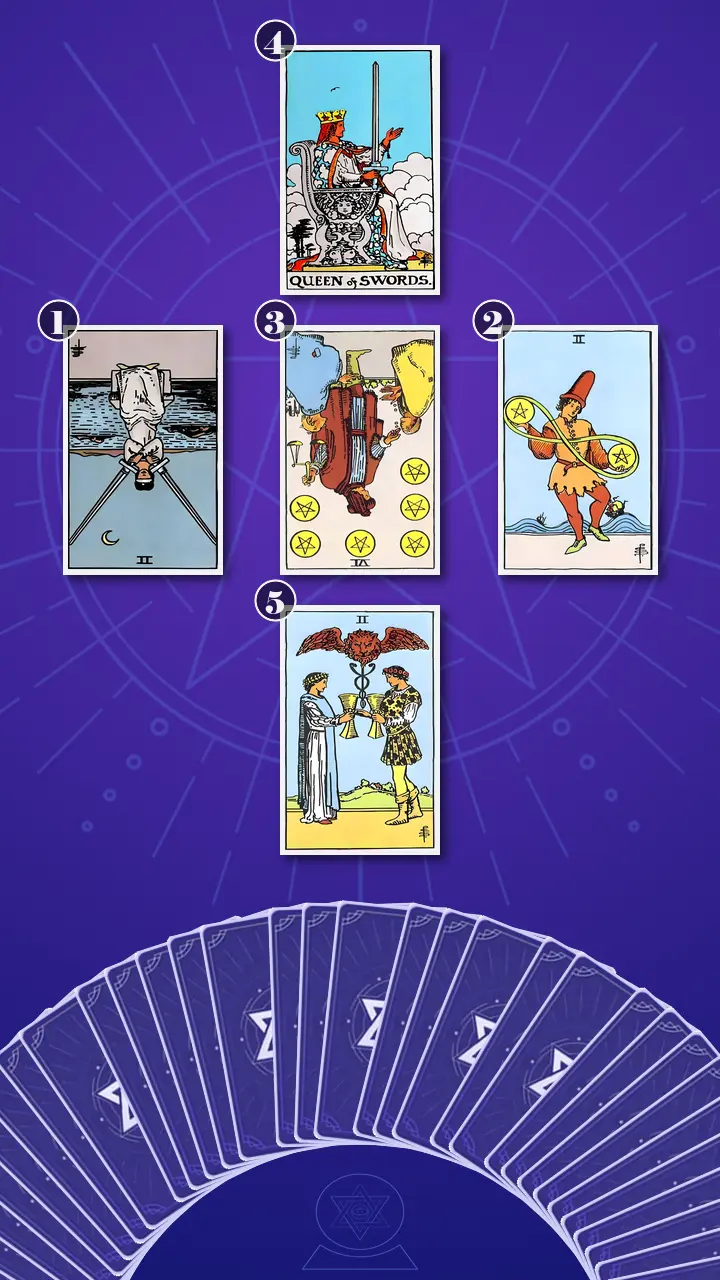
For her question, I chose The Bridge, a five-card relationship spread. This was not a broad life reading, and it did not need the noise of a Celtic Cross. When the issue is a friend texting other people while you’re talking and you want to know how to bring it up without sounding dramatic, the cleanest spread is the one that can hold both viewpoints, the shared dynamic, the message itself, and the relational truth that follows.
This is also how tarot works best in my experience: not as a prediction machine, but as a decision-making tool. Card meanings only come alive in context. The same card that might signal adaptability in a work reading can show split attention in a friendship reading. In The Bridge, the first card would show Jordan’s immediate hurt, the center card would expose the real issue under the issue, and the fourth card — the bridge itself — would show the communication stance most likely to reconnect both sides without self-erasure.
When the Phone Became a Third Presence at the Table
Position One: The Draft-Delete Loop
Now I turned over the card that showed Jordan’s immediate hurt, self-censorship, and the silence she carried home after the hangout. It was the Two of Swords, reversed.
I told her this card could not have been more precise. In modern life, it looks like leaving the cafe outwardly calm and then starting the real conversation alone on the ride home — reopening the chat, deleting “Hey, small thing” three times, replaying the exact pause where someone else’s text cut into your sentence. The energy here is blockage. Air, which should help her say what happened, had turned inward and jammed itself into a loop.
“This is the Notes app cursor blinking at you,” I said. “It is like having twelve browser tabs open and the same one auto-refreshing every thirty seconds. Maybe it was nothing. But why are you still carrying it?”
Jordan gave a brief laugh with a bitter edge. “Okay,” she said, wincing. “That is uncomfortably accurate. I hate that I do exactly that.”
“And that matters,” I told her. “Because playing it cool can cost more than saying the small true thing. This card is not calling you dramatic. It is showing me the price of peacekeeping when it tips into self-erasure.”
Position Two: The Friend’s Visible Pattern, Not a Mind-Reading Story
I turned to the card that reflected her friend’s observable mode of engagement during hangouts, without pretending we could read her mind. It was the Two of Pentacles, upright.
On her friend’s side, I did not see cruelty. I saw modern urban multitasking on reflex: half in the catch-up, half clearing pings from group chats, work, or dating life, as if the phone had become a third presence in the hangout. The energy here is excess motion and partial balance — like low-battery mode for attention, technically still on, but not giving full power anywhere.
That distinction mattered. In a city where everyone’s phone is half social life and half emergency lane, understanding the behavior as habit can feel safer than admitting the impact. But explanation is not the same thing as excuse. “You do not need to argue with imagined motives,” I said. “You only need to name what the camera on the table would have caught.”
Her shoulders dropped a fraction. Relief and annoyance crossed her face at the same time, which is often what truth looks like before it settles.
Position Three: When a Friend on Their Phone During a Hangout Starts to Feel Like Low Priority
Then I turned over the center card, the one revealing the reciprocity issue underneath the surface annoyance. It was the Six of Pentacles, reversed.
This was the weighted hinge of the whole spread. I told Jordan that the reading had now moved beyond phone etiquette. This was about reciprocity. She had brought full bandwidth to the conversation and gotten spotty Wi-Fi back. A small digital habit had started translating into a bigger question: who is actually carrying the signal in this friendship?
That is why feeling low-priority when a friend is on their phone during a hangout can sting so much harder than it looks from the outside. Reversed, the Six of Pentacles shows imbalance in the exchange. Not a dramatic betrayal. Not proof that the friendship means nothing. But enough unevenness that, once Jordan got home, she found herself doing an emotional audit — who planned the hang, who asked follow-up questions, who stayed present, who texted after. The scales had already appeared in her head.
Her reaction came in a sequence I have learned to trust more than quick agreement. First, her breath paused. Then her gaze went slightly unfocused, as if one specific cafe table had returned in full detail — the hiss of the espresso machine, the clink of cups, the glow of a screen. Then she pressed her lips together and said quietly, “I know it sounds small, but it stopped feeling small when I noticed I was giving full attention and getting half back.”
“Exactly,” I said. “This is not about building a case file against a friend. It is about noticing where wanting connection has quietly turned into counting evidence.”
When the Queen Lifted Her Sword
Position Four: The Sentence That Can Cross
The room went very quiet when I turned over the fourth card. This was the bridge itself — the message, the tone, the quality of speech that could reconnect both sides without Jordan abandoning herself.
It was the Queen of Swords, upright.
Jordan was still caught in the same pressure point I see all the time: the after-hangout commute shrinking an entire evening down to one glowing phone screen, one tight throat, one first sentence that never feels perfect enough to send. She was trying to solve a relationship problem entirely inside her head.
You do not have to keep the blindfold on to look easygoing; lift the Queen’s sword, name the behavior plainly, and let clarity cut a bridge back to connection.
I let the sentence sit in the air.
Her body reacted before her logic did. First she went completely still, fingers suspended over the sleeve of her sweater. Then her eyes shifted away from the cards and fixed somewhere past my shoulder, the way people look when six separate memories suddenly line up into one pattern. Then came the emotional release — but not relief at first. It was a flash of anger. “But if it is that simple,” she said, voice thinner and sharper than before, “then what have I been doing? Just sitting there making myself smaller?”
I answered her the way I wish more people were answered in moments like that. “Not smaller for no reason. You built a strategy that kept the hangout moving and protected you from feeling exposed. It was adaptive. It just is not giving you the information you need anymore.”
Something visibly softened. Her jaw unclenched. Her shoulders dropped, slowly, almost cautiously, as if her body did not yet trust how much it was allowed to let go. She took a deep breath, and with it came that strange second feeling that often follows clarity: not only relief, but a faint dizziness. When the fog lifts, the path is easier to see, but it is also yours to walk. Outside my window, a streetcar bell sounded and then faded, and the silence after it felt like a clean cut through static.
My old Wall Street brain always recognizes this card instantly. On a trading floor, the strongest negotiators were never the loudest. They named the live term under dispute, stated their threshold, and stopped overselling. In my work now, I call that Negotiation Alchemy: blending clear BATNA logic with intuitive signaling. Jordan’s BATNA was not to punish her friend or threaten the friendship. It was to leave guesswork. Her minimum acceptable term was simple — basic presence. Her signal needed to match it: steady tone, one fact, one impact, no apology for existing.
In plain modern language, the Queen of Swords is the cleanest possible Slack message: one fact, one impact, no paragraph of cushioning. It is like turning off autocorrect on your need so it stops translating itself into jokes and disclaimers.
“You do not need a flawless case to justify your hurt,” I told her. “One observable behavior and one honest impact are enough. You do not need a courtroom case to ask for basic presence. A clear ask is not the same thing as being high-maintenance.”
“Before this session ends,” I added, “you’re going to write a two-line Bridge Sentence in Notes: when X happens, I feel Y. You do not have to send it today. Practicing it already counts.”
Then I asked, “Now, with this new perspective, think back to last week. Was there a moment when this insight would have made you feel different?”
She nodded almost immediately. “At the cafe,” she said. “I could have just said, ‘Wait — finish this story with me phone-free for one minute?’ Instead I made the joke.”
That was the real turn of the reading: not from hurt to blame, but from swallowed hurt and wording rehearsal to calm candor and grounded self-respect.
Position Five: What Mutuality Would Actually Look Like
The final card showed what healthier mutuality could look like after a clear conversation, and what truth would become visible if the bridge were actually attempted. It was the Two of Cups, upright.
I liked this as an ending because it did not promise perfection. It promised mutuality that could be observed. Two people putting their phones face-down without it becoming a weird power move. A story getting to finish. An apology, an adjustment, or, just as usefully, a clear limit revealed.
The energy here returns to balance. Air gets clean first, and then Water can move again. “Let the conversation measure reciprocity, not your likability,” I said. “Success is not forcing the friendship into harmony. Success is learning whether this bond can meet honest feedback halfway.”
Jordan looked back down at the spread, and this time her expression was steadier. The cards had not told her what her friend secretly meant. They had done something better: they had shown her what was hers to name.
From One Behavior to One Impact
When I laid the five cards back in order, the story was clean. The reading began with a blocked inner loop: hurt swallowed in real time, then rehearsed to death later. It moved through the friend’s visible split attention, then landed on the real wound underneath it — reciprocity. Jordan’s blind spot was that she kept treating clarity like something she had to earn by gathering more proof and better wording, as if her need only counted once it became impossible to criticize. But the transformation direction was the opposite: stop trying to prove you are not too much, and make one direct request for the kind of presence you want.
The bridge was not built out of certainty. It was built out of one clean sentence.
So I gave her a practical framework I use in readings and in real-world communication, a pared-down version of my Cocktail Party Algorithm. In socially delicate moments, I think in three beats: open lightly, name the live issue, then leave space. No over-explaining. No courtroom brief. One behavior. One impact. Then stop.
- Draft the Bridge SentenceThat night, I asked her to open Notes and write exactly two lines: “When we’re hanging out and there are a lot of replies happening, I feel a bit sidelined.” Then read it out loud once in her room and once on a short walk.Set a five-minute timer. If the sentence starts turning into therapist voice or customer-service voice, pause. Natural voice beats perfect voice.
- Use One-Moment, One-ImpactI told her to choose one recent example only and send a low-drama opener that week: “Hey, tiny thing from last time — can I be honest for a sec?” Then name one behavior, name one impact, and stop long enough to let her friend respond.Do not build a backlog case file. One recent moment keeps the conversation grounded and lowers defensiveness on both sides.
- Keep a Phone-Free Minute ReadyBefore the next hangout, I had her pick one in-the-moment line she would actually say if the screen lit up again: “Wait — finish this story with me phone-free for one minute?” Say it once, calmly, then keep going.Treat the response as information, not a verdict. Minimum version: place your own phone face-down first, so your body remembers the kind of presence you are asking for.

A Week Later: The Quiet Proof
Six days later, Jordan sent me a screenshot instead of a spiral. She had used the small opener, named one moment, named the impact, and stopped. Her friend replied with an apology and admitted she had not realized how reflexive the texting had become. At their next coffee, both phones stayed face-down by the sugar jar, and Jordan got to finish her story.
It was not a movie ending. She told me she slept well that night, but the next morning her first thought was still, What if that was too much? Then, in her own words, she laughed at herself a little and got on with her day. That is what grounded self-respect usually looks like at first — clearer, steadier, and still human.
When I think about that reading now, I do not remember a woman learning how to be less needy. I remember a woman learning that her need for presence did not need to disappear just because tension entered the room. That is the real Journey to Clarity the cards offered her.
Sometimes the loneliest part is not the phone on the table — it is the split second your throat tightens and you decide your need for presence is the part that has to go quiet. If I could leave one thing with you from this Bridge spread for friendship communication and reciprocity, it is this: noticing that moment is already a form of self-respect.
So if you did not have to prove you were low-maintenance first, what one clear sentence would you want someone close to hear from you?
Every reading at AceTarot is a Journey to connect with inner wisdom and empower next step.
Learn more about our Journey to Clarity.