A Catch-Up in Checkout Lines, Then One Sentence Changed the Terms

Finding Clarity in the Checkout-Line Catch-Up
If you work hybrid, protect your weekends like gold, and still hear yourself typing “I’m easy :)” when brunch turns into errands, you probably already know low-effort hang resentment better than you want to.
When Jordan (name changed for privacy), a 28-year-old account coordinator from Toronto, sat across from me, she did not arrive with a dramatic betrayal story. She arrived with 2:18 p.m. on a Saturday inside a Shoppers Drug Mart on Queen Street West: fluorescent light flattening everything, detergent and perfume testers in the air, cart wheels clicking over tile while she held someone else’s basket and watched a “catch-up” become a pharmacy stop. She told me, “I do not need a huge gesture, but I do want a hangout to actually be a hangout.”
I could see the whole problem in her body before I finished shuffling. Her jaw kept setting, then releasing. One hand rested over her stomach as if she could untie the knot from the outside. She wanted real quality time and mutual presence, but the second a plan stopped feeling mutual, another fear took over: if she asked for what she actually wanted, would she sound difficult? Her resentment felt to me like a coin held under the tongue—small, metallic, impossible to ignore once it was there.
She looked at me and said the line I hear so often from big-city women who have learned to survive by being easy to fit in: “If I have to ask for basic consideration, does that mean I care more than they do?”
“No,” I told her softly. “It means your body is faster than your politeness. It already knows the difference between being included and being considered. Let’s map that difference together. That’s how we get to clarity.”

Choosing the Compass: A Relationship Spread for Boundary Clarity
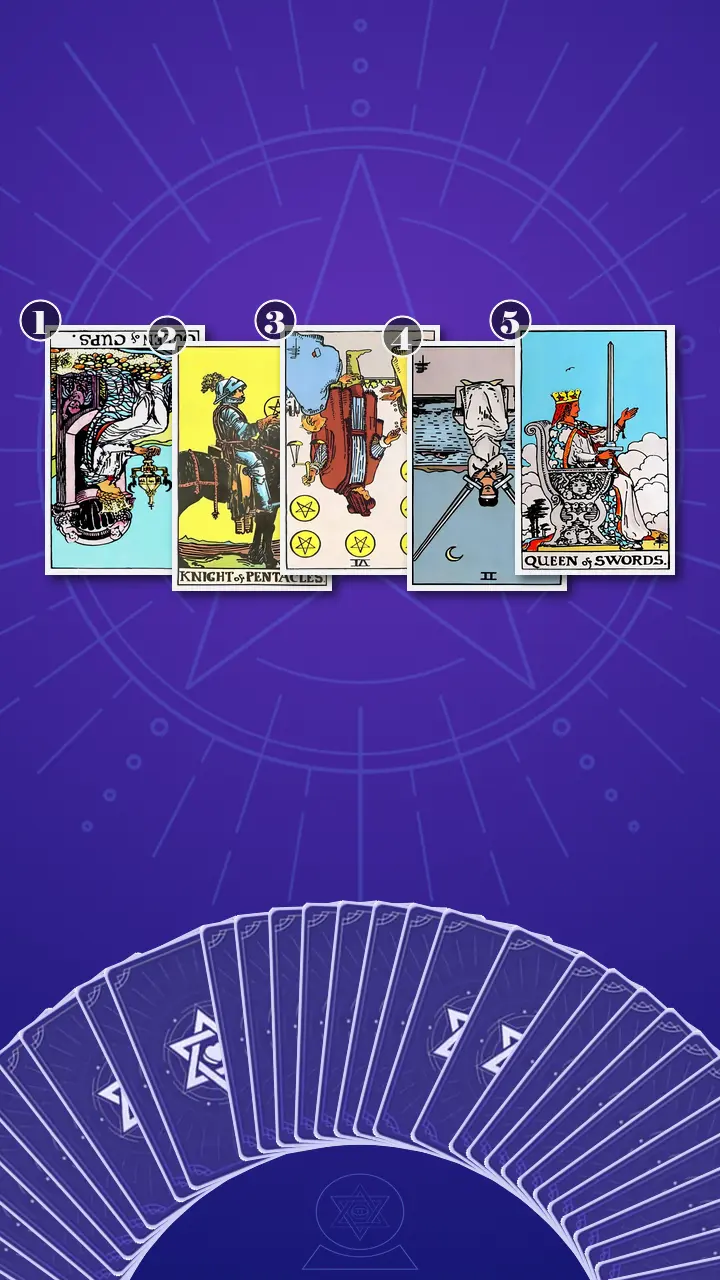
I asked Jordan to take one slower breath and hold the real question in mind: every hang turns into their errand run—what boundary now? Then I shuffled slowly and laid five cards in a straight horizontal line from left to right, the way I do when I want a relationship dynamic to reveal itself without blame, performance, or fantasy.
I chose a classic five-card Relationship Spread because this issue is not mainly about fate or long-range prediction. It is about reciprocity, communication, and how tarot works when card meanings are kept in context. For anyone wondering about the best tarot spread for friendship boundaries or people-pleasing in dating, this is often the cleanest one: self, other, shared pattern, hidden blocker, guidance. It mirrors the actual arc of a low-effort hang resentment problem—what I feel, how they operate, what happens between us, what keeps me silent, and what my next step can be.
I told her what I was looking for before I turned a single card: the first position would show her current stance and the self-silencing already draining her; the center card would name the active pattern between them; the fourth would reveal the blind spot that turns one honest sentence into a whole mental saga; and the final card would point to the healthiest boundary now.
Reading the Route Instead of the Excuse
The Covered Cup
I turned the first card for the position that presents Jordan’s current relational stance, including the self-silencing and over-accommodating behavior already in motion. The card was the Queen of Cups, reversed.
I told her this was the exact energy of seeing the plan drift in the iMessage thread, feeling disappointed immediately, and still replying with warmth: “Whatever works,” “haha totally,” “I’m easy.” Later, on the TTC ride home, the whole hang replays on loop and something that looked harmless leaves you feeling weirdly small. The lidded cup matters here. The feeling is real, deep, and already known—but kept covered so nobody else has to deal with it.
Energetically, I read this as care in excess and boundaries in deficiency. Too much attunement to the vibe, too little permission to protect your own preference. I asked her, “When the last invite started sliding into ‘one quick stop’ territory, what did you want to say before you talked yourself out of it?”
She let out a short laugh with a bitter edge. “That’s brutal,” she said, then shook her head. “But yeah. I always know early.” Her thumb moved once around the rim of her cup, and I felt the first layer of self-doubt loosen.
The Still Horse
Next I opened the card for the other person’s mode of engagement in the situation, specifically the convenience-led, task-oriented style that turns social time into errands. The card was the Knight of Pentacles, upright.
I never villainize this Knight too quickly. In modern life, this is the person whose default mode is task-first: pharmacy stop, return, groceries, maybe coffee if time allows. Their routine can look dependable, even caring in its own practical way, but it does not automatically separate efficient time from emotionally present time. The still black horse tells me a lot: steady, useful, organized—yet not especially active in relational presence unless somebody names the difference.
This is balanced earth, but it is narrow earth. Plenty of follow-through. Very little spontaneous emotional prioritizing. I said, “They may genuinely think they’re including you. But being folded into their route is not the same thing as being chosen for mutual time.” Jordan nodded, slower this time, less hurt and more awake.
The Tilted Scales at the Center
Then I turned the center card, the position that names the lived pattern between them and binds the issue to the real-world experience of uneven reciprocity. It was the Six of Pentacles, reversed.
This was the thesis card, so I said that aloud. One person’s errands set the route, timing, pace, and purpose; Jordan supplies the flexibility, companionship, and emotional ease. She clears her afternoon, but the plan is structured around what the other person needs done. On the surface, nothing terrible is happening. Underneath, the terms are uneven from the start. It is the exact feeling of standing under fluorescent lights, holding the basket, thinking, “Nothing awful is happening, so why do I feel so off?”
The reversed scales make the imbalance visible. Not cruelty. Structure. Whose time, comfort, and agenda are setting the terms of this hang? That is the real question. Being included isn’t the same as being considered. Low-effort hangs create high-effort resentment.
Jordan’s reaction came in a clean three-step sequence that I have learned to trust. First her breath paused. Then her eyes lost focus for a second, as if she were replaying three separate Saturdays at once. Then her shoulders dropped with a hard exhale. “Yes,” she said quietly. “That’s exactly it. I feel like an add-on, and then I gaslight myself because nobody did anything technically mean.”
The Blindfold That Already Knows
After that, I opened the fourth card, the position that reveals the hidden blocker—especially the fear of seeming difficult and the mental stalemate that keeps the boundary unspoken. The card was the Two of Swords, reversed.
I told her this is the draft-delete card. You know the truth before you send the reply; the whole struggle is that saying it feels socially expensive. It is the blinking cursor in a text box when you already know the sentence, but your mind starts leaving twenty-seven browser tabs open: tone, fairness, timing, whether you need a stronger example, whether “normal people” would just go with it. The blindfold is perfect here. She is not missing the truth. She is delaying the sentence that would make the truth visible.
Energetically, this is blocked air. Not confusion—postponed clarity. Years ago, training intuition on transatlantic cruises, I learned something simple: people get more upset from vague instructions than from clear ones. The same is true in relationships. I call the correction Social Role Switching. Jordan has been defaulting to Supportive Mode—the mode for soothing, accommodating, smoothing over. But this moment does not need Supportive Mode. It needs Assertive Mode: calm tone, clear terms, no novella. Say the headline before you build the whole case.
She pressed her lips together and stared at the card. “I literally have Notes app drafts,” she said. “Plural.” The admission came with a tiny wince and a half-smile, the exact look people get when they feel uncomfortably but accurately seen. I answered, “Good. That means the boundary already exists. We are not inventing it. We are interrupting the delay.”
I reminded her that this is why the text thread matters so much. The plan is still only text there. Which means the pattern is still interruptible there. Awkward now is often cheaper than resentment later.
When the Queen Raised Her Sword
The One-Line Boundary
By the time I reached the final card, the room had gone unusually still. Even the traffic below my window softened into a low hush, and the radiator clicked once with a silver little sound that felt almost like punctuation. This last position points to the healthiest boundary now—the response that turns implied hope into explicit terms. The card was the Queen of Swords, upright.
I love this Queen because she is not cold; she is precise. In modern systems language, she is the difference between a paragraph-long text that manages everybody’s feelings and a clean Slack message that actually says what is needed. Jordan’s split screen was obvious to me: on the left, the old script—“haha totally, no worries, whatever works, I don’t mind”; on the right, the actual boundary-first reply—“I’d love to meet when we can actually catch up, but I’m going to skip errand hangs.” Kindness versus vagueness, not kindness versus harshness.
Energetically, this is balanced air: discernment, self-respect, and concise honesty. The raised sword and open hand say the same thing together—firm meaning, fair delivery. And because of my own old life on ships, I felt the metaphor instantly. Onboard, we never gave boarding instructions in the wrong mode. Warmth mattered, yes, but clarity kept people from ending up on the wrong deck. Boundaries work like that too. Wrong mode creates drift. Right mode creates direction.
Stop proving you are easygoing by swallowing your irritation; name the kind of time you want and let the Queen's raised sword separate real connection from someone else's to-do list.
I let the sentence breathe in the room.
At first Jordan did not look relieved. She looked angry. “But if I say that,” she said, her voice tightening, “then I have to find out whether they actually want me there—or whether they just want company while they do stuff.”
That was the real setup, and I named it gently. Her phone lights up with a plan that sounds like a catch-up, her stomach drops before she has even replied, and some part of her already knows this is about to become somebody else’s Saturday route. The old pattern promises safety through vagueness. But vagueness has been expensive.
“Yes,” I said. “And that’s why this card is an antidote.”
Then I gave her the quieter truth underneath the whole reading. “You do not need a more dramatic offense to justify a clearer limit. If the time only works when your needs stay vague, the pattern is already clear enough.”
She went through it in layers. First came a tiny physical freeze; even her fingers stopped moving. Then the cognition landed, and her gaze slipped past me toward the rain-marked window as if she were replaying the exact lunch-break draft she had typed and deleted under office fluorescents. Then came the release. Her mouth opened, closed, and opened again. Her eyes shone—not fully with tears, more with that sting people get when something names them exactly. I watched the tension leave her shoulders so quickly it almost looked disorienting, the faint sway that comes when you set down a bag you forgot you were carrying. “So I’m not overreacting,” she said, very softly. “I’m under-saying it.”
“Exactly,” I told her. “This is the shift from self-silencing resentment to self-respecting clarity. Not hardness. Not drama. Just truth with structure.”
I asked, “With this new lens, can you think of a moment last week when this would have changed how you felt?”
She laughed then, but this time the sound was clean. “Tuesday,” she said immediately. “If I had just sent, ‘I’m up for coffee and catching up, not tagging along on errands,’ I would not have spent the whole TTC ride home doing a post-mortem on my own tone.”
From Low-Effort Hang Resentment to a Clean Sentence
When I read the whole spread as one story, the logic was sharp. Jordan begins in the Queen of Cups reversed: caring, perceptive, already aware, but using that awareness to protect the mood instead of protect her preference. Across from her sits the Knight of Pentacles: not necessarily cruel, just convenience-led, task-first, routine-based. In the center, the Six of Pentacles reversed reveals the real structure: her time bends, their route leads. Then the Two of Swords reversed shows the choke point—she is not unclear about what feels bad; she is treating one clean sentence like a major social event. The Queen of Swords resolves the whole corridor by naming the terms before resentment has to keep doing the talking.
I pointed out the blind spot directly. She had been assuming she needed a courtroom case before she could ask for a basic standard. She did not. The transformation direction was much simpler: move from hoping they infer what quality time means to stating the kind of hang you are actually available for. Kind doesn’t have to mean available for whatever.
Then I gave her a framework from my cruise years that she immediately grinned at. I call it Maritime Social Protocol. Before anyone boards a social plan, name the route, the purpose, and your exit point. In everyday language, that means we stop boarding vague invitations and then resenting the destination.
The Maritime Social Protocol
- The Actual Catch-Up Script Before the next invite locks in, send one preference sentence by text: “I’d love to meet when we can actually catch up, but I’m going to skip errand hangs.” Use it with the next friend or date whose message already sounds convenience-first. If it feels too sharp, write it in your Notes app and leave it unsent for one hour. The goal is a clean sentence, not perfect courage.
- The Errand-or-Hang Check When someone says, “Come with me while I...,” ask one clarifying question: “Are we actually hanging out, or are you doing errands and I can join if that works for me?” Use it before you leave home, especially when your weekend already lives in tight Google Calendar blocks. Keep it short. Naming the structure is not accusing anyone of being bad; it is simply making the terms visible.
- The After-This-Stop Exit If the outing is already underway, switch into Assertive Mode in real time: make eye contact, slow your speech, and say, “I’m going to head out after this stop.” Use it after the first pharmacy, grocery run, or pickup instead of losing the whole afternoon. Put your end time in your phone calendar before you leave. Small exits teach your nervous system that boundaries can be ordinary.

A Week Later: The Quiet Proof
Five days later, I got a screenshot from Jordan. The invite read, “Want to catch up Saturday? I just need to do one quick return first.” Her reply was pure Queen of Swords—one line, no apology spiral: “I’m up for meeting when we can actually catch up, but I’m going to pass on errand hangs.” A minute later came the answer: “Fair. Coffee Sunday?”
The plan got clearer; she slept a full night, then woke with the old thought—What if that was rude?—and smiled into her pillow because, for once, the fear was still there but it was not driving.
I sat with that message for a moment and felt the quiet satisfaction I always feel when tarot does what it does best. Not fortune-telling. Pattern-telling. This five-card Relationship Spread for friendship or dating boundary clarity had moved her from sounding chill in the moment and resentful later to something steadier: clear without being harsh, self-respect without over-explaining.
When you're smiling in the checkout line with your jaw locked, trying to be low-maintenance while your stomach quietly tells you this is not actually time together, the hardest part is wondering whether asking for more would make you harder to keep.
If you stopped hoping they would guess what quality time means, what one simple sentence would make your next yes feel more like you?