From Daily Text Pressure to Honest Pacing in a New Friendship

The 6:18 p.m. Streetcar Spiral of Daily Texting Pressure
When Jordan (name changed for privacy), a 28-year-old marketing coordinator in Toronto, sat down with me, I recognized a pattern I see constantly in people whose nervous systems spend the day inside Slack, email, and campaign timelines: they are warm in person, then start editing themselves the second a friendship becomes daily on-screen.
They gave me the scene immediately. It was 6:18 p.m. on a Tuesday on the 504 King streetcar heading west after work. The brakes screeched at every stop, the fluorescent strip lights buzzed against the fogged window, their coat was still winter-damp at the sleeves, and their phone felt too warm in their palm. A new text from a friend they genuinely liked lit up the screen. Jordan read it in the notification preview, locked the phone, unlocked it two stops later, typed three versions, deleted the warmest one, and sent the driest reply.
‘I like them,’ they said, rubbing one thumb over the edge of the phone case. ‘I just don’t want this to become a thing I owe every day.’
That was the heart of it: wanting consistency with a new friend, yet feeling pressure from daily texts as if every reply were a tiny auto-renew contract sliding under the door. It was the exact problem people summarize as ‘new friend texts every day and I feel pressure,’ and the exact late-night search behind questions like why do daily texts make me anxious even when I like the person. The tension lived visibly in their body — shoulders pulled high, breath skimming the top of the lungs, that small elevator-drop in the stomach every time the screen lit up. It was less like simple anxiety and more like trying to review terms and conditions while the train was moving.
I told them gently, ‘Nothing about this makes you cold. Your system is reading one kind message like an assignment because it thinks closeness might be decided for you before you get a say.’ Then I placed the deck between us and said, ‘Let’s draw a map through that fog. We’re not here to judge the friendship. We’re here to understand why daily texting pressure has started to feel bigger than the text itself.’

Choosing the Compass: The Shadow Spread for Friendship Texting Anxiety
I asked Jordan to put their phone face down, take one slow breath, and hold only one question in mind: ‘Why does steady contact feel like pressure, even when I like the person?’ Then I shuffled. I have never cared for empty theatrics; the ritual matters because it helps the body cross from reaction into observation.
For this kind of question, I use The Shadow Spread — a four-card tarot spread for hidden relationship patterns. As a Jungian psychologist, I love this layout because it does not waste time predicting what the other person ‘really means.’ It shows me how tarot works at its most practical: card meanings in context, arranged to reveal the logic underneath the stuck feeling.
This spread was perfect for Jordan because the real issue was not whether the new friend was too much. The real issue was response paralysis around a new friend’s messages: first the visible symptom, then the fear underneath it, then the boundary wisdom inside the fear, and finally the small action that turns insight into something livable. In other words: reaction, shadow, truth, integration.
I told Jordan what I was watching for as I laid the cards left to right. The first card would show why a normal text currently lands like a burden. The second would reveal the fear about closeness, obligation, and loss of control. The third — the hinge card, and the most important today — would name the healthier boundary truth. The fourth would bring us back to everyday behavior and show the next steps toward finding clarity.
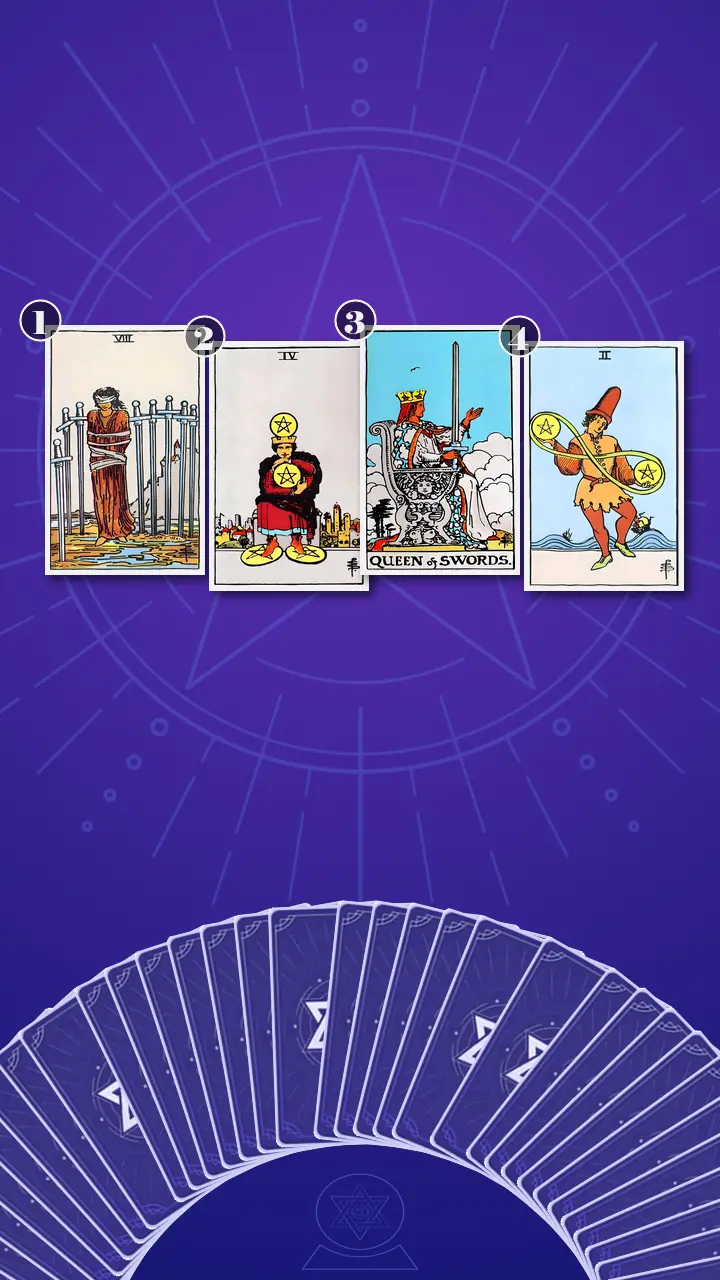
Reading the Contraction Cluster
Position One: The Text That Feels Like Terms and Conditions
I turned over the first card and said, ‘Now we’re looking at the card that shows the visible symptom — why a daily text lands as pressure instead of simple connection.’ It was the Eight of Swords, upright.
I know this card well. It is trapped Air: thought turned into enclosure. In Jordan’s life, it looked exactly like that Tuesday streetcar spiral — seeing a friendly message during the commute home and reacting less like a person in conversation than like someone negotiating a contract. Read the preview. Don’t open it yet. Draft three versions. Delay until the reply sounds neutral enough not to set future expectations. It was, as I told them, very Black Mirror: one normal text turned into a terms-of-service screen their nervous system thought needed legal review.
The blindfold mattered. So did the loose bindings. So did the ring of swords. Jordan was feeling trapped by rules that had never actually been spoken. The choice was still there, but panic had narrowed the corridor. I told them, ‘A daily text becomes pressure the moment it starts feeling like a contract.’
Jordan let out a short laugh that carried more wince than humor. ‘Wow,’ they said. ‘That is accurate enough to feel a little rude.’ Their hand froze halfway to the tea mug, then settled back down. That was the first sign of recognition I wanted: not shame, just the sharp click of pattern meeting language.
Position Two: Guarding the Last 12 Percent
I turned the second card. ‘This one reveals the hidden shadow — the fear about closeness, obligation, and loss of control underneath the reaction.’ The Four of Pentacles, upright.
This card showed me rigid Earth: protection turning into bracing. After a full day of Slack pings, client messages, and email follow-ups, Jordan was treating time, attention, and emotional warmth like the last 12 percent of a phone battery. A daily text felt threatening not because the friend was objectively demanding, but because Jordan assumed a natural reply might quietly open an always-on lane. Through my Cross-cultural Decoding lens, I could see them carrying workplace reachability rules into a friendship: every ping meant action, every pause needed management. So they rationed warmth, slowed access, and called it timing.
As I looked at the figure holding the pentacle tight against the chest, I had one of those quick inner flashes that still come from my years training intuition on cruise ships. At sea, repeated proximity makes people invent social contracts that do not exist: breakfast twice in a row becomes ‘we’re attached now,’ a kind conversation on deck becomes ‘I owe more access.’ I learned early that repetition is not the same as agreement. I looked back at Jordan and said the line they most needed: ‘Warmth and access are not the same thing.’
Their jaw tightened first. Then their gaze drifted off the cards as if replaying a dozen after-work notifications. Then came the exhale — slow, quiet, almost embarrassed. ‘Control,’ they said finally, answering the question I had not yet needed to ask. ‘If I reply naturally, I feel like I lose control of how fast this gets close.’ Once they said it aloud, the defensiveness stopped looking random. It looked protective.
When the Queen Lifted Her Sword: Finding Clarity
Position Three: The Boundary Truth That Changes the Whole Story
When I turned the third card, the room altered. A ribbon of late light slid across the table and caught the blade first, as if the card wanted its own entrance. ‘This,’ I said, ‘is the card that names the healthier boundary principle — the wisdom inside the shadow.’ It was the Queen of Swords, upright.
Her energy was clean Air, but not the trapped kind from the Eight. This was discernment. Directness. Self-respect. In real life, she looked like Jordan stopping the draft-delete-delay cycle and saying something simple and true: ‘I like hearing from you — I’m just not always a daily texter, but I do want to stay in touch.’ That was the answer to the question underneath the whole reading: how to say I’m not a daily texter without sounding rude. The upright sword was the sentence. The open hand was the warmth.
This is where I used one of my own diagnostic lenses, something I call Social Role Switching. Most people in Jordan’s position think only two modes exist: fully available and soft, or distant and hard to reach. The Queen of Swords rejects that false binary. She blends Supportive Mode with Assertive Mode. On crowded ships, I watched the people with the healthiest boundaries do exactly this: they stayed kind without turning themselves into public property. Jordan did not need a colder personality. They needed a cleaner mode.
I asked them to picture that 6:18 p.m. streetcar ride again — phone in hand, brakes shrieking, work still buzzing in the body, one perfectly nice message somehow feeling heavier than the laptop in the tote bag. They were still trying to answer the wrong question: not ‘What is true for me?’ but ‘How do I avoid creating the wrong impression?’
Daily texts are not chains; let the Queen's upright sword cut imagined obligation away so honest pacing can replace silent management.
Jordan’s whole body reacted in three clear beats. First, stillness: their fingers stopped moving, and even their breath paused halfway in the chest. Then the thought landed deeper; their eyes lost focus for a second, as if they were replaying last Tuesday frame by frame and noticing how much energy had gone into managing a precedent that no one had asked for. Then came the release, but it was layered. Their shoulders dropped. Their mouth opened slightly. Their eyes went bright, not quite tears, more the sting that comes when relief and self-recognition arrive together. And then, almost immediately, vulnerability followed the relief. ‘But if I say that,’ they asked me, voice lower now, ‘doesn’t it sound like I’m pushing them away?’
‘No,’ I said. ‘It sounds like an adult making the rules of access visible instead of hoping the other person guesses them. You don’t have to earn space by being hard to reach.’
I let that sit between us for a moment. Then I asked, ‘Now, with this new perspective, think back to last week. Was there a moment this would have changed how you felt?’ Jordan nodded immediately. ‘Tuesday on the streetcar,’ they said. ‘I could have just told them I like hearing from them, but I’m wiped after work and slow on text sometimes. That would have felt more honest than... whatever performance I was doing.’ That was the real shift, the one I trust most in readings like this: from contract-like vigilance around every text to boundary-led ease with sustainable contact.
Position Four: The Rhythm That Makes Closeness Livable
I turned the last card. ‘This one points to the small actionable shift that turns delayed management into sustainable, honest contact.’ The Two of Pentacles, upright.
Here the energy changed again. Earth was still present, but now it was flexible instead of clenched. I translated it for Jordan in plain terms: this is not about deciding whether you are a ‘slow texter’ forever or whether this friendship must become daily. It is about building a rhythm that fits real life. Fuller replies on a lunch walk. A short bridge message on a slammed day. A voice note on the way home instead of a perfect paragraph at 11:41 p.m. in bed.
The figure in the card balances two pentacles inside an infinity loop while ships rise and fall behind them. That is exactly what sustainable contact looks like. Not no movement. Not total access. Movement with balance. I told Jordan, ‘Consistency is information, not a demand.’ Their face softened in a way it had not at the beginning. Not total certainty — that would have been too neat — but the grounded look people get when change starts to feel doable instead of theoretical.
From Contract to Rhythm: Actionable Next Steps
Once all four cards were on the table, the story was unmistakable. Jordan’s nervous system was translating emotion into logistics. A kind message arrived, work-burnout made it feel heavier, fear of losing control tightened around it, and timing became a substitute for truth. The blind spot was not that Jordan needed more analysis. It was that they were using delay, cooler tone, and rationed warmth to do the job of an honest boundary. The transformation direction was simple, but not always easy: stop silently managing the pace and start naming the pace that is actually sustainable.
I summarized it as clearly as I could: ‘Clearer pacing works better than colder replies.’ Then I reached for one of my favorite intervention tools, what I call Maritime Social Protocol. Years on transoceanic decks taught me that social overwhelm eases when you use three clean moves: send a warm signal, name the boundary, and offer a realistic re-entry point. It works just as well in modern friendships as it did on crowded ships.
- Boundary-First ReplyTonight, open your Notes app and draft one sentence for this specific friend: ‘I like hearing from you — I’m not always a daily texter, but I do want to stay in touch.’ Read it out loud once while walking home or making tea. The next time they text, reply normally first and add that line instead of delaying for hours.In my Ready-to-use Scripts, this is Supportive Mode plus Assertive Mode in one sentence. If you start over-explaining, cut the message in half.
- Capacity Window TextingChoose one or two realistic reply windows for this week — for example, Wednesday lunch walk and Friday after dinner — and turn off notification previews or use Focus Mode for this thread after work. If the friend texts outside those windows, use one bridge line like ‘Busy day here, but I’ll reply later tonight’ or ‘I’m slow on text sometimes, but I’m here.’These windows are support rails, not rules. If you miss one, reset without guilt. Sustainable contact matters more than instant consistency.
- The 15-Second Notification CheckFor the next three notifications from this person, pause before opening the thread. Drop your shoulders, unclench your jaw, and ask two fast questions: ‘Do I have capacity right now?’ and ‘Am I reacting to this text, or to the precedent I think it creates?’ If the answer is ‘not now,’ set a reminder for later that day instead of promising yourself you’ll remember.This is not a deep ritual. It is a pattern interrupt. One word is enough: pressure, guilt, interest, or not now.

A Week Later: The Quiet Proof
A week later, Jordan sent me a message just after lunch. No spiral, no essay — just a screenshot of a text they had sent and a second line beneath it: ‘I used the script. They were completely fine. We’re doing coffee on Ossington this weekend instead of texting all day.’ Then, after a beat, another message: ‘I still woke up this morning thinking, what if that sounded rude? But I laughed this time.’ That was enough. Clear but still a little tender. Exactly right.
That is what I mean by a Journey to Clarity. Not becoming endlessly available. Not solving friendship texting anxiety by force. Just moving from silent management into honest pacing, from feeling stuck in response paralysis to texting boundaries without sounding rude — warmth without constant access. This is why I trust The Shadow Spread so much when people ask me why daily texts make them anxious even when they like the person: it shows where the private contract lives, and it shows how to put it down.
When your phone lights up and your shoulders tense over one kind message, the ache is often not the text itself — it’s the fear that closeness will be decided for you before you get to choose it. If this story felt uncomfortably familiar, let that recognition be gentle, not damning.
If you didn’t have to manage this connection silently, what one honest sentence about your pace would feel most like you?