The Morning My Boss Was CC'd Again—And I Stopped Writing Evidence
The CC Line That Hits Before Coffee
If you read the CC line before you read the email—and your jaw clenches when you see your boss’s name—this is that kind of workplace triangulation.
Jordan (name changed for privacy) sat across from me on a video call, Toronto morning light turning her condo kitchen a little too honest. I could hear the kettle click off in the background; the counter looked cold under her forearms where she leaned in like she was bracing for impact.
“It’s the same person,” she said, voice careful in that way people get when they’re trying to sound reasonable while their nervous system is doing something else. “My work friend keeps CCing our boss. And it’s not even escalation-worthy stuff. It’s… coordination. But the second I see my boss on CC, I’m not reading the ask anymore. I’m reading the implication.”
Her hand went to her face without thinking—thumb at her jaw. “I draft three versions in Notes. I reread for tone. I add context I shouldn’t have to add. I’m not trying to start drama, I just want it to stop. But if I set a boundary, will it look like I’m hiding something?”
The defensiveness wasn’t an abstract feeling—it sat in her like a mouthguard she couldn’t take out: jaw tight, stomach clenched, every email notification treated like a social threat.
I nodded slowly. “CC changes the room—and you’re allowed to have rules for the room. Let’s make this practical. Today isn’t about ‘winning’ against a coworker. It’s about finding clarity: what boundary protects your work and your reputation without turning your inbox into a courtroom.”

Choosing the Compass: The Celtic Cross · Context Edition
I asked Jordan to take one breath where she could feel it—down into her ribs, not up in her throat. While she did, I shuffled, not as a mystical performance, but as a way to let the question become a single point instead of a hundred buzzing tabs: What boundary do I set when my coworker keeps CCing my boss?
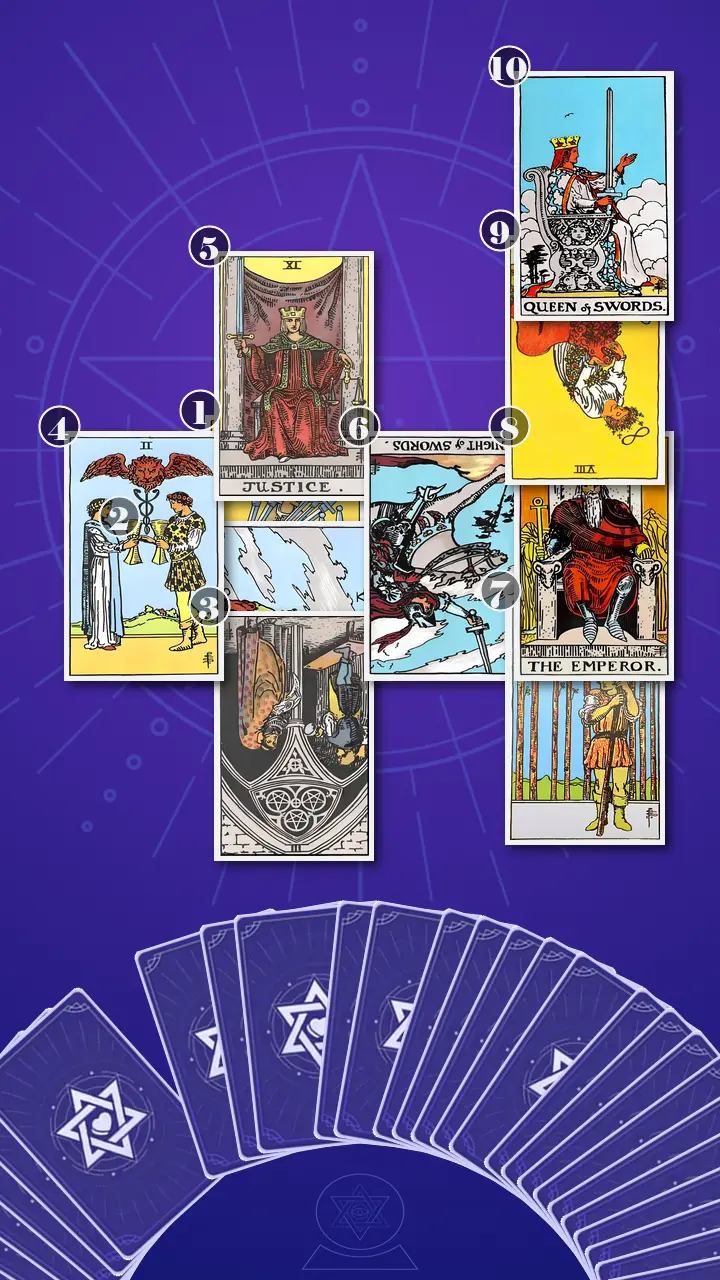
“I’m going to use the Celtic Cross · Context Edition,” I told her. And for you reading this: this spread works when the issue isn’t a simple yes/no. A CC habit can look small, but it’s layered—perception, power, trust, and communication defaults. This layout maps the surface trigger (the boss on CC) to the deeper system that keeps the pattern alive, then aims toward a sustainable boundary.
I previewed the structure so she’d know we weren’t wandering: “The first card shows the observable problem in the thread. Another card crosses it—what makes it hard to address cleanly. We’ll drop to the root cause underneath the emails. And the final outcome here isn’t ‘fate’—it’s the best-aligned boundary stance if you engage consciously.”
Reading the Map: When Emails Become a Stage
Position 1: The observable problem in the thread
“Now we turn over the card representing the observable problem in the thread: what the CC’ing behavior is doing to your sense of safety and clarity at work.”
Seven of Swords, upright.
I didn’t have to reach far to translate it into her life. “This is you opening a routine coordination email and instantly feeling the vibe shift because your boss is CC’d—like the message isn’t just about the task anymore, it’s about positioning. You start tracking phrasing and timelines the way you’d track evidence, because you don’t trust the conversation to stay peer-level.”
The Seven of Swords is Air running in excess: strategy, indirectness, and that backward-glance energy of ‘who’s watching?’ It keeps you scanning for subtext instead of staying with the work.
I leaned in. “What’s the exact moment you feel the spike—seeing the CC line, reading the wording, or imagining your boss’s interpretation?”
Jordan gave a small laugh—short, sharp, almost embarrassed. “Seeing the CC. It’s instant. Like… it’s not even about what they’re asking. It’s about what story they’re telling about me in the thread.”
Position 2: The main friction point (crossing energy)
“Now we turn over the card representing the main friction point: what makes this hard to address cleanly.”
Five of Swords, upright.
“The CC turns the thread into a reputational contest,” I said. “You can feel yourself wanting to ‘win’ with a technically correct but slightly sharp reply. Even imagining that reply makes you feel isolated afterward—like you defended yourself but lost the relationship.”
This is Air in excess again—win/lose thinking. The card’s lesson is brutal and useful: you can be right and still pay for it socially. That’s why your body is treating a normal email like a trial.
I watched her blink hard once. Her shoulders rose, then didn’t quite drop. “And I don’t want to make an enemy at work,” she said, quieter. “But I also don’t want to keep letting this happen.”
“That’s the bind,” I said. “Are you trying to solve the work—or trying to survive being perceived?”
Position 3: The root driver underneath the emails
“Now we turn over the card representing the root driver underneath the emails: the hidden belief or system issue that keeps the CC pattern alive.”
Three of Pentacles, reversed.
I let my tone intentionally shift from emotion to process. “The real root isn’t just personality—it’s workflow. There’s no agreed system for drafts vs. decisions, so people use CC’ing as a stand-in for structure. Without a clear ‘who decides what,’ your coworker loops the boss in early to feel safer, and you over-document to avoid being misrepresented.”
Earth energy here is in deficiency: missing blueprint, missing shared standards. This is the ‘doc with six versions named FINAL_final_v3’ problem. When the process is unclear, visibility becomes the substitute for alignment.
Jordan’s face changed—less armored, more tired. “So I’m not crazy,” she said. “It’s not just… me being sensitive.”
“Exactly,” I replied. “If the workflow is unclear, people use visibility as structure. That doesn’t make the CC feel good—but it means you can fix this like an adult system issue, not a character issue.”
Position 4: What the relationship used to be
“Now we turn over the card representing what the relationship used to be: the prior tone that makes the current behavior feel like a betrayal.”
Two of Cups, upright.
“This used to feel like a real work friendship—quick DMs, mutual help, a sense of ‘we’ve got each other,’” I said. “That history is why the CC shift hits like betrayal. We used to talk to each other. Now we talk around each other.”
The Two of Cups is relational energy in balance. It’s the baseline you remember—peer-to-peer first, escalation second. No wonder the current dynamic feels like someone quietly moved the conversation from a 1:1 DM into a public channel where the audience matters more than the work.
Jordan swallowed. Her eyes slid away from the camera for a second, like she was replaying a specific Slack thread. “It did feel like we were allies,” she admitted. “And now it feels… cold.”
Position 5: Your desired boundary principle
“Now we turn over the card representing your desired boundary principle: the standard you want to set that is fair, professional, and self-respecting.”
Justice, upright.
“This isn’t a vibe check,” I said, tapping the image of the scales and sword with my finger. “It’s an escalation policy.”
Justice is structured Air in balance: fair standard + clear wording. “This is you stopping, in real time, the obsession with ‘Do they think I’m difficult?’ and shifting to ‘What is a fair escalation rule for this team?’ You write a one-sentence standard: what stays between collaborators first, and what genuinely requires your boss.”
I had a quick flashback—years ago on a transoceanic cruise, watching a guest spiral because a tiny misunderstanding turned public at the captain’s reception. The fix was never more explanation. It was always protocol: who says what, where, and in what room. The sea taught people what offices forget: structure keeps emotions from capsizing.
Jordan nodded—one of those nods that isn’t agreement yet, but relief at a shape forming.
Position 6: The next communication risk point
“Now we turn over the card representing the next communication risk point: how this could escalate if you respond on autopilot (or how to avoid escalation).”
Knight of Swords, reversed.
“Another CC thread lands and your adrenaline writes the email: fast, sharp, and then increasingly defensive as you try to correct the record,” I said. “The risk isn’t that you’re wrong—it’s that speed makes you sound combative or overly legalistic, which invites more oversight and more CC’ing.”
This is Air in blockage: momentum without direction. The charging posture becomes ‘hovering over Send’ urgency. And here’s the line I gave her, plain and dry: “Longer isn’t safer. Clearer is safer.”
Jordan exhaled like she’d been holding her breath since Monday. “I do that,” she said. “I write receipts emails. And then I’m exhausted.”
Position 7: Your stance and bandwidth
“Now we turn over the card representing your stance and bandwidth: how you’re showing up and what you can realistically hold.”
Nine of Wands, upright.
“You’re still doing your job, but you’re braced—opening threads already tense, expecting another boundary cross,” I said. “You’ve built an internal fence—screenshots, drafts, careful tone—but you’re tired of living behind it.”
This is fire-and-willpower in excess: resilience that’s starting to harden into hyper-vigilance. The card isn’t scolding you. It’s naming the cost of staying in defense mode all day.
Jordan’s fingers rubbed her thumb knuckle, tiny repetitive motion. “I’m exhausted,” she said, simply. “I hate that an email can do this to me.”
Position 8: The power structure around you
“Now we turn over the card representing the power structure around you: what the boss and workplace hierarchy represent in this dynamic.”
The Emperor, upright.
“Your boss’s CC isn’t neutral,” I said. “It changes the hierarchy in the room. In this environment, authority responds best to structure and scope—not interpersonal nuance. Your boundary will land better framed as process (‘when we escalate’) than as complaint (‘how it makes me feel’).”
The Emperor is stabilizing energy in balance, but it can feel heavy when you’re early in your career: stone throne, clear chain of command, rules you can’t pretend aren’t there.
I smiled a little, because this is where my old life always shows up. “On a cruise ship, there are rooms you can be casual in, and rooms you can’t. When the captain enters, the room changes. That’s not personal—it’s protocol. Maritime social protocol says: if the room changes, you change your stance on purpose, not in panic.”
Jordan’s eyes widened. “That’s… exactly what it feels like. Like the captain just walked in.”
Position 9: The emotional double-bind
“Now we turn over the card representing the emotional double-bind: what you hope will happen and what you fear will happen if you set a boundary.”
Strength, reversed.
“You rehearse the direct conversation in your head, then in real life you smile and keep it light because you’re afraid of looking ‘too intense,’” I said. “You don’t fully trust yourself to be firm without spiraling into apology or snapping—so the boundary keeps getting postponed until resentment builds.”
This is inner steadiness in deficiency. Not because you’re weak—because you’re trying to control the lion by pretending it isn’t there. The lion here is legitimate anger and self-protection.
Jordan’s voice got small. “I’m scared it’ll make me look guilty,” she said. “Like… why would I care unless I did something wrong?”
“That fear makes sense,” I replied. “But a boundary isn’t a defense. It’s a scope decision.”
When the Queen of Swords Cut Through the CC Theatre
When I reached for the final card, the room got quiet in that particular way video calls do—when you can hear your own breathing for a second.
Position 10: Best-aligned boundary integration
“Now we turn over the card representing best-aligned boundary integration: the most sustainable way to communicate and protect your work without becoming combative.”
Queen of Swords, upright.
“This is like you sending a short, calm message that sets the rule, then stopping the audition for approval and letting the boundary do its job,” I said. “Firm standards, clean language, no courtroom tone.”
Here the Air element is finally in balance: refined clarity instead of frantic defense. The Queen holds a raised sword—truth, line, limit—and an open hand—an invitation to collaborate within that limit.
I looked at Jordan and let the setup land. She was in that familiar moment: boss on CC, jaw locked, and suddenly she wasn’t writing to her coworker—she was writing to an invisible audience in her head.
Stop trying to win the thread and start naming the boundary—like the Queen of Swords, cut through the CC theatre with one clean, professional line.
I let a beat of silence sit there, like a bell tone after a hard sentence.
Jordan’s reaction came in a small chain, almost physical math: first, a freeze—her breath caught and her eyes went very still. Then her gaze unfocused, like she was replaying the last five email drafts in her Notes app. Then the release: a slow exhale that softened her cheeks, shoulders dropping a centimeter as if something unclenched behind her ribs.
“But if I’m that clear,” she said, and there was a flicker of anger under it, “doesn’t it mean I’ve been doing it wrong? Like I’ve been… performing.”
I met that without flinching. “It means you were adapting,” I said. “You built safety through documentation because you didn’t have a clear rule. That was intelligent. Now we’re updating the strategy. You don’t need to be warmer or louder—you need to be clearer.”
Then I brought in my signature lens—the one I used to teach crew members crossing cultures and power dynamics on ships: Social Role Switching. “Right now, you’re stuck trying to be in two roles at once: the supportive friend and the airtight defendant. The Queen of Swords asks you to pick the right mode for the right room.”
“In a 1:1 conversation, you can use Supportive Mode: curious, collaborative, human. In a CC’d thread—the captain’s room—you use Assertive Mode: slow speech, clear scope, one rule.”
I asked her gently, “Now, with this new lens—can you think of one moment last week when this would’ve changed how you felt?”
Jordan blinked, and her voice steadied. “Tuesday,” she said. “I was on the TTC and I almost sent this… sharp thing. If I’d had one line—one rule—I wouldn’t have spiraled for hours.”
That was the shift in real time: from writing for approval to writing from internal authority. Not certainty—ownership.
From Performance to Policy: Actionable Advice for Workplace Triangulation
Here’s the story your spread told, start to finish: the CC line (Seven of Swords) turned normal work into optics management, and the pressure tempted you into win/lose messaging (Five of Swords). Underneath, the real fuel wasn’t your “sensitivity”—it was a missing collaboration blueprint (Three of Pentacles reversed). You grieved the loss of a peer-level ally tone (Two of Cups), and your nervous system kept you armored (Nine of Wands) in a hierarchy-driven environment (The Emperor). The turning point was Justice: replacing vibes with a fair, repeatable escalation rule. The warning was the reversed Knight: don’t let adrenaline hit send. And the integration was the Queen of Swords: clean boundary, calm delivery.
Your cognitive blind spot is this: you’ve been treating every CC as something you must defend against, so your emails get longer to prove innocence. But the transformation direction is simpler—and more powerful: shift from managing your boss’s perception in real time to stating a consistent escalation rule and redirecting the conversation back to peer-to-peer alignment.
Jordan’s eyes narrowed a little, practical. “Okay,” she said. “But I don’t have time for a whole… process. I barely have time to breathe between meetings.”
I nodded. “Perfect. Then we make it small and repeatable. Not a performance. A protocol.”
I offered her my cruise-born tool that works shockingly well in offices: Maritime Social Protocol—when the room changes, you don’t improvise your personality. You follow a short script.
- Write your “CC Room Rule” (5 minutes)Open a Notes doc titled My CC Rule. Draft one reusable sentence: “For early drafts/coordination, let’s align 1:1 first and loop [Boss Name] in only if we need a decision or escalation.”If your throat tightens and you start adding disclaimers (“not trying to start drama”), stop. One sentence. Save it. That’s enough.
- Use the 20-minute send delay on any CC’d threadWhen your boss is CC’d, set a 20-minute timer before you hit send. Then rewrite your reply into three sentences: (1) acknowledge, (2) next step, (3) peer-first alignment request: “Got it. I can do X by Friday. Before we loop in [Boss], can we confirm Y together?”If 20 minutes is impossible, do the 5-minute version while you’re waiting for a Teams meeting to start. The goal is pacing, not perfection.
- Set the boundary live once (10 minutes)Send a neutral calendar invite (“Project alignment / comms”). In the chat, use my ready-to-use Assertive Mode script: make eye contact, slow your speech, and say: “I need us to align 1:1 on early drafts. When our boss is CC’d at that stage, it changes the tone.”No psychoanalyzing. No proving motives. Name the behavior, name the workflow impact, name the request. Then stop talking.
“And if it happens again after that?” Jordan asked.
“Then you don’t renegotiate,” I said. “You repeat. Queen of Swords energy isn’t loud—it’s consistent. Don’t win the thread. Name the rule.”

A Week Later: Ownership, Not Certainty
A week later, Jordan messaged me. Not an essay—three lines, which felt like its own proof.
“I made the Notes doc. I used the three-sentence reply with a 20-minute delay. And I booked a 10-minute ‘Project alignment’ chat. My coworker said, ‘Oh, sure,’ like it was normal. I didn’t refresh my inbox afterward.”
Her win wasn’t a dramatic confrontation. It was a quieter thing: she ate lunch without rereading an email five times, even though a part of her still expected the other shoe to drop. Clear, but a little vulnerable—like walking without armor and noticing the air on your skin.
That’s the real Journey to Clarity I trust: not a fantasy where office politics disappear, but a shift where your nervous system stops treating every message like evidence, because you’ve written a rule you can stand on.
When your boss gets CC’d, it can feel like the air leaves your chest—like you have to choose between being liked and being safe, so you start writing as if every sentence will be used as evidence.
If you stopped writing for approval for one week, what simple rule would you want your emails—and your nervous system—to follow instead?