Getting Talked Over on Zoom Meetings—And How to Claim a Clear Turn

Finding Clarity in the 11:14 a.m. Zoom Pile-On
If your Zoom meetings feel like a speed-run where every pause gets filled, you’ve probably Googled something like “why do I get talked over on Zoom” at least once.
Taylor (name changed for privacy) logged in from a Toronto condo living room that looked perfectly normal—plant by the window, a mug of coffee gone lukewarm—but the energy around their laptop was anything but calm. The fan kept whining like it was working overtime, and the Zoom grid was too bright against the flat winter daylight. I watched their cursor blink in a Notes doc—three crisp bullets ready—while their thumb hovered over Unmute like it was a hot stove.
“It keeps happening,” they said. “I start a sentence, someone overlaps me, and I just… stop. Then I end up typing the whole thing in Slack after with ‘just to add…’ like I’m asking permission.”
What they were describing wasn’t just annoying. It was that split-second surge—jaw tightening, throat narrowing, breath going shallow—right before speaking, like their voice had to squeeze through a door someone else kept closing. They wanted to contribute confidently and be recognized, but they feared taking space would make them look rude, incompetent, or out of place. So they waited for the perfect opening…and disappeared.
I let that land. “We’re not here to turn you into the loudest person in the room,” I told them. “We’re here to find a method—something you can rely on the next time your hand hovers over Unmute. Let’s see what’s actually happening in the room, and what lever you can pull to change it.”

Choosing the Compass: The Transformation Path Grid (6) · Context Edition
I asked Taylor to take one slow breath—not as a mystical ritual, but as a clean transition from reacting to observing. While they held their question in mind, I shuffled and listened for the shift I’ve learned to hear after years of reading people on moving ships: the moment the nervous system stops bracing and starts paying attention.
Today I used my Transformation Path Grid (6) · Context Edition—a 2×3 layout that separates diagnosis from change. It’s ideal for workplace communication, because it keeps the reading self-empowering: we look at what’s happening on Zoom, what your internal constraint is, what’s underneath it, and then we get very practical about signals, structure, and boundaries.
In this grid, the top row names the pattern (Situation → Blockage → Root). The bottom row is where we build the pivot (Catalyst → Action Plan → Integration). For Taylor, I flagged three roles to watch closely: the moment-of-interruption blockage, the turning point lever, and the how-to language that would let them hold their lane without becoming someone they’re not.
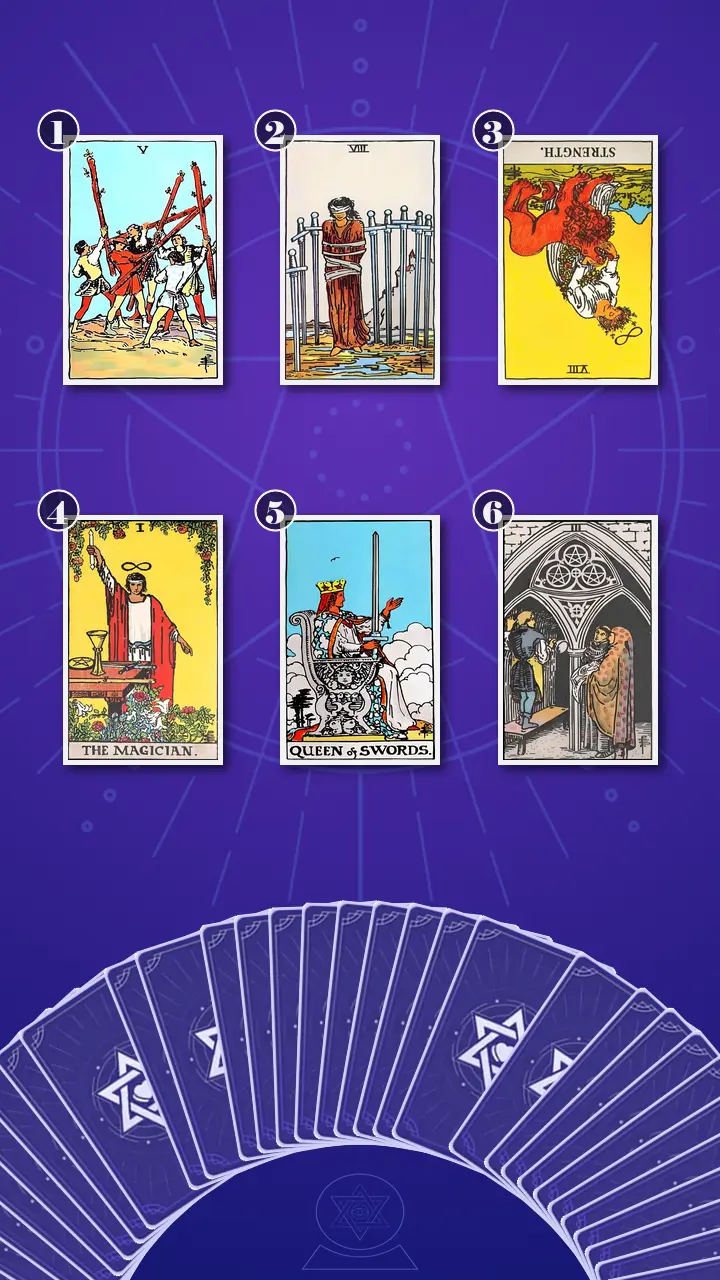
Reading the Grid: Why the “Perfect Gap” Never Comes
Position 1 — What the group dynamic looks like right now: Five of Wands (upright)
“Now we turn over the card representing what the group dynamic looks like right now when you try to speak on Zoom,” I said. “Five of Wands, upright.”
The image is all crossing sticks and bodies jostling—no clear leader, no clean lane. And the modern translation fit too well: You join a recurring Zoom brainstorm where everyone is ‘collaborative’ but also fighting for airtime—people jump in over each other, silence gets filled instantly, and the loudest voice sets the pace. It’s not that your ideas are weak; it’s that the room rewards speed over clarity.
Energy-wise, this is excess Fire: fast, competitive, reflexive. “So here’s the first relief,” I told Taylor. “This card doesn’t blame you. It says the room is structurally built for overlap.”
Taylor gave a small laugh that sounded like it had been squeezed through their teeth. “That’s… brutally accurate,” they said. “Like, it’s almost rude how accurate.”
Position 2 — What’s blocking your voice in the moment: Eight of Swords (upright)
“Now we turn over the card representing what’s blocking your voice in the moment,” I said. “Eight of Swords, upright.”
The blindfold and the loose bindings always get me. Not because the person is powerless—but because they’re acting like they are. The lived scene was right there: Camera on, you’re ready to contribute, but your brain runs a rapid risk-check—tone, hierarchy, timing—and you stay muted. You rewrite the same sentence in your notes until it’s flawless, then decide it’s too late. The meeting moves on, and you’re left with a tight throat and a quiet, sinking “I missed it again.”
This is blocked Air: thinking turning inward until it becomes a cage. I mirrored the exact loop back to them—mute icon, cursor blinking, the internal legal brief: If I jump in now, I’ll look rude. If I wait, I’ll miss it. If I speak imperfectly, I’ll get corrected. Freedom versus safety, and safety keeps winning by a fraction of a second.
Taylor didn’t even argue. They just nodded once—tight-lipped, relieved in a way that looked almost annoyed. Like: Oh. So it’s a pattern. Not a personality defect.
Position 3 — The deeper root reflex: Strength (reversed)
“Now we turn over the card representing the deeper root: the self-belief or emotional reflex that makes you release the floor too quickly,” I said. “Strength, reversed.”
Reversed, Strength isn’t weakness. It’s courage dialed down too far—gentleness turning into self-erasure. The modern-life version was painfully familiar: You equate confidence with aggression, so you try to be ‘nice’ by yielding instantly when someone overlaps you—“sorry, go ahead”—even mid-point. Later you feel resentful and weirdly powerless, like your professionalism is costing you your presence.
I watched Taylor’s throat bob when they swallowed. Their shoulders rose half an inch, then dropped. “I want to be liked,” they admitted, eyes flicking away from the cards. “But I also want to be taken seriously. And in the moment, it feels like I can only pick one.”
“That’s the root pressure,” I said, keeping my voice calm. “Not incompetence. Not lack of ideas. A nervous-system reflex that equates direct with danger.”
When The Magician Raised a Wand
Position 4 — The turning point lever: The Magician (upright)
I paused before turning the next card. Even the room seemed to quiet—the kind of hush I remember from a cruise deck at midnight, when the wind drops and you can suddenly hear the water’s rhythm instead of the party noise.
“Now we turn over the card representing the turning point: the resource that helps you change the interaction without becoming someone you’re not,” I said. “The Magician, upright.”
And there it was: hands visible, tools on the table, one arm raised like a clean signal. The lived translation was almost instructional: Before the call, you decide your one headline sentence. In the meeting, you Raise Hand as soon as you know you want in (not when there’s a perfect gap). When you’re called on—or when you claim the turn—you unmute immediately and say, “I’m going to add one point here,” then deliver the headline before you elaborate.
Setup: Taylor had been trapped in the same trap-door moment—hover over Unmute, watch someone fill the pause, then open Slack to type a careful “just to add…” with three bullets. It wasn’t them being unqualified. It was them waiting for a perfect gap in a room that doesn’t really have gaps.
Stop waiting to be invited into the conversation; raise your wand and use the tools on the table to create your opening.
I let a beat of silence sit there.
Taylor’s reaction came in a chain. First: a physical freeze—their breath caught and their fingers stopped fidgeting with the mug handle. Second: the cognition sank in—their gaze went slightly unfocused, like they were replaying a meeting but editing the outcome. Third: emotion moved—an exhale, slow and shaky, and their jaw unclenched as if they’d been holding it all week.
“But… if I do that,” they said, and there was a flash of resistance—anger, almost—“doesn’t it mean I’ve been doing it wrong this whole time?”
“It means you’ve been trying to survive with the tools you thought were allowed,” I answered. “In my work—Jungian, but also practical—I call this Social Role Switching. You’ve been stuck in Supportive Mode in a space that occasionally requires Assertive Mode. Not aggressive. Not dominating. Just a clean role change: ‘It’s my turn for one sentence.’”
I leaned in. “Now, using this new lens—was there a moment last week when this would have changed your body?”
Taylor didn’t even have to think. “Tuesday. The stakeholder call. My point was ready. I could’ve raised my hand the second I knew.” Their voice softened, but in a different way now—less apologetic, more clear. “I thought I needed permission. I needed a method.”
This was the shift: from tense holding-back and mute-button hesitation to calm, structured speaking that claims a clear turn and lands in the work.
Clean Edges, Real Work: The Boundary and the Build
Position 5 — Your practical speaking-up strategy: Queen of Swords (upright)
“Now we turn over the card representing your practical speaking-up strategy: what to say and how to hold your lane,” I said. “Queen of Swords, upright.”
She’s all clean edges: upright sword, forward gaze, an open hand that says I’m fair, and I’m not folding. The modern scenario was instantly usable: You stop cushioning your point with apologies. You speak in short, structured beats and use a calm boundary when interrupted: “I’m going to finish my thought—one sentence.” You don’t over-explain; you just complete the sentence and pause, giving the room something clear to respond to.
Energy-wise, this is balanced Air: clarity without cruelty. I gave Taylor a line I’ve taught thousands of travelers in loud, cross-cultural spaces—adapted for corporate Zoom: “Make eye contact with the camera, slow your speech half a notch, and say: ‘I need ten seconds to finish—one sentence.’”
They repeated it once under their breath, testing the shape of it. Then they nodded. “Kind and direct aren’t opposites,” they said, almost surprised. “They’re a combo.”
Position 6 — Integration: Three of Pentacles (upright)
“Now we turn over the card representing integration: how to make your contributions land and be recognized as part of the team’s work,” I said. “Three of Pentacles, upright.”
This card is a blueprint in a shared space—collaboration that leaves receipts. The modern translation captured the win condition: Your comment lands best when it’s tied to the team’s output: “Here’s the risk and the proposed fix.” After the meeting, you post a two-line recap in Slack and tag one relevant person so your contribution is clearly part of the workstream—not a late attempt to be noticed.
That’s Earth energy: credibility you can point to. Not “I spoke.” But “Here’s the decision, the risk, the next step.” Like a pull request—specific, actionable, easy for others to build on.
The One-Sentence Protocol: Actionable Advice for Your Next Zoom
Here’s the story the whole grid told in plain language: the room is loud and fast (Five of Wands), your brain responds by tightening into an internal style guide (Eight of Swords), and underneath that is a belief that being liked requires being smaller (Strength reversed). The way out isn’t volume. It’s method: visible signaling and tool-use (The Magician), plus clean boundary language (Queen of Swords), so your point lands in the work where it can’t be waved away (Three of Pentacles).
The cognitive blind spot was subtle but costly: Taylor had been treating speaking as a performance that must be perfect and polite—rather than a tool that can be used briefly, clearly, and respectfully. The transformation direction was equally specific: shifting from waiting for the “perfect gap” to claiming a clear turn with concise lead-ins, visible signals, and one firm sentence before elaboration.
- Raise-Hand-Then-Unmute RuleBefore the next meeting, decide your main point. The moment you know you want in, hit Raise Hand—don’t wait for a clean pause. When you get the floor (or when there’s the first workable opening), unmute immediately and take your turn.Expect it to feel “rude” the first few times because you’re breaking an old safety rule. Keep your tone neutral—slower, not louder.
- One Sentence First (10-minute drill)Open a blank doc and write 3 versions of the same point: (1) a 10-word headline, (2) one supporting detail, (3) one ask. Then practice saying only the headline out loud once.If your throat tightens, pause, exhale, and stop—no pushing through. Come back later; you’re training safety, not forcing a performance.
- Clean-Edge Boundary ScriptIf someone overlaps you, switch into Assertive Mode and say: “I’m going to finish my thought—one sentence.” Then complete the sentence and pause. After the meeting, post a 2-line Slack recap: (1) decision/risk (2) next step, and tag one relevant teammate.Keep it clean, not cold. Long explanations read as nervousness; brevity reads as confidence.
On ships, we used what I half-jokingly call Maritime Social Protocol: in a noisy cocktail crowd, you don’t wait for silence that never comes—you signal your turn, speak your headline, then let others respond. Zoom is the same ocean, just with better buttons.

A Week Later: Ownership, Not Perfection
A week later, Taylor messaged me: “I raised my hand early. I said, ‘One point from my side.’ Someone started to jump in and I used the line—‘I’m going to finish my thought—one sentence.’ My voice shook a little, but I finished. And then my manager built on it.”
They added, almost sheepishly: “I slept through the night, but when I woke up I still had that thought—what if I sounded weird? I just… didn’t spiral. I made coffee and moved on.”
That’s the real Journey to Clarity: not a perfect personality transplant, but a small, repeatable turn you can take—again and again—until your body stops treating visibility like danger.
When you’re talked over, it’s not just annoying—it’s that tight-throat moment where you’re choosing between being ‘easy to work with’ and being real in the room, and your body learns to stay small before your mind even finishes the sentence.
If you didn’t need the perfect gap, what would your one clean sentence be the next time you feel your hand hover over Unmute?