From Snap Score Surveillance to Steadier Self-Trust: A One-Text Reset

Finding Clarity in the 8:42 p.m. Snap Spiral (When a Streak Ends and Your Chest Tightens)
If you’re a 20-something in a city like Toronto and a Snap streak ending can ruin your whole evening like a mini breakup, even though you keep telling yourself it’s “not that deep,” you’re not alone.
Taylor (name changed for privacy) came into my café with that specific kind of tired that isn’t about sleep. It’s the kind you get when you’ve been doing emotional math in your head for hours. Outside, the street was already winter-dark, and inside the espresso machine hissed like it was trying to exhale for both of us.
She told me it happened on a Tuesday—8:42 p.m., Netflix paused, TTC streetcar bell still echoing in her skull from the ride home. She’d sunk into her condo couch with one sock half-off, phone warm in her palm, blue light drying her eyes out. Then she noticed it: the streak was gone.
Not dramatic, not cinematic—just one tiny metric disappearing. But her body reacted like a siren: throat tight, hands jittery, and that hollow, heavy drop in the stomach that feels like missing a step on the stairs. The moment she saw the number vanish, her thumb started the loop—chat thread → Snap score → story views → back again.
“It’s just a streak,” she said, and her laugh didn’t quite land. “But it feels like a verdict.”
I watched her shoulders hold themselves up like they were bracing against a wave that hadn’t even hit yet. Under her words was the real contradiction: she wanted to feel secure and chosen in the friendship, but she was terrified that a lapse in attention meant she was forgettable—replaceable—not worth keeping.
The rejection wasn’t an abstract feeling. It was like trying to swallow around a pebble lodged in your throat while your brain opens twenty browser tabs looking for proof you still matter.
“Okay,” I said gently, sliding a small cup of water across the table the way I do when someone’s nervous system is already running hot. “Let’s not shame the spiral. Let’s map it. We’re going to use tarot the way I use coffee—practical, honest, and built for real life. A little journey to clarity.”

Choosing the Compass: The Four-Layer Insight Ladder Tarot Spread
I asked Taylor to take one slow inhale—like she was smelling the first pour of espresso—and then another. Not as a ritual for “mystery,” but as a transition: from reacting to observing.
While I shuffled, I told her what I was using: the Four-Layer Insight Ladder · Context Edition. It’s one of my favorite spreads for social media anxiety and rejection triggers—those moments where something tiny (a streak, a “Seen,” a view count) detonates into a whole identity story.
For anyone reading who’s ever Googled “How to stop spiraling after a Snap streak ends,” this spread works because it doesn’t pretend the question is “Will they come back?” It’s “What story got activated in me, and what do I do now?” The ladder structure goes: surface trigger → emotional atmosphere → old wound → protection pattern → medicine → integration. Symptom to mechanism to a next step you can actually take.
I flagged the rungs we’d lean on most: the second card for how ambiguity turns into a story, the third for the old rejection script, and the fifth for the inner capacity that breaks the loop—before we touch the last rung, the low-stakes move for this week.
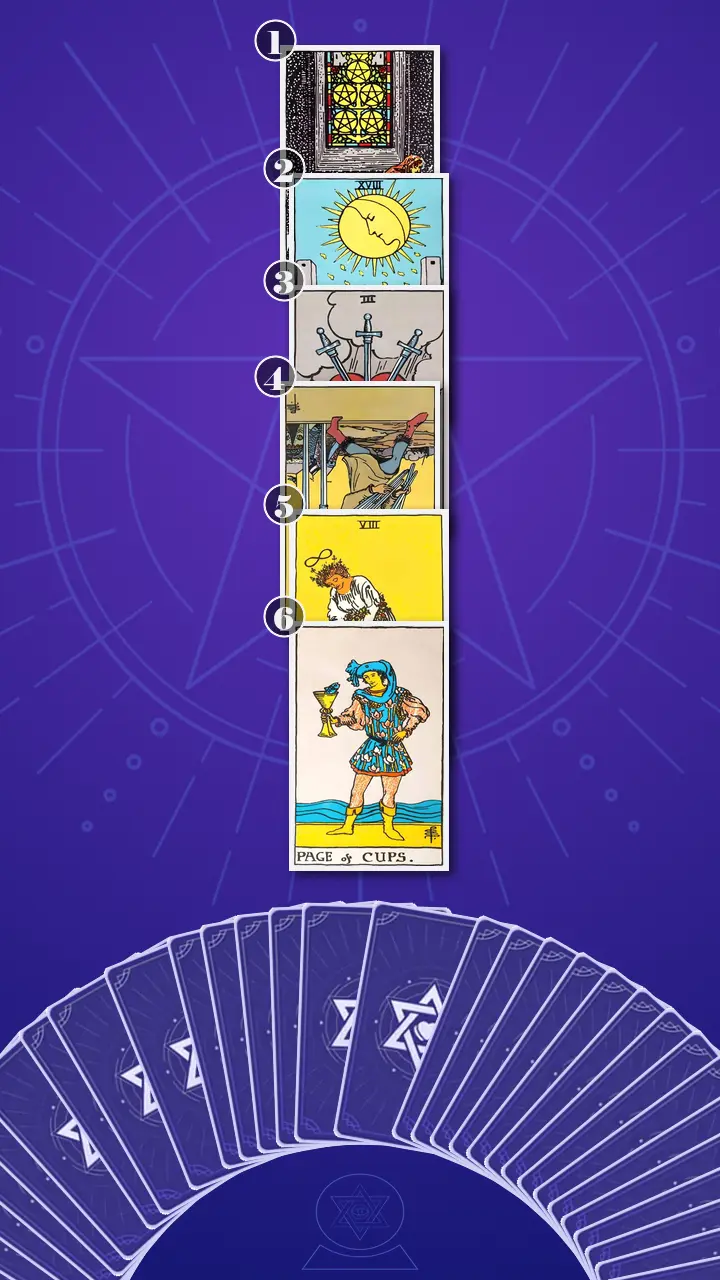
Reading the Ladder: From “Out in the Cold” to “Fog-to-Facts”
Position 1: The visible trigger and the spiral you can actually observe
“Now we’re turning over the card that represents the visible trigger and the most observable behavioral spiral after the streak ends,” I said.
Five of Pentacles, upright.
In modern life, this card is painfully literal: you’re in your warm apartment after a long Toronto workday, but the second you see the streak ended, you feel socially out in the cold. You start scanning Snapchat like it’s weather radar—Snap score, story views, last active—trying to find warmth in numbers while sitting right next to the real doorway: asking a simple question, or leaning on an actual support system.
Energetically, this is deficiency: a shortage of felt belonging. The Five of Pentacles doesn’t mean you’ve been rejected as a fact. It means your nervous system interprets the change as exile. Like the card’s two figures in the snow, your attention stays outside the lit window—even if warmth exists a few steps away.
Taylor made that unexpected little sound—half laugh, half wince. “That’s… yeah. That’s so accurate it’s kind of rude,” she said. “Like, it’s cold. That’s the exact feeling.”
“It’s not cruel,” I replied. “It’s precise. And precision is how we get out of the loop.”
Position 2: How ambiguity gets interpreted in the moment (the story your mind writes)
“Now we’re turning over the card that represents how ambiguity gets interpreted in the moment—the story your mind starts telling when you don’t have clear information,” I said.
The Moon, upright.
This is the card of uncertainty, projection, and your brain trying to control the unknown by writing the ending first. The streak ending becomes a blank screen your mind projects onto. So you build a case file: “They’re active, they’re posting, they’re viewing other people… so it must mean I’m being phased out.” It feels like intuition, but it’s really fear wearing intuition’s clothes.
Here’s the split-screen I saw as I looked at Taylor across the table:
Scene A (Fog): late-night blue light, her thumb moving like it’s on autopilot, re-opening the same chat thread, checking their Snap score like it’s due diligence, zooming in on story views like she’s watching a true-crime binge and hunting for the one clue that proves motive. Her throat tightens. Her hands jitter. The caption in her head reads: “They’re active but not with me.”
Scene B (Facts): a Notes app list titled “What I actually know.” One sentence. Clean. Boring. True.
I said it the way I’d say it to someone staring down a complicated menu: “Ambiguity isn’t proof—your brain just hates the unknown.”
Taylor gave a small, nervous laugh, like she’d been caught narrating her own documentary. Her eyes stayed on the card, but her jaw unclenched a fraction.
Position 3: The old rejection script this plugs into (the earlier wound)
“Now we’re turning over the card that represents the old rejection script or earlier wound this situation plugs into,” I said. “This is the line your brain pulls off the shelf.”
Three of Swords, upright.
When this card shows up, I listen for the sentence that hurts more than the situation itself. In modern life it’s: when you see the streak is gone, an old line slices through—“People always leave,” “I’m forgettable,” “I’m the one who cares more.” Your body reacts like the loss is already confirmed: tight throat, hollow stomach drop. Then you start behaving as if you’ve been rejected, even though all you actually have is a missing digital routine.
Energetically, this is excess Air: sharp conclusions, harsh inner captions, pain turned into “truth” too fast. The rain in the card isn’t melodrama—it’s what it feels like when your system gets drenched in an old memory.
Taylor didn’t cry. She did something quieter: her gaze unfocused for a second, like she’d rewound to a past friendship shift—the slow replacement with no clear conversation. Then she swallowed. “The line is literally, ‘People replace me without saying it,’” she said, barely above the espresso machine’s hiss.
I nodded. “That’s the wound. Not the streak.”
Position 4: The protection strategy that avoids rejection but keeps the loop going
“Now we’re turning over the card that represents the protection strategy that tries to prevent rejection but keeps the loop alive,” I said.
Seven of Swords, reversed.
This is the part of the ladder where people usually get embarrassed—so I slowed down and kept my voice warm. In modern terms: you try to protect yourself by staying indirect. You don’t ask, you monitor. You post a Story “casually,” then watch the view list like it’s a pulse. You go quiet to look unbothered, but you keep checking their Snap score in private. It’s a strategy meant to avoid rejection—yet it keeps you stuck in suspense and makes you feel even more exposed inside.
Energetically, reversed Seven of Swords is blockage—the strategy has stopped working. It’s also exposure: the pattern can’t hide from you anymore.
I gave Taylor the metaphor I use when someone is running two identities at once. “It’s like you’ve got two tabs open. Tab 1 is ‘I don’t care.’ Tab 2 is ‘I care a lot.’ And your RAM is overheating.”
She pressed her lips together—recognition plus that little sting of shame. “I literally do the hint-posting thing,” she admitted. “Like… I hate that I care this much, so I pretend I don’t.”
“That makes sense,” I said. “And here’s the line this card asks you to consider: Stop negotiating for certainty with surveillance. You don’t get clarity that way. You get more fog.”
When Strength Held the Lion: Self-Led Sensitivity, Not Performance
Position 5: The key inner capacity to practice to break the pattern
I let the café noise soften around us—the grinder, the low chatter, the steam wand—until it felt like a quiet room inside a loud city.
“Now we’re turning over the card that represents the key inner capacity to practice to break the pattern and restore self-trust,” I said. “This is the bridge.”
Strength, upright.
In modern life, Strength is simple and brutally hard: the urge to refresh is loud and animal-fast. Strength is you pausing anyway—two breaths, shoulders down, phone face-down for a minute. You don’t shame yourself for caring, and you don’t use caring as a reason to spiral. You lead yourself: choose a clear message or a clear boundary, because you trust yourself to handle the answer—whatever it is—without turning it into a referendum on your worth.
Energetically, this is balance: tenderness with firmness. Not “being chill,” not controlling the outcome—being steady while you wait in the unknown.
And this is where my café brain always jumps in—my own private professional flashback, twenty years behind this counter. When espresso is extracted too long, it turns bitter. When it’s too short, it turns sour. There’s a sweet spot where the cup tastes like itself.
I looked at Taylor and used my Social Espresso Extraction lens—the way I identify the “optimal extraction time” for different social contexts. “Your checking loop is over-extraction,” I said. “Too much time, too much heat, too many pulls. It doesn’t make the connection clearer—it makes it bitter inside you. Strength is choosing the right extraction: one clean sentence, pulled quickly, and then you let it sit. You don’t keep yanking the handle because you’re scared it won’t be enough.”
She blinked, like she wanted to argue and couldn’t. Her hand hovered over her phone, then pulled back.
(Setup)
You know that moment on the couch after work—TTC noise still in your ears—when you open Snapchat “just to check,” and your stomach drops because the streak is gone, so your thumb starts doing the anxious loop: chat → Snap score → story views → back again.
Stop letting the streak decide your worth, and start practicing gentle courage—the kind that holds the lion softly but firmly.
(Reinforcement)
Taylor’s breathing stopped for half a beat, like her body had been waiting for someone to say it out loud. Her eyes went glossy—not full tears, but that thin shine you get when a truth lands in your chest before it reaches your thoughts. First her shoulders lifted (the reflex to defend), then they dropped, slowly, like setting down a heavy bag you forgot you were carrying. Her fingers curled around the edge of her cup, then loosened. She let out a shaky exhale that sounded like relief and irritation at the same time.
“That’s… harder than stalking their Snap score,” she said, and there was resistance in it—because Strength doesn’t give you the dopamine hit of a new clue.
“Exactly,” I said. “So we make it doable. A 10-minute Strength Reset before you send—or don’t send—anything: phone face-down, three-minute timer, then write two lines: ‘The story my brain is telling is…’ and ‘What I actually know is…’ If your chest tightens more while you write, you’re allowed to stop. This is practice, not a performance.”
I paused. “Now, with this new lens—gentle courage instead of surveillance—think back over the last week. Was there a moment where the streak or a delayed reply made you brace, and this insight could’ve changed what you did next?”
She stared at a spot on the table, like she was replaying a clip. Then she nodded once. “Last night. I posted a Story just to see if she’d view it.”
“That’s the exact hinge,” I said. “This is the shift—from rejection-driven surveillance and mind-reading to self-led sensitivity, steady self-trust, and grounded clarity. Not because the other person becomes predictable, but because you become reliable to you.”
Position 6: A concrete, low-stakes next step for communication this week
“Now we’re turning over the card that represents a concrete, low-stakes next step for communication or self-soothing this week,” I said.
Page of Cups, upright.
This card is the antidote to performance. Instead of hint-posting or waiting in silence like it’s a test, you send something human: short, warm, slightly awkward, honest. It’s not a TED Talk about the streak. It’s an offering that makes room for reality: they could be busy, stressed, distracted, or simply not tracking the streak the way you are—and you still get to name that it pinged you.
Energetically, Page of Cups is healthy openness: not pouring your whole heart out on the table, but not hiding it behind strategy either.
Taylor’s face softened the tiniest bit—the expression people get when they realize “simple” is allowed. “So I can just… ask,” she said.
“One clean sentence beats a week of hint-posting,” I told her. “Every time.”
The One-Clean-Sentence Protocol: Actionable Next Steps (Without the Surveillance Hangover)
I leaned back and stitched the whole ladder into one story for her—because this is how tarot becomes usable, not just interesting.
The Five of Pentacles shows the moment the streak ends and your body reads it as exile—standing outside warmth that might still exist. The Moon shows your brain turning ambiguity into a movie, hunting “evidence” to soothe the unknown. The Three of Swords names the older script—“People replace me without telling me”—that makes the uncertainty feel lethal. The reversed Seven of Swords shows the protection move: indirect testing, hint-posting, monitoring, going silent to preserve pride. Then Strength arrives as structural support: self-led sensitivity with a steering wheel. And Page of Cups turns that steadiness into one sincere, low-drama message.
Your cognitive blind spot, Taylor, is thinking that digital consistency equals emotional security—and that if you can just gather enough data, you’ll earn certainty without having to be vulnerable. The transformation direction is the opposite: separate data from story, regulate first, then communicate directly and lightly—so your self-worth stops being app-dependent.
I also told her she could reuse this exact framework anytime she feels stuck at a relationship crossroads: the Four-Layer Insight Ladder · Context Edition tarot spread for social media rejection triggers and relationship uncertainty is basically a repeatable map—surface trigger → story → old wound → protection → medicine → integration.
- Do a 2-minute “Fog vs Facts” checkOpen Notes and make two columns: What I know (e.g., “the streak ended”) and What I’m imagining (e.g., “I’m being replaced”). Then say one line out loud: “The old story is: I’m forgettable. That’s a story, not a verdict.”If your body spikes (tight throat, hot face), stop early and do one sensory reset: wash your hands, sip water, or step outside for 60 seconds. Clarity beats completion.
- Send one clean check-in text (Page of Cups style)Pick the “tiny” version if you’re activated: “Hey—noticed our streak ended and it weirdly pinged my feelings. Are we good?” Or a lighter option: “Lol our streak died—everything okay on your end?”No receipts. No Snap-score evidence. If you feel an urge to write a paragraph, save it to Notes and send the one-sentence version instead.
- Run a 60-minute No-Surveillance Hour (Strength practice)After you send the text, set a 60-minute timer and do not check Snap score, stories, or their activity. Put Snapchat in a folder or off your home screen for that hour.I call this a Social Thermometer move: you’re choosing “warm” connection, not scalding intensity. Warm is steady. Warm is self-respect.

A Week Later: The Quiet Proof of Self-Trust
A week later, Taylor came back in for a latte and stood by the pastry case like she was trying not to make it a big deal. “I did the tiny text,” she said, voice casual, eyes bright. “And I didn’t check for an hour. I hated it for the first ten minutes. Then I… kind of forgot to hate it.”
She didn’t tell me the friendship magically became effortless. She told me something better: she slept through the night once. The next morning her first thought was still, “What if I was wrong?”—but this time she exhaled, put her phone face-down, and made coffee anyway.
That’s the journey to clarity I trust most: not instant certainty, but a steadier relationship with uncertainty. Not less sensitivity—more leadership with it.
When a streak ends, it’s not just a number dropping—it’s that familiar full-body brace that says, “Here we go again, I’m about to be quietly left behind,” even while you’re trying to look totally fine.
If you didn’t have to prove you were “chill” tonight, what would a single, kind, self-led next move look like—one breath, one boundary, or one honest sentence?