From Feeling Replaceable to a Clean Check-In: A Tarot Friendship Case

Feeling Replaceable in a Friendship, Somewhere Between Bloor-Yonge and Home
You’re a 20-something in Toronto with a real job and a real calendar, yet one Instagram Story can still trigger full-body “I’m replaceable” panic.
Alex (name changed for privacy) said it like a confession, like she was sliding a note across a table and hoping I wouldn’t judge her handwriting. She was 28, a junior marketing manager, and she looked exactly like someone who’s been holding her breath in tiny intervals—between meetings, between notifications, between “seen” and “replied.”
She described Tuesday, 8:47 PM on Line 1 heading north: standing near the door, TTC announcements crackling, the air smelling faintly like wet wool and winter. “I open Instagram just for a sec,” she told me, “and I see her clinking glasses with this new person. And my throat—” She touched the base of her neck like the feeling lived there. “It tightens. Then my hands just… do their thing.”
Her “thing” was the spiral: swipe away, scroll back through DMs, compare timestamps, count emojis like they’re market signals. A quick 😂 on her message, a full paragraph for the new friend. Her stomach dropped like an elevator that doesn’t warn you. She’d stop herself from sending anything real, because real felt risky.
“I swear I’m not jealous,” she said, and her laugh came out thin. “I just feel suddenly irrelevant. And I hate that a single Instagram story can ruin my whole evening.”
The contradiction was right there, pulsing under every sentence: she wanted secure closeness and to feel chosen—while fearing that if she asked for reassurance, she’d confirm the worst story in her head: that she was easy to swap out.
It sounded exhausting in a specific way: like trying to read a street sign in a snowstorm you can’t turn off, while your thumb keeps reaching for the phone anyway.
I leaned in a little. “We’re not going to try to ‘win’ against a new bestie,” I said gently. “We’re going to look at what this moment is touching in you—and what one next step could give you actual clarity instead of more receipts. What past ‘swap-out’ story is this moment renting space from?”

Choosing the Compass: The Four-Layer Insight Ladder (Context Edition)
I asked Alex to take one slow breath with me—not as a ritual for the universe, but as a clean handoff from doomscrolling brain to present-moment brain. I shuffled slowly, the sound of the cards soft as paper in a quiet room. On my desk, there was also a strip of blotter paper—habit from my other life as a Paris-trained perfumer. When people are flooded, giving the nervous system something neutral and sensory can help it stop hunting for danger in pixels.
“Today we’ll use a spread I call the Four-Layer Insight Ladder · Context Edition,” I said.
And for you, reading this: the reason this spread works for questions like ‘my best friend found a new best friend—what do I do?’ is that the pain rarely comes from the new person alone. It comes from a layered inner replay: the present reaction, the trigger, the older imprint underneath, and the belief that keeps you stuck in silence. This ladder format is the smallest, clearest map I know that still shows the full mechanism—then gives you a way out.
I pointed to the invisible “steps” we were about to walk down and back up. “Card one shows your most repeatable reaction when that new-bestie moment appears. Card two is the specific cue that flips the switch. Card three goes deeper—the old ‘replaceable’ story. Card four is the shadow belief that traps you in monitoring or going quiet. Then we pivot: card five is the resource that helps you hold the feeling without obeying it, and card six is your next step in real life—what to actually say or do.”
Alex nodded, but her fingers still looked restless, like they were half-dreaming of the refresh button.
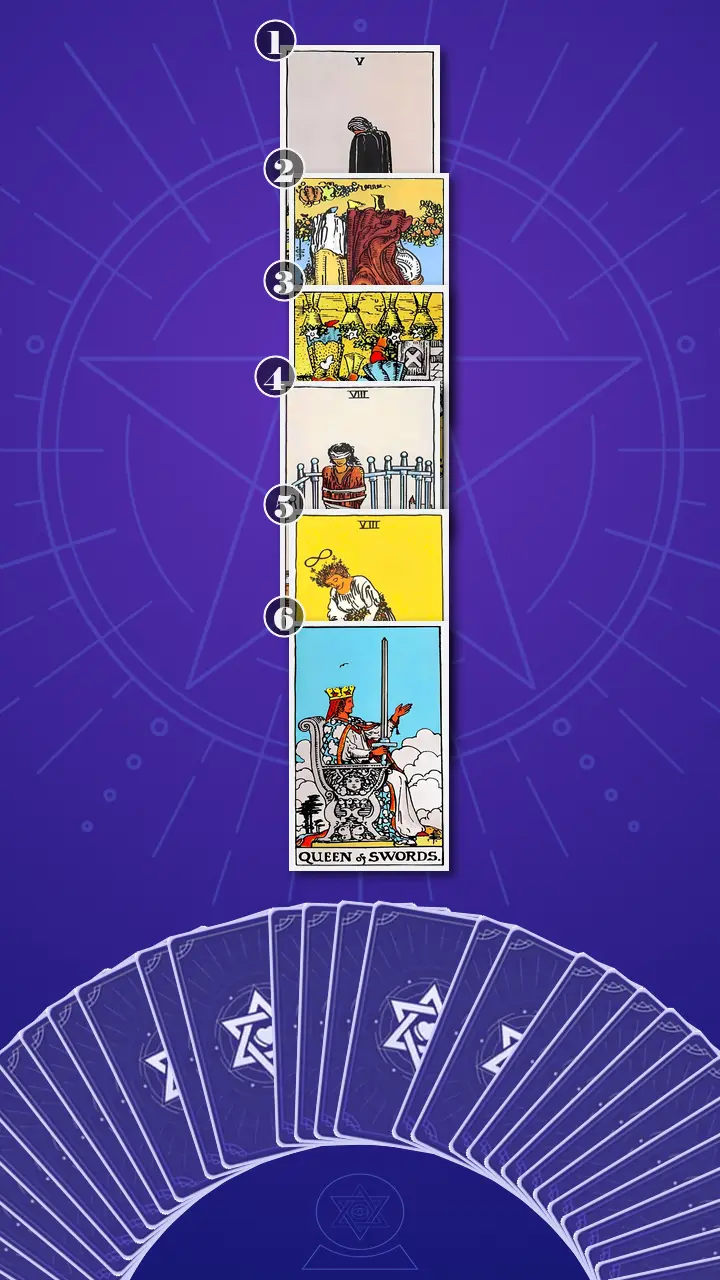
Reading the Map: From the Spilled Cups to the Mental Cage
Position 1 — Present symptom: what shows up first
“Now we turn over the card that represents the present symptom: the most observable current reaction pattern when the friend’s new bestie appears,” I said.
Five of Cups, upright.
In the card, a cloaked figure stares at three spilled cups while two full cups stand behind them, unnoticed. I kept my voice simple. “This is grief plus selective attention,” I told her. “Not dramatic grief—more like your attention becomes a flashlight that can only point at loss.”
And I anchored it in her life the way the card asked me to: “You tell yourself you’re just casually checking Instagram after work, but one Story of your friend with their new bestie hits like a punch. You immediately scan for what’s ‘gone’—less texting, fewer invites, different jokes—and you miss the quieter evidence that the bond still exists. The two upright cups are still there. Your nervous system just can’t see them when it’s activated.”
Energy-wise, Five of Cups is Water that has tipped into excess: feelings flooding the lens until the mind starts calling it truth.
Alex didn’t nod. She let out a short laugh that had a bitter edge. “That’s… rude,” she said. Then softer: “It’s accurate. Like, too accurate.”
“I know,” I said. “Tarot can feel a little too HD. But it helps because it names the pattern without calling you a problem.”
Position 2 — Immediate trigger: the cue that flips the switch
“Now we turn over the card that represents the immediate trigger: the specific social cue that flips the emotional switch into comparison and alarm,” I said.
Three of Cups, reversed.
“This is belonging energy that feels distorted,” I explained. “In reversal, the warm circle becomes a ‘closed circle’ feeling. Triangulation. Exclusion. The third-wheel itch.”
I tied it to her exact sting: “A group photo. A tagged brunch. A string of inside jokes in the comments—suddenly your brain turns friendship into a table you’re not seated at. Instead of ‘they’re having fun,’ it becomes ‘I’m not in the group anymore,’ and you start shrinking yourself to avoid looking like the needy third wheel.”
The energy here is connection turning into competition—blockage in community. Not because community is bad, but because your system reads expansion as replacement.
Alex’s mouth tightened. “I don’t want to compete for my own friend,” she said. “But my brain makes it… a ranking system anyway.”
“That’s the reversal,” I said. “Joy becomes a scoreboard.”
Position 3 — Root story: the past imprint replaying today
“Now we turn over the card that represents the root story: the past ‘replaceable’ imprint being replayed in today’s friendship moment,” I said.
Six of Cups, reversed.
“This one is important,” I told her, and I felt the room get a little quieter, the way it does when someone’s about to recognize a memory before they even name it. “Six of Cups is old attachment. In reversal, it’s the past leaking into the present.”
I used the translation that fit her life: “This doesn’t feel like just a current friend shift—it feels like an old script resurfacing. The same body-feeling you had years ago when you were the ‘backup friend’—or the friend who had to be easy and pleasant to keep a spot—gets activated by one tiny cue today, and you react as if you’re back in that earlier version of you.”
Energy-wise, this is Water memory: not just emotion, but emotion with a timestamp. The reversal shows it’s not resolved—it’s still running in the background like an app you didn’t realize is draining your battery.
Alex’s hands, which had been clasped too tightly, loosened. She looked past the table for a second, eyes unfocusing like she was replaying an older scene on a hidden screen. “Middle school,” she said finally. “My best friend just… upgraded. Like, overnight. And I remember deciding that if I was ‘easy’ and helpful, I’d be harder to drop.”
I let that land. “That makes so much sense,” I said. “If you learned closeness could be withdrawn, your system starts gathering proof before it lets you relax.”
Position 4 — Shadow belief: the thought trap that keeps you stuck
“Now we turn over the card that represents the shadow belief: the constricting interpretation that keeps you stuck in silence, monitoring, or testing,” I said.
Eight of Swords, upright.
“This is the mental bind,” I said. “The feeling of being trapped, judged, powerless—even when there are options. The blindfold and the loose bindings matter: the constraint is real emotionally, but it’s not as absolute as it feels from inside the story.”
I spoke directly into her nightly loop: “You draft a text, delete it, draft it again, then decide the ‘smart’ move is silence. You keep monitoring instead—reading into emojis, response times, Story views—because asking directly feels like stepping into rejection. The result is a lonely limbo where nothing can actually get clarified.”
And then I used my own lens—my Social Pattern Analysis. “Here’s the hidden interaction barrier I see,” I said. “You’re trying to protect the friendship by being low-maintenance. But the pattern you’re sending—without meaning to—is distance. In social dynamics, distance is a loud signal. So the belief becomes self-confirming.”
I paused, then gave her the scene the card was begging for—the late-night evidence folder. “I can almost see it,” I said softly. “Phone glow at 12:13 AM. Notes app open like an evidence log. Timestamps. Unsent drafts. Inner monologue goes: If I say it, I’ll look needy → if I don’t say it, at least I can’t be rejected. That’s safety-through-silence. But it costs you connection-through-clarity.”
Alex froze for a beat—breath held, fingers hovering like they were about to swipe. Then her shoulders dropped a fraction. Then she exhaled, small and surprised. “Oh,” she said. “Yeah. That is… literally what I do.”
“And it’s not because you’re broken,” I told her. “It’s because your brain is trying to keep you from re-living the swap-out moment.”
I added one line, clean as a knife but kind: “If you need receipts to justify your feelings, the relationship will always feel like a trial.”
When Strength Spoke: Taking Your Hand Off the Refresh Button
Position 5 — Transforming resource: what helps you hold the feeling
I took a breath before turning the next card. “We’re flipping the turning point now,” I said. “The resource that changes the whole system.” The air felt different—less frantic, like the room had stopped vibrating with notifications.
“Now we turn over the card that represents the transforming resource: the inner capacity that helps you hold the feeling without acting from fear,” I said.
Strength, upright.
On the card, a woman holds a lion with gentle hands. No wrestling. No domination. Just steadiness. “This is self-compassionate courage,” I said. “Not performative confidence. Not ‘being chill.’ It’s the ability to hold intense feelings without letting them drive the car.”
I translated it into Alex’s exact life: “The jealousy hits, and instead of reacting—scrolling, testing, going quiet—you pause. You breathe until your hands stop twitching for the phone. You remind yourself: feelings can be real without being proof. From that steadier place, you choose one aligned action—not to compete, but to care for your own heart and show up with dignity.”
Setup (the moment you recognize yourself): It was easy to see the loop in her face: 9:41 PM, she opens Instagram “for a second,” sees them laughing with the new bestie, and her stomach drops. Then she’s auditing reply times and inside jokes—like her feelings need receipts before she’s allowed to matter.
Delivery (the sentence that changes the plot):
Stop auditioning for a spot in their life and start gently holding your own ‘inner lion’—then ask for what you need with calm clarity.
I let silence sit for two full breaths. In my work with scent, you learn this quickly: the first second is impact, but the next few seconds are where meaning blooms.
Reinforcement (what it looks like in a body, not a slogan): Alex’s expression shifted in layers. First, her eyes widened slightly, like she’d been called out by name in a crowded room. Then her jaw unclenched—tiny, almost imperceptible. Then her hands, which had been gripping her phone like a railing, loosened and set it down on the table with a soft click. She swallowed, and I saw her throat bob—like the tightness finally had permission to move.
“But if I stop auditioning…” she said, and there was a flash of resistance, almost anger. “Doesn’t that mean I’ve been doing it wrong the whole time?”
I didn’t rush to comfort her out of it. “It means you’ve been trying to survive an old story with the tools you had,” I said. “Strength isn’t shame. Strength is an upgrade.”
I slid a blotter strip toward her—not as a magic trick, but as a cue. “Smell this,” I said. It was a simple citrus I keep for resets: bergamot and grapefruit, clean and bright. “Let it be your ‘pause’ button.”
“Here’s a 10-minute reset I want you to try,” I continued, keeping it practical and small—because Strength is always about what you can do in the moment, not what you can become someday:
10-minute “Lion → Sentence” reset: (1) Put your phone face-down (or in another room) for 2 minutes. (2) One hand on chest, one on belly—take 6 slow breaths. (3) Write one clean sentence you could send: “I’ve been missing our one-on-one time—can we plan something this week?” If your body spikes (tight throat, shaky hands), pause and stop; you can come back later. The goal is clarity, not forcing a conversation today.
Alex nodded slowly, like her nervous system was testing the idea for sharp edges. “That feels…” She searched for the word. “Permission-y.”
“Exactly,” I said. “This is the pivot from proof-seeking insecurity and silent testing to self-respecting clarity and direct connection.”
I asked her the question that makes insight usable: “Now, with this new lens—can you think of one moment last week where your jealousy spiked, and this reset would have changed what you did next?”
She didn’t answer right away. First, she went still. Then her gaze drifted to the side, like she was replaying a memory. Then she exhaled. “Monday,” she said. “She reacted to my message with a 😂, and I opened Instagram to check if she was out with the new friend. I could’ve… just stopped. Just breathed. And then asked for what I wanted instead of punishing myself with the scroll.”
The Queen of Swords and the One Clean Ask
Position 6 — Next-step embodiment: what to do in real life
“Now we turn over the card that represents the next-step embodiment: one practical relational move that turns insight into self-respecting connection,” I said.
Queen of Swords, upright.
“This is clarity with maturity,” I told her. “Boundaries without cruelty. Truth without a courtroom.”
Then I used the exact modern scenario that belongs to her: “You stop hinting and testing and send one clean message that matches your values: clear, kind, and specific. Not a confrontation, not a meltdown—just reality. You name what you value (your friendship) and what you want (time together), and you let the friendship respond to truth instead of your private audit trail.”
Energy-wise, Queen of Swords is Air in balance: thought used as a tool, not a cage.
Alex gave a small nod. “I can picture that,” she said. “But I always… over-explain.”
“That’s where your marketing brain and your heart can work together,” I said. “Right now you’re treating the friendship like a project with infinite status checks. Queen of Swords is one straightforward stakeholder update.”
I held up an imaginary phone. “Draft 12 is where you apologize for having needs, add three disclaimers, and somehow mention you’re ‘totally fine’ five times.”
Alex snorted. “Yep.”
“Draft 1 is this,” I said, and I kept it clean on purpose: “I really value our friendship, and I’ve been missing our one-on-one time. Want to do Thursday at 7:30—coffee and a walk at Bellwoods?”
Then I brought in my other specialty—because communication is also a kind of presence. “In perfumery, we talk about sillage—how far a scent travels. Too much and it overwhelms the room. Too little and it disappears. Your message can have sillage, too.”
This was my First impression calibration through sillage control strategy, translated into words. “Your goal isn’t to flood her with emotion or to vanish into silence,” I said. “It’s to let one honest sentence travel the right distance: far enough to be felt, not so far it turns into a performance.”
Alex’s shoulders dropped again. This time it looked like relief. “That sentence feels doable,” she said. “Like… I could actually send it without a 45-minute draft spiral.”
From Proof to Clarity: Actionable Next Steps You Can Start Tonight
I leaned back and stitched the whole ladder into one simple story, the kind that answers the question, why does this keep happening? “Here’s what your cards say,” I told Alex. “When you feel replaced, Five of Cups narrows your attention to what looks lost. Three of Cups reversed turns someone else’s joy into a closed-circle threat. Six of Cups reversed shows this isn’t only about today—it’s an old ‘backup friend’ imprint resurfacing. Eight of Swords is the belief that if you speak up, you’ll be rejected—so you stay silent and gather proof instead. Strength is the exit ramp: regulate first, hold the inner lion, then move. And Queen of Swords is the move: one clean, respectful check-in.”
“Your cognitive blind spot,” I added gently, “is thinking you need more information—more screenshots, more timestamps—to deserve asking for closeness. But what you actually need is clarity, not more surveillance.”
“The transformation direction is simple, even if it’s uncomfortable,” I said. “Shift from mind-reading and silent testing to one clear, respectful check-in that names what you value and what you need.”
Then I gave her a tiny plan. Not a personality transplant. Just next steps.
- The 2-Minute Lion Reset (before any friendship text)When you feel the urge to check their Stories or over-edit a message, put your phone face-down for 2 minutes. One hand on chest, one on belly. Take 6 slow breaths, then ask: “What do I actually want—connection, reassurance, or information?”If your brain says “this is cringe,” label it as the Eight of Swords talking. Do the smallest version anyway—just 3 breaths counts.
- The 2-Sentence Clean Description (no story, just truth)Pick one stingy moment this week (a photo, an inside joke, a short reply). Write exactly two sentences: (1) what happened with zero interpretation, (2) what you felt in your body (throat, chest, stomach, hands). Stop there.Don’t decide what it “means” the same night. This interrupts the Five of Cups tunnel vision and gives you clean data without spiraling.
- One Clean Ask (Queen of Swords script)Send one direct, non-accusatory ask within 7 days: “I miss our one-on-one time—want to plan something for Thursday at 7:30?” Add a place (coffee/walk at Bellwoods) so it becomes real instead of floating “we should totally do something” energy.Send it as-is—no disclaimers, no “lol I’m being dramatic,” no mention of the new friend. A clean ask beats a silent test.
Before she left, I offered one more tiny tool from my world: “If you’re flooded, use a cleansing citrus spray—literal or metaphorical,” I said. “Citrus is sharp in the best way. It cuts through mental fog. Even a quick rinse of your hands with a lemony soap can signal to your body: we’re not in the trial anymore.”

A Week Later: Clear, Not Perfect
Six days later, I got a message from Alex.
“I did the phone-face-down thing,” she wrote. “My hands were shaking at first. But I sent the text exactly like we wrote it. No disclaimers.”
Then: “She said yes. We’re doing a walk Thursday.”
It wasn’t a movie ending. It was something better: real life shifting one degree toward honesty. Alex told me that the morning after she sent it, she still woke up with the first thought—what if I’m wrong?—but this time she noticed it, breathed once, and didn’t open Instagram to bargain with the feeling. She made coffee, and the day stayed hers.
That’s what I mean when I say a tarot reading can be a Journey to Clarity. Not because it predicts who will choose you, but because it shows you where you’ve been trying to earn belonging through silence—and how to step into self-respect instead.
When you’re trying to be “low-maintenance” so you won’t get left, every inside joke you’re not part of can land in your body like proof you don’t belong—before you’ve even said what you need.
If you didn’t have to earn your place by staying silent, what’s one simple, honest sentence you’d want to send this week—just to invite the connection you actually value?