The Slack Recap That Turned My Idea Into Theirs—And What I Did Next

Finding Clarity in the TTC Slack Refresh
You’ve drafted the same “friendly clarification” Slack message three different ways, deleted it three different times, and now you’re watching the credit narrative solidify in real time.
Jordan told me that sentence like she’d said it to herself a hundred times already—like it was a fact she could hold onto in place of sleep.
She was 28, an early-career product manager in Toronto, and she described the moment with the kind of specificity your body forces on you when something feels unfair: 8:47 p.m. on a Tuesday, TTC Line 1, fluorescent lights flickering just enough to make the window reflection look haunted. The train rattled. Slack refreshed. And there it was—her friend’s recap, bright on the screen: “Next steps on my idea…”
“My jaw literally locked,” she said, pressing two fingers to the side of her face like she could massage the memory out. “I typed, ‘Quick clarification…’ and backspaced until it was blank. And then I just… watched it sit there.”
The problem wasn’t only the stolen credit. It was the double-bind underneath it: Jordan wanted to reclaim credit and protect her professional reputation, but she was terrified of damaging the friendship—and of being seen as difficult at work, the kind of label that sticks like a bad nickname.
In her words: “I’m not trying to start drama. I just want the record to be accurate. But if I say something now, it’ll look like I’m keeping score.”
The anger in her wasn’t loud. It was compressed—like a soda can you’ve shaken and put back in the fridge, pretending it’s fine, while the pressure keeps building. Tight jaw. Tight chest. Restless, keyed-up energy that made it hard to read a Jira ticket without your brain snapping back to the meeting.
I nodded, slow and direct. “You’re not overreacting—you’re reacting to a story being written without you in it.”
And because this is exactly the kind of workplace boundary dilemma that spirals into decision fatigue, I said the thing I say when the air in the room feels too tight to breathe through: “Let’s not try to win the whole war tonight. Let’s try to find clarity—one clean next step at a time.”

Choosing the Compass: Celtic Cross · Context Edition
I asked Jordan to take one slow breath—not as a mystical ritual, just a nervous-system reset. Then I shuffled with her question held in plain language: My friend took credit for my idea in a meeting—what’s my next step?
“Today we’ll use the Celtic Cross · Context Edition,” I told her. “It’s still the classic Celtic Cross, but I read it like a clarity-and-boundaries map, not a prediction.”
For a workplace credit theft situation, this spread is ideal because it separates three things people usually mash together: what happened publicly, what’s blocking you internally, and what the team environment is rewarding. It also keeps the reading ethical and action-oriented—especially with position 6 refocused as an immediate next step within a week, and position 10 as the best-integrated way forward (a strategy you can actually use, not a fate sentence).
I gave her a quick preview so she wouldn’t feel like she was being led blindfolded into symbolism:
“Card 1 shows what’s happening on the surface right now—the lived situation in the aftermath. Card 3 goes underneath that to the hidden root: the fear that’s driving the hesitation. Card 6 gives your grounded next step within a week. And card 10 is the mature response—the communication boundary that protects both clarity and professionalism.”
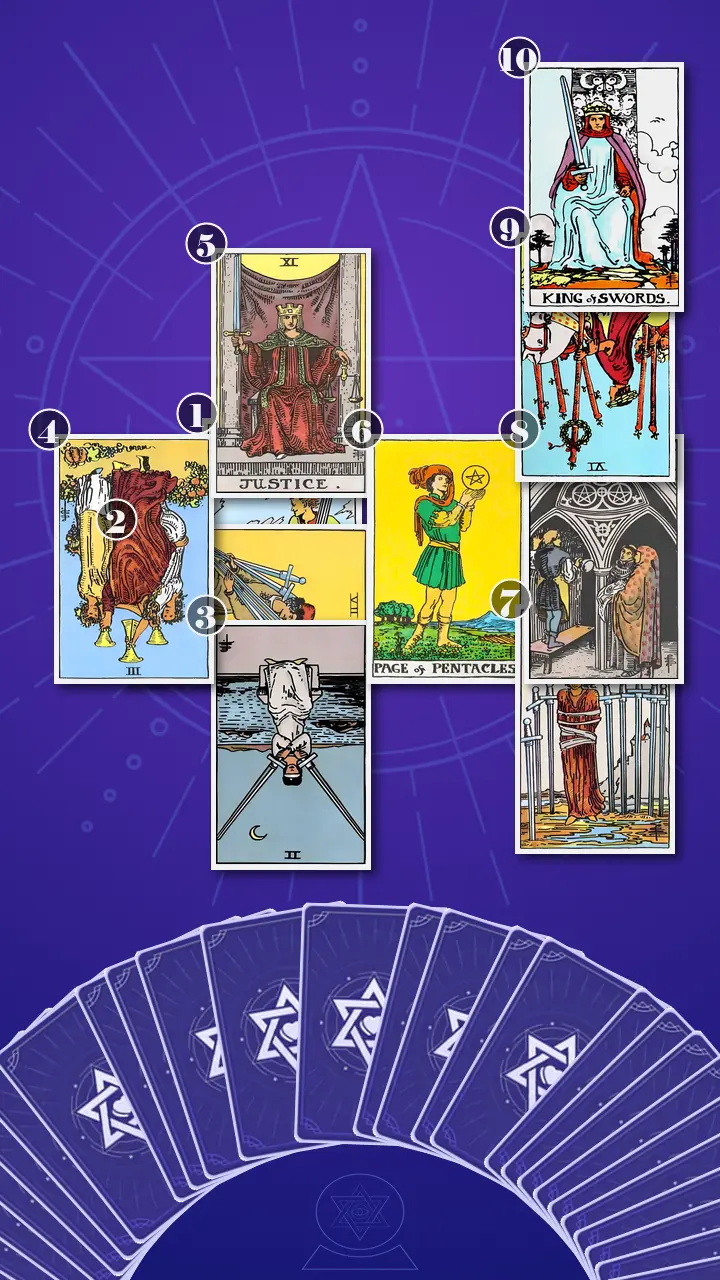
Reading the Map: Card Meanings in Context
Position 1 — What is happening on the surface right now
“Now we turn over the card that represents what is happening on the surface right now (the lived situation in the meeting aftermath),” I said.
Five of Swords, upright.
This one always feels like cold air on the back of your neck. And in modern life, its translation is painfully specific: It’s the after-meeting moment where you realize the room heard a different story than the one you lived—your friend’s confident summary became the headline, and now every follow-up feels loaded, like any correction will start a mini war.
The Five of Swords is Air energy in excess—strategy without relief, replay without resolution. It’s the mental weather of “I need to fix this,” plus the social fear of “If I fix this, I look like the villain.”
Jordan let out a small laugh that was more bitter than amused. “That’s… brutal,” she said. “Like, accurate. But brutal.”
I kept my tone steady. “That reaction makes sense. This card doesn’t just show conflict—it shows the social cost of conflict. The wound here isn’t only the idea; it’s trust and tone.”
Position 2 — The core challenge
“Now we turn over the card that represents the core challenge (what makes the situation hard to address cleanly),” I said.
Seven of Swords, upright.
The modern scenario for this card is almost a transcript of what you described: Your friend didn’t say “I stole this,” they just walked off with the framing—talking fast, presenting your idea as ‘the plan,’ leaving enough ambiguity that calling it out feels socially risky—and you can already imagine them playing it off as a misunderstanding.
This is Air energy in a blocked/sideways form—indirect tactics, deniability, optics management. The obstacle isn’t your competence. It’s narrative control.
Jordan’s eyes narrowed at the card like she wanted it to confess. “It’s the ‘I didn’t technically say it was mine’ thing,” she said.
“Exactly,” I replied. “And here’s where people lose weeks: they try to prove intent. But you don’t have to prove intent to set a norm. You only need to correct the record and make ownership trackable.”
Position 3 — The hidden root
“Now we turn over the card that represents the hidden root (the underlying fear or internal conflict driving hesitation),” I said.
Two of Swords, reversed.
The modern life scenario is the one you’ve been living on loop: You’re internally frozen: you draft “Just to clarify…” in Slack, delete it, then draft a longer version, delete it too. Outwardly you look calm; inwardly you’re blindfolded by the fear that any choice will change how people see you—nice teammate vs assertive professional.
Reversed, the Two of Swords is decision-making energy in deficiency. Not because you can’t decide, but because every option feels like it comes with a social identity cost. The blindfold isn’t “there are no options”—it’s “I can’t see a safe option.”
I asked her the question this position always wants answered: “When you imagine correcting the record, what’s the scariest ‘and then…’ your brain jumps to?”
Jordan didn’t answer immediately. Her fingers tightened around her water bottle, then loosened. “That I’ll look petty,” she said. “And then my manager thinks I’m insecure. And then… I’m not trusted with the next project.”
“That’s the root,” I said softly. “Not the lack of receipts. The fear of losing belonging.”
Position 4 — Recent context
“Now we turn over the card that represents recent context (what happened leading up to this, especially the relationship dynamic),” I said.
Three of Cups, reversed.
In context: Because it’s a friend, not a random coworker, it hits twice: you’re mad about the credit, and you’re grieving the feeling that work-friendship didn’t automatically mean loyalty. You feel tempted to vent to a third person for validation, which risks turning a two-person issue into a team vibe problem.
Reversed, this is social energy in imbalance—triangulation risk. The “circle” becomes unstable. The card’s advice is simple and modern: don’t turn a Slack boundary into a team politics episode.
Jordan’s mouth pressed into a thin line. “I almost messaged another PM like, ‘Am I crazy or…?’”
“That impulse is human,” I said. “But it’s also how this becomes messy. Keep it contained. One private conversation, or one clean recap. No recruitment tour.”
Position 5 — What you consciously want
“Now we turn over the card that represents what you consciously want (your standard for fairness, recognition, and integrity),” I said.
Justice, upright.
The modern scenario is almost calming in its plainness: You’re not craving applause—you’re craving accurate attribution and a consistent standard. You want the team’s process to reflect reality: who proposed it, who owns next steps, what’s documented, and how decisions get tracked.
Justice is balance—truth with structure. In my old life on Wall Street, I used to think fairness was a feeling. Then I watched deals happen. Fairness isn’t a vibe. It’s a system: terms, documentation, repeatability. Justice is that part of you that wants a team culture where “collaboration” doesn’t mean “whoever talks loudest gets the credit.”
Jordan exhaled through her nose, like she’d been holding her breath since Tuesday. “Yes,” she said. “I want it on paper.”
Position 6 — Immediate next step within a week
“Now we turn over the card that represents your immediate next step within a week (the most grounded action you can take now),” I said.
Page of Pentacles, upright.
Here’s the shift from mental warfare to something you can do with your hands: You drop one solid artifact into the shared system: a concise recap, a linked doc, a ticket with clear ownership and next steps. No grand confrontation—just making your contribution visible and trackable while the meeting is still fresh.
This is Earth energy arriving like a weighted blanket. Not in a “bury your feelings” way—in a “make reality trackable” way. The Page doesn’t argue. The Page ships a first draft.
I watched Jordan’s shoulders lower a fraction. That’s the Page’s effect: the body recognizes something doable.
“This is where I’m going to give you a sentence you can steal,” I said. “Because in work politics, one artifact beats ten drafts.”
She gave a short, surprised laugh—less bitter this time. “Version history as receipts,” she said.
“Exactly,” I replied. “Google Docs and Notion don’t care who’s charismatic. They care who wrote it.”
Position 7 — Your stance and agency
“Now we turn over the card that represents your stance and agency (how you’re holding yourself, and what you can control),” I said.
Eight of Swords, upright.
The modern scenario is the cage you described perfectly: You feel like there’s no safe script, so you choose silence. Then silence becomes precedent, and you feel even more boxed in. It’s not that you have zero options—it’s that fear makes every option feel like a social landmine.
Let me freeze-frame it the way this card insists we do: your laptop open, the Slack thread glowing, the cursor blinking like a tiny metronome counting down your courage. Your jaw clenched. Your chest tight. Your inner monologue running the same two lines on repeat: If I say it, I’m petty. If I don’t, I’m invisible.
This is self-censorship energy—Air turned inward until it becomes a trap. The bindings in the card are loose, though. That’s the point: the fear is real, but the constraint is not absolute. One deliberate step changes the geometry.
Jordan stared at the card, then at the table. “It feels like a career-limiting move either way,” she said, quietly.
“I hear that,” I said. “But we’re going to separate real risk from imagined certainty of fallout. Most teams don’t punish clarity. They punish chaos. And you’re not proposing chaos—you’re proposing alignment.”
Position 8 — Your environment
“Now we turn over the card that represents your environment (team culture, power dynamics, and what others are likely responding to),” I said.
Three of Pentacles, upright.
This card’s modern translation is basically: Your workplace responds to structure more than vibes: when roles, owners, and artifacts are clear, people respect it. The environment is telling you: put it in the system (doc/ticket/plan), and the system will help hold the truth.
Earth energy in balance. A system that can be worked with. That matters, because it means you’re not trying to change human nature; you’re trying to use process—recaps, owners, deliverables—to keep attribution accurate.
I said, “This is your permission slip to be boring. To be the person who writes the recap, links the doc, tags the DRI. That’s not petty—that’s product management.”
Jordan’s lips twitched. “So… I can treat this like updating a shared doc, not a moral debate.”
“Exactly,” I said. “Like fixing a commit message, not fixing it with vibes.”
Position 9 — Hope and fear
“Now we turn over the card that represents hope and fear (what you’re afraid will happen if you speak up, and what you’re craving),” I said.
Six of Wands, reversed.
Its modern scenario is the one that makes you refresh Slack like it’s a scoreboard: You’re scared this becomes your reputation: the person who does the thinking while someone else gets the public praise. You keep checking Slack reactions and manager comments like a scoreboard, and it makes you either want to disappear or overperform loudly.
Reversed, this is recognition energy in blockage. The fear isn’t just “I won’t get credit for one idea.” It’s “I’m being assigned a brand I didn’t choose.”
“This is where the soft skills tax shows up,” I told her. “If you’re quiet, you’re ‘easy.’ If you’re direct, you’re ‘difficult.’ That’s not fair—but it’s real.”
Jordan’s eyes flashed. “So what am I supposed to do?”
I didn’t sugarcoat it. “Choose a third option: be clear. Being ‘nice’ shouldn’t require being invisible.”
And then I slid my thumb to the last card, the one I’d been waiting for—the antidote.
When the King of Swords Set the Terms
The room felt quieter as I turned it over, like the HVAC in that glass meeting room finally clicked off and you could hear your own breathing again.
“Now we turn over the card that represents the best-integrated way forward (a communication and boundary strategy that protects both clarity and professionalism),” I said.
King of Swords, upright.
In modern terms: You correct the record with calm authority: one factual line that names your contribution, plus a clear next step in writing. You don’t litigate intent. You set a repeatable boundary and let consistency—not emotional intensity—do the work.
Setup. I looked at Jordan and named the exact trap she’d been living in: you’re on the TTC refreshing Slack, jaw tight, watching a recap turn your idea into someone else’s story—while you argue with yourself about whether clarity will make you look “difficult.” You’re trying to find the one perfect sentence that can’t be criticized, and the search itself is keeping you silent.
Delivery.
Stop trying to be "easy" at the cost of being erased; speak with clean facts and calm authority—like the King of Swords who names reality and sets the terms.
I let that sit for a beat. No extra words. Just air.
Reinforcement. Jordan’s face changed in layers: first a small stillness, like her brain had paused the constant playback. Then her eyes unfocused for a second—like she was replaying that Wednesday meeting in the glass room, seeing the moment her friend said “as I mentioned,” and noticing the exact second she swallowed her voice. Her shoulders, which had been held up like armor, sank half an inch. Her hands unclenched from the bottle without her noticing. Then her throat worked, a swallow that wasn’t about water. “But if I do that,” she said, voice thinner than before, “doesn’t that mean I should’ve done it immediately? Like… I messed up?”
That’s the vulnerable part of clarity: it doesn’t just show you what to do next; it shows you where you’ve been paying a quiet cost.
“No,” I said, firm and kind. “It means you’re done paying the ‘easy’ tax. Clarity is not cruelty. It’s a boundary you can repeat. And you’re allowed to start repeating it now.”
Then I brought in the toolset I built long before tarot—back when I negotiated terms sheets for people who smiled while they tried to take an inch. “This is where my Negotiation Alchemy lens helps,” I told her. “In any negotiation, you need two things: a clean narrative and a BATNA—your best alternative if the other person plays dumb. Your BATNA here isn’t ‘blow up the friendship.’ It’s: you have an artifact, a doc, a recap, a deliverable with your name on it. That’s leverage without drama.”
I asked her, gently but directly: “Now, with this new lens—think back to last week. Was there one ten-second moment where this sentence would’ve changed how you felt in your body?”
Jordan nodded once, sharp. “When the recap hit,” she said. “I could’ve replied in-thread. One sentence. Not paragraphs.”
That nod was the shift—from hot anger and disbelief toward calm, fact-based self-advocacy. Not perfect. But real.
From Insight to Action: The One-Page Credit Protocol
When I looked across the whole spread, the story was clean: a Swords-heavy situation (Five + Seven + Two reversed + Eight) created a loop of rumination and self-censorship, especially because friendship made the social stakes feel higher (Three of Cups reversed). Justice showed Jordan’s true north—standards, accuracy, integrity. Then Earth arrived (Page + Three of Pentacles): documentation, deliverables, shared systems. And finally, the King of Swords turned that mental energy into something mature: calm authority you can repeat.
The cognitive blind spot I named for Jordan was simple: she’d been trying to solve a systems problem with a likability strategy. Hoping fairness would emerge on its own. The transformation direction was the opposite: stop hoping the story corrects itself; start making your contribution trackable and speakable—in real time and in writing.
“You don’t need to win a courtroom,” I told her. “You need a protocol.”
- Drop the artifact (24–48 hours)In the shared Slack channel (or a thread on the recap), send a 4–6 line recap that includes one neutral ownership sentence and one forward-moving deliverable. Example: “Quick recap: In the meeting I proposed X (goal: Y). I’ll write up a 1‑pager with options by Friday EOD; please add comments in the doc.”If your nervous system spikes, set a 7-minute timer. Draft only the two sentences (ownership + next step), send it as-is, then step away from Slack for 20 minutes.
- Create your ‘credit script’ in Notes (10 minutes)Make a template with three versions under 25 words each: (A) Slack recap line, (B) live-meeting line, (C) private DM line. Keep them reusable, like a saved reply. Your live-meeting version can be: “Just to clarify for the notes: I brought up X, and the intent was Y.”Ask yourself as you write: are you trying to be understood—or trying to be un-criticizable? Choose clarity over perfection.
- If you address the friendship: use my Cocktail Party Algorithm (15 minutes)Send a calendar invite for a short private chat. Then follow a 3-phase script: (1) Warm open: “I value working with you.” (2) Clear boundary: “When X was summarized as your idea, it put me in a tough spot. Going forward, I need my contributions attributed accurately in meetings.” (3) Close with process: “Let’s do quick owner callouts in recaps so we’re aligned.”Don’t debate intent. One request, one norm. If it gets heated, repeat: “I’m not accusing; I’m aligning the record.”
Before we ended, I offered one more grounding tool—small, practical, and a little “me.” “If you’re going into a meeting where you need King of Swords energy,” I said, “try a tiny intention cue. My clients sometimes use Dress Code Cryptography: wear something that signals calm authority to you—a solid color, clean lines, no ‘apology outfit.’ It’s not about optics. It’s about reminding your body you’re allowed to take up professional space.”

A Week Later: Ownership, Not Certainty
Six days later, Jordan texted me a screenshot: a Slack thread reply, short enough to be boring. Two sentences. Ownership and next step. No “just.” No backstory. No vibe-management. Under it, a teammate had reacted with a simple thumbs-up. Her manager had replied: “Perfect—thanks for capturing this. Looking forward to the 1‑pager.”
Her follow-up message came after the screenshot: “My hands were shaking when I hit send. Then I felt… weirdly calm. Like I could finally focus.”
The bittersweet part showed up too, because it always does: she told me she slept through the night for the first time in a week, but when she woke up her first thought was, What if they think I’m difficult? Then she paused, stared at her own sent message, and said out loud, “No. That was clear.”
That’s what this kind of tarot reading is for—finding clarity at a career crossroads, yes, but also taking a feeling-stuck moment and turning it into actionable advice and next steps you can actually do between meetings.
When someone edits your work out of the story while you’re still in the room, it’s not just anger—you can feel your body go tight because you’re trying to protect belonging and credibility at the same time.
If you didn’t need a perfect confrontation—just one clean, repeatable sentence—what would you want that sentence to be this week?