Three Tabs Open in a Childhood Room—And the Shift to One Fair Choice

The 3:12 p.m. Glitch in a Childhood Bedroom
When Maya (name changed for privacy) booked with me, I recognized a pattern I hear constantly from late-20s freelancers back in Toronto: one normal afternoon becomes a client draft, a banking app, and a half-written Hinge reply all open at once, and one sound in the hallway is enough to tip the whole thing into decision paralysis. By the time she found me, she had already searched some version of why can’t I focus in my childhood bedroom and moved back home and feel like a teenager again.
She was 28, a freelance graphic designer, temporarily back in her parents’ house because Toronto rent had turned adult life into a math problem with attitude. At 3:12 on a Tuesday, she sat in her childhood bedroom with a client brief open on her laptop, Wealthsimple glowing on her phone, and a half-typed Hinge reply blinking in another tab. The radiator clicked. Her old desk lamp cast the same yellow light she grew up with. The duvet smelled faintly of home laundry soap.
She looked at me over the screen and said, “I can handle my life anywhere else, so why does this room make me feel seventeen?” Her shoulders had locked upward, her chest was heavy, and her attention kept skidding from one tab to the next. The disorientation wasn’t abstract; it felt like trying to read a TTC map inside a shaken snow globe. She wanted clarity around work, money, and dating, but the minute the room woke up around her, childhood patterns took the wheel. She knew these were adult tasks, but in this room they stopped feeling like hers.
I didn’t rush to correct her. I just nodded. “That makes sense to me,” I said. “We don’t need to shame the fog. We need to map it. Let’s make this a journey to clarity.” That was why I reached for my Energy Diagnostic Map · Context Edition right away: not to tell her fate, but to show her where the blur lived, what fed it, and where her adult self was already waiting.

Choosing the Weather Map
I asked Maya to put both feet on the floor and take one slow breath while holding the question in plain language: why do work, money, and dating all go blurry in this room? I shuffled slowly, the way I do at the planetarium when I dim the room before a show begins—not for drama, but to help the mind stop sprinting and focus on one sky at a time.
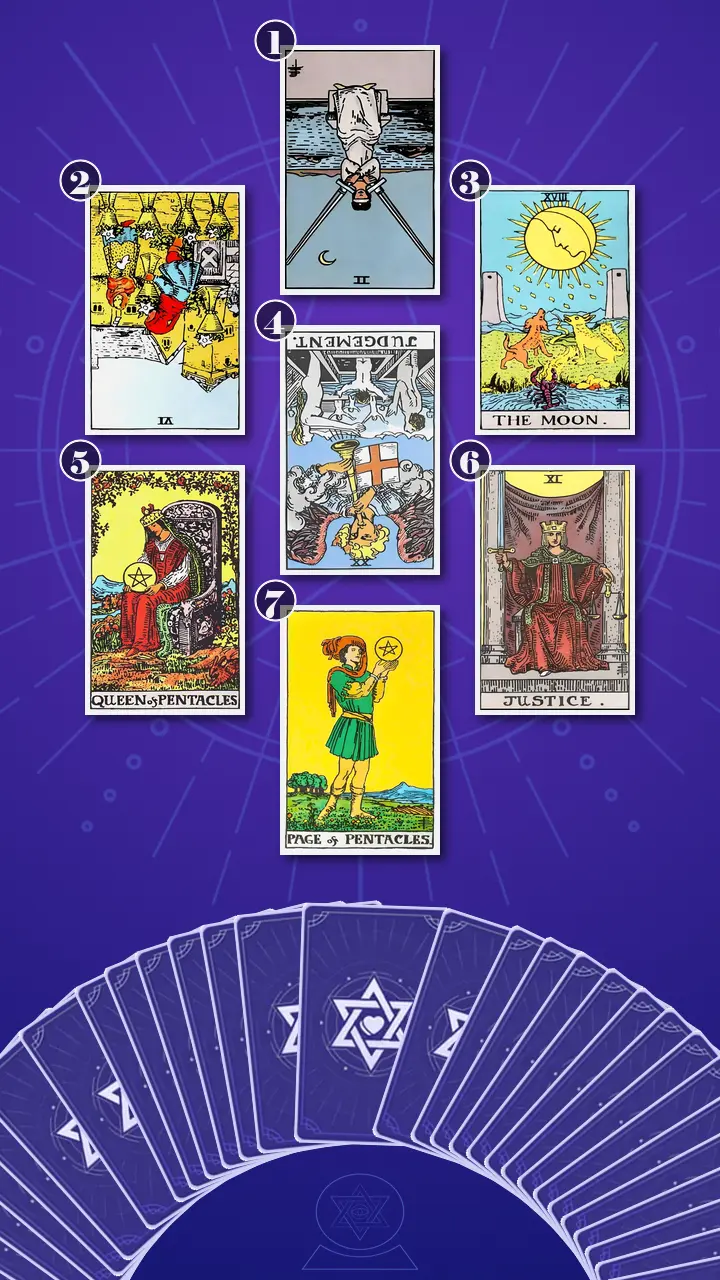
I told her I was using the Energy Diagnostic Map · Context Edition. This is how tarot works best for me: like a sky chart. I’m not using the cards to announce an unavoidable future. I’m using them to locate pressure, motion, interference, and available direction. For a problem like adult identity regression in a childhood bedroom, a simple Past-Present-Future spread would flatten the issue. Her struggle wasn’t a timeline. It was a loop: visible blur, inner regression, environmental haze, core blockage, stabilizing resource, key shift, embodied next step.
I showed her the circular layout. The top card would reveal the surface symptom—the multitab blur across work, money, and dating. Two cards to either side would show the inner tug-of-war and the environmental amplifier. The center card would name the real blockage. Then the lower arc would show the resource already available, the transformation that could restore clarity, and one practical next step that would make self-trust visible again.
Reading the Pressure System
Position 1: The Tabs That Look Like Productivity
I turned over the card representing the surface symptom from the diagnosis: the specific blur, multitasking, and unfinished decisions showing up across work, money, and dating. It was the Two of Swords, reversed.
The image was almost too accurate. Maya was right there in it: on the bed mid-afternoon with a client revision open on her laptop, Wealthsimple on her phone, and a dating reply blinking in another tab. She kept toggling between them, adjusting her Spotify focus playlist, and rereading drafts, because staying half-engaged with all three felt safer than risking one wrong move in the room. This was blocked Air energy leaking into everything—not a lack of intelligence, but clarity jammed by over-monitoring. The crossed swords over the chest showed self-protection posing as thoughtfulness. The loosened blindfold told me she could partly see the issue already.
“Which tab do you bounce away from first,” I asked her, “the client email, the money decision, or the dating reply?”
She let out a short laugh that landed with a little bitterness. “Okay, wow. That’s rude,” she said. “Also, the client email.” Her thumb kept rubbing the edge of her phone while she said it. That half-laugh was the exact response I expected: instant self-recognition. The day looked active, but nothing had landed.
Position 2: The Orbit of the Younger Self
Next I turned the card representing the inner tug-of-war behind the symptom: the pull between present-day adult agency and older childhood responses that reawaken in the room. It was the Six of Cups, reversed.
This card showed me that the room was not just reminding her of the past; it was quietly recruiting her back into it. The second Maya sat at the same desk she used in high school, beneath old posters and beside school-era objects, her inner voice got younger. She started waiting to feel allowed before spending money, answering a client, or replying to someone she liked, as if the room restored an older script where caution and approval mattered more than agency. That is Water pulled backward: familiar, soft-looking, and deeply interfering.
I looked at the card, then back at her shelf of trophies and old paperbacks. “The room remembers an older you,” I said. “It does not outrank the you who lives now.”
Her eyes flicked toward the yearbook on the shelf. She exhaled through her nose, long and thin, like someone finally noticing she’d been bracing without meaning to. “It’s like my voice changes in here,” she said. “Even in my own head.”
Position 3: Moonlight on Ordinary Tasks
I turned the card representing the environmental amplifier: how the childhood room and its emotional cues intensify the blur. The Moon appeared upright.
The Moon was perfect here. The room acted like emotional moonlight: not false, just dim and charged. A basic adult task—sending a client email, checking a balance, confirming a date—started carrying meanings far bigger than the task itself, especially when family noise, old objects, and evening light made the space feel both comforting and surreal. It had that strange Severance quality: familiar set, altered operating system. The dog and the wolf in the card mirrored the split inside her body—part of her trying to stay socially composed, part of her going feral with projection.
“A trigger is not a verdict,” I told her. “The Moon doesn’t mean the room is telling the truth. It means the signal is distorted.”
By then, rain had started tapping lightly against her window, and the sound made the room feel even more sealed. I asked what shifted first in her body when the old bedroom took over. “My throat,” she said immediately. “Then my chest. Then my head gets weirdly floaty.” Naming the room-weather made the card usable. Once the atmosphere had a name, it stopped pretending to be destiny.
Position 4: The Invisible Approval Panel
Then I turned the center card, the one naming the central blockage from the psychological mechanics: the underlying fear and old self-judgment keeping the pattern alive. It was Judgement, reversed.
This was the tightest knot in the whole spread. Judgement reversed told me Maya often already knew the next responsible move, but in this room she delayed as if an invisible panel from the past still had the right to approve or reject her adulthood. She audited her choices instead of inhabiting them. She waited for certainty, permission, or absolution that never arrived. The problem wasn’t only confusion. It was self-recognition held in draft mode.
“If we strip away the practical excuses,” I asked, “what are you actually afraid a wrong move in this room would prove about you?”
Her gaze dropped to the duvet. First her jaw tightened. Then her eyes lost focus for a second, like she was replaying a Sunday afternoon of unsent emails and reopened budget notes. Then her voice came out quiet and embarrassed. “That I’m less stable than I thought,” she said. “That maybe I only look adult when I’m not here.”
The shame in that sentence was quiet, but it filled the room more than any hallway noise. As she said it, I had one of those small professional flashes I sometimes get from years under the planetarium dome: people think the stars vanish when city glow obscures them, but the stars are still there. Conditions changed; essence did not. Her capability felt the same to me—obscured, not absent.
Position 5: The Room That Serves the Life You Live Now
I turned the card representing the underused resource already available to her—the part of her that could create steadiness and self-support inside the trigger space. It was the Queen of Pentacles, upright.
I was relieved to see her. This was Earth entering the spread at exactly the right moment. The Queen of Pentacles said the antidote would not begin as a dramatic mindset overhaul. It would begin with physical support. Maya’s shift started the moment she treated the room like a place that needed practical care rather than psychic purity: water on the desk, one lamp on, old school clutter moved out of direct eyeline, charger plugged in, calendar open, both feet on the floor, one current-life object within reach. The Queen does not ask her to perform adulthood. She asks her to support it.
Maya’s shoulders dropped for the first time. “Okay,” she said, looking at the card instead of away from it. “That I can actually do.” That tiny exhale mattered. It was the first felt sense of change: less trapped, less abstract, more embodied.
When Justice Raised the Sword
Position 6: The Antidote
When I reached the sixth card, the atmosphere shifted. In this spread, this position carries the key transformation: the precise cognitive and behavioral shift needed to interrupt the regression loop and restore self-trust. The card was Justice, upright.
Before I said anything else, I let the scene sharpen in both our minds: the laptop open, the banking app lit up, a text half-written, someone moving past the bedroom door, her chest getting heavy while her thoughts tried to buy ten more minutes. This was the exact place where she kept waiting to feel clear before she acted.
You do not need to keep hiding behind crossed swords and old verdicts; let Justice raise the sword of discernment and choose from your present values, not the room’s memory.
I let the sentence stay in the air. First her breathing paused. Then her fingers froze halfway around her mug. Then her eyes went slightly unfocused, as if three or four recent afternoons were replaying at once. When she finally spoke, there was a flash of anger in it. “But if that’s true,” she said, “then I’ve been letting a room decide way too much.”
“Not decide,” I said gently. “Trigger. There’s a difference.” I leaned a little closer to the card. “In my Galactic Gravity Analysis, family spaces behave like gravity wells. They can pull posture, timing, even desire into an older orbit. But gravity is influence, not destiny.” Looking at Justice’s upright sword, I flashed back to the clean white vector lines I draw across the Tokyo planetarium dome when I explain orbital correction. A spacecraft doesn’t need to escape the whole system in one move. It needs one precise burn. “Justice is that burn,” I told her. “In plain language, it’s switching from vibes to receipts. Not ‘Who do I become in here?’ but ‘What is the fairest next choice for my current self?’”
Her face softened and flushed at the same time. One shoulder dropped, then the other, and with the release came that strange moment I often see after a real insight—the slight dizziness of standing up too fast inside your own life. She blinked hard. “So I don’t need the room to feel neutral first?”
“Exactly,” I said. “Clarity is not what you wait for in this room; it’s what you rebuild with one fair choice. Now, with this new frame, think back to last week. Was there a moment when this would have changed how you felt?”
She nodded slowly. “The coworking pass,” she said. “I knew I needed it. I turned it into some moral issue.”
That was the real crossing point in the reading. Not from shame to perfection, but from disorientation and self-doubt toward grounded agency. Justice was not asking her to become immune to old weather. It was inviting her to become the fair authority in her own life while the weather still existed.
Position 7: The Small Proof That Lands
Finally, I turned the card representing the grounded next step: one concrete, manageable action that rebuilds adult agency in real time. It was the Page of Pentacles, upright.
This card always feels refreshingly honest. The Page of Pentacles doesn’t promise a total life reset. It asks for one measurable completion. One invoice sent. One savings transfer made. One dating reply answered with a clear sentence. One client follow-up written and sent before the mind opens seventeen backup tabs. The Page studies one pentacle, not the whole mountain range. One completed task is better evidence than ten loops of overthinking.
Maya gave a second laugh, softer this time. “So basically,” she said, “stop making a Notes app system for the task and just do the task?”
“Exactly,” I said. “Twelve minutes. One finish line. Beginner energy is not a downgrade here. It’s medicine.” She sat a little straighter after that, the kind of posture that tells me someone is no longer asking whether change is allowed, only whether it is doable.
From Fog to a Usable Forecast
When I looked back over the whole spread, the story was clean. Two of Swords reversed showed the visible productivity theater: the client draft, the banking app, the unanswered Hinge message, all half-open so commitment could be postponed while activity still looked convincing. Six of Cups reversed and The Moon explained why this happened specifically in the childhood room: the younger self got activated, and the environment thickened ordinary choices into emotional events. Judgement reversed revealed the deepest blockage—she was waiting for a permission slip from an invisible panel, treating a triggered state as evidence about her adulthood. Then Queen of Pentacles, Justice, and the Page of Pentacles reorganized the system: steady the body and the room, separate room-weather from present facts, then build self-trust through one clean completion.
I said it to her as clearly as I could. “Your blind spot isn’t that you’re weak here. It’s that you’ve been treating the room as proof. The shift is smaller and stronger than that: the room becomes a setting, not an identity. Old weather may still roll in, but it doesn’t get the steering wheel.”
When I started translating that into action, Maya immediately said, “But I don’t always have ten clean minutes in that house.” I appreciated that. Real obstacles matter. So I gave her a stripped-down solo version of my Solar Eclipse Mediation, a three-part method I usually use for conflict: name the shadow, reduce the glare, choose the line of light you can actually follow. We made it practical enough to survive a real Tuesday.
- Boundary-First Bedroom RitualBefore weekday work, spend 5 minutes making the room visibly support your current life: put water on the desk, switch on one lamp, move school-era objects out of your eyeline, plug in your charger, open your calendar, and place one present-day object—a work notebook, planner, headphones, transit card, or laptop stand—in the center of the desk.If resistance says this is too small to matter, treat that as old fog. Do the minimum version if you need to: one glass of water, one cleared square of desk, one current-life object in view.
- The One Fair Choice MethodBefore opening a second tab, read the note: “What is the fairest next choice for my current self?” Then choose one domain only—work, money, or dating—and within 10 minutes write two lines: “Room weather: ___. Fact: ___.” After that, make one values-based move: send the email, make the transfer, or answer the message.If 10 minutes feels too sharp, shrink it to 2. The goal is not perfect calm. It is one fair present-day decision.
- Single-Task Completion SprintFor 3 days this week, do not switch domains until one measurable task is complete. Set a 12-minute timer and define the finish line before you begin: one invoice sent, $75 transferred, one clear dating reply, one client follow-up delivered.Keep it almost boringly specific. Completion over intensity. If you get activated halfway through, stand up, feel your feet on the floor, and finish a smaller version without turning the pause into self-criticism.
None of this required her to solve work, money, and dating all at once. It only required one clean data point at a time. That was the whole principle: a trigger is not a verdict, and self-trust compounds faster through evidence than through analysis.

A Week Later: The Quiet Proof
A week later, Maya sent me a photo instead of a long update. In it, I could see a cleared square of desk, a glass of water, her current planner covering the old yearbook, and only one browser tab open. Her message was short: “Invoice sent before anything else. Booked the coworking pass. Replied yes.”
She added one more line: “I still woke up with the thought, what if I got it wrong? But I laughed, made coffee, and opened one tab.”
That was the real gift of the Energy Diagnostic Map · Context Edition. It didn’t magically remove every old feeling from the room. It showed her that the pattern was organized, which meant it could be reorganized. The room still had memory. She still had choice. And in the end, her life moved because she moved it.
Sometimes the strangest part of being back in your childhood room is how a totally ordinary email, bank transfer, or text can tighten your chest like one wrong move could shrink you back into a version of yourself you thought you’d already outgrown. If the room is weather and not a verdict, what is one small present-day choice you might want to make there this week?
Every reading at AceTarot is a Journey to connect with inner wisdom and empower next step.
Learn more about our Journey to Clarity.