When Dad Asked 'You Okay?': Letting One Honest Sentence Stay

When Dad Asked if She Was Okay, the Joke Arrived First
I have learned that if you’re a twenty-something city worker who can survive a TTC commute, write a polished client email, and still answer Dad’s “Are you okay?” with a joke about your flop era, a reading like this will land close to the bone.
When Jordan (name changed for privacy) joined me, she did not start with a dramatic confession. She gave me a Wednesday-evening image instead: Line 1 southbound, doors beeping, fluorescent light buzzing, winter coats pressed too close, her phone warm in her palm, Dad’s text glowing on the screen—You okay? She typed the real answer, deleted it, and sent, “just thriving on caffeine and consequences,” then asked if he had watched the game.
She made a quick half-smile while telling me, the kind that shows up a split second before the jaw locks. “I want him to know I’m not okay,” she said, “but the second he asks, I panic and make it funny.” What sat in her throat felt almost visible to me, like trying to swallow a shard of sea glass while smiling for a photo: bright, sharp, and determined not to cut anyone else.
She told me she had already done the late-night search-bar version of this—why do I make jokes when someone asks if I’m okay, is self-deprecating humor a defense mechanism, why does a caring text make me panic—and none of those questions were silly. They were accurate. All day she knew how to do Slack-green-dot energy: available, competent, lightly funny. But when direct care arrived, that polished version of her kept stealing the microphone.
“That makes sense,” I told her. “We are not here to shame the joke. We are here to see why it speaks first, and how to help one honest sentence survive long enough to reach your dad.”

Choosing the Bridge: A Situation-Obstacle-Advice-Outcome Spread for Emotional Honesty
I asked her to put her phone face down, take one slow breath, and hold the question exactly as it lives in her life: Dad asked if I was okay—why do I still make it a joke? Then I shuffled, not as theater, but as a way of helping the nervous system stop sprinting long enough to notice itself.
For this reading, I chose a Situation-Obstacle-Advice-Outcome tarot spread for emotional honesty. When people ask me how tarot works in moments like this, I say that I am not using the cards to predict whether a father will respond perfectly. I am using them to reveal a pattern: the visible reflex, the hidden defense, the medicine, and the next grounded step. This four-card layout is especially strong when someone keeps deflecting feelings with humor, because it is compact enough to stay honest and spacious enough to show the full chain.
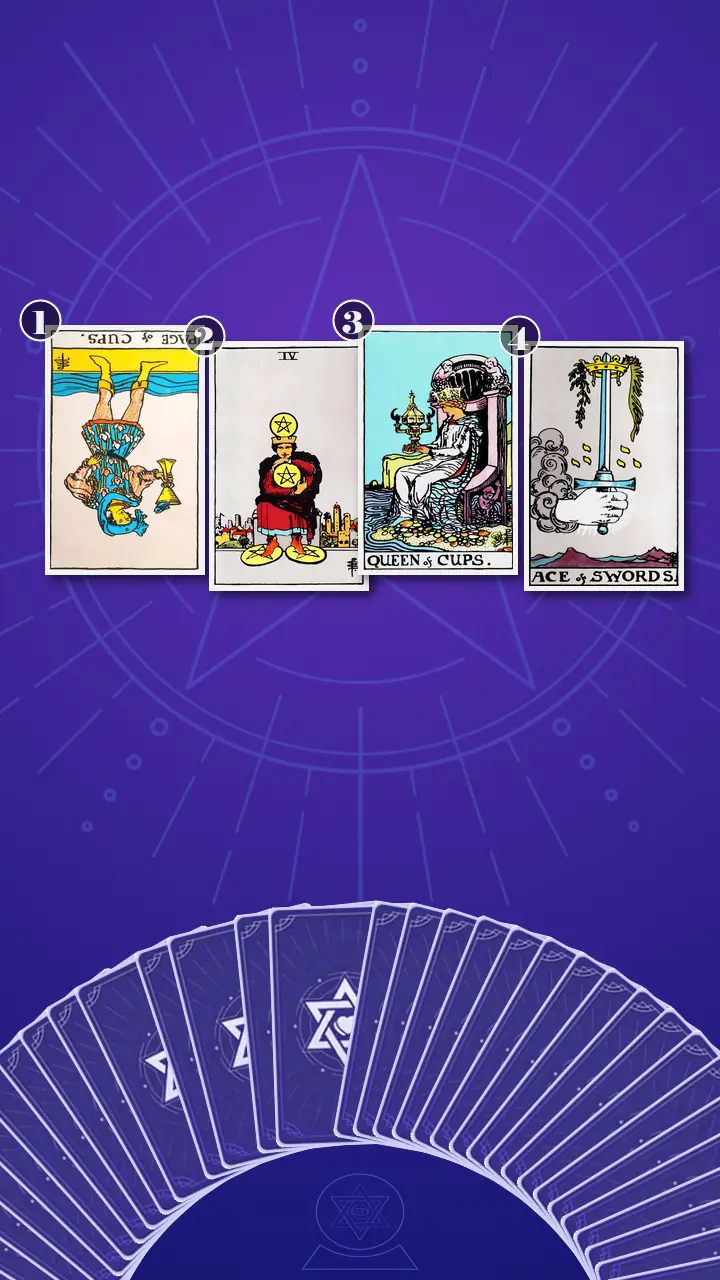
I laid the cards in a straight line like a short bridge. The first would show the exact five seconds between being noticed and answering. The second would reveal what honesty seems to cost her. The third—the hinge of the whole reading—would show the corrective energy that supports emotional self-trust. The fourth would show how that inner shift becomes a cleaner response pattern in real life.
Reading the Bridge from Reflex to Truth
Position 1: The Message That Turned Into a Bit
Now I turned over the card representing the visible symptom knot: the specific moment when care arrives and is turned into humor instead of honesty. It was the Page of Cups, reversed.
In real life, this was exactly the scene Jordan had just described: Dad texts late after a rough day, the first real reply flashes up for half a second, and then a Fleabag-level joke lands where the honest feeling almost could have. The fish rising from the Page’s cup is that sudden real feeling—unexpected, tender, a little awkward. Reversed, the message does not disappear. It comes out sideways.
This is blocked water, not absent water. Feeling surfaces, then gets autocorrected into wit before anyone can touch it. The joke is not random. It is the shield that learned to speak first. Jordan was not failing to answer care; she was rerouting it through charm fast enough to stay in control of the mood.
Jordan let out a small laugh that carried a sting in it. “Okay,” she said, rubbing her thumb against the rim of her mug, “that is accurate enough to be annoying.” Then, more quietly: “If I make it funny, it doesn’t get weird.”
Position 2: The Grip That Calls It Control
Next, I turned over the card representing the deeper block beneath the joke, especially the need to stay controlled, easy, and unreadable when vulnerability is invited. It was the Four of Pentacles, upright.
This card could not have been clearer. On a call with Dad, Jordan keeps the conversation anchored in safe, measurable things—deadlines, rent, groceries, TTC delays, who needs what, what got done—because practical competence feels less risky than being emotionally received. The coin pressed to the chest tells the whole story. She is holding the truthful answer so tightly that care begins to feel invasive instead of comforting.
Here the energy is not balance. It is excess earth: over-control, over-containment, over-management. The hidden belief underneath it is, If I say the real thing, now I have to manage his worry too. A conversation can stay light and still leave you alone.
When I see this card in family readings, I often use a lens I call Generational Echo Mapping. In Venice, a voice thrown across a narrow canal does not come back as the same sound; it returns altered by stone, distance, and memory. I told Jordan that when her dad asks, “Are you okay?”, she is not only hearing his present question. She is also hearing older echoes: stay easy, stay competent, do not become a problem, do not drop the mood. So she answers the echo before she answers him.
For a brief second, I flashed back to my years on cruise decks, watching passengers grip the rail hardest just before the swell passed. Control rarely meant the sea was dangerous; it meant the body had decided bracing felt safer than feeling. Jordan did the same thing with language.
She went still in three visible beats. First her fingers tightened in the sleeve of her hoodie. Then her eyes slid away from the screen, as if she were replaying a dozen family calls at once. Then the exhale came—long, low, and unwilling. “Yes,” she said. “That’s the part nobody sees. I’m already managing the reaction before anything has even happened.”
When the Queen of Cups Held the Room Still
Position 3: The Lidded Cup and the Ten-Second Pause
When I reached the third card, the atmosphere changed. On Jordan’s end, the kettle clicked off and the kitchen went quiet except for the low fridge hum. In my room, the afternoon light from the canal stopped flickering and rested flat against the table. This was the hinge of the reading—the card representing the key corrective energy that directly challenges the defense pattern and supports emotional self-trust.
I turned it over. Queen of Cups, upright.
This is what Queen of Cups advice for vulnerability actually looks like in real life: before replying, Jordan gives herself a brief private pause and notices what is true—“I’m more worn down than I’ve been saying”—without mocking it, polishing it, or turning it into a bit. The Queen’s lidded cup matters here. She does not spill everything. She does not deny what is inside, either. It is the emotional equivalent of a spill-proof mug: the feeling is real and present, but it does not have to flood the whole room. This is balanced water, mature water, held water.
Because I grew up around Murano glass, I offered Jordan one of my oldest lenses: the Glass Workshop Metaphor. Hot glass does not become beautiful because someone grabs it harder; that only warps the form. It needs steady breath, a shaping hand, and a moment in the annealing oven so it can cool without shattering. “Your feeling is like that,” I told her. “It is not dangerous because it exists. It gets distorted when you throw a joke over it too fast. The Queen of Cups is emotional annealing. She lets the feeling keep its shape long enough for you to know what it actually is.”
I asked her to picture the commute again: train rattling, phone warm in her hand, Dad’s text open, the joke already halfway up her throat because speed still feels like safety and honesty still feels like exposure.
Stop turning tenderness into a punchline; let the Queen of Cups hold the feeling in her lidded cup long enough for one honest sentence to surface.
Jordan froze first. Her fingers stopped moving on the mug handle, and even her mouth forgot its usual quick half-smile. Then the recognition moved inward; her eyes went slightly unfocused, not blank, but busy—as if she were watching every deleted draft, every “lol I’m fine,” every polished paragraph that had replaced one simple truth. When she looked back at me, the first thing that surfaced was not relief. It was resistance. “But if I do that,” she said, and her voice sharpened for a second, “won’t he worry? Doesn’t that mean I’ve basically been making this worse?”
“No,” I said gently. “It means you have been trying to control a reaction before it even arrives. You do not have to tell the whole story to tell the truth.”
That was the turning point. Her jaw loosened. Her shoulders dropped by an inch. A breath came out of her chest like it had been waiting behind a locked door all week. There was relief in it, yes, but also that strange little dizziness that comes after a heavy bag slides off your shoulder and you suddenly have to learn your own balance again. I asked her, “Now, with this new lens, can you think of a moment last week when one honest sentence would have changed how alone you felt?” She nodded before she answered. “Thursday night,” she said. “I had the sentence. I just didn’t let it live long enough.”
That is the real shift the Queen brought into the room: from performing okayness to stay easy to love to testing support through direct, contained honesty. Not oversharing. Not collapsing. Just letting one true line survive.
Position 4: The Sentence That Finally Cuts Through
Finally, I turned over the card representing the most grounded next step for integration: how honest feeling becomes clear language and a healthier response pattern. It was the Ace of Swords, upright.
This card is clarity with almost no decoration. In real life, it looks like Jordan answering the next check-in with a clean sentence such as, “Honestly, I’ve been more overwhelmed than I’ve let on,” instead of burying the truth under irony, disclaimers, or a breezy paragraph that sounds social-media-capable but says almost nothing. It is like clearing a fogged-up screen with one swipe so the message underneath can actually be read. The sword rises from cloud because clarity is the last step, not the first.
This is balanced air. Not too many words. Not zero words. Just an accurate one. My Ace of Swords advice for speaking the truth is always simpler than people expect: say less, but say what is real. One honest sentence is still honesty.
Jordan gave me the first soft laugh of the session that did not feel defensive. “That actually feels more doable,” she said. “Like… less polished, but more real.” She had just described the card perfectly.
From Mood Control to One Honest Sentence
Taken together, the cards told a very coherent story. The Page of Cups reversed showed the unsent emotional message getting turned sideways into wit. The Four of Pentacles showed why: honesty had become linked with burden, worry, and loss of control, so practical updates stepped in like body armor. The Queen of Cups showed the antidote—holding the feeling without mocking it or spilling it. And the Ace of Swords showed the outcome of that practice: plain truth, spoken cleanly.
Jordan’s cognitive blind spot was not that she used humor. Humor is not the problem. Disappearing inside it is. She had been assuming that if her dad heard the real answer, the whole mood would drop and she would immediately become responsible for his feelings. The transformation direction was gentler and more radical than “be more vulnerable.” It was this: stop using humor to control the room, and start using one direct sentence to reveal what is actually true.
Because her biggest fear was getting pulled into managing his reaction, I gave her one of my own practical tools—the Bollard Marking Method. In Venice, a boat does not stay steady by pretending the tide is calm. It stays steady by tying to something solid. A healthy honest reply can work the same way: one line of truth, one line of boundary, no unnecessary performance.
The One-True-Sentence Dock Line
- Build the “One True Sentence” noteTonight, open your Notes app and create a note called “One True Sentence.” Write three replies you could realistically send Dad or one trusted person: “I’ve been a bit overwhelmed lately.” “I’m not really okay today, but I don’t need you to fix it.” “Honestly, I’m more worn down than I’ve sounded.”Start with the least intense sentence, not the bravest one. If it stays unsent, it still counts as rehearsal.
- Use the ten-second Soft Containment PauseBefore you answer the next caring text, put your phone face down for ten seconds. Hold your mug or place a hand on your chest and name the feeling in plain language: tired, sad, overloaded, embarrassed, lonely. If humor slips out first, follow it immediately with one literal sentence.The cringe is not a stop sign. It is usually just the body reacting to a new kind of honesty.
- Save one Bollard replyStore a ready-made message in your phone for the next check-in: “Rough day, if I’m honest. I’ll be okay, just a bit maxed out. I don’t need advice right now—just answering honestly.” Use it with Dad this week so honesty does not have to be improvised under pressure.Think of the boundary sentence as the dock line: it keeps the conversation steady without cutting connection.
I reminded Jordan of one more rule: literal before funny. Let clarity lead. Wit can come second if it still feels natural. That is how you stop performing okayness without turning honesty into a whole emotional TED Talk.

A Week Later, the Quiet Proof
Six days later, Jordan sent me a screenshot. Dad had texted after work: “You okay?” This time she wrote, “Honestly, I’ve been more overwhelmed than I’ve let on. I’ll be okay, just a bit maxed out.” No meme. No pivot. No weather report disguised as personality. A minute later he answered, “Thanks for telling me. Want to talk, or do you want company by text?”
She chose text. Slept a full night. In the morning the old thought still showed up—What if I made it a whole thing?—but she read her own message once, smiled into the pillow, and let the thought keep walking.
That is what a Journey to Clarity often looks like in relationship readings. Not a cinematic confession. A cleaner nervous system. A shorter sentence. The first small proof that support does not have to be earned by sounding easy.
When the person you most want to tell the truth to looks right at you, the throat can close before the words arrive—not because nothing is there, but because being cared for can feel more exposing than carrying it alone. If that is where you are tonight, please know this: noticing the shield is already a beginning.
So if you did not have to explain everything, what one honest sentence might feel possible the next time care reaches you before your joke does?
Every reading at AceTarot is designed to connect you with your inner wisdom and empower your next step.
Learn more about our Journey to Clarity.