Sending the 7:15 Text, Moving from Instant Rescue to Chosen Support

The 2:17 p.m. Slack-and-FaceTime Split
When a client keeps her phone face-up beside her laptop during focus time because her parents might need help with a password reset, I know I am not looking at simple niceness. I am looking at the family IT role eating a workday alive.
Nina (name changed for privacy) sat across from me in my studio and described a Tuesday at 2:17 p.m. in her downtown Toronto condo so vividly I could almost hear it: Slack pings stacking in the corner of her screen, her mother’s FaceTime call lighting up the phone beside her monitor, the laptop fan warm against her wrists, the coffee already gone cold. The fluorescent spill from the kitchen flattened the room into that strange work-from-home half-office, half-home blur, and while she said, “Okay, tell me what you see,” her jaw locked and her shoulders climbed toward her ears.
“Dad’s laptop, Mom’s Wi-Fi, Slack pinging,” she said, giving me a look that was half exhausted and half embarrassed. “Why am I still family IT? I want to be helpful. I also want one uninterrupted hour to do my actual job.”
I could feel the core contradiction immediately: she wanted to be loving and reliable for her parents, and she also needed protected time, focus, and firmer boundaries for her own adult life. The resentment in her was not dramatic. It was quieter and worse—like running Slack, FaceTime, and guilt in the background all at once, a whole invisible operating system chewing through her battery. I told her what I tell many people at this exact threshold: being useful is not the same thing as being available on demand.
Then I leaned in and softened my voice. “We’re not here to judge the fact that you care,” I said. “We’re here to see the pattern clearly enough that caring stops costing you your whole nervous system. Let’s make a map for the relationship underneath the router.”

Choosing the Compass: A Five-Card Relationship Spread for Family IT Burnout
I asked Nina to put both feet on the floor, take one slow breath, and say the question once without editing it. While I shuffled, I set a paper blotter touched with neroli and cedar beside her tea. I use scent this way often—not as theatre, but as a practical threshold. It gives the body a cue that we are stepping out of reaction and into focus.
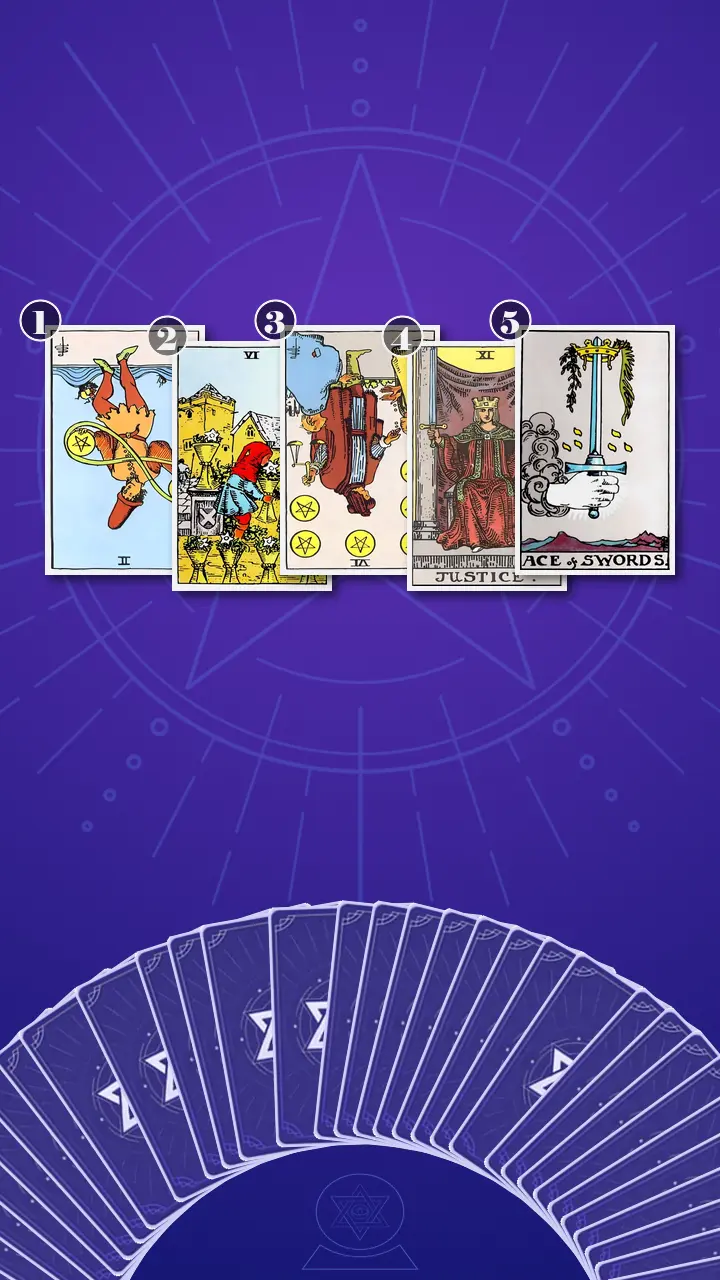
For her, I chose the Relationship Spread · Context Edition, a five-card relationship tarot spread I use when the real issue is not the device itself but a recurring pattern between people. I did not need the overbuild of a Celtic Cross here. What I needed was cleaner architecture: self, family system, shared loop, the lesson that rebalances it, and the next step that can actually be tested this week. This is how tarot works best for family boundaries and over-functioning—it does not predict whether the Wi-Fi will fail again; it shows who is expected to bend first every time it does.
I told Nina what I was watching for. The first card would show the visible always-on helper role she slips into when work and family collide. The center card would reveal the hidden economy of the relationship—who gets immediate relief and who absorbs the time cost. The fourth card would name the fairness principle that could interrupt the whole loop. The fifth would turn that insight into one clear sentence she could really use.
Reading the Loop Beneath the Wi-Fi
Position 1: Two of Pentacles Reversed, or the Afternoon That Never Lands
The first card I turned stood in the position of Nina’s current role inside the relationship—the visible symptom of split attention, the always-on helper part of her that shows up the second work and family tech requests collide. It was the Two of Pentacles, reversed.
In modern life, this card is painfully specific. It is 2:11 p.m., a customer update half-drafted, Slack popping off, and her mom calling because the Wi-Fi “just stopped working.” She answers because it should be two minutes. Then she is in router settings on FaceTime, one hand still near the keyboard, one eye on Slack, and thirty minutes later she has not fully landed anywhere. Reversed, the energy here is blocked rhythm. Not lack of competence—almost the opposite. Too much competence, too many demands, too much reactive juggling. It feels like having twenty-three browser tabs open and losing the one that actually matters.
Nina let out a short laugh that had a sting in it. “That’s literally my afternoons,” she said. “I tell myself it’ll be quick, and then I’m rereading the same work thread three times like I’m cramming for an exam.” I nodded. What looks like capability from the outside can feel like mental whiplash on the inside, and I wanted her to feel that I saw both.
Position 2: Six of Cups, the Cached Version of You
The second card sat in the position of the family script underneath the issue—the old capable-kid role that still shapes what her parents expect from her. I turned over the Six of Cups, upright.
This card was not accusing anyone of cruelty. It was showing me familiarity. Her parents still reach for her with the same built-in assumption they had when she was the teenager who could fix the family printer faster than anyone else. The moment someone says, “Can you just help for a sec?” the relationship slides backward into a sheltered old courtyard where she is the reliable kid and everybody else can stay a little less capable. Upright, the Six of Cups carries warmth, loyalty, and tenderness—but in this spread, that warmth also functions like an outdated app that keeps auto-filling the same old identity even after her life changed.
I watched Nina’s face soften, then tighten. “My dad literally says, ‘Can you remote in like you used to?’” she said. There it was. Not a villain. A cached version of her. “A delayed reply is not a character flaw,” I told her. “Sometimes it’s the only way the present gets a vote.”
Position 3: Six of Pentacles Reversed, the Hidden Invoice
The third card marked the recurring dynamic itself—the psychological mechanics that reward instant rescue and keep dependency intact. At the center of the spread sat the Six of Pentacles, reversed.
This is the lunch-break scene in card form: a quick salad, a text about a laptop update, forty minutes of unpaid support, and then an after-dinner catch-up session for her own work because her parents’ emergency got absorbed by her schedule instead of shared across the family. Reversed, the giving here is imbalanced. The card’s scales make that unmistakable. Their request stays small because her calendar pays for it. This is not kindness versus selfishness. It is care versus access. If help only works on your depletion, it isn’t balanced.
Her reaction came in three small waves. First, her breath caught and held. Then her eyes unfocused for a second, as if she were replaying a dozen “quick fixes” at once. Then the exhale came, low and tired. “I say yes to be nice,” she said quietly, “and then I feel mad anyway.” I answered her just as quietly. “Because the real issue is not whether you love them. It’s the unspoken rule that your time has to bend first every time.”
When Justice Weighed Love Against Guilt
Position 4: Justice Upright, Fairness Before Fixing
When I reached for the fourth card, the room changed. A streetcar hissed past outside, then the sound dropped away. I turned the card over and laid it between us: Justice, upright.
This card stood in the position of the transformation lever—the lesson that directly challenges guilt-based helping. The moment I saw the scales and the upright sword, my perfumer’s mind flashed to Paris training rooms and balance tables. In fragrance, one note too bright can throw an entire composition out of proportion. You do not solve that by pouring more into the formula. You solve it by restoring structure. Nina’s bond with her parents was not broken. It was out of balance. Too much guilt in the top note. Not enough fairness in the base.
I told her I use something in sessions that I call my Conflict Transformation System. I separate the issue, the timing, and the bond. The issue may be real: the Wi-Fi is down, the password loop is annoying, the laptop update is stuck. The timing is negotiable. The bond is not on trial. When those three get fused together, every missed call feels like rejection. Justice is the card that uncouples them. It moves a family from vibes-based support to actual terms and conditions. Not colder—just clearer.
I asked Nina to picture that mid-afternoon moment again: Slack stacking, the phone lighting up with a parent’s call, her shoulders already braced before she had even answered, her body acting as if a delayed reply would be a moral failure instead of a timing decision.
Stop using guilt as the scale of love; let Justice weigh the bond fairly, and let the raised sword draw a clean line between support and self-erasure.
I let that sit between us for a beat.
First, she went very still. Her fingers froze around the cold mug. Then her gaze slipped off the card and blurred, as if she were replaying every 4:53 p.m. missed call and every Sunday-night printer photo in fast forward. When she looked back at me, the first emotion was not relief. It was a flash of anger. “But if I do that,” she said, almost sharp with herself, “doesn’t that mean I’ve been training everyone to expect this?” Her shoulders rose, held, and then dropped an inch. I uncapped a bergamot strip—one of the calming scent cues I use when a conversation needs honesty without escalation—and the air sharpened very slightly. “It means the system has been co-authored,” I said. “Not caused by you alone, and not fixed by blaming yourself. Love does not require instant access to your time. A fair relationship can survive a delayed reply—and sometimes that is exactly how it becomes more adult.” I watched the understanding land with that strange mix I know so well: relief, grief, and the tiny dizziness that comes when someone puts down a burden they had mistaken for proof of love.
“Now,” I asked her, “with this new lens, think about last week. Was there a moment when this would have changed how you felt?”
“Wednesday,” she said immediately. “I could have texted instead of answering. Nothing was actually on fire.”
That was the hinge. Not a move from love to coldness, but from resentful hyper-vigilance to the first real shape of adult-to-adult support and steadier self-respect. Fairness is part of love too.
Position 5: Ace of Swords, One Message Instead of Another Essay
The final card stood in the position of behavior—the one clear communication step that could protect both care and focus. I turned over the Ace of Swords, upright.
This card was beautifully literal. One raised sword. One clean line. In Nina’s life, it looked like one plain message about what counts as urgent, what to try first, and when she is actually available. No essay. No spiral. No twelve-text preamble drafted like a courtroom defense for having a calendar. Upright, the Ace holds balanced air: clarity, directness, and a new mental beginning. Clarity does more repair than another apology.
Here I brought in another framework from my practice: Intergenerational Communication Decoding. When adult children feel guilty, we tend to over-explain because we are trying to manage everybody’s feelings in advance. When parents are stressed, long explanations blur. Three concrete lines work better than a whole emotional thesis. Before I had even finished that thought, Nina had opened her Notes app. I asked her to write a three-line family tech script within the next ten minutes: what counts as urgent, what to try first, and one time she was available this week. Not to force herself to send it on the spot. Just to make the line visible.
From Default Fixer to Family IT Office Hours
By the time we reached the end of the spread, the story was clear to me. This was never just a productivity problem. It was an old family operating system still auto-loading the capable-kid version of Nina, then rewarding instant rescue until her own focus, lunch breaks, and evenings became the invisible cost of everyone else’s convenience. The two Sixes told the story beautifully: what once felt loving and bonding had never been updated, so familiarity had slowly hardened into unequal labor. Then Justice and the Ace of Swords cut the loop open. The breakthrough was not working harder. It was speaking more clearly.
I named the blind spot for her as gently as I could: she had been treating guilt as evidence. If she felt bad delaying a response, she assumed delaying must be wrong. But guilt is not always guidance. Sometimes it is just the alarm that goes off when an old role stops being automatic. Her transformation direction was just as clear: move from instant rescue to clear, scheduled, teach-back support. From helping because panic says jump, to helping because choice says yes.
- Set Family IT Office HoursTonight, open Google Calendar and choose one or two 20-minute help windows for this week—something real, like Tuesday 7:15-7:35 p.m. and Thursday 7:15-7:35 p.m.—and label them ‘Family IT.’ When a request lands outside those windows, send one line: ‘I’m in work mode right now. I can look at it at 7:15 tonight. If it’s urgent, text me a photo of the screen.’Keep the window small so your body believes it. If it feels weirdly formal, that usually means the hidden system is finally becoming visible. Use the same bright citrus hand cream, candle, or room spray before each help window; in my work, that shared-space scent cue helps the nervous system learn that support is scheduled, not emergency mode.
- Draft the One-Message ResetThis week, write one family message with only three parts: what counts as urgent, what they should try first, and when you are available. A usable example is: ‘If the internet is fully down or you can’t log into something time-sensitive, text me the exact message. Otherwise, please try restart + send me a photo of the screen, and I can help tonight after 7:15.’ Save it in Notes or pin it in the family chat.Read it out loud once and cut any defensive essaying. Shorter is usually kinder because it is easier to follow. If sending it today feels too activating, keep it as a draft for 24 hours. The goal is a usable script, not the perfect script.
- Use the ‘Urgent or Tonight?’ Sorting QuestionAt the next request, ask one thing before you troubleshoot: ‘Is anything actually blocked right now, or can we put this on tonight’s list?’ If you do help, end by having them repeat the last two steps back to you instead of taking over the whole process. Build a tiny ‘before you call me’ checklist: restart, photo of the screen, exact wording of the error.The likely pushback is ‘It’s easier if you just do it.’ That may be true in the moment, but it keeps the pattern expensive for you long-term. Keep teach-back small. One repeated step is enough. Your boundary is not ‘figure it out alone’; it is ‘I’m not the instant-fix button.’
These were not punishments. They were boundary-first tech support. A fairer support lane. The kind that protects care instead of quietly draining it.

A Week Later, the Jaw Unclenched First
Five days later, I got a message from Nina with a screenshot attached. She had sent the text: “I’m in work mode till 7:15. If it’s urgent, send the error message. Otherwise I can help tonight.” Her mother had replied with a photo of the screen. No one spiraled. No one accused her of being cold. Later that evening, Nina helped her restart the router—and had her repeat the last step back.
She sent the text, then ate takeout alone at her kitchen counter, staring at the quiet family chat for almost a minute. Clear, but still shaky. Nothing exploded.
The next morning, she wrote again: “I still had the thought—what if that sounded blunt? But I also finished work on time for once.” That is how clarity usually arrives when I read for family tech support burnout. Not as a total personality rewrite. As one clean sentence. One held boundary. One evening that finally belongs to you again.
When I think back on that session now, what stays with me is not the router or the laptop. It is the precise shift this Relationship Spread · Context Edition made visible: from guilt-based helping to chosen support, from instant availability to adult accountability, from split attention to steadier self-respect.
Sometimes the hardest part is not the tech problem at all—it is that split-second when your jaw tightens, your chest goes alert, and wanting one hour for yourself suddenly feels like being a bad daughter.
If love did not have to be proven through instant rescue this week, what would a fairer version of help look like in your actual calendar—your own Family IT Office Hours, one sword-clean sentence saved in Notes, or one moment when you check the calendar before you check your guilt?