From Family-Visit Guilt to Self-Respect: A Hotel Boundary Script

The 11:47 p.m. Hotel Re-Book Loop
You book the hotel for your trip home, then cancel it after a guilt-heavy call, then re-book it at 11:47 PM like you’re trying to outsmart your own nervous system.
Taylor (name changed for privacy) said that to me like it was a confession and a punchline at the same time. She was 29, a UX designer in Toronto, and the way she held her phone—screen-up, thumb hovering—made it look less like a device and more like a live wire.
She’d taken our session from her office kitchen at 12:14 PM, leaning into the counter with a lukewarm coffee. The fluorescent lights had that thin, mosquito-buzz hum. Her phone was warm in her palm from being opened and closed too many times: hotel confirmation email, then her mom’s text thread, then back again. Her shoulders kept inching toward her ears like they were trying to disappear.
“I want space, not distance,” she said. “But the second I type I’m staying at a hotel, it feels like… a moral statement.”
Underneath the words, I could hear her main emotion the way I hear tension in a voice call: not loud, but tightened. Guilt that felt like trying to swallow a stone while smiling—heavy in the stomach, jaw clenched, and an itchy urge to keep ‘fixing’ the wording until it becomes uncriticizable.
I nodded, slow and steady. “We’re not here to make you colder or tougher,” I told her. “We’re here to find clarity—so you can protect your rest and show up with your family without buying closeness with self-abandonment.”

Choosing the Compass: The Horseshoe Spread
I had her take one long breath—nothing mystical, just a nervous-system gear shift. While she breathed, I shuffled my worn Rider–Waite deck beside the little speaker on my desk. As a radio host, I’m always listening for signal under noise; tarot works the same way for me. It turns the vague fog into named parts.
“Today I’m going to use the Horseshoe Spread,” I said.
For a boundary-setting situation—especially one loaded with family history—the Horseshoe is practical because it moves in the exact order your body moves when you go home: the pull of the past, the freeze in the present, the hidden ‘should’ underneath, the social friction, other people’s lens, and then very specific advice and integration. This isn’t “Will they like it?” It’s “Why is this hard, what gets triggered, and what keeps it clean?”
I pointed at the arc I’d lay out: “Card 2 will show the exact place you stall right before you state the hotel boundary. Card 3 will reveal the unspoken rule powering the guilt. Card 6 is your advice card—how to communicate it in a way that’s clear and self-respecting.”
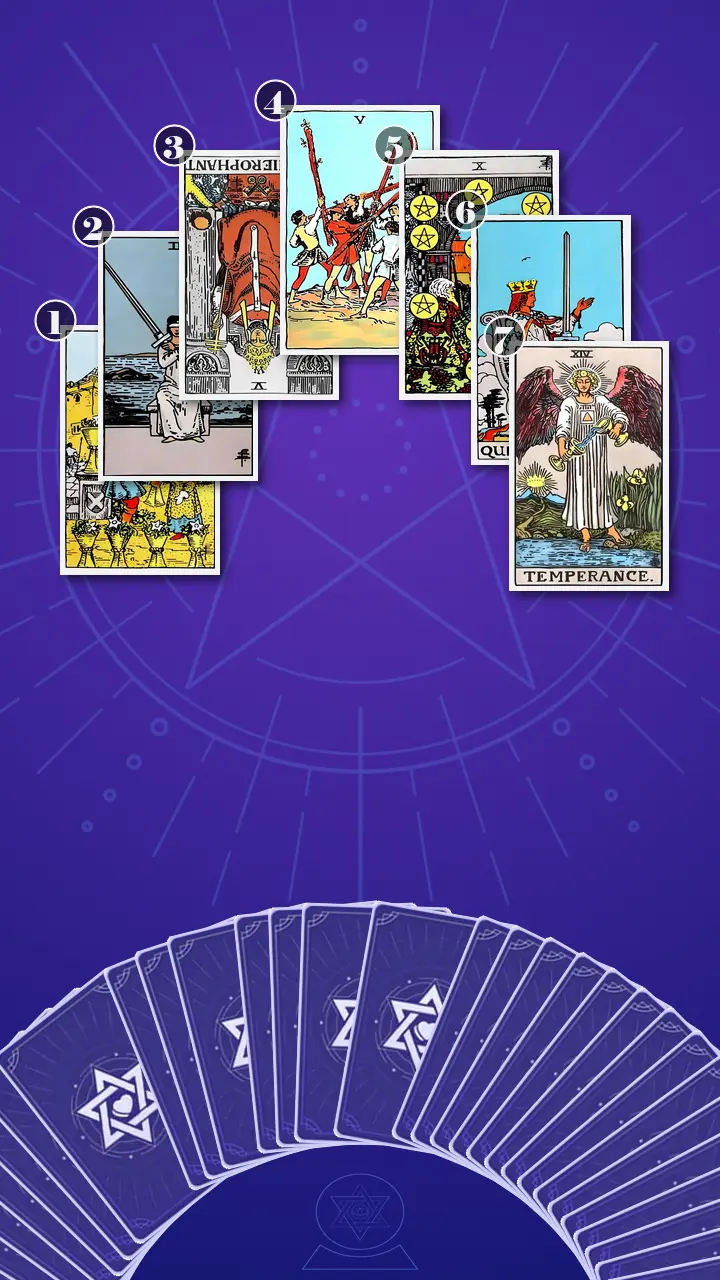
Reading the Arc: From Nostalgia to Decision Fatigue
Position 1 — Past home-visit conditioning
“Now we’re turning over the card that represents past home-visit conditioning: what old roles and expectations get activated when you return,” I said.
Six of Cups, upright.
The image is gentle—kids in a courtyard, a cup of flowers. And that’s the trick of it: warmth can carry an assignment.
I anchored it to her real life, exactly as it shows up: you land in your hometown and suddenly you’re speaking softer, asking permission for basic things, defaulting to being ‘easy.’ Staying in your old room feels sweet and familiar for five minutes… and then your nervous system remembers why you moved out.
Taylor gave a small laugh that wasn’t quite laughter—more like air escaping through a crack. “That’s so accurate it’s… kind of mean,” she said, rubbing her thumb along the edge of her mug.
“It’s not judging you,” I replied. “It’s naming the spell. The card is saying: the hotel decision isn’t only about sleep. It’s about whether adult-you gets to exist under that roof.”
Position 2 — Present sticking point
“Now we’re turning over the card that represents your present sticking point: the specific place you stall or over-edit before stating the hotel boundary,” I said.
Two of Swords, upright.
Blindfold. Crossed swords. Still water behind her—peace maintained by not looking directly at the thing.
And the modern-life translation landed immediately: your hotel plan exists in three places—your head, your Notes app, and a booking email you keep reopening. But it doesn’t exist in the real world because you haven’t said it out loud.
I described what I could almost see happening on her lunch break like a split-screen.
On the left: Just be easy. Don’t make it a thing. You type a long, ultra-reasonable message—sleep, work calls, not wanting to inconvenience anyone—then delete it.
On the right: I’m allowed to rest. Your thumb hovers over Send anyway. Your jaw tightens. You retype one sentence softer. Then softer again.
“That’s the energy,” I said. “Air—thought—stuck in a blockade. It’s not that you don’t know what you want. It’s that you’re trying to pre-solve everyone’s feelings before you make a simple plan.”
Her exhale came out quiet and flat, like she’d been holding it for a while. “Yeah,” she admitted. “I keep waiting for the moment it’ll feel easier.”
Position 3 — Hidden influence
“Now we’re turning over the card that represents the hidden influence: the unspoken family rule or internalized ‘should’ behind the hotel decision,” I said.
The Hierophant, reversed.
Even reversed, he’s still sitting there like a stamp of approval: this is how we do it, this is what counts, these are the rules of the house.
I made it concrete. “This is the family home as an unwritten rulebook you didn’t consciously agree to, but still feel graded by,” I said. “Somewhere in the background, there’s a rule like: If you come home, you stay here. And if you don’t… your choice gets translated into meaning.”
Then I did the quick “rule translation” beat out loud, because hearing it externalized is half the liberation: “Hotel = rejection. Hotel = ‘too fancy.’ Hotel = ‘you’ve changed.’ Those are family-coded meanings. They’re not objective truth.”
Taylor’s eyes went a little distant for a second—the way people look when they’re suddenly remembering ten holidays at once. Then she nodded once, sharp. “It’s tradition pressure,” she said, like she’d finally named the monster correctly.
“Exactly,” I replied. “This isn’t your personal failure. It’s a legacy system. Reliable, familiar—and not always compatible with your current life.”
Position 4 — Obstacle
“Now we’re turning over the card that represents the obstacle: what turns this boundary into conflict, guilt, or negotiation,” I said.
Five of Wands, upright.
Five people, all swinging at once, no coordination. It’s not one conflict—it’s noise.
I narrated it as a dialogue collage, because that’s how it actually hits in the body—like overlapping notifications:
“Wow, too fancy for us now?”
“We never see you.”
“We can make the guest room nicer!”
“When I was your age, I just stayed with family…”
“And suddenly,” I said, “you’re answering a committee. The obstacle isn’t your hotel choice. It’s the room trying to turn your preference into a debate where everyone competes to define what it ‘means.’”
Taylor let out a tense little laugh, the kind that says oh my god, yes, that exact circus. Her shoulders tightened, then dropped an inch like she’d decided she was allowed to stop blaming herself for the existence of friction.
Position 5 — Others’ lens
“Now we’re turning over the card that represents others’ lens: how your family may interpret the hotel choice,” I said.
Ten of Pentacles, upright.
The card is architecture—legacy, continuity, the feeling of “we’re all here.”
“To them, shared roof can equal loyalty,” I told her. “Keys on the counter, pajamas, coffee at the same table. So when they hear ‘hotel,’ they might genuinely hear ‘you’re opting out.’ Not because they’re villains—because they translate through their values.”
This is where my work with sound and family systems always gets specific. I asked, “What’s the default music in your parents’ house?”
She blinked. “CBC in the morning. And my dad plays… like, classic rock when he cooks. Always the same playlists.”
“That’s your Family Playlist right there,” I said—my signature diagnostic lens. “Not ‘good’ or ‘bad’—just information. Your family runs on familiar tracks. Same routines, same emotional tempos. So your hotel choice isn’t only a plan; it sounds to them like you’re changing the station.”
Her face softened in a way that mattered. “So they’re not trying to punish me,” she said quietly. “They’re trying to keep the song the same.”
“Yes,” I said. “And we can respect the song without surrendering your sleep.”
When the Queen of Swords Cut Through the Group Chat
“We’re turning over the most important card in this reading,” I said, and the room felt suddenly quieter—as if even the fluorescent buzz took a step back.
Position 6 — Advice
“Now we’re turning over the card that represents advice: how to communicate and hold the boundary in a way that’s clear and self-respecting,” I said.
Queen of Swords, upright.
The upright sword. The steady gaze. The open sky that says: we can be kind without being negotiable.
I gave her the modern-life scenario exactly as it’s meant to land: you send a short message that stands on its own—no essay, no pre-apology. One calm reason (rest), then pivot to connection with a specific plan. And if someone tries to reopen the debate, you repeat the same line—steady, not icy.
“This is the energy of clean language,” I said. “In sound terms? It’s taking the reverb off your sentence. No extra echoes, no apologetic background noise.”
She swallowed. “But if I say it that simply…” Her voice tightened, and for a second anger flashed through the nerves. “Doesn’t that mean I’ve been doing it wrong this whole time?”
That reaction made sense. When people stop over-explaining, they often grief the years they spent trying to earn permission. I kept my tone warm and structured. “It doesn’t mean you were wrong,” I said. “It means you were surviving an old rulebook.”
She was exactly in the setup I see again and again: on your lunch break flipping between the hotel confirmation email and your mom’s text thread, rewriting the same two sentences until your shoulders creep up and your stomach goes tight. She was trying to find the perfect wording—something that would guarantee nobody felt anything.
Stop trying to word your boundary so no one feels anything; speak it cleanly like the Queen’s upright sword, and let your consistency do the persuading.
I let a beat of silence sit there—no rushing to soften it.
Her reaction came in three steps, like a wave you can actually watch if you’re paying attention. First, a tiny freeze: her breath caught, and her thumb stopped moving entirely. Then the cognition seeped in: her eyes unfocused, like she was replaying every draft she’d written in her Notes app. Finally, the release: she exhaled from somewhere deeper than her lungs, and her shoulders dropped as if they’d been holding up a backpack she forgot she was wearing.
“Oh,” she said, voice thin with relief and nerves at the same time. “So the goal isn’t… making it unreactable.”
“Exactly,” I told her. “A boundary doesn’t land because you found the perfect wording—it lands because you say one clear preference, then you stay consistent long enough for it to become normal.”
I leaned in with my coach voice, but kept it gentle. “Now, with this new lens—think back to last week. Was there a moment where you were about to hit Send, and your body tightened, and you started adding reasons?”
She nodded immediately. “Yesterday. I had the sentence. Then I added three lines about work calls, and then I deleted the whole thing.”
“Right,” I said. “This is your shift—from guilt-driven people-pleasing and over-explaining to calm, self-respecting clarity and consistent boundaries. Not a personality transplant. A new script.”
And because I work with sound as much as words, I added one more layer—my Conflict Mediation lens. “When you send it,” I said, “read it once out loud at a slower tempo than you think you need. Around 70 beats per minute. It signals calm authority. You’re literally setting the frequency of the conversation.”
Position 7 — Integration
“Now we’re turning over the card that represents integration: what a healthier visit looks like when the boundary is held consistently,” I said.
Temperance, upright.
Two cups. Water moving between them. One foot on land, one in water. A middle path with real structure.
I translated it into the most believable montage: you keep the hotel, and the visit gets calmer—not because everyone instantly loves it, but because you’re rested and less reactive. You show up for the moments that matter, then you leave the house and decompress without anyone watching.
“This is closeness and space both being real,” I said. “Connection chosen, not performed.”
One Reason. Two Sentences. Repeat if Needed.
I tied the arc together for her, plain and honest: “Six of Cups says going home pulls you into a younger role. Two of Swords shows the stall—drafts, delays, trying to pre-solve feelings. Hierophant reversed names the real pressure: tradition, the old rulebook. Five of Wands warns that the boundary can become ‘meaning-by-committee.’ Ten of Pentacles explains their translation: shared roof equals loyalty. Then Queen of Swords gives you the antidote—clean language—and Temperance shows what happens when you hold it: a warmer visit because your nervous system isn’t fried.”
“Your cognitive blind spot,” I added, “is thinking your wording can control their emotional weather. That’s why you keep writing a 12-slide deck for a two-sentence decision.”
“Your transformation direction is the key shift: from earning permission through explanations to stating a clear preference with one calm reason and a repeatable boundary script.”
Then I gave her the practical next steps—small, boring, effective. And I built in one of my signature communication tools, because sound can create space when words are still tender.
- The Two-Sentence Hotel BoundaryIn your Messages app, send: “I’m staying at a hotel this trip so I can rest well. I’m really looking forward to seeing you—can we do breakfast at 9 on Saturday?”If you feel yourself adding a second or third justification, stop. Your boundary works better if it’s boring.
- The Loop-Line MethodPick one repeat line for pushback: “I hear you. I’m still staying at the hotel.” Say it once, then don’t add reasons.Set a 3-minute timer and practice out loud twice. Put one hand on your stomach, take one slow breath, and prioritize steadiness over intensity.
- Time-Not-Roof Translation + a Soundproof BarrierCreate a simple itinerary: two anchor connection points (e.g., Sat breakfast + Sun dinner) plus one protected downtime block. When you get back to the hotel, do a 2-minute decompression reset (shower, stretch, tea) before scrolling. If the house gets loud, use a “Soundproof Barrier”: headphones or a low-volume white noise track while you recharge.Planned time together isn’t the same as unlimited access. Offer structure, not an argument.

A Week Later: Ownership, Not Certainty
A week later, Taylor texted me a screenshot: her two-sentence message, sent. Under it, her mom’s reply: “Okay… I guess. Breakfast at 9.” Not perfect. Not a movie-ending hug. But real.
She added one line of her own: “I’m at the hotel. I feel weirdly calm. I keep waiting to feel guilty, but mostly I just… slept.”
I pictured the bittersweet version of that calm: she’d kept her plan, then sat alone in a quiet lobby chair for ten minutes, letting the day drain out of her shoulders—still hearing her family’s kitchen clatter in her head, but softer now, like it was finally at a livable volume.
This is what I love about a real Journey to Clarity: it doesn’t require you to stop loving anyone. It just asks you to stop negotiating your basic needs like they’re evidence in a trial.
When you’re trying to protect your rest and still belong, even a hotel reservation can feel like you’re holding your breath—like one simple choice might get translated into “you’ve changed” before you’ve even arrived.
If you let your hotel stay be a normal adult plan—not a moral statement—what’s the smallest, cleanest sentence you’d want to say first?