Family Photo Day Makes You Shrink—One Boundary Toward Real Presence

The Front-Camera Smile in a Too-White Bathroom Light
If you hear “Smile!” or “Don’t be so serious” and your whole body goes into people-pleasing autopilot—shoulders in, voice smaller, wide grin—because you can’t handle being the one who ‘ruins the moment.’
Maya (name changed for privacy) sat across from me on a video call, the kind where you can tell someone has already been rehearsing the conversation in their head. She was 29, in Toronto, and the first thing she did was tilt her screen slightly—like she was still deciding what angle would get the fewest comments.
“Family photo day is coming up,” she said. “And I hate that I’m already… preparing.”
I asked her what “preparing” looked like, specifically—because vague anxiety is hard to work with, but concrete rituals tell the truth.
“Saturday morning,” she said. “8:46-ish. Condo bathroom. The overhead light is… brutal. Like Shoppers Drug Mart fluorescent lighting. I flip to the front camera to practice my face. And my jaw tightens like a clamp.”
As she spoke, I watched her shoulders rise a millimeter, like her body remembered the script on cue.
“It’s like I want to be seen as me,” she continued, “but I’m scared that taking up space will make me the problem. And then I end up smiling so hard my cheeks hurt. I step back. I become… smaller.”
The way she said “smaller” wasn’t metaphorical. It was anatomical—tight jaw, shoulders pulled in, breath stuck high in the chest, like bracing for commentary. Self-consciousness wasn’t an emotion; it was a posture.
“That makes so much sense,” I told her. “And not in a ‘just be confident’ way. In a nervous-system way. Let’s see what old role is getting activated—and what would help you stay emotionally honest and physically present, even in small ways. That’s our Journey to Clarity today.”

Choosing the Compass: The Horseshoe Spread for Family Photo Day
I invited her to take one slow inhale and one long exhale—not as a mystical thing, but as a way to bring her attention back from the future-photo to the present moment. While she breathed, I shuffled my deck and asked her to hold one clear question in mind: “During family photo moments, what old role makes me force a smile and shrink—and what’s the cleanest way out?”
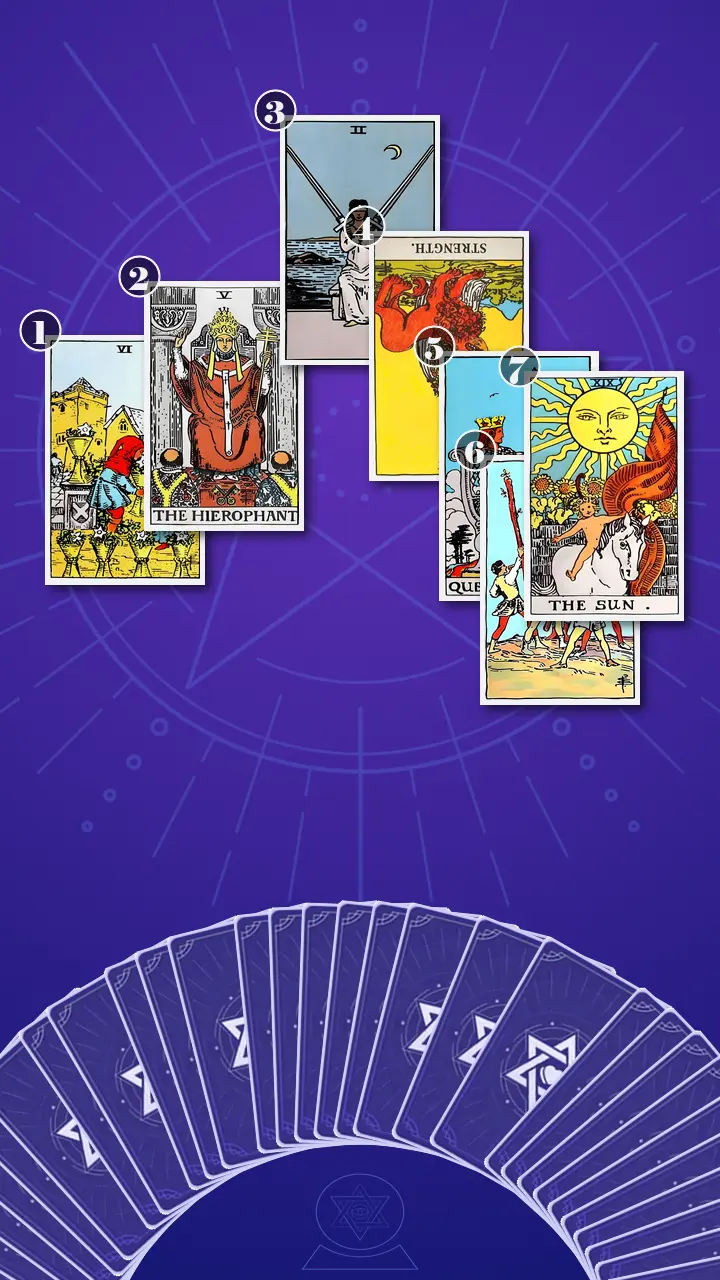
“Today I’m using the Horseshoe Spread · Context Edition,” I said. “It’s a seven-card tarot spread that’s especially good for family dynamics, role regression, and boundaries—because it separates the past conditioning from the present trigger, and it shows the hidden move your body makes before your brain catches up.”
For anyone reading who’s curious about how tarot works in a practical way: I don’t use cards to tell you what your family will do like it’s fate. I use them like a structured mirror. The Horseshoe layout is compact, but it gives a full arc: origin story, current script, hidden influence, obstacle, advice, external dynamics, and integration—so you can stop feeling stuck and start seeing next steps.
“The three positions I want you to listen for,” I told Maya, “are the hidden influence—the freeze that happens before you even choose—then the obstacle, which is usually where people-blame lives, and then the advice, which is where your boundary gets clean.”
Reading the Map: The Old Script and the Present Ritual
Position 1: The old family role’s origin story
“Now flipped over,” I said, “is the card that represents the old family role’s origin story: what early conditioning taught you to ‘smile and stay small.’”
Six of Cups, upright.
“This one is gentle, but it’s not ‘small,’” I said. “In modern life, it’s like walking into a family gathering and—before anyone even says hi—your body remembers the ‘good kid’ version of you. You automatically soften your voice, widen your smile, make yourself useful… because that used to earn you safety and praise.”
I watched Maya’s mouth twitch into a half-smile that didn’t look amused. More like: caught.
She let out a short laugh with a bitter edge. “That’s… rude. Like, accurate. But rude.”
“Yeah,” I said softly. “Tarot can be like that. But this isn’t a character flaw. It’s a learned belonging strategy. You learned that pleasant = safe.”
The Six of Cups energy, here, is balance in the sense that it’s faithfully showing the original contract—two kids, a gifted cup, a simple exchange that can become an unspoken lifetime agreement: ‘Be sweet, and you’ll be okay.’
And because I’m a perfumer, I asked a question that people don’t expect in a tarot session: “What’s the first smell you associate with these photo days?”
Maya blinked. “Coffee. And… my aunt’s perfume. It’s strong.”
That mattered. In my work, I call it Family Energy Diagnosis: the way emotional roles travel through a system like scent does—quietly, instantly, before language. If coffee plus a specific perfume equals “be good,” your body will time-travel before you can stop it.
Position 2: What family photo day activates right now
“Now flipped over,” I said, “is the card that represents what family photo day activates right now: the present-day script and expectations.”
The Hierophant, upright.
“This is the ritual card,” I told her. “Family photo day starts to feel like a ceremony with rules no one wrote down but everyone enforces: stand where you’re told, look happy, don’t question the timing, don’t bring ‘a mood’ into it. Your body obeys the script before you can decide if you even agree with it.”
The Hierophant’s energy is excess here—too much structure, too much ‘right way,’ too much measuring belonging through compliance.
“That’s exactly it,” Maya said. “Like it’s not just a photo. It’s… proof.”
“Instagram tags and Facebook albums as public evidence,” I said, “are basically the modern Hierophant.”
Position 3: Hidden influence—what happens before you notice
“Now flipped over,” I said, “is the card that represents the hidden influence: the internal move that happens before you even notice—the freeze, the mask, the self-editing.”
Two of Swords, upright.
“This is the blindfold vs the camera lens,” I said. “In modern life: right before the photos, you internally decide, ‘Whatever happens, I’m not reacting.’ You go neutral to avoid choosing between honesty and harmony. The smile becomes a mask—not because you’re fake, but because you’re trying to keep anything from escalating.”
I slowed down here, because this card is where people finally stop blaming their personality and start noticing the mechanism.
“It’s like putting your feelings on Do Not Disturb,” I said, “so nothing pings loud enough to cause a scene.”
Maya went still. Not performatively—actually still. Her gaze unfocused for half a second, like her brain replayed a memory at double speed: a camera lifting, someone saying “Smile,” her own internal click—Don’t react. Don’t make it weird.
“And the cost,” I added, “is that neutrality turns into invisibility.”
Position 4: The main obstacle—why you shrink instead of staying embodied
“Now flipped over,” I said, “is the card that represents the main obstacle: what makes you shrink and perform instead of staying embodied and authentic.”
Strength, reversed.
“This is so specific,” I told her. “In modern life: the camera comes up and you clamp down on yourself—tight smile, arms close, breath held—like your feelings are a problem you have to ‘handle.’ You’re not lacking courage; you’re spending it on containment. Afterward, you feel drained and weirdly resentful because you were performing calm instead of actually being okay.”
Strength reversed is a blockage of embodied steadiness. The lion is still there—your feelings are still alive—but the gentleness turns into over-control.
I let my voice go extra warm here, because this is where shame tries to move in and claim the room.
“You call it being ‘easy,’” I said. “Your nervous system calls it survival.”
Maya’s hand rose to her jaw without her noticing. She pressed her fingertips lightly into her cheek, like she was suddenly aware of the soreness she’d been ignoring.
“If your body gets smaller,” I added, “that’s data—not a personality flaw.”
When the Queen of Swords Spoke: One Clean Edge
Position 5: The antidote—what helps you step out without escalating conflict
I took a breath before turning this card. “We’re flipping over the key card now,” I said. “This is the one that tells us what actually changes the pattern.”
“Now flipped over,” I continued, “is the card that represents the antidote: the boundary or mindset that helps you step out of the old role without escalating conflict.”
Queen of Swords, upright.
“In modern life,” I said, “this is you not smiling harder—just choosing one clean preference and stating it calmly: ‘I’m going to stand here,’ or ‘Give me one second.’ No auditioning for approval. No managing anyone’s reaction. Quiet, adult, specific.”
Maya’s first response surprised me. She didn’t soften. She stiffened.
“But if I do that,” she said, sharper than before, “they’ll think I’m being rude. Like… who do I think I am?”
There it was: the old contract defending itself.
I nodded. “That reaction makes sense. The Queen of Swords can look ‘cold’ when you’ve been trained to believe warmth equals compliance.”
Then I did what I often do when family dynamics are involved: I used my other lens—my Intergenerational Communication Decoding. “In your family,” I asked, “who’s allowed to be direct? Like, who can say, ‘Move, I’m taking the picture,’ and it’s fine?”
Maya exhaled through her nose. “My uncle. My mom, sometimes. Not me.”
“So it’s not that directness is ‘rude,’” I said. “It’s that you’ve been assigned the role where your directness gets policed. The Queen isn’t asking you to become harsh. She’s asking you to become precise.”
Setup: the two seconds before the shutter
You know that moment right before the photo—someone says “Smile!” and your body moves on autopilot. Your jaw locks, shoulders round, and you step half a pace back like you’re trying to take up less of the frame.
Delivery: the line that cuts cleanly
Stop trading your voice for a ‘nice’ photo; choose one clean boundary and hold it like the Queen of Swords holds her upright blade.
I let the sentence sit there for a beat, the way you let top notes settle before you judge a fragrance.
Reinforcement: the reaction (and the practice) that makes it real
Maya’s body ran a whole sequence in three quiet steps.
First: a tiny freeze—her breath stopped mid-inhale, her lips parted like she’d been interrupted.
Second: her eyes went slightly unfocused, as if she was watching herself in a tagged photo, hearing the family chatter in surround sound, feeling the shame-flash of being singled out.
Third: her shoulders dropped, not dramatically, but like something heavy was finally allowed to unhook. Her exhale was thin at first, then deeper. “Yeah,” she whispered. “That’s… that’s it. I keep buying peace with my face.”
“Exactly,” I said. “Old line: ‘I’ll just go with whatever.’ New line: one sentence, no explanation.”
And because we needed it to be doable—not inspirational—I gave her the micro-scene. “I want you to imagine your phone in selfie mode,” I said. “Not practicing a smile. Practicing a sentence.”
“I don’t need to convince them,” I added, letting the Queen energy come through clean. “I just need to choose.”
Then I invited her into the rehearsal that makes this a real boundary, not a concept: “Open Notes and write one sentence you can say without explaining. Stand up—feet hip-width apart. Soften your jaw. One slow inhale, one slow exhale. Say the sentence out loud three times at normal volume. If you feel your chest tighten and you start adding reasons, pause. Hand on sternum. One more breath. And stop. You’re practicing presence, not winning an argument.”
Maya nodded, eyes shiny but steady. “Okay. That’s… weirdly relieving.”
“That relief,” I said, “is your system recognizing a different kind of belonging: one that doesn’t cost you your voice.”
And I anchored it plainly, because this is the pivot: “This is the shift from keeping the moment comfortable for everyone to staying emotionally honest and physically present, even in small ways.”
That’s the beginning of moving from self-conscious bracing into grounded self-respect—imperfect, but real.
The Room’s Noise, and the Sunlight After
Position 6: External dynamics—what the family system is doing
“Now flipped over,” I said, “is the card that represents external dynamics: what the family system is doing that pulls you into the role—noise, opinions, pressure.”
Five of Wands, upright.
“This is the photo scrum,” I told her. “Multiple people directing, teasing, rushing, rearranging. Your nervous system reads it as: too many inputs, too much potential criticism. You shrink to reduce your surface area.”
I painted it fast, like a montage: three voices at once, someone waving you over, someone fixing hair, someone insisting ‘quick, quick,’ and the camera being raised like a starting pistol.
Maya gave a half-laugh—this time with more tenderness. “It’s literally that. It’s chaotic.”
“And that matters,” I said, “because it means the problem isn’t ‘why am I like this.’ The room is overstimulating. You don’t have to regulate the whole room. You only have to stay anchored in one body—yours.”
Position 7: Integration—what showing up as you can look like
“Now flipped over,” I said, “is the card that represents integration: what ‘showing up as you’ can look like after you practice the shift.”
The Sun, upright.
“This is visibility without distortion,” I told her. “A photo captures you as you actually are: grounded, present, maybe not grinning. And you realize warmth isn’t in the perfect expression—it’s in not leaving yourself to keep the image pretty.”
“Neutral is allowed,” I said. “Soft is allowed. Real is allowed.”
The Sun’s energy is balance—not ‘be happy,’ but ‘be seen.’ It’s the opposite of the blindfold. It’s you letting the internal blindfold come off, even if the room stays messy.
The One-Clean-Edge Plan: Actionable Advice for the Next Photo Moment
I leaned back and let the whole arc settle into one story, because this is where tarot becomes useful: not just meaning, but sequence.
“Here’s the narrative,” I said. “The Six of Cups shows you learned early that being sweet and low-maintenance kept you safe. The Hierophant shows family photo day still runs like a tradition—belonging measured through performance. The Two of Swords shows the hidden move: you go neutral and mask up to avoid choosing between honesty and harmony. Strength reversed is the choke point—your courage gets spent on controlling your face instead of supporting your body. The Queen of Swords is the pivot: one clean boundary that keeps you present. The Five of Wands validates the external chaos. And The Sun is the new role: genuine visibility, even if imperfect.”
“Your cognitive blind spot,” I added, “is that you’ve been treating the forced smile like the problem—when it’s actually a solution you built for an old environment. A forced smile is often a boundary you never got to say out loud.”
“And the transformation direction is clear,” I said. “From ‘keeping the moment comfortable for everyone’ to ‘staying emotionally honest and physically present, even in small ways.’”
Then I gave her a plan that didn’t require a personality transplant—just a few clean moves.
- Write your One Clean Edge sentence (2 minutes)Open Notes and write ONE boundary line you can say without explaining: “I’m going to stand here.” Or “One second.” Keep it to one sentence. Put it where you can glance at it in the bathroom before photos.If you start adding reasons, delete them. No explanation is the feature, not the bug.
- Do the jaw-unclench + one full breath reset (10 seconds)In the photo moment, before you move, soften your jaw and take one full inhale + exhale. Then place your feet where you want them—hip-width, not “edge of the frame.”If someone rushes you, say “One second” while you’re exhaling. It buys you time without starting a debate.
- Bring a scent anchor for calm boundaries (optional, but powerful)Use a tiny, personal calming scent (a dab of neroli, lavender, or clean musk on your wrist or scarf) as a cue for your body: “adult me is here.” Smell travels straight to memory; we’re using that on purpose.Keep it subtle—this is for you, not the room. If you’re sensitive, even a citrus hand cream can work as a quiet anchor.
That last step is my communication strategy in action—dialogue atmosphere enhancement with calming scents, but applied inward first. Because if your body can stay regulated, your words don’t have to fight so hard.

A Week Later: A Photo That Felt Like Her
A week later, Maya messaged me on her lunch break. “Photo day happened,” she wrote. “I did the sentence.”
She told me she went to the bathroom right before the group shot, glanced at her Notes app, and whispered it once—no smile practice. When the camera came out, someone started to shift her. She heard herself say, quietly, “One second.” She took the breath. She stood where she wanted.
“I didn’t feel brave,” she added. “But I felt… in my body.”
Later, she saved one photo privately. Not for Instagram. Not to prove anything to the group chat. Just a small receipt to her nervous system: I can be seen and survive. She said it felt a little lonely and a little freeing at the same time—like choosing herself in a room that still hadn’t learned her new language.
That’s the real Journey to Clarity: not a perfect family dynamic, but a new inner posture. From self-conscious bracing and shrinking into the “easy one” to grounded self-respect and genuine presence—even if imperfect.
When the camera comes out, it’s not vanity—it’s that old fear of being labeled “difficult” making your body go small before you even get a choice.
If you didn’t have to earn belonging with a bigger smile, what’s one tiny way you’d let yourself take up space in the next photo—just enough to feel like you’re actually in it?