When Side DMs Follow a Tense Group Chat: Stepping Out of Mediator Mode

The 8:47 p.m. Slack Glow on Line 1
You’re 27, hybrid-working in a Slack-heavy job, and the second a group channel gets tense, someone slides into your DMs with “what do you think?”—classic group chat triangulation loop.
Jordan (name changed for privacy) told me that on a Tuesday night, on the Line 1 subway heading north, their phone screen looked almost aggressive against the dark window—like a tiny stage light aimed right at their face. The train hum vibrated in their knees. A Slack notification buzzed and their stomach cinched tight, the way it does when you step off a curb and a cyclist appears out of nowhere.
“It’s not even a big fight,” they said, the words coming out fast, like they were trying to outrun the feeling. “The channel is… ‘fine.’ But then there’s one message with a weirdly formal period, and suddenly my brain is doing forensic linguistics. And then—like clockwork—someone DMs me. ‘Can I be honest?’ ‘What do you think?’”
I watched their hands while they spoke. Restless thumbs. Micro-pauses, like invisible typing bubbles in the air. It wasn’t just anxiety. It was the particular unease of being made responsible for a group’s emotional weather—like their nervous system had been hired as an unpaid moderator.
“You want to stay connected and respected in the group,” I reflected back, keeping my voice plain and steady, “but you’re afraid that if you speak directly—if you stop participating in side-channel politics—you’ll get rejected or blamed for ‘making it a thing.’”
Jordan let out a breath that sounded like a laugh, except it didn’t rise. It dropped. “Yeah. And I hate that I care this much. I miss when our chats felt simple.”
“We’re not going to moralize this,” I said. “We’re going to map it. Let’s figure out what loop you’re actually in—so you can step out of it with clarity, not with more overthinking.”

Choosing the Compass: The Energy Diagnostic Map (7) for Group Chat Triangulation
I didn’t light incense or ask Jordan to believe in anything they didn’t already believe. I invited them to take one slow breath, feel the chair under their thighs, and hold the question in a practical way: “Group chat + side DMs: what triangulation loop am I in?”
As I shuffled, I explained what I was doing in the simplest terms: “Tarot works best as a mirror and a pattern-recognition tool. It can show structure—what’s feeding the cycle, what’s rewarding it, and where your leverage is.”
For this, I chose a spread I use when the problem isn’t one decision but a repeating system: Energy Diagnostic Map (7) · Context Edition.
Here’s why this layout fits group chat drama so well: this issue isn’t linear. It’s a loop created by visibility (the group channel) plus backchannels (the side DMs). This spread puts the repeating “engine” in the center, then separates what’s visible, what’s internal, and what the social environment rewards—so we stop blaming your personality for a structural incentive problem.
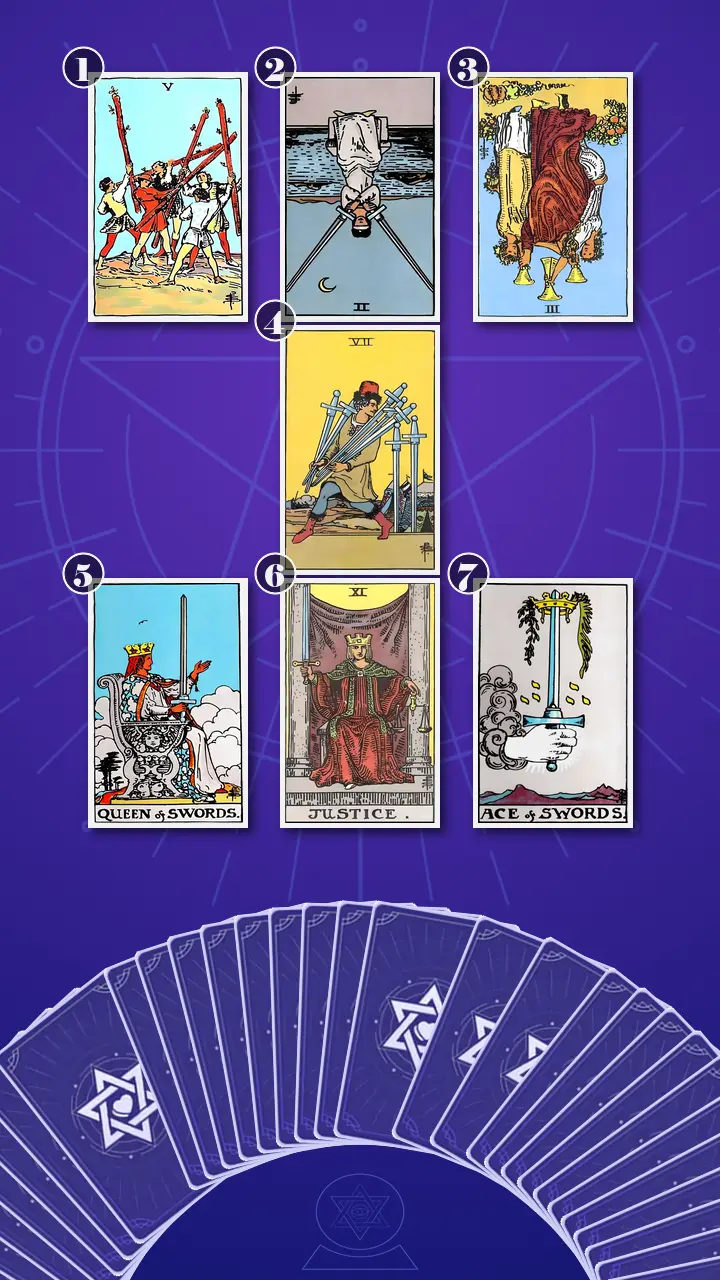
I also told Jordan what to expect as we went: “The top arc will show (1) the surface signal in the group chat, (2) your inner tug-of-war, and (3) the external pressure in the social field. The center card is the core triangulation engine. Then the bottom row becomes: (5) your usable resource, (6) the key transformation, and (7) one concrete next step you can try this week.”
Reading the Map: Card Meanings in Context
Position 1 — Surface signal: what’s actually happening in the group chat
“Now we’re opening the card that represents the surface signal: what’s actually happening in the group chat that makes the situation feel unstable.”
Five of Wands, upright.
I tapped the image lightly. “This is the visual of five people swinging at once. No shared rhythm. No coordination. In modern life, it’s exactly what you described: you open the Slack channel and see five people responding at once—one correcting details, one making a snarky joke, one piling on with ‘to be fair,’ one dropping a reaction that changes the tone, one changing the subject. The issue isn’t even clear anymore; the competition becomes: who’s right, who’s loyal, who gets the last word.”
“Fire energy,” I said, “and it’s in excess. Too much heat, too many fast moves.”
Jordan gave me that bitter half-laugh again—short, sharp. “That’s… too accurate. Kind of brutal.”
“Brutal isn’t the goal,” I replied, “but accurate is useful. This tells us something important: your nervous system isn’t reacting to one message. It’s reacting to a crowded room of crossed signals. And in that noise, side DMs feel like ‘clarity,’ even when they’re not.”
Position 2 — Inner tug-of-war: where you’re stuck in your body and mind
“Now we’re opening the card that represents the inner tug-of-war: how you’re responding internally and what decision is getting stuck.”
Two of Swords, reversed.
“This card is famous for the blindfold,” I said, “and reversed, the blindfold slips. You can sense what’s happening—but you still hesitate to choose the clean line. In your life, it’s the draft-delete cycle: the message in the group chat that would clarify everything in one go, sitting there like a sealed envelope you keep rewriting because you’re trying to find the version that can’t be misread.”
I watched Jordan’s hands tighten and release around their phone. “This is Air energy—communication—but it’s blocked. You’re trying to stay neutral because neutrality feels safe… while also noticing that neutrality is already being interpreted as a stance.”
Jordan stared at the table for a second, eyes unfocusing like they were replaying last night’s thread. “I literally had it in Notes. I rewrote it, like… seventeen times. I kept thinking, ‘Which version is safest?’”
“And here’s the flip,” I said gently. “The ‘safest’ version—meaning the one that tries to control everyone’s feelings—is what keeps the stalemate alive.”
I added one practical caution, because reversed cards have a particular trap: “The overcorrection risk is firing off a long clarifying message that covers every angle and pre-apologizes for everything. It reads defensive and invites more debate. We’ll aim for clean, not exhaustive.”
Position 3 — External social pressure: what the group rewards or punishes
“Now we’re opening the card that represents external social pressure: what the group dynamic rewards or punishes right now—usually without saying it out loud.”
Three of Cups, reversed.
“This is the ‘closed circle’ card,” I said, “and reversed, the celebration becomes a gate. In your world, it’s the side DM that feels warm at first—‘I trust you, don’t tell anyone’—but then it subtly asks you to agree with a negative take about someone else.”
“Reversed Water energy,” I continued, “often looks like belonging becoming conditional. Who’s in the inside thread? Who gets the real story? It can feel like being offered a VIP wristband in exchange for a verdict.”
Jordan’s mouth tightened. “That’s the worst part. It’s like… I feel flattered and gross at the same time.”
“Exactly,” I said. “The social reward is closeness. The cost is recruitment.”
Position 4 — Core triangulation engine: the pattern that keeps repeating
“Now we’re opening the card that represents the core triangulation engine: the specific communication pattern that keeps the loop repeating.”
Seven of Swords, upright.
I didn’t rush this one. “This is the backchannel card. Indirect moves. Selective sharing. Context that travels sideways instead of being spoken where it belongs.”
“In modern terms: Jordan receives a screenshot DM that reframes the group thread as a personal slight. Now you’re holding stolen context—a curated version of reality that changes how you see everyone. And then people use you as a relay: ‘don’t say I said this, but…’”
I named the inner loop out loud, because the Seven of Swords thrives on unnamed dynamics: “In your head it becomes, ‘If I don’t respond, I’m rude. If I respond, I’m recruited.’ Then you reread the thread, copy/paste pieces into Notes, draft, delete, check reactions, monitor who’s online. Not because you’re dramatic—because the system is set up to make you the merge conflict.”
It was the cleanest place to use a modern metaphor without forcing it: “Triangulation is like doing version control in private. Everyone has a different branch of the truth. And somehow, the merge conflicts become your job.”
Jordan exhaled sharply—then went still. Their thumb stopped scrolling. “Oh… yeah.”
“Side DMs don’t reduce drama,” I said, letting the sentence land with no extra heat. “They just privatize it.”
As I spoke, I noticed a familiar ache behind my own ribs—a flash of memory from my childhood in the Highlands, watching adults keep peace by passing messages through the ‘safe’ person. In a small village, we called it keeping the hearth warm. But it always made one person the chimney. All the smoke went through them.
“This isn’t your flaw,” I told Jordan. “It’s an engine. And engines can be turned off.”
Position 5 — Usable resource: the part of you that can change your role
“Now we’re opening the card that represents your usable resource: the part of you that can change your role in this dynamic without controlling others.”
Queen of Swords, upright.
“This is you with a raised sword and an open hand,” I said. “Clarity with boundaries. Not cruelty. One clean edge at a time.”
Then I made it scriptable, because the Queen of Swords is strongest when she’s repeatable: “Someone tries to vent about a third person in a DM, and you reply with one calm line: ‘I’m not going to discuss them privately—can we address it in the channel?’ No essay. No apology tour.”
I watched Jordan’s shoulders drop—just a fraction, but it was real. They could imagine it: fewer words, less emotional Wi‑Fi extending.
“You’re allowed to opt out of being the group’s emotional Wi‑Fi extender,” I added, because sometimes the permission is the medicine.
And this was where I brought in my own lens—my family’s way of seeing patterns without blaming people. “In my work, I call this Generational Pattern Reading. Not because your coworkers are your family, but because roles repeat. The ‘translator’ role is an old role in many homes: the kid who could read the room, keep the peace, carry the message.”
Jordan looked up sharply. Not defensive—recognized. “I was… that kid.”
“Then the Queen of Swords isn’t asking you to become mean,” I said. “She’s asking you to stop automatically volunteering for a job you never applied for.”
When Justice Held the Scales: The Standard That Breaks the Loop
Position 6 — Key transformation: the principle that resets the rules
“We’re turning over the most catalytic card now,” I said quietly, and the room seemed to get a little more still—as if even the air wanted to listen. “This is the card that represents the key transformation: the principle that breaks the pattern and resets the relational rules of engagement.”
Justice, upright.
Setup. Jordan had been living inside a moment that repeats: the channel goes tense, then the side DM arrives—“can I be honest?”—and suddenly they’re holding someone else’s story like fragile glass. Their mind scrambles to say the perfect thing so nobody is mad, because belonging feels like it’s on the line.
Delivery.
Not “keep everyone comfortable through private backchannels”; choose the clean cut of one fair standard, like Justice’s scales and sword.
I let the silence sit. Not as theater—more like letting snow settle after a gust.
Reinforcement. Jordan’s breath caught first—just a small pause, like their lungs forgot the next step. Their eyes went wide, then distant, the way people look when a sentence reaches back and touches five different memories at once. Their shoulders, which had been lifted for most of our session, slowly dropped as if someone finally loosened a strap. Their hands unclenched around the phone, and the muscles at the edge of their jaw softened. Then came the emotion in layers: a flash of irritation—almost anger—followed by relief so sharp it made their eyes shine. “But,” they said, voice tight, “if I stop translating… won’t they think I’m escalating? Won’t I lose people?”
I nodded. “That’s the discomfort phase of stepping out of the messenger role. Justice doesn’t promise comfort. Justice promises consistency. And consistency is what makes you un-recruitable.”
“Fair doesn’t mean comfortable,” I said, anchoring the principle. “Fair means consistent.”
Then I asked the question that turns insight into lived memory: “Now, with this new lens, can you think back to last week—was there a moment this standard would have made you feel different?”
Jordan swallowed. “Monday. Someone DM’d me, ‘Can you talk to them? They’ll listen to you.’ I felt… important. And sick. If I’d had a standard, I could’ve said no without turning it into a whole emotional negotiation.”
“That’s the shift,” I said. “From hypervigilant group-chat unease and messenger-guilt toward integrity-led clarity and calm self-respect. You’re not trying to control the group. You’re choosing what you participate in.”
Position 7 — Next step: one actionable communication move this week
“Now we’re opening the card that represents the next step: one actionable communication move that puts the new principle into practice this week.”
Ace of Swords, upright.
“One blade,” I said, “not five. One sentence, not a paragraph. One channel, not three.”
I made it painfully practical: “This is the moment you post one clear clarifying question in the shared channel—short, factual, non-accusatory—instead of carrying three conversations privately. Or you send one boundary sentence in a DM that ends third-person commentary.”
Jordan nodded, then winced. “I always want to add a second paragraph. Like… insurance.”
“That second paragraph is how the old role sneaks back in,” I said. “The Ace of Swords is clarity over coverage.”
And I gave them a beat to picture follow-through: “Write it. Send it. Then close the app for 15 minutes. No rereading, no read-receipt math. Let the message stand like a fence post in the ground.”
From Insight to Action: The Justice Standard and Your Next Steps
When I looked back over the whole map, the storyline was clean: the Five of Wands showed visible heat—everyone talking at once. The Two of Swords reversed showed how that heat turns inward, becoming a drafting-and-deleting stalemate in your body. The Three of Cups reversed showed the social incentive: side threads as belonging currency. And the Seven of Swords named the engine: stolen context moving sideways, turning you into a messenger instead of a peer.
Your resources and way out were equally clear: Queen of Swords gives you a clean boundary line; Justice gives you a consistent fairness standard; and Ace of Swords turns it into one concrete message that reduces ambiguity instead of managing feelings.
The cognitive blind spot I saw most strongly was this: you’ve been treating “keeping everyone comfortable” as the price of belonging. But comfort can be purchased with secrecy, and secrecy always sends the bill to the most conscientious person in the room. The transformation direction is to move from bridge-and-translator to clear communicator—speaking transparently in the shared space when it’s shared, and opting out of third-person arbitration when it’s not yours to carry.
Here are your next steps—small enough to start, specific enough to work.
- Save the Queen LineIn your phone Notes, save one boundary script: “I’d rather keep this in the group so context stays shared.” Use it the next time someone DMs you about a group issue.Expect to feel “mean” for 30 seconds. That’s withdrawal from a role, not proof you’re cold. Don’t add explanations.
- Write Your Justice Standard (One Line)Pick one sentence you can repeat all month: “Group topics in the group; private feelings in private.” If a DM tries to recruit you into a verdict, reply with that standard and redirect to the channel.Before you send anything, do a 10-second check: “If this got screenshot, would it still feel fair?”
- The Ace Move: 12 Words, Then Hands OffChoose one active triangulation thread. Draft a message (max 12 words) and send it in the right place. Example: “Can we clarify X here so everyone has the context?”After sending, set a 15-minute no-check window. Stand up and do one small chore—wash a mug, wipe the counter—so your body learns you don’t have to monitor the vibe in real time.
And because my work is rooted in Nature Empathy—bringing your attention back to rhythm instead of panic—I offered one more micro-tool from my own toolkit, adapted for city life: my 3-minute energy check.
“When the notification hits,” I told Jordan, “don’t go straight to the screen. Go to a living thing.”
If you have a houseplant, touch the soil. Notice: dry, damp, or soaked? If it’s soaked, you’ve been over-watering—over-managing. If it’s bone dry, you’ve been neglecting yourself while tending everyone else. Either way, the plant gives you a fast, non-dramatic truth: your attention is a resource, and it has seasons. Then you choose: respond with your Justice standard, or don’t respond yet at all.

A Week Later: Fewer Messages, More Self-Respect
A week later, Jordan sent me a short update. No screenshots. No three-paragraph analysis. Just: “Got a ‘can I be honest?’ DM. I used the line. I redirected to the channel. My stomach still dropped, but I didn’t spiral.”
They added, “I went for coffee alone after. It felt… weirdly quiet. Like I kept expecting my phone to demand something.”
That quiet is part of it—the bittersweet part. When you stop being the group’s translator, you don’t just lose the stress. You also lose the familiar feeling of being needed. And for a moment, that can feel like loneliness even when it’s actually freedom.
From where I sit, this is what a real Journey to Clarity looks like: not a perfect group chat, not instant harmony—but one person choosing integrity-led communication, one fair standard, one clean sentence, and a nervous system that slowly learns it doesn’t have to be on-call for other people’s subtext.
When every notification feels like a social test, you start editing yourself into a safe little translator—staying ‘liked’ at the cost of being real, and calling it peace because conflict feels like it could exile you.
If you didn’t have to earn belonging by managing the backchannel, what’s one sentence you’d be willing to say in the shared space this week?