From Baby-Book Self-Doubt to Self-Trust: Learning Context, Not Verdict

The Baby Book Glow That Turned Into an Audit
You open your baby book in your Toronto apartment for a quick hit of nostalgia, and somehow it turns into a full-on self-worth audit—hello, Sunday Scaries but make it childhood.
Jordan showed up to our session with that exact look I’ve seen on decks of ships at 2 a.m.—the face of someone who’s technically safe, but can’t unclench. She’s 29, a UX designer, the kind of job where “polished and client-ready” is basically a personality requirement. When she spoke, her voice was steady, but her hand kept rubbing the edge of the baby book like it might bite.
“It’s… ridiculous,” she said, then swallowed like something was caught in her throat. “I opened it because it’s cute. And then ten minutes later I’m reading captions like they’re… evidence. Like I’m about to get graded.”
She described Tuesday night, 8:47 p.m.—overhead condo LEDs a little too white, faint takeout smell in the air, the TTC hum leaking through the window. The baby book open to neat handwriting: such a good baby. Her phone screen warm in her palm. “My brain translates ‘cute’ into ‘criteria,’” she told me, half-laughing, half-wincing. “And then I do the thing where I rewrite an email three times and don’t send it.”
What I heard underneath was the core contradiction: she wanted to honor her childhood story, and she was terrified that if she looked too closely, she’d find proof she’d been “too much” or “not enough.”
Self-doubt can be loud, but hers was physical—like a tight throat and chest with a restless urge to figure it out before she was allowed to relax. It reminded me of standing in a Venetian alley where the tide is rising: you can’t argue with the water. You can only notice it, and choose your footing.
“You’re not ridiculous,” I said, keeping my voice soft and unhurried. “You’re doing what a lot of smart, high-functioning brains do: turning tenderness into a problem you can solve. Let’s make a map of it—so we can move from pressure to clarity.”

Choosing the Compass: The Four-Layer Insight Ladder Spread
I asked Jordan to take one slow breath—not as a mystical ritual, but as a psychological handoff. A way to tell the nervous system, We’re not sprinting. We’re observing. While she held the baby-book question in mind, I shuffled slowly, listening to the familiar whisper of cardstock the way I listen to canal water: small sounds that reveal a current.
“Today,” I told her, “we’ll use a spread I like for inner child questions that aren’t about predicting the future. It’s called the Four-Layer Insight Ladder · Context Edition—a 2x3 grid.”
For anyone reading along who’s ever wondered how tarot works for something this intimate: this spread is structured, not spooky. It’s the smallest layout that still holds the whole arc without turning your feelings into a ten-card investigation. It moves through: trigger → belief → origin → current loop → protected fear → practice. That last word matters. Because you don’t unlearn a childhood belief by understanding it once; you unlearn it by living differently in small, repeatable ways.
I previewed the three most important layers out loud: “Card 1 will show what the baby book stirred and what you did with the feeling. Card 2 names the inherited rule—the ‘should’ that still runs in the background. And Card 6 is the path: the new belief to practice this week, in a grounded way.”
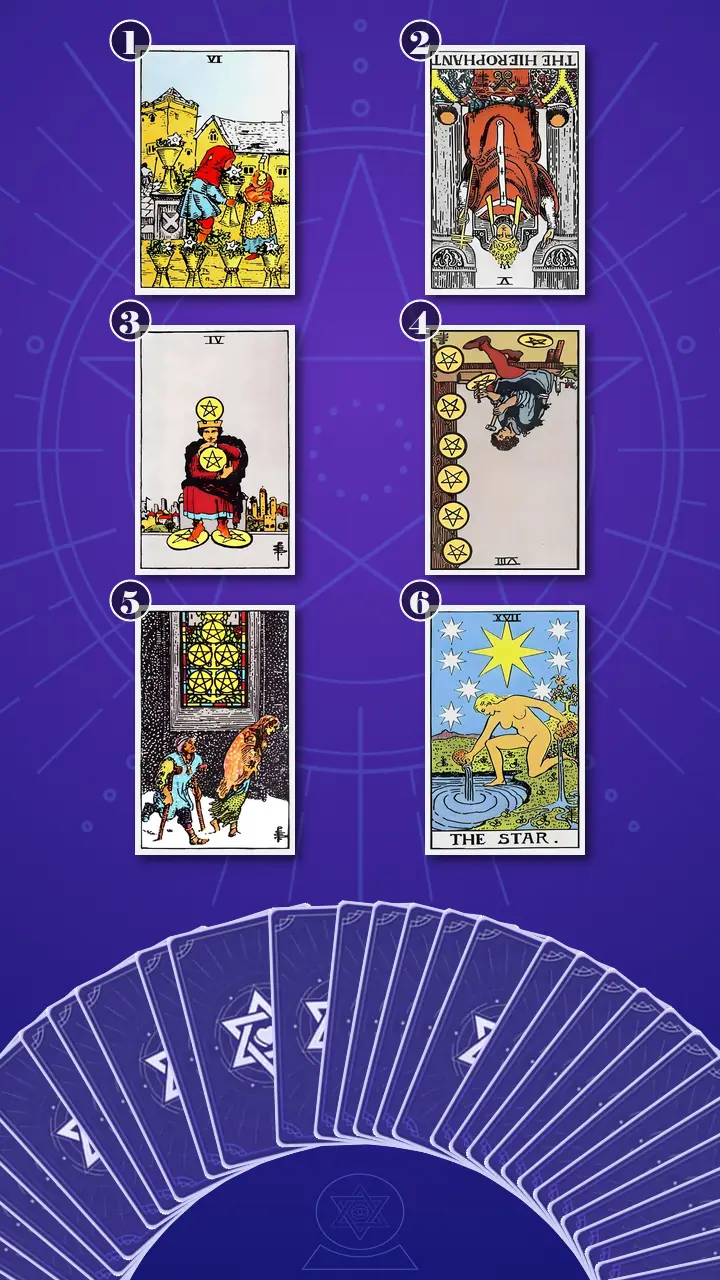
Reading the Staircase: From Nostalgia to the Inner Rule-Maker
Position 1 — Present trigger: what the baby book is stirring emotionally and what you’re doing with that feeling right now.
“Now we’re turning over the card that represents the present trigger—what the baby book stirred, and how you’re managing that feeling in real time,” I said.
Six of Cups, upright.
I didn’t need to stretch for this one; it landed exactly where her story already lived. “This is the time capsule card,” I told her. “It’s you opening the baby book expecting a soft, sweet moment—photos, captions, the vibe of ‘back then.’ For a minute it’s tender. Then the brain flips the page into evaluation mode: ‘Was I good? Was I easy? Was I lovable?’ The memory stops being a time capsule and starts feeling like evidence.”
In terms of energy, the Six of Cups here is balance trying to happen—warmth and connection are available. But the moment you treat warmth like a test, the energy tips into a subtle blockage: nostalgia becomes a courtroom.
Jordan let out a small laugh that wasn’t amused. It had teeth in it. “That’s… so accurate it’s kind of mean,” she said, but her eyes stayed on the card like it had finally said something honest.
“Nostalgia isn’t a courtroom,” I said gently. “Your baby book isn’t evidence.”
She blinked hard, as if that sentence hit a place behind her eyes she hadn’t been able to name.
Position 2 — The childhood belief to unlearn: the inherited ‘rule’ that still runs in the background.
“Now we’re turning over the card that represents the childhood belief to unlearn—the inherited rule that still runs in the background, even when you think you’re just being rational,” I said.
The Hierophant, reversed.
“This card is tradition, authority, ‘the right way’—and reversed, it often shows up as an inner rule-maker you’ve outgrown but still obey,” I explained. “In modern life, it can sound like a calm, corporate narrator in your head. Not cruel—just… compliant.”
I used the translation that matched Jordan’s lived moment: “A reasonable-sounding voice sets the rules: be polite, be impressive, don’t be complicated. It feels like maturity, but it’s actually an inherited standard—an internalized ‘how to be acceptable’ handbook that keeps running even when no one is asking for it.”
Here the energy is Air-as-rules, and it’s a blockage: meaning becomes “shoulds.”
“Listen for the contrast,” I told her, leaning into the echo technique. “One voice says, ‘This is my opinion.’ Another says, ‘This is a rule I learned.’ They can sound identical.”
Jordan’s shoulders lifted like she’d been caught mid-scroll. Then she paused, and a surprised little laugh escaped her—quiet, almost relieved. “Oh my God,” she said. “It really does sound like… a policy manual. Like I’m reading my baby book the way I’d read a client brief.”
“Exactly,” I said. “And that’s not a character flaw. It’s a coping strategy that used to help you belong.”
Position 3 — Origin layer: what kind of safety strategy formed around that belief (without blaming anyone).
“Now we’re turning over the card that represents the origin layer—what safety strategy formed around this belief, without blaming anyone,” I said.
Four of Pentacles, upright.
This is the body card. The grip. The bracing. “In the modern-life version,” I said, “this is you holding everything tight—needs, feelings, even questions. Keeping life contained and controlled: no messy asks, no emotional ‘spills,’ no unpredictability. It’s protective, but it also teaches your body: connection is something you could lose if you’re not careful.”
Energetically, this is Earth in excess—stability turned into rigidity. The nervous system chooses control because it’s predictable.
And because Jordan lives where everything feels expensive—rent, groceries, winter—her psyche does what a city does in February: it budgets warmth. “Toronto life can feel costly enough that emotional risk seems unaffordable,” I said, mirroring the echo. “So the body learns: stay contained, stay safe.”
Jordan swallowed hard. I saw her jaw unclench, then re-clench, then finally soften. She exhaled through her nose like she’d been holding that air for years. “Yeah,” she said quietly. “I don’t… I don’t ask. I just manage.”
“And that makes sense,” I told her. “This card doesn’t shame you. It explains you.”
Position 4 — Present-day pattern: the specific adult behavior loop that keeps the belief alive.
“Now we’re turning over the card that represents the present-day pattern—the repeatable adult loop that keeps the belief alive,” I said.
Eight of Pentacles, reversed.
“This is the ‘v12_final_FINAL2’ card,” I said, and Jordan winced immediately—the exact response this card always gets from perfectionists who think they’re just being diligent. “Upright, it’s craftsmanship. Reversed, it’s effort trapped in perfectionism. Progress that stalls because the real risk isn’t the work—it’s being seen.”
I leaned into the montage technique, keeping it quick and undeniable: “You reopen the draft. You change one sentence. You close the laptop. You reopen it. You soften the tone. You add context. You delete half. You tell yourself, ‘Just one more pass and then I’ll send it.’”
She let out a sharp breath like a laugh that didn’t fully land. “That’s literally me,” she said. “Like… to the comma.”
“Perfectionism isn’t ambition—it’s a safety behavior,” I said, letting the line sit. “In this position, the energy is Earth in blockage: steady work turns into anxious overwork, and anxious overwork turns into not shipping. You get short-term relief—no one can criticize what you didn’t send—but the long-term cost is stuckness and isolation.”
Jordan’s eyes flicked away from the card as if it was too intimate. Then she looked back. “It’s so weird,” she said. “I tell myself I’m being responsible. But it’s like I’m trying to become… uncriticizable.”
“Yes,” I said. “And nobody can live there forever.”
Position 5 — What the belief is protecting: the core fear about worth or belonging that makes the belief feel necessary.
“Now we’re turning over the card that represents what the belief is protecting—the fear that makes the rule feel necessary,” I said.
Five of Pentacles, upright.
Even over video, I felt the temperature drop. This card always carries a winter scene: two figures outside in the cold, a warm stained-glass window glowing nearby.
“In modern terms,” I said, “this is you walking yourself through emotional winter with your collar up—while the warm building of support is right there in your contacts, group chats, and community. Shame whispers the door is locked.”
Energy-wise, this is Earth in deficiency: scarcity of belonging. Not necessarily real scarcity—felt scarcity. The kind that makes you assume you’re a burden before you even ask.
I named the conflict pair directly: “Independence versus support. And here’s the hard truth this card brings without cruelty: If you only feel lovable when you’re low-maintenance, closeness will always feel expensive.”
Jordan’s eyes softened. Her gaze went a little unfocused—the way it does when someone’s brain is replaying a memory without fully narrating it. Her hand hovered over her phone, like she had the urge to text someone and didn’t know if she was allowed.
“I hate that I do that,” she whispered. “The ‘I’ll just handle it’ thing. Even with friends who would absolutely show up.”
“It’s not hate-worthy,” I said. “It’s protective. It just isn’t serving you anymore.”
When The Star Refused to Be a Performance
Before I turned the last card, I noticed the room go quieter on my end—the canal outside my window settling into that glassy stillness Venice gets right before night fully closes. It felt like the reading itself had reached the bottom of the staircase.
“We’re turning over the most important card now,” I told Jordan. “This is the unlearning path: the new belief to practice, and a grounded way to integrate it this week.”
The Star, upright.
The image is simple and radical: a figure without armor, pouring water onto land and into a pool. One pour is practical. One pour is emotional. Both count.
Setup. Jordan had come in hoping for a single sentence—one childhood belief she could identify and fix fast. But the spread showed what really happens: you open the baby book for sweetness, your chest tightens, and “aww” turns into “What does this prove about me?” Then you chase safety by rewriting messages, polishing work, staying un-needy—trying to become impossible to judge.
Delivery.
Stop treating your worth like a rulebook you must follow, and start treating it like water you can pour back into yourself—The Star only shines when you stop armoring up.
I let silence hold it for a beat, the way I used to on ships when someone finally heard their own truth over the engine hum.
Reinforcement. Jordan’s reaction came in layers—so human it made my chest ache. First, a brief freeze: her breath caught and her eyes widened just slightly, like her body didn’t know whether to accept something that gentle. Second, the cognition seeped in: her gaze dropped to the card, then drifted off to the side, as if she was replaying every “I’m fine!” she’d ever said with a smile that cost her. Third, the release: her shoulders lowered a full inch. Her jaw softened. She exhaled slowly, and her voice came out quieter, less sharpened by urgency.
“This feels… doable,” she said, almost surprised. “Not like… a brand-new identity. More like… I can just stop punishing myself.”
I nodded. “That’s The Star. It’s not a glow-up. It’s rehydration.”
And this is where my own Venetian lens always clicks in—my Glass Workshop Metaphor. “On Murano,” I said, “glass doesn’t survive intensity alone. You can shape it in heat, but if you cool it too fast, it cracks. There’s a step called annealing—slow, steady cooling—so the structure can hold. The Star is annealing for the self. Tiny, consistent care that tells your nervous system: you’re safe with you.”
“Now,” I asked her, “use this new lens and look back at last week. Was there a moment—rewriting an email, hovering over a text, closing your laptop—where this would have changed how you felt in your body?”
She blinked, eyes bright. “Tuesday,” she said instantly. “I literally had the message written. It was clear. I just… kept trying to make it perfect. Like perfect would keep me included.”
“Exactly,” I said. “And this is the shift: from tight self-monitoring and approval-based self-doubt to gentle self-trust and steady, workable confidence. Not because you proved the old rule wrong—but because you practiced a new kind of safety until it became real.”
Private Proof and Dock-Piling Boundaries: Your Next 7 Days
I gathered the whole spread into one thread for her—so it wasn’t six separate insights, but one coherent story:
“The baby book (Six of Cups) opens tenderness, but your mind turns tenderness into evidence. Then the Inner Rule-Maker (Hierophant reversed) steps in with inherited standards—be easy, be impressive, be uncomplicated. Your nervous system protects you with control (Four of Pentacles), which turns into perfectionistic labor that stalls real action (Eight of Pentacles reversed). Underneath all of it is the fear of being outside the warm building (Five of Pentacles)—the fear that if you stop performing, you won’t belong. The Star says the antidote isn’t a better performance. It’s private, repeatable self-support.”
“The blind spot,” I added, “is that you’ve been treating self-worth like a compliance system: follow the rules, earn belonging. The transformation direction is context, not a verdict. Your childhood story is information. It’s not a grade.”
Then I gave her next steps that were small enough to be believable—because big promises tend to trigger the same old ‘do it perfectly’ reflex.
- The 7-Minute “Private Proof” RitualOne evening this week, set a timer for 7 minutes. Make tea and sit by the window—no emails, no “inner child” reels, no Notion templates, no optimizing. Just sit and let your body feel what it feels.Expect your brain to call this “too small to matter.” That’s the point. If it feels too tender, shrink it to 2 minutes and stop early—your only job is to notice, not to push.
- Context-Not-Verdict AnchorWrite one sentence on a sticky note: “Context isn’t a verdict.” Put it inside the baby book or on your laptop lid—where your approval-checking habit actually happens.Keep it un-aesthetic on purpose. This isn’t décor. It’s a cue to interrupt the courtroom energy.
- The Bollard Marking MessageThe next time you feel the urge to over-explain, send the first clear version of the message—and add one boundary line: “No rush to reply—just wanted to name it.” Think of it like tying your boat to a dock bollard: a small post that keeps you steady while you wait.If you feel the “one more tweak” urge, stand up, drink water, and hit send before you sit back down. Exit ramp beats perfect timing.
Jordan hesitated at that last one, and I welcomed it. Real life always pushes back. “But I swear I don’t have the five minutes,” she said, voice tightening. “I get home and it’s like my brain goes straight into fix-it mode.”
“Then we go smaller,” I said, coach-voice without harshness. “Twenty seconds. Hand on chest before you interpret anything. You can be busy and still be kind to your nervous system.”

A Week Later, the Quiet Proof of Self-Trust
Six days after our reading, I got a message from Jordan. No long explanation. No apology. Just: “I sent the email after one pass. It was fine. Nobody died. Also I did the tea thing by the window. It felt weirdly… holy? In a not-cringey way.”
She added one more line: “I’m still anxious in the morning. But now it’s like I can see the rule instead of being owned by it.”
That’s what a Journey to Clarity looks like in real life: not a dramatic rewrite of your past, but a steady shift in how you treat yourself in the present. The Star doesn’t demand that you stop feeling tender. It simply asks you to stop turning tenderness into a verdict.
And if tonight you look back at your childhood and your chest tightens, it’s not because you’re behind on healing—it’s because some part of you still thinks being lovable means being easy, impressive, and never too much.
So let me turn this gently toward you: if you treated your childhood story as context—not a verdict—what’s one tiny way you’d let yourself be more honest this week, even if it isn’t perfectly polished?