Cold Takeout, Therapy Tabs, and the Night Booking Changed Meaning

Finding Clarity in the 11:24 p.m. Scroll
If you're the kind of mid-20s city worker who can write a polished Slack update in two minutes but will spend 90 minutes rewriting a therapy inquiry after midnight, Taylor (name changed for privacy) was exactly there when we met. I have learned, over many readings, that you can be highly functional in public and still freeze in private the second support becomes real.
On my screen, Taylor sat cross-legged on a sofa in a west-end Toronto apartment and told me about Thursday at 11:24 p.m.: takeout gone lukewarm in the paper box, laptop light washing the room blue, Psychology Today open next to a Manulife benefits PDF and a half-written contact form. The fridge hummed. A faint soy-sauce smell lingered. Their cursor hovered over Send until their throat locked and their stomach pulled tight, and then they did what they always did—they closed the laptop and promised themself they would book when they could explain it better.
By the next morning on Line 2, with dry winter air still stuck in their coat sleeves and Slack already open on their phone, the whole night had shrunk into something they were already trying to dismiss. That was the exact loop inside the question I hear so often: why do I keep researching therapists but not booking, and why does hitting send on a therapist email feel so humiliating?
"I know I probably need support," Taylor told me, giving a short laugh that didn't reach their eyes. "I just don't want to make it a whole thing. What if I book and then realize I was being dramatic?"
I could hear the core contradiction immediately: wanting to book therapy and be supported, while fearing that asking for help would somehow prove they were too much. The shame in their body had the texture of a zipper snagged high in the throat—small, private, and impossible to ignore once it caught. I answered as gently as I could. "That loop makes sense. Research can be a hiding place. Let me help you draw a map through this fog, so tonight we move a little closer to clarity and a little farther from self-cross-examination."

Choosing the Ladder Instead of a Verdict
I asked Taylor to put both feet on the floor, unclench their jaw once if they could, and hold the question in the plainest language possible: Do I book, or do I keep treating my need like evidence against me? Then I shuffled slowly. Not as theatre, and not as prophecy—just as a way to let the nervous system step out of the sprint for half a minute.
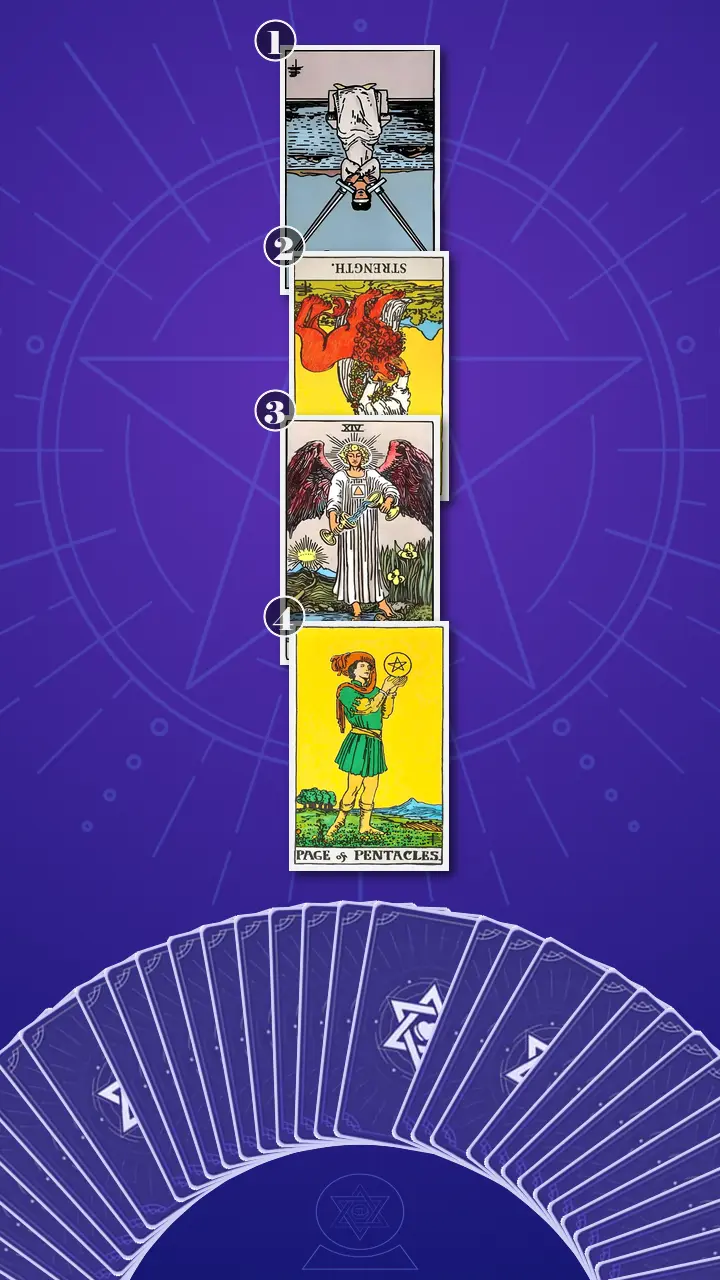
For this session, I chose the Four-Layer Insight Ladder · Context Edition, a four-card tarot spread for help-seeking shame and therapy booking anxiety. This is how tarot works best for decision fatigue: not by predicting whether someone is "meant" to do something, but by revealing the structure underneath the stuckness. Taylor's problem was not really a yes-or-no choice. It was support permission anxiety—a shame threshold around whether they were allowed to be held at all.
The first position would show the visible habit: the therapy-tab paralysis itself. The second would uncover the hidden belief beneath it. The third, and most important, would offer the reframe that could restore balance. The fourth would point to one grounded next step—something practical enough to use before the mind could turn it into another all-night optimization project.
I told Taylor the cards were not there to judge whether they "needed therapy enough." They were there to show the mechanics of the loop, card meanings in context, and the next usable move.
The Tabs That Called Themselves Research
Position 1: The Symptom Knot — Two of Swords Reversed
I turned the first card. "This is your current symptom knot," I said. "The concrete behavior that shows up right at the threshold of support." The card was the Two of Swords, reversed.
It could not have been more specific. In modern life, this card looks exactly like Taylor on a weeknight with five tabs open—bios, specialties, transit distance, fees, insurance coverage—while a short inquiry email sits unsent. On the surface it resembles careful decision-making. In context, it is something else: using research to delay the moment of being witnessed.
The reversed Two of Swords is blocked Air. Too much processing, not enough permission. The blindfold says the need is already felt in the body, but the mind keeps acting as if one more pass through the information will make the choice emotionally risk-free. The crossed swords over the chest are the posture Taylor had already described perfectly: shoulders up, breath shallow, stomach clenched, cursor hovering. Like keeping Maps open to the destination but never pressing Start.
I asked, "When you close the tab, is your body really asking for more information—or for less exposure all at once?"
Taylor gave a small, bitter laugh and leaned back. Their fingers stopped around the mug, then tapped once against the ceramic. "Okay," they said. "That's annoyingly exact. I keep telling myself it's research. But it doesn't feel like research by the end."
"No," I said. "By the end, it feels like self-protection. What if the hardest part isn't finding the perfect therapist, but letting someone see that you need one?"
They looked at the card again, then at me. I nodded. "Research can be a hiding place."
Position 2: The Hidden Root — Strength Reversed
I turned the second card. "Now we're underneath the habit," I said. "This is the hidden root—the belief that makes help feel dangerous." The card was Strength, reversed.
Whenever Strength reverses in a reading like this, I do not read weakness. I read force turned inward. In Taylor's life, it showed up as the almost Severance-like split between the polished daytime self and the after-hours collapse: composed in meetings, fast in Slack, sounding fine in public, and then crying in the shower later while rehearsing how to sound easier to deal with if anyone asked what was wrong.
The energy here is deficient self-trust and excess self-control. The lion's open mouth is emotional intensity—the part of Taylor that gets hit hard by a rough meeting, a lonely commute, a late-night spiral. The gentle hand, missing in the reversed form, is the skill they have not been offering themselves: steady contact without shame. Instead, the inner caretaker has become an inner enforcer. Don't make it a whole thing. Tone it down. Be easier to hold.
I told them, "You're not failing at coping; you're stuck at the doorway of being seen."
For a second they didn't answer. Their breath caught, their eyes unfocused as if a memory had loaded behind them, and then they looked down at the table off-screen. "That line," they said quietly, "is rude in the most useful way." One shoulder lifted in a half-shrug before dropping again. "I really do think if someone saw the full size of it, they'd conclude I'm high-maintenance."
"That," I said, "is the real fear. Not 'What if the therapist isn't perfect?' but 'What if my need makes me less worthy of care?' That's why the booking page feels like a courtroom instead of a first conversation."
When Temperance Poured Between Two Cups
Position 3: The Key Reframe — Temperance Upright
When I turned the third card, the atmosphere changed. Even through a screen I felt it. The same laptop glow was still lighting Taylor's face, but it no longer felt like interrogation light. This was the pivot of the entire reading, the antidote card, and it arrived exactly where it should: Temperance, upright.
I asked Taylor to picture the weeknight couch scene again—cold takeout, therapist tabs, cursor over the contact button, throat tight because the real question was no longer Which therapist? but Am I allowed to need this? This is the spot where shame usually floods the language with words like justify, prove, dramatic, enough.
Then I slowed down and gave them the sentence the card had been building toward.
You are not 'too much' for the room; let Temperance's two cups show you that feelings can be held, mixed, and met one honest step at a time.
I let the silence stay open, then translated it plainly. "Support is not a final verdict on how bad things are," I said. "It's a steadier container for what is already real."
In moments like this, my old cruise years return to me in a flash. I spent a long time teaching people to trust the body when conditions changed at sea, and I learned that safe docking almost never depends on perfect weather. It depends on recognizing the workable window before fear turns delay into a bigger risk. That is why, with Temperance, I use a lens I call Choice X-Ray.
So I laid it out for Taylor without drama. Keep researching therapists without contacting one, and the short-term benefit is obvious: no exposure, no chance of feeling needy, no moment of being fully seen. But the hidden cost is brutal—you stay alone with the weight, and shame charges interest. Send one honest inquiry or book one consult, and yes, the short-term cost is a tight throat and some awkwardness. But the hidden benefit is steadiness, structure, and evidence that support can be ordinary. Support is not something you earn by breaking down hard enough. It is a container.
Taylor went still in three waves. First their breathing paused completely, one hand suspended halfway to their face. Then their gaze slipped past me, not avoidant so much as inward, as if they were replaying every late-night tab spiral at once. Finally the emotion landed. Their jaw unclenched. Their shoulders dropped a fraction, then more. Their eyes shone, not theatrically, just suddenly less defended.
"But if that's true," they said, voice thinner now, "then I've been making myself submit evidence for basic care."
"Yes," I said softly. "And you can stop doing that."
They pressed their lips together, exhaled through the nose, and gave a tiny nod that looked almost disoriented—like setting down a bag they'd carried so long they had forgotten its weight. That was the shift right there: not from pain to perfection, but from shame-tight hesitation and self-minimizing to cautious self-permission and grounded self-respect.
I asked, "Using this new lens, if you think about last Sunday night, what would have changed?"
Taylor answered almost immediately. "I wouldn't have asked whether I was bad enough. I would've asked whether one conversation might help me feel steadier this week."
Position 4: The Grounded Landing — Page of Pentacles Upright
The fourth card was Page of Pentacles, upright. "This is your grounded next step," I told Taylor. "Not the perfect feeling. Not a life verdict. The smallest action that makes the insight usable."
In modern life, the Page is gloriously boring. One short inquiry. One availability check. One screenshot of the benefits card. One 15-minute block in Google Calendar so the task stops floating around like a guilty open tab and enters real life. The energy is Earth—balanced, teachable, practical. This card does not ask Taylor to feel fearless. It asks them to act like a beginner who's allowed to learn by doing.
"A three-line email can count as self-respect," I said. "This card loves boring admin, because boring admin quietly changes a week."
Taylor laughed for real this time. Then the practical resistance arrived, right on schedule. "Okay, but what if I make the 15-minute block and still dodge it? Or spend the whole time rewriting the message?"
"Then we lower the bar again," I said. "You don't need the perfect explanation to make a real first move. This is not your memoir. It's first contact."
I told them I wanted to pair two strategies from my own practice: a Port Decision Model and a 48-hour Reality Test. In port, you do not wait forever for ideal conditions; you use the workable window and make one clean maneuver. Over the next two days, Taylor did not need certainty. They needed one completed admin step small enough that shame could not inflate it into a referendum on their whole life.
I could see the reflection in their glasses shift as they opened their phone—probably the Notes app list already titled therapists, sitting somewhere between grocery reminders and random midnight thoughts. This time it looked less like evidence and more like a place to begin.
Boring Admin, Big Care in the Next 48 Hours
When I gathered the reading together, the story was clean. The Two of Swords reversed showed the visible loop: therapy-tab paralysis that looks productive from the outside. Strength reversed named the engine underneath it: the shame-based belief that visible need lowers worth, so Taylor edits their feelings before anyone else can. Temperance shifted the whole frame from courtroom logic to container logic. The Page of Pentacles grounded that change in Earth, where care stops being a referendum and becomes one practical contact step.
The blind spot was equally clear: Taylor had been mistaking self-silencing for maturity. They thought support had to be justified by severity, perfect wording, and the exact right level of distress. The transformation direction was simpler, and far kinder—letting one concrete need be witnessed without apology, then acting before the mind could reopen twelve tabs and call it caution.
So I gave them a route. Not a reinvention. Just a route. I paired the Single-Tab Support Rule with my Venetian Merchant Method—no fantasizing about ten future outcomes, just a workable evaluation of one option by availability, coverage, and one calming signal.
- Use the Single-Tab Support RuleSet a 10-minute timer and choose one therapist using only three criteria: availability, cost or coverage, and one line in the bio that feels calming enough. Then close every other tab and keep only that contact page open for 24 hours.If your brain demands one more comparison pass, name it clearly: optimization can be camouflage. A 70% fit is enough for a first consult.
- Send the Three-Line Reach-OutCopy and paste this into one email to one therapist only: "Hi, I'm looking for support and wanted to ask about your availability for an initial consultation. I'm especially looking for help with stress, shame, and difficulty reaching out. Thanks." Put a 15-minute therapy-admin block on your calendar so the task has a lane.If sending feels too activating, draft it with the recipient filled in and come back later. One tiny finished admin step still counts.
- Witness One NeedText one trusted friend, "I've been having a harder week than I look, and I'm trying not to minimize it." No joke after it. No apology attached.If live conversation feels too exposed, send a voice note instead. The goal is contact, not a perfect performance.

A Week Later: The Quiet Proof
A week later, Taylor sent me a message from a coffee shop: "Booked one consult. Then sat here staring at the confirmation email like it might revoke itself."
I smiled when I read it. That was all the proof I wanted. Not a transformed life. Not total certainty. Just one person moving a need out of a late-night spiral and into the ordinary architecture of care.
That was the real journey to clarity. Not deciding whether Taylor was "bad enough" for therapy, but letting support become something they were allowed to try. One honest booking step had already begun to feel less like proof of failure and more like self-respect.
There is a very specific kind of loneliness in needing support, feeling your throat tighten at the contact button, and still trying to edit yourself into someone easier to hold. If tonight you recognize yourself in that doorway, please know this: noticing the trial you keep putting your own need through is already the beginning of finding clarity.
If one part of you didn't have to prove anything first, what tiny support step would feel okay to try next—the single-tab rule, the three-line reach-out, or simply letting one feeling be witnessed without apology?
Every reading at AceTarot is a Journey to connect with inner wisdom and empower next step.
Learn more about our Journey to Clarity.