From Publish Panic to Version 1 Momentum: A Portfolio Leap Tonight

The 10:43 p.m. Publish Hover
If you’ve ever hovered over the “Publish” button and suddenly found one more thing to tweak—welcome to portfolio perfectionism.
Taylor’s Zoom camera showed a Toronto condo living room lit mostly by laptop glow. Their knees were pulled up on the couch, the machine warm against their thighs, and the fan inside it had that insistent, dry whir that makes everything feel later than it is. On their second monitor, I could see the loop: zoom in, nudge spacing, zoom out, refresh the mobile preview—again. Their trackpad hand moved like it was stuck on a tiny carousel.
“It’s basically done,” they said, and their voice tried to sound casual. But their jaw was set like they were biting down on a secret. “But I can’t ship it like this.”
I watched their shoulders creep upward the way they do right before a hard conversation—like the body wants to turn into a smaller target. It wasn’t just nervousness. It was that contracted, restless buzz in the hands that shows up when the next click feels personal.
“So the question is,” I mirrored back, keeping my tone steady, “publish today and be seen… or hide behind perfectionism because being judged for anything less than perfect feels like it would land on you, not just the work.”
Taylor’s eyes flicked to the browser tab with the draft site and back. “Yeah. Everyone else posts like it’s nothing. And I’m over here choosing between two fonts like it’s life or death.”
The anxiety in the room had a texture to it—like trying to breathe through a scarf that’s pulled a little too tight. Not dramatic. Just constant. And familiar.
“Okay,” I said. “Let’s make this a Journey to Clarity. Not a pep talk. A map. Something you can actually use tonight.”

Choosing the Compass: The Decision Cross Spread
I had Taylor take one slow breath—not as a mystical ritual, just a clean transition. On trading floors we called it a reset; you interrupt the momentum long enough to make an intentional choice. I shuffled while they held the question in one sentence: My portfolio’s ready—publish today or hide behind perfectionism?
“We’re going to use a five-card layout called the Decision Cross,” I explained, angling the camera so they could see the cross form on my table. “It’s made for a binary dilemma—publish vs delay—without turning it into an endless timeline where you can keep negotiating with yourself.”
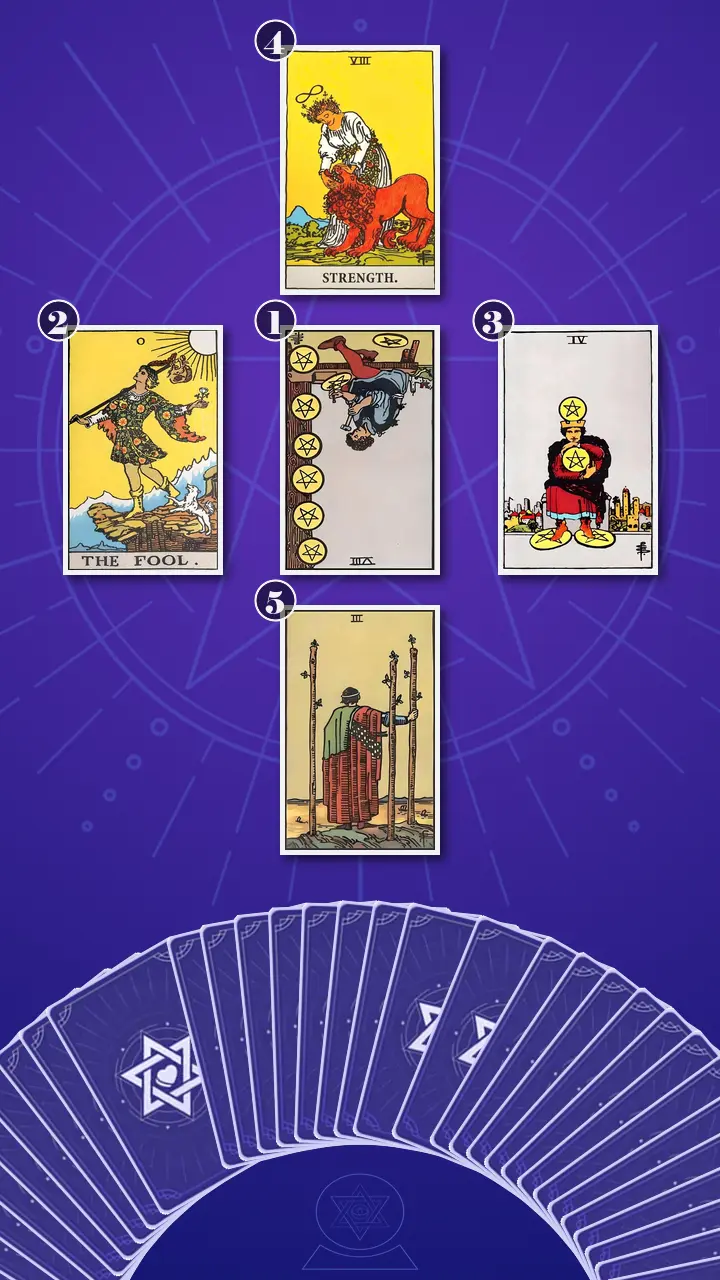
For anyone who’s ever wondered how tarot works in a practical, modern way: this spread is basically a decision model. It isolates (1) the stuck pattern, (2) the lived energy of Option A, (3) the lived energy of Option B, (4) the inner skill that stabilizes you at the exact moment of choice, and (5) the most constructive integration—momentum and next steps, not a fate sentence.
“Card 1,” I told Taylor, “will name the specific loop that keeps you from shipping even though you’re ready enough. Card 2 and Card 3 are the tug-of-war—publish today vs hide behind perfectionism. Card 4 is the medicine. And Card 5 is what becomes easier once you apply it.”
Reading the Map: Craft, Control, and the First Step Off the Cliff
Position 1 — Current stuck point: the specific behavior pattern keeping the portfolio unpublished
“Now we turn over the card representing the current stuck point—the exact behavior pattern keeping the portfolio unpublished despite being ready.”
Eight of Pentacles, reversed.
I didn’t have to stretch for the translation. “It’s late and you’re doing a ‘responsible’ final pass—except it’s the same paragraph again. You’re swapping thumbnails, nudging typography, rechecking spacing on mobile, and telling yourself you’re improving quality… but really you’re buying temporary safety from being judged. The portfolio is ready enough; the loop is what’s not.”
Reversed, this card isn’t “bad work.” It’s diminishing returns: craftsmanship turning into compulsion. The energy is blocked—Earth energy that’s supposed to build something solid, but instead keeps you in the workshop because the town square (feedback, opinions, recruiters, clients) feels too loud.
Taylor let out a small laugh that landed sharp at the end, like it surprised them. “Oh my god,” they said. “That’s… so accurate it’s kind of cruel.”
And there it was—the two-beat inner monologue the card always exposes:
Beat one (the cover story): “I’m just improving quality.”
Beat two (the real motive): “I don’t want to be judged.”
Their fingers, still on the trackpad, made a tiny tightening motion—like they were bracing to defend one more edit. Deep emotional syncing isn’t dramatic; it’s when someone feels seen down to the micro-behavior.
Position 2 — Option A energy: what ‘publish today’ unlocks
“Now we turn over the card representing Option A: publish today—what it unlocks psychologically and behaviorally.”
The Fool, upright.
“Your cursor hovers over Publish,” I said, using the card’s modern life scenario exactly as it wanted to be used. “You don’t have a guarantee of applause, and that’s the point: you’re choosing a clean start. You ship a Version 1 with essentials—clear projects, clear role, clear contact—so you can finally get real feedback instead of running imagined critiques in your head.”
The Fool’s energy is Air—movement, experimentation, first reps. Not reckless. Not careless. Just… not held hostage by needing certainty.
Taylor’s mouth softened like they were about to argue with the idea, but instead they exhaled. It was small, but I’ve seen that exact exhale on a trader’s face right before they finally place the order they’ve been hovering over for an hour.
“Version 1 is not a verdict,” I added, and watched their eyes drop to the corner of their screen where the Publish button lived. “It’s a feedback portal.”
Position 3 — Option B energy: what ‘hide behind perfectionism’ protects and costs
“Now we turn over the card representing Option B: hide behind perfectionism—what it protects, and what it quietly costs you.”
Four of Pentacles, upright.
“You keep the portfolio link private like it’s something that could be taken from you—or used against you,” I said. “You tell yourself you’re being strategic, but you’re actually trying to control the moment of judgment. The cost is quiet: fewer applications sent, fewer conversations started, fewer chances for the work to do what it’s supposed to do.”
Upright, the Four of Pentacles is control as protection. The energy isn’t “lazy.” It’s guarded. It’s you clutching the link in drafts the way someone clutches a personal playlist they refuse to share because it feels too revealing.
I asked the card’s pointed question, cleanly: “Are you controlling quality… or controlling other people’s reactions?”
Taylor’s eyes shifted off-camera, like they were looking at a memory. Their shoulders didn’t rise this time; they dropped a fraction, uncomfortable but honest. “Reactions,” they said. “It’s reactions.”
When Strength Spoke: Better Pixels Won’t Buy You Safety
Position 4 — Best advice: the inner skill to practice so values lead, not fear
I let the silence sit for a beat. The room—two cities connected by Wi‑Fi—felt suddenly quieter, like the background hum stepped back. “We’re turning over the hinge card now,” I said. “The one that decides whether this stays a career crossroads and decision fatigue loop… or turns into actual forward motion.”
“Now we turn over the card representing the best advice—the inner skill to practice so the decision is led by values rather than fear.”
Strength, upright.
“Right as you feel the urge to spiral into edits, you pause,” I said, grounding it in their reality. “You name the fear—being seen—and you keep your hands steady anyway. You publish with compassion and discipline: not forcing yourself, not shaming yourself, just choosing a calm, firm next step. Your worth stays separate from the response.”
This is where my old life always flickers in. On Wall Street, risk wasn’t a feeling; it was something you structured. You didn’t eliminate it. You contained it, sized it, hedged it. And Strength—done correctly—is emotional risk management.
I brought in my own framework the way I naturally think: “I want to run a quick Risk-Reward Matrix on this moment,” I told Taylor. “Three scenarios, like a simple forecast. Best case: you publish and it lands well—great. Base case: you publish and it’s… fine. A couple people click, one recruiter asks a question, you adjust. Worst case: you publish and someone doesn’t care, or gives blunt feedback. Here’s the key: none of those outcomes is lethal. But the cost of not publishing is guaranteed—no visibility, no feedback loop, stalled opportunities. That’s the opportunity cost you’re paying nightly, one 2px nudge at a time.”
Taylor swallowed. I could see the moment their brain tried to treat “worst case” like a courtroom.
So I slowed down and followed the exact arc this card requires.
Setup
You’re on your couch at 10:43 PM, laptop heat on your thighs, retyping the same case study headline again—jaw clenched—because hitting “Publish” feels like letting strangers grade you.
Delivery
Stop gripping your portfolio like a shield and start holding your fear gently like Strength taming the lion—publish, then refine from steadiness.
I let the sentence hang there for a second. No extra explanation. Just air.
Reinforcement
Taylor’s body did a three-step reaction chain I’ve learned to trust more than any words. First, a tiny freeze—breath caught, fingers hovering over the trackpad like the cursor inside them stopped moving. Then their gaze unfocused, as if their mind replayed every almost-publish night, every “still refining it” text, every LinkedIn launch post that made their stomach drop. Finally, the release: their shoulders lowered in a slow, reluctant surrender, and their jaw unclenched like it had been holding a coin between its teeth.
“But… if I’m not brutal,” they said quietly, “how do I make myself do it?”
“That’s the lie perfectionism sells,” I replied. “That the only way you move is by threatening yourself. Strength is the opposite: it’s leadership. It’s steady hands.”
I gave them the three-line internal script from the card, simple enough to use mid-spiral:
(1) “I’m scared of being seen.”
(2) “I can still ship.”
(3) “My worth isn’t up for voting.”
Then I asked, exactly when it mattered: “Now, with this new lens—can you think back over the last week? Was there a moment where this would’ve changed the choice you made… even by 10%?”
Taylor blinked fast, like their eyes were adjusting. “Yesterday,” they said. “A recruiter asked for my link. I stalled. If I’d had this… I could’ve sent it.”
And that was the shift in real time: from visibility paralysis and perfectionism-as-a-shield… to the first inch of steady self-trust. Not certainty. Not a promised outcome. A new stance.
Position 5 — Integration: the most constructive next-step outcome (momentum, clarity, self-trust)
“Now we turn over the card representing integration—where the energy consolidates when you apply the advice.”
Three of Wands, upright.
“The link is live,” I said. “Now you can do the part that actually changes your life: sending it out, applying, sharing, having conversations, seeing what lands. Instead of optimizing in private, you watch what happens in reality—who clicks, what questions they ask, what doors open once the work can travel.”
This card is fire with a horizon. It’s what happens when you stop treating your portfolio like a final exam and start treating it like a living product release.
Taylor nodded once, decisively—like they’d just moved from “thinking about doing” to “choosing.”
The One-Page Shipping Ledger: Actionable Advice for the Next 48 Hours
I leaned back and summarized the story the spread told us, plain and usable: the Eight of Pentacles reversed shows your craft has become a safety ritual—micro-edits that soothe you short-term while stealing your visibility long-term. The Four of Pentacles explains why: control feels like protection when judgment feels personal. The Fool offers the exit: a scoped Version 1 that creates real data. Strength is the bridge—the nervous-system leadership that lets you be brave and kind at the same time. And the Three of Wands is the payoff: momentum once the work circulates.
The cognitive blind spot here is subtle: you’ve been treating “more polish” as if it buys “more safety.” It doesn’t. Better pixels won’t buy you safety—steadiness will. The transformation direction is exactly this: from “perfect before public” to “publish a version and iterate from real-world feedback.”
Taylor frowned, practical again. “Okay, but I genuinely don’t have time. I open it for ten minutes and suddenly it’s midnight.”
“Perfect,” I said, not flinching. “Then we’re going to use constraints. In finance, constraints are what make decisions real. Here are your next steps—small enough to start, structured enough to hold.”
I brought in one of my go-to tools—the way I’d run it in a boardroom, but adapted for a human nervous system: a Boardroom-style decision ledger plus a pre-commitment ritual that interrupts the spiral.
- The 7-Minute Public-Safe SprintSet a 7-minute timer. In your portfolio editor, make only “public-safety edits”: typos, broken links, missing alt text, contact info. No aesthetics, no layout tweaks, no “let me just check mobile again.” When the timer ends, stop—even mid-urge.If your hands get buzzy or your chest spikes, put one hand on your sternum and exhale for 6 seconds. Tell yourself: “This is discomfort, not danger.”
- Pre-Commit the Publish Window (Trading-Floor Focus)Before you re-open the editor, book the next available 30-minute window today to publish (calendar invite). During that window: you publish or schedule the publish. You do not negotiate scope in real time.If it feels too intense, publish to a hidden URL first and send it to one trusted person. Same timeline, smaller audience.
- One Person, One Question Feedback AskSend the live (or hidden) link to one person and ask one specific clarity question: “Does my role in Project X read clearly in 10 seconds?” Not “Is it good?”Copy/paste a share note: “Here’s my Version 1. I’m iterating. Feedback on clarity, not polish, would help.” This prevents you from turning their response into a referendum on your worth.
“And one more boundary,” I added, because this is where people relapse into analytics doom: “If checking Google Analytics or Plausible spikes you, don’t check for 48 hours. Schedule a reminder instead. We’re collecting useful data, not feeding panic.”

A Week Later: The Quiet Proof
Six days later, Taylor messaged me a screenshot: a plain homepage, a simple “Version 1” note in their private Notion, and—most importantly—a live URL in the browser bar. “Published,” they wrote. “Then I went to a Queen West café and just… sat there for an hour. No celebration. Just breathing.”
It wasn’t a movie ending. They still woke up the next morning with a flicker of “what if it’s not enough?”—but this time, they didn’t open the editor to anesthetize the feeling. They sent one application instead. That’s what momentum looks like at the beginning: small, specific, real.
This is the part I love about a Decision Cross tarot spread for a publish-today vs hide-behind-perfectionism dilemma: it doesn’t tell you what you “should” be. It shows you where your energy is leaking, what your fear is buying you, and what kind of inner leadership turns visibility into a learnable skill.
Because when you treat “Publish” like a verdict, your shoulders tense and your jaw locks—so you keep fixing tiny things, because micro-control feels safer than letting anyone actually see you.
If you didn’t need this version to prove anything about you, what’s one small way you’d let your work be visible this week—just enough to start getting real data back?