Draft-Delete Loop Around 'Can I Call?'—And the Shift to One Plain Ask

The 11:48 p.m. Draft-Delete Loop and the Fear of Being a Burden
I meet a lot of twenty-something city workers who can write flawless Slack updates all day and still fall apart in the quiet gap between midnight and sleep. That is where fear of being a burden in friendship likes to show up: not as a dramatic collapse, but as a draft-delete loop around five small words.
When Jordan (name changed for privacy) sat down across from me in the back room of my café, she smelled faintly of cold air, laundry detergent, and the burnt edge of a coffee grabbed too fast on the way over. She gave me the kind of half-laugh I hear from people who are tired of sounding composed. Then she told me about 11:48 p.m. in her Toronto apartment kitchen: one sock in her hand, TikTok audio blurring from the bedroom, the fridge humming too loudly, her phone screen throwing blue light over her thumb while she typed ‘can I call for a sec?’ into iMessage, deleted it, typed it again, deleted it again, and put the phone face down like that might cancel the need itself.
‘I can be there for people all day,’ she said, looking at the table instead of me. ‘But asking for ten minutes back feels weirdly impossible.’
I could feel the real contradiction immediately: she wanted comfort and connection from a friend, but the moment she needed it, her body treated the ask like social contraband. The shame sat in her throat like she had swallowed an ice cube whole; her chest was clenched so tightly it was as if some invisible hand had zip-tied the ribs together. And underneath all that tension was something quieter and sadder: having people is not the same as feeling allowed to need them.
I told her gently what I tell many reliable, low-maintenance people who do not realize how lonely that role can become: the unsent text is still a real bid for care. A lot of high-functioning loneliness looks exactly like being reachable and never asking. Then I wrapped both hands around my espresso cup, met her eyes, and said that our job today was not to judge the freeze. Our job was to draw a map through it, and for that, I already knew I wanted the Shadow Spread · Context Edition on the table.

Choosing the Compass: The Shadow Spread · Context Edition
I asked Jordan to hold her cup for a moment before drinking it and take one slow breath with me. In my space, that is the only ritual I insist on: not mystery, just a clean transition from spiraling to noticing. Then I shuffled slowly, listening to the soft brush of card edges against my palms and the far-off hiss of the milk steamer out front.
For a question like this, I do not use tarot to predict whether a friend will answer. I use it to show how the pattern works. The Shadow Spread · Context Edition is a four-card spread that moves in the exact sequence this pain moves: first the visible symptom, then the hidden wound under it, then the emotional medicine, and finally one small embodied next step. That is why it fits support-seeking shame so well. The real issue is rarely the wording of the text alone. The real issue is the story about worth, belonging, and emotional permission that rushes in before the message can be sent.
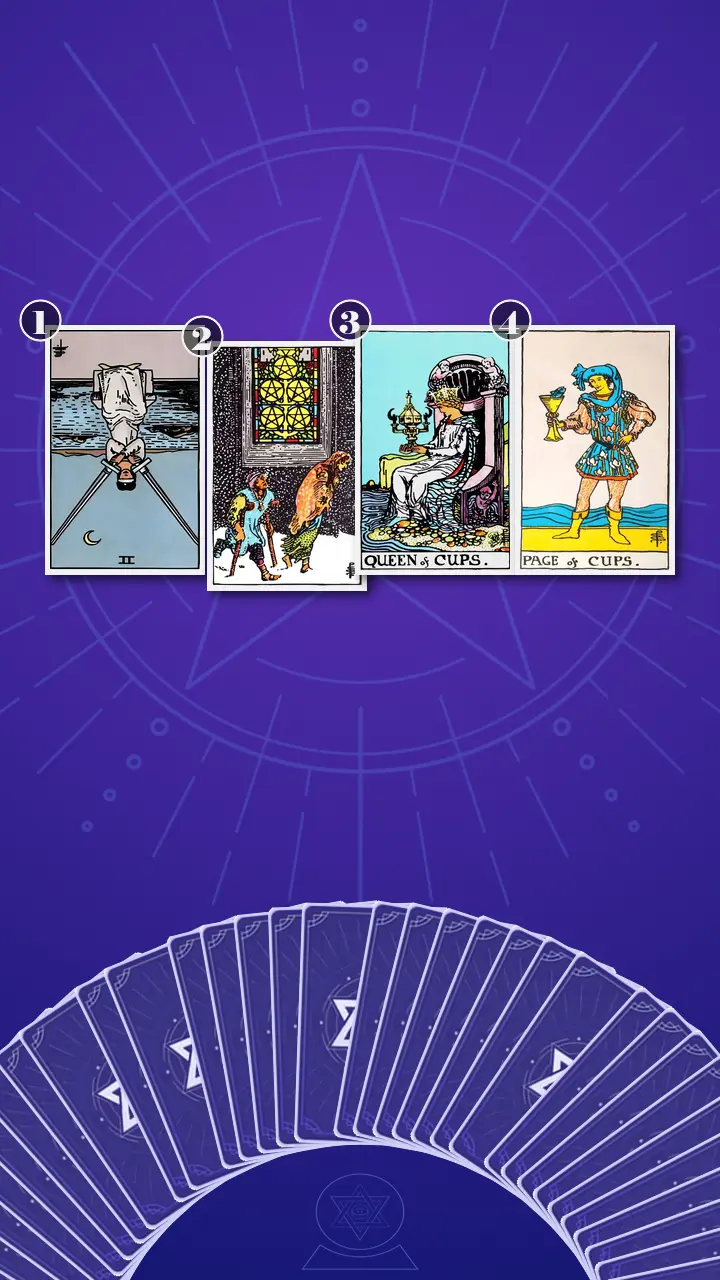
I laid the cards in a straight horizontal line from left to right, the way I like to for this spread. It reads like a single emotional sentence: symptom, shadow, medicine, practice. I told Jordan that the first card would show the exact type-delete freeze she already knew too well. The second would reveal the belonging wound turning a simple ask into a test she feared she might fail. The third card would show the antidote—the emotional stance that could challenge the idea that needing someone makes her too much. And the fourth would turn that insight into one small, doable friendship bid she could actually practice this week.
Reading the Bridge from Silence to Speech
Position 1: The Chat Box That Never Becomes a Call
I turned over the card representing the visible type-delete pattern and the immediate self-protective freeze around asking for contact: the Two of Swords, reversed.
This card was almost painfully literal in context. I told her I was looking straight at the open chat at 11:48 p.m., the blinking cursor, the sentence rewritten for tone three times, and the phone placed face down because sending feels more dangerous than staying lonely. In the old Rider-Waite image, the blindfold and crossed swords can look abstract until you place them in modern life. Here, the blindfold became emotional self-covering. The crossed swords became every possible wording treated like a separate risk assessment: make it lighter, not now, they’re probably busy, maybe tomorrow, maybe you’re being dramatic.
Reversed, the energy felt like blocked Air turning in on itself. Too much analysis, not enough movement. This is what happens when self-protection starts masquerading as careful communication. On the surface it looks efficient, thoughtful, even mature. Underneath, it keeps the feeling fully active while preventing any corrective experience from reaching it. No one can reassure what no one is allowed to see.
Jordan gave a short, bitter laugh and shook her head. ‘That’s honestly rude,’ she said. ‘It’s exactly that. I make it sound less intense until there’s nothing real left to send.’ Her fingers tightened around her cup, then loosened. That sharp little laugh told me the recognition had landed where it needed to. I nodded and told her again: the unsent text is still a real bid for care. Silence does not mean the need was small. It means the need got edited out before anybody else could meet it.
Position 2: Outside the Warm Room
I turned over the card representing the belonging wound and scarcity belief that makes support feel unsafe to request: the Five of Pentacles, upright.
There it was—the real bruise under the behavior. I told her this card is what it feels like to know you technically have people you could text, but to experience support as if it is for better-timed, easier, less messy versions of yourself. It is the emotional logic of standing in a grocery store self-checkout line, seeing friends’ dinner Stories under warm restaurant lighting, and instantly deciding there is no socially acceptable way to text ‘can I call?’ It is the row of names in your phone feeling like lit windows in winter: care is visible, but psychologically not available to you when you need it most.
In this position, the Five of Pentacles showed me Earth energy shaped by scarcity. Not a lack of actual human beings in her life, but a deficiency in felt belonging. The fear was not only that a friend might be busy. The deeper fear was that a pause, a delayed reply, or a flat tone would somehow prove she had asked at the wrong time, asked too much, or misread the friendship entirely. That is the hidden script that turns one plain sentence into a verdict on your worth.
As I said this, I had one of those small private flashes my café has given me over the years: winter mornings when someone stands outside my front window peering in, convinced there is no table for them, while I can already see two empty chairs from behind the counter. I thought of that stained-glass window in the Five of Pentacles and how often shame makes warmth look invitation-proof.
Jordan went very still. First her jaw set. Then her gaze dropped to the card and stayed there too long. Then came the sentence I had been expecting. ‘I know my friends care,’ she said quietly, ‘but somehow not on the days I’m least composed.’
That was the exact shame under it. I let the silence breathe for a second and then said, as gently as I could, ‘Friendship is not a prize for being low-maintenance.’ I watched that line land in her shoulders before it reached her face.
When the Queen of Cups Lifted the Shame Out of the Chat Box
Position 3: The Antidote
When I turned the third card, the room changed. Even the grinder out front clicked off, and for a beat the whole café seemed to hold still with us. This was the card representing the emotional stance that directly challenges the idea that needing someone makes you too much: the Queen of Cups, upright.
I told Jordan that the Queen of Cups is balance in emotional form. Not oversharing. Not drowning. Not pretending to be fine. She is emotional self-trust, receptivity, and unashamed tenderness. In modern life, she is the moment you stop cross-examining your own feelings and say, either in Notes or to an actual friend, ‘I’m not okay tonight, and that is information—not failure.’
This is where I used one of the lenses I have developed from years of listening to people over espresso cups and card spreads alike: my Milk Foam Layer Analysis. Some communication lives entirely in the foam—pretty, light, easy to serve, easy to receive. A joke about a character-building Hinge date. A breezy ‘lol I’m alive.’ A useful link sent instead of the truth. But foam is not the drink. The Queen of Cups asks for what is underneath: the actual emotional content, held with dignity instead of hidden in decorative language.
In the version of the scene Jordan had described to me, it was late, the laundry was half folded, the apartment was finally quiet, and her thumb hovered over a text that would take three seconds to send and somehow felt socially illegal. She was treating one human need as if it required a full defense brief.
You do not have to hide your feelings like contraband; hold them like the Queen's cup—carefully, openly, and worthy of being received.
A need does not become embarrassing just because it has to be said out loud.
Jordan’s reaction came in layers. First, a physical freeze: her breathing stopped so completely that the tiny clink of her spoon against porcelain sounded louder than it should have. Then came the cognitive hit: her eyes lost focus for a second, not drifting away from me but inward, as if she were replaying every TTC commute reply, every almost-text, every rough night translated into a joke before it could become visible. Then the emotional release arrived in a more complicated form than relief. She frowned. Her mouth went tight. ‘But if I do that,’ she said, and now there was some anger in it, ‘and they sound obligated, I’ll feel stupid for asking. Like I made it real for no reason.’
I shook my head. ‘No. That would not mean your need was wrong. It would mean you got information about capacity in that moment. You are not asking for unlimited rescue. You are making one calm, honest bid for connection.’
Her grip on the cup loosened. Then her shoulders dropped—first a little, then enough for me to see how hard she had been bracing. Her eyes brightened, not quite tears, more like the body’s startled response to finally being spoken to kindly. When she exhaled, it sounded like air she had been holding since the first deleted text. I asked her, ‘Now, with this new lens, can you think of a moment last week when this would have changed the whole night?’
She nodded almost immediately. ‘On Line 1,’ she said. ‘A friend texted me “How are you?” and I typed “rough morning honestly,” then turned it into “I’m good lol.”’
That was the hinge. Not a giant personality change. Just the first real step in the transformation from apologizing for needing care to making simple, sincere bids for connection.
Position 4: The Slightly Awkward Text That Matters
I turned over the final card representing the small, embodied friendship bid that could be practiced this week: the Page of Cups, upright.
I smiled when I saw it. The Page of Cups is one of my favorite cards for real-world emotional action because it does not ask for polish. It asks for sincerity. In Jordan’s life, this is the slightly imperfect text that goes out before she can make it sound effortless: ‘Hey, rough night—could I call for 10 if you’re around?’ No essay. No joke cover. No pretending she only counts if comfort arrives telepathically.
The energy here was gentle Water in motion. Beginner energy, yes, but not weak energy. It is the courage of being emotionally new at something that matters. The Page does not wait until the message sounds like a branded campaign. It sends the BeReal version, not the curated feed version. Specific beats polished when you are asking for care.
Jordan actually smiled at that. A small one, but real. ‘That sounds awkward,’ she said.
‘Exactly,’ I said. ‘And awkward is survivable. Lonely is just familiar.’
She looked back at the card and nodded slowly. I could almost see the sentence forming in her head with less static around it.
From Insight to Action: One Plain Ask This Week
When I looked across the full spread, the story was beautifully clear. First came the visible freeze: a message rewritten until the moment passed. Under that sat the older wound: the sense of standing outside the warm room, convinced care exists but not safely for you. Then came the medicine: emotional self-trust, the ability to name a feeling before putting it on trial. And finally, the practice: one small, sincere message that lets friendship become something you participate in, not something you have to earn by being easy.
I told Jordan that her cognitive blind spot was not a lack of caring people. It was the way she kept turning need into moral evidence. She was treating a simple request for ten minutes of comfort as if it could reveal a fatal character flaw. She was also reading schedule uncertainty as identity data. A late reply is not automatically rejection. A busy tone is not automatically proof you are hard to hold. The direction of change was simple, though not always comfortable: one feeling, one ask, one boundary. That is how to ask a friend for support without overexplaining.
Then I gave her the most practical version of the reading. Years behind an espresso bar taught me a rule I now use in readings too: Social Espresso Extraction. If you let a shot run too long, bitterness takes over. Jordan’s support texts were doing the same thing after midnight—over-extracting fear, shame, and imagined reactions. So I wanted her next steps to be small, warm, and time-bound.
- One-Feeling, One-Ask DraftAfter one overstimulating workday this week, before your usual spiral hour, open Notes or one trusted friend’s chat and write only two lines: ‘I feel overwhelmed tonight’ and ‘I want 10 minutes on the phone.’If your chest spikes when you read it back, say it out loud once and stop there. Naming it still counts, even if you do not send it yet.
- The Two-Edit Send RuleChoose one friend who has already shown warmth before and send a plain-language support bid such as ‘Hey, rough night—could I call for 10 if you’re around? No pressure if tonight is bad.’Give yourself a maximum of two edits. Cut any sentence that is trying to prove you deserve care. A gentle ask is not a demand.
- The Warm Room TestIf a call feels too big, use what I call the Social Thermometer: lower the intensity without hiding the truth. Ask for a quick voice note, a fifteen-minute walk tomorrow, or simple company instead of all-or-nothing rescue.If they cannot do that moment, treat it as schedule data, not identity data. Put the phone across the room for two minutes instead of reopening the draft.
I reminded her that none of this was about becoming effortlessly vulnerable overnight. It was about giving her nervous system a new experience: that a need can be named plainly, held with dignity, and answered without becoming proof that she is too much.

A Week Later, the Quiet Proof
A week later, I got a message from Jordan. It was short enough to make me smile: she had sent the text at 10:21 p.m., before the usual collapse point. ‘Hey, rough night—could I borrow 10 minutes on the phone if you’re around?’ Her friend replied six minutes later: ‘Yes, calling now.’
The part that moved me most was not the speed of the reply. It was what Jordan wrote after. She said the call was not magic, and the night did not turn cinematic. Afterward she sat alone by her apartment window with peppermint tea, city light on the glass, still a little shaky, but no longer locked outside the warm room. The next morning, her first thought was still, ‘What if that was dramatic?’—and then, for the first time, she laughed and did not obey it.
That is what a real Journey to Clarity often looks like in my world. Not a solved life. Not perfect certainty. Just one honest movement from contraction toward contact. This is why I trust the Shadow Spread · Context Edition so much for questions like this: it does not flatter the pattern, but it does make the next step mercifully clear.
Sometimes the loneliest part is not being alone—it is holding your phone with a tight chest, wanting one kind voice, and feeling ashamed that you need it at all. If that feeling lives anywhere in you, I hope you remember what the Queen and Page showed us today: friendship is not a prize for being low-maintenance, and specific beats polished when you are asking for care.
So the next time your own chat box is open and your thumb is hovering over send, what is one plain sentence you might let stay there—held like the Queen’s cup instead of hidden like contraband?