The Calendar, Bank App, and DMs Loop—and the First Boundary That Holds
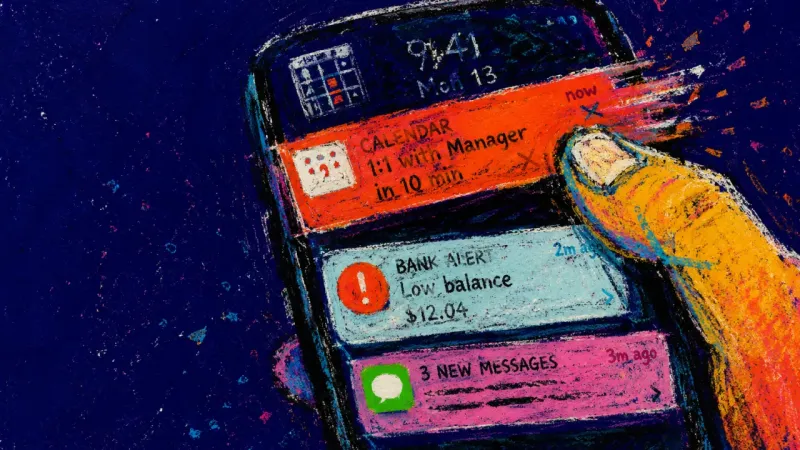
The One-Boundary-One-Anchor Reset in the 9:58 p.m. Wall of Blocks
If you’ve ever answered a DM in under two minutes while your bank app is sitting there in red like a judgment, this is for you.
Jordan (name changed for privacy) came onto our video call with the kind of smile people wear when they’re trying to prove they’re fine. She was 29, in Toronto, and the light from her laptop made her look slightly underwater—blue and bright in the wrong way.
She turned the camera just enough for me to see her screen: Google Calendar, packed so tightly the week looked like a quilt stitched from solid blocks of colour. The fridge hummed in the background. Her screen brightness was harsh, the kind that makes you squint even when you’re not tired—though she was clearly tired. She hovered over “add event” like adding one more thing would magically create time.
“It’s everything,” she said, and her voice had that clipped edge of someone trying not to start crying over something that sounds too normal to cry about. “My calendar is full. My bank app is… red. And my DMs are buzzing. I just want to reset, but I don’t even know what the first move is.”
As she spoke, I noticed her body telling the truth before her words did: a tight chest that kept her breaths shallow, a jaw clenched while her thumb did a restless little refresh motion in the air, like her phone was still in her hand.
It looked like trying to run your week like a browser with 37 tabs open—calendar, bank app, Slack, DMs—and wondering why everything feels slow and hot and fragile.
“You’re not bad at life—you’re stuck in a refresh cycle with no clean stopping point,” I told her, keeping my tone steady. I’ve spent years guiding people under a dome of stars in Tokyo, watching them relax the moment a pattern becomes visible. “Let’s not try to solve your whole life tonight. Let’s do something more useful: we’ll find the first reset—the one boundary that holds, and one concrete anchor that makes the next 24 hours feel manageable. That’s our journey to clarity.”

Choosing the Compass: How the Energy Diagnostic Map Organizes Decision Fatigue
I asked Jordan to put her phone face down, just for three minutes. “Before we pull cards, we’re going to do a quick nervous-system reset,” I said. “I call it my pre-meeting cosmic breathing. No mysticism—just a way to stop your body from sprinting while your brain is trying to think.”
We inhaled for four counts, held for two, exhaled for six—like easing a spacecraft out of a spin. I shuffled slowly, not as a performance, but as a pacing tool. In the planetarium, we don’t start with the Big Bang; we start with the night sky you can actually see. Tarot is similar when it’s used well: not prediction, but pattern recognition.
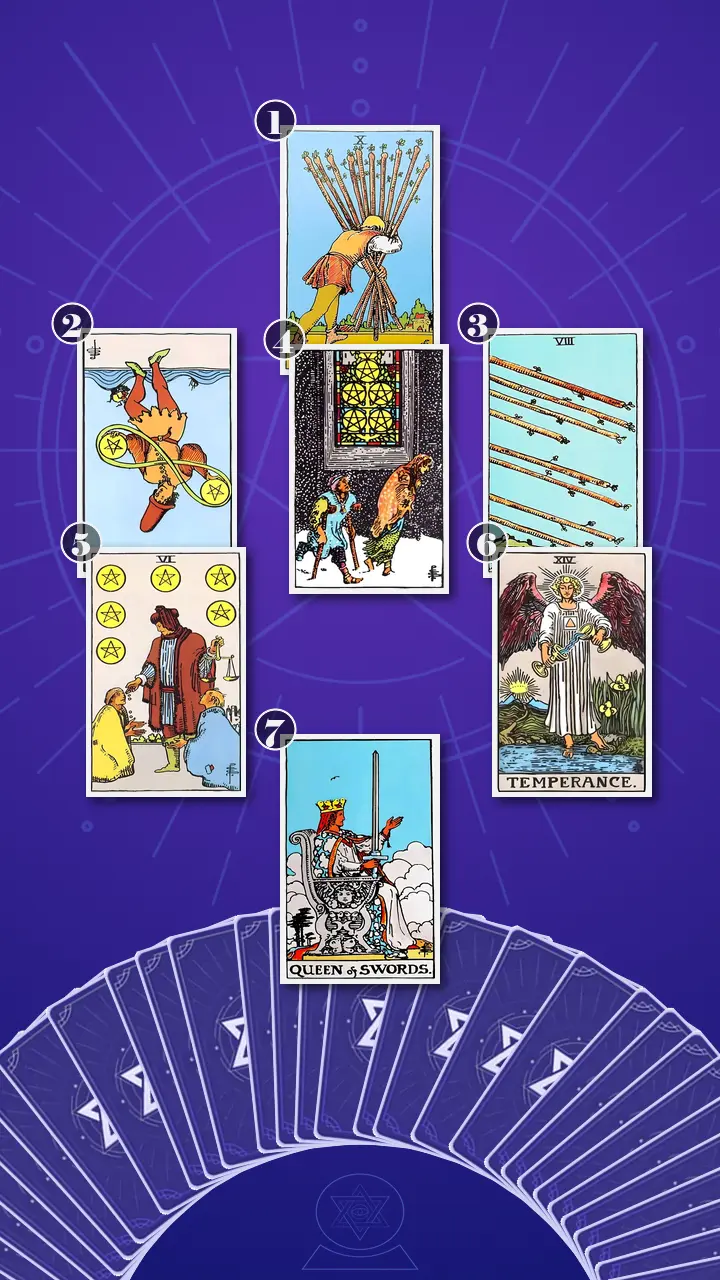
“For this question,” I explained, speaking as much to you as to Jordan, “I’m using a spread I designed called the Energy Diagnostic Map (7) · Context Edition. It’s built for moments when everything feels urgent—time pressure, money stress, and notification-driven urgency all at once.”
“The point isn’t to predict an outcome,” I continued. “It’s to find your first reset. The positions move like a descent: we start with the visible overload, then the inner juggle, then external pressure. We drop into the real blockage underneath (often money/security). Then we look for support you can access without fixing everything. We identify the key transformation lever—and we end with one grounded next step you can do immediately.”
I pointed to three positions we’d pay special attention to: “The center card will name what’s really keeping the loop running. The transformation card will show the shift that changes everything. And the final card will give you one practical boundary—something you could actually say or do tonight.”
Reading the Map: The Fire-Speed Sprint and the Earth Repair Sequence
Position 1 — Surface overload: the most visible pattern in your day
“Now we’re turning over the card that represents surface overload—the most visible pattern in your day.”
Ten of Wands, upright.
I angled the card toward the camera. “This is the wall-of-blocks week. A calendar full of meetings, errands, and ‘quick catch-ups’ you said yes to because it felt safer than disappointing anyone. You’re moving all day, but you can’t see what actually matters—like your priorities are literally blocked from view.”
In energy terms, the Ten of Wands is excess: responsibility stacked past capacity. It’s the moment when productivity becomes a kind of blindness.
Jordan let out a small laugh—quick, sharp, almost involuntary. “Okay,” she said, and there was bitterness in it. “That’s… brutal. Like, yes. It’s exactly that.”
“It’s not a character flaw,” I said. “It’s load. And load hides the horizon.”
Position 2 — Inner tug-of-war: how you’re juggling, and what it’s costing you
“Now we’re turning over the card that represents your inner tug-of-war—how you’re trying to juggle competing demands, and what it’s costing you internally.”
Two of Pentacles, reversed.
“This is the endless refresh loop,” I said. “Calendar → bank app → DMs → back to calendar. You keep ‘fixing’ the plan with tiny adjustments, but the constant adjusting becomes the reason nothing feels finished.”
Reversed, this energy is blockage: the juggling isn’t flexible anymore, it’s frantic. It’s like standing on uneven ground trying to keep two spinning plates stable—except the plates are your schedule and your bank balance. Your nervous system is doing micro-sprints all day.
Jordan nodded, but it was the kind of nod that didn’t land. Her eyes kept flicking—like her attention had learned to scan for threats. “I open my phone before I even sit up,” she admitted. “Calendar, bank, messages. Like I have to do it before I’m allowed to start.”
“That’s not organization,” I said gently. “That’s your body trying to prevent a feeling.”
Position 3 — External pressure: what the environment is demanding
“Now we’re turning over the card that represents external pressure—what your environment is demanding from you.”
Eight of Wands, upright.
“This is the speed,” I said. “Pings, follow-ups, ‘quick question,’ group chats that never stop. Messages arrive without context and your body reads speed as urgency, so you match their pace automatically.”
In energy terms, the Eight of Wands is excess again—velocity that bypasses choice. It’s notification anxiety at work and in group chats. Even when nothing is truly on fire, your nervous system acts like it is because everything is moving diagonally at you all at once.
Jordan’s shoulders lifted almost imperceptibly, like she was bracing for the next vibration. “Teams makes me move faster,” she said. “Even if I’m already behind.”
“Right,” I said. “If speed were the thing that made life feel stable… wouldn’t you feel stable by now?”
Position 4 — Core blockage: the deeper pain that keeps the loop running
“Now we’re turning over the card that represents the core blockage—the deeper pain point that keeps the overload loop running, especially around money and security.”
Five of Pentacles, upright.
I felt the room—two different cities, one shared silence—get a little quieter.
“This is the ‘bank app red’ moment,” I said. “And not just financially—emotionally. You see a low balance or pending charges and immediately feel exposed. Behind. Alone with it.”
I described the micro-scene as if I’d watched it happen (because in a way, I had—Jordan’s body had been acting it out all night): “Thumb taps the app. Red numbers. A heat-flush in your face. Chest tightens. And you close it like it’s a hot stove. Then your brain says, ‘I’ll deal with it when I’m ready.’ And right after that: ‘I’m never ready.’ So you do the only thing that gives instant proof of competence—move faster. Reply faster. Book more. Stay available.”
Jordan paused. Swallowed. Her gaze went slightly unfocused, like she was watching herself do it. Then, quietly: “Yep. That’s… exactly what it feels like.”
“Here’s something I want you to borrow,” I said, and this was where my research brain always comes in. “A red balance isn’t a moral failing. It’s a systems moment.”
And I used my Dark Matter Detection lens—the way I look for the unseen mass shaping an orbit. “The obvious stress is ‘money is tight.’ The overlooked factor—the dark matter—is shame. Shame makes support feel unreachable even when it’s right there. Like the lit window in this card. There’s warmth, structure, help… and you keep walking past it because you think needing it means you failed adulthood.”
Her fingers, which had been fidgeting near her phone, went still for the first time.
Position 5 — Available resource: support you can access without fixing everything
“Now we’re turning over the card that represents an available resource—support, tools, or mindset you can access without fixing everything at once.”
Six of Pentacles, upright.
Jordan exhaled as soon as she saw it, like her body recognized the picture before her mind did.
“This is fair exchange,” I said. “Support. Balance. A system where what comes in and what goes out isn’t a secret emergency.”
In energy terms, the Six of Pentacles is balance: not deprivation, not panic, but a workable scale. It can look like setting a small autopay, requesting an extension, splitting a cost, renegotiating a timeline with your manager—one stabilizing move that makes the week survivable.
“If your life were a sky chart,” I told her, drawing from my other toolkit, “we’d stop staring at every star at once and do a quick constellation alignment: what are the few points that actually form a pattern you can navigate by?”
Jordan gave a tiny nod—more like permission than agreement. “I could ask for an extension on one bill,” she said. “I keep telling myself it’s ‘not bad enough’ to do that, which is… dumb.”
“Not dumb,” I corrected. “Protective. But outdated.”
When Temperance Poured Between Two Cups: Finding Clarity Through Pace Control
Position 6 — Key transformation: the shift that creates a true reset
“We’re turning over the most important card in this reading,” I said. “The one that shows the key transformation—what changes everything when you integrate it.”
Temperance, upright.
Jordan was still caught in the familiar problem-solving trance—Sunday night brain trying to fix the whole week in one sitting. You could see it in the way her shoulders stayed lifted, and how her eyes kept trying to jump ahead to solutions: reply to everyone, reorganize the calendar, maybe doom-scroll r/personalfinancecanada until she found the perfect rule that would make her stop feeling like she was behind.
Stop trying to outpace the chaos—start pouring your energy deliberately, like Temperance, and the reset begins.
After I said it, I let the silence sit for a beat, the way I do when a planetarium goes dark and people realize they can finally see.
Jordan’s reaction came in a chain—three small, honest steps.
First: her breath caught. Not dramatic—just a half-second freeze, like her body had been running on “always vibrate” and someone finally touched the mute switch.
Second: her eyes softened and unfocused, drifting slightly to the side as if replaying a memory. “Last week,” she said slowly, “I was on the TTC and my phone kept buzzing. I answered three messages while standing, and I still felt like I was failing.”
Third: the release. Her shoulders dropped maybe one percent, then another. Her jaw unclenched. She didn’t look euphoric—she looked… steadied. And then she got unexpectedly vulnerable, which is often what happens when pace finally slows: “But if I stop moving… it feels like everything will catch up and I’ll drown.”
“That fear makes sense,” I said. “But Temperance isn’t asking you to stop. It’s asking you to regulate.” I told her what I tell people when I’m guiding them through eclipses and meteor showers: timing matters as much as effort. “Moderation isn’t a reward. It’s the strategy.”
Then I brought in my signature diagnostic lens—my Gravity Assist Simulation. “In spaceflight, a small, well-timed adjustment changes the whole trajectory. You don’t ‘power through’ across the solar system. You borrow gravity. You choose a slingshot moment. Your boundary is that slingshot. Your anchor task is the burn that steadies your direction. One deliberate pour now changes the orbit of your next 24 hours.”
I asked her, “Now, with this new lens—pace control as the first reset—can you think of one moment last week when you could’ve chosen a slower, deliberate pour? Not as a moral win. Just as data.”
Jordan blinked, and her eyes got a little wet, the way they do when someone realizes they’re allowed to stop earning rest. “Friday at 4:56,” she said. “I kept trying to clear my inbox so I could relax. But every reply made another thread. I could’ve stopped. I could’ve… picked one boundary.”
“Exactly,” I said. “This is you moving from frantic urgency to steadier focus—one lever at a time.”
Position 7 — First reset step: one actionable boundary you can make immediately
“Now we’re turning over the card that represents your first reset step—one actionable boundary or choice you can make immediately to regain traction.”
Queen of Swords, upright.
“This is the boundary voice,” I said. “Short, kind, time-bound. No people-pleasing paragraph. No over-explaining. One clean message that makes a protected time block true.”
The Queen’s energy is balance through clarity: your attention becomes a resource you allocate on purpose, not something other people’s urgency gets to spend for you.
I offered Jordan a script, because when you’re overwhelmed, words are often the hardest part: “Try: ‘I’m in meetings right now—can I reply by tomorrow EOD?’ Or: ‘I can take this on next week, not today.’”
Jordan stared at the card and then gave the smallest, fiercest nod. “I can do one sentence,” she said. “One sentence feels… possible.”
The 24-Hour Dashboard Rule: Actionable Advice That Actually Fits a Loud Week
I looked back over the full map and told Jordan the story it was telling—simple, but not simplistic.
“The Ten of Wands says you’re carrying too much on the surface. The Two of Pentacles reversed says your inner life is stuck in an endless refresh cycle—switching tabs to prevent a feeling. The Eight of Wands says your environment is training you to live at someone else’s speed. And the Five of Pentacles is the engine underneath: money stress turning into shame, so rest feels unsafe.”
“But the Six of Pentacles shows a stabilizer already available: fair exchange and structure. And Temperance says the real reset isn’t a dramatic overhaul—it’s pace control. Finally, the Queen of Swords turns it into a boundary you can communicate without guilt.”
“Your cognitive blind spot,” I said carefully, “is that you’ve been treating speed as proof of control. And you’ve been confusing responsiveness with reliability. That’s why you’re busy all day but still feel behind.”
“The transformation direction is clear: shift from trying to reset everything at once to choosing one boundary and one concrete anchor that makes the next 24 hours feel manageable.”
I framed it the way I frame navigation under a night sky—my interstellar navigation strategy. “You don’t need a perfect route. You need one star to steer by, and one rule that keeps you from drifting.”
- Write your Queen-of-Swords sentenceOpen Notes and paste one reusable line: “I’m in meetings right now—can I reply by tomorrow EOD?” Use it once today (work, friend, group chat—anywhere you feel that ‘reply in two minutes’ pressure).Expect the guilt spike. That’s your old rule talking. If you start over-explaining, stop at one sentence and hit send.
- Protect one real hour (your anchor)Pick a defendable 60-minute block in the next 24 hours. Put it on your calendar as: “Admin / money check-in (no pings).” Turn on Do Not Disturb for that hour.If 60 minutes feels impossible, do a 25-minute timer. The win is the protected block—not finishing your whole life.
- Do the 15-minute numbers-only money checkDuring your protected block, open your bank app and write only data: current balance + next 3 charges. No problem-solving, no shame-story, then close the app.Stopping at 15 minutes is part of the practice. You’re teaching your nervous system, “I can look, and I don’t have to spiral.”
“If you want a name for this,” I added, “it’s the One-Boundary-One-Anchor Reset. And it’s exactly what the Energy Diagnostic Map (7) · Context Edition is designed to find: one boundary that holds, one anchor you can repeat.”

A Week Later: The Quiet Proof of Regained Self-Trust
Six days later, Jordan messaged me a screenshot—not of a perfect budget or an empty inbox, but of something smaller and more powerful.
It was her Notes app. One line at the top: “I’m in meetings right now—can I reply by tomorrow EOD?” Under it: “Admin block: 12:30–1:30 (DND).”
“I used the sentence twice,” she wrote. “No one got mad. And I did the numbers-only bank check. It sucked for about 90 seconds and then it was… just numbers.”
Her change wasn’t loud. It was a loosening. Clear but still a little tender: she slept a full night, but in the morning her first thought was still, “What if I mess it up again?” This time, she noticed the thought, exhaled once, and didn’t reach for her phone immediately.
That’s what I mean by a journey to clarity: not a whole new life, but a steadier orbit. Moderation as strategy. A boundary that protects your attention. An anchor you can repeat when the week gets loud.
When everything is pinging at once, it can feel like one missed reply or one low balance will expose you as not actually in control—and your body reacts like it has to sprint to stay safe.
If you gave yourself permission to make just one boundary and one anchor for the next 24 hours—what would make tomorrow feel 10% more manageable?
Every reading at AceTarot is a Journey to connect with inner wisdom and empower next step.
Learn more about our Journey to Clarity.