From Raise-Talk Performance Anxiety to Grounded Confidence: Saying the Number

The 2 a.m. Salary-Tab Spiral (When Asking for a Raise Feels Like a Moral Test)
If a calendar invite that says “Performance Review / Comp Review” makes your throat tighten like you’re about to be graded as a person, I know exactly what kind of night you’re having.
Maya (name changed for privacy) sat down across from me and didn’t even fully take her coat off—just shrugged it halfway, like her body was still bracing for tomorrow. It was 8:47 PM on a Tuesday in her Toronto condo living room; the faint scrape of streetcar noise leaked through the window, and the laptop on her throw pillow threw that familiar aquarium-blue light across her hands. A half-finished mug of tea cooled beside the trackpad, the surface of it reflecting a messy constellation of open tabs: salary guide, Glassdoor, another salary guide, her Notion brag doc, a Notes app draft titled “Raise Script v6.”
She demonstrated the loop like she was embarrassed by how practiced it was. Alt-tab. Copy a line. Delete it. Type: “I was wondering if it might be possible…” Backspace. Type it again. Her shoulders crept up so slowly you could almost miss it—like her body was trying to become smaller than her own request.
“I can prove I deserve it,” she said, voice thin in a way that sounded more like dryness than doubt. “I just don’t know how to say it without sounding… gross.”
And there it was: the core contradiction in one word. She wanted fair pay and professional value—and at the exact same time, she was bracing to be judged as greedy or ungrateful for wanting it plainly.
The performance anxiety wasn’t abstract. It lived in her jaw like a clamp. It lived in her throat like she’d swallowed a sentence that was too big to fit. It lived in the shallow, protective breath she took whenever she got close to saying the number out loud—as if her body believed the number was a confession.
“Okay,” I told her, keeping my voice steady and simple. “We’re not here to hype you up or tell you to ‘just be confident.’ We’re here to get you clear. Let’s draw a map through the fog—so tomorrow becomes a conversation you can navigate, not a trial you have to pass.”

Choosing the Compass: The Transformation Path Grid (6) Tarot Spread
I asked Maya to put both feet on the floor and let her hands rest on her thighs. “Before we read anything,” I said, “let’s do a three-minute reset. I call it cosmic breathing—not because it’s mystical, but because your nervous system understands rhythm.”
We inhaled for four counts, held for two, exhaled for six—like easing a spacecraft into a stable orientation. The goal wasn’t to erase nerves. It was to widen the space around them.
“Tonight we’ll use a spread I built for moments exactly like this,” I explained, setting six cards into a clean 2×3 grid. “It’s called the Transformation Path Grid (6) · Context Edition.”
To anyone reading along who’s ever searched “tarot spread for salary negotiation anxiety” at 1 a.m.: this is why I like this grid. It’s practical. Low cognitive load. It moves you from what you’re doing (the observable spiral) to what’s driving it (inherited money rules and scarcity roots), then into a reframe and two concrete next steps. No outcome prediction. Just clarity and actionable advice.
“Top row,” I told her, pointing: “what’s happening tonight, what’s blocking you, where it comes from.” Then I tapped the bottom row. “Reframe for tomorrow, how to speak, and how to ground the outcome so your self-worth doesn’t get stapled to one meeting.”
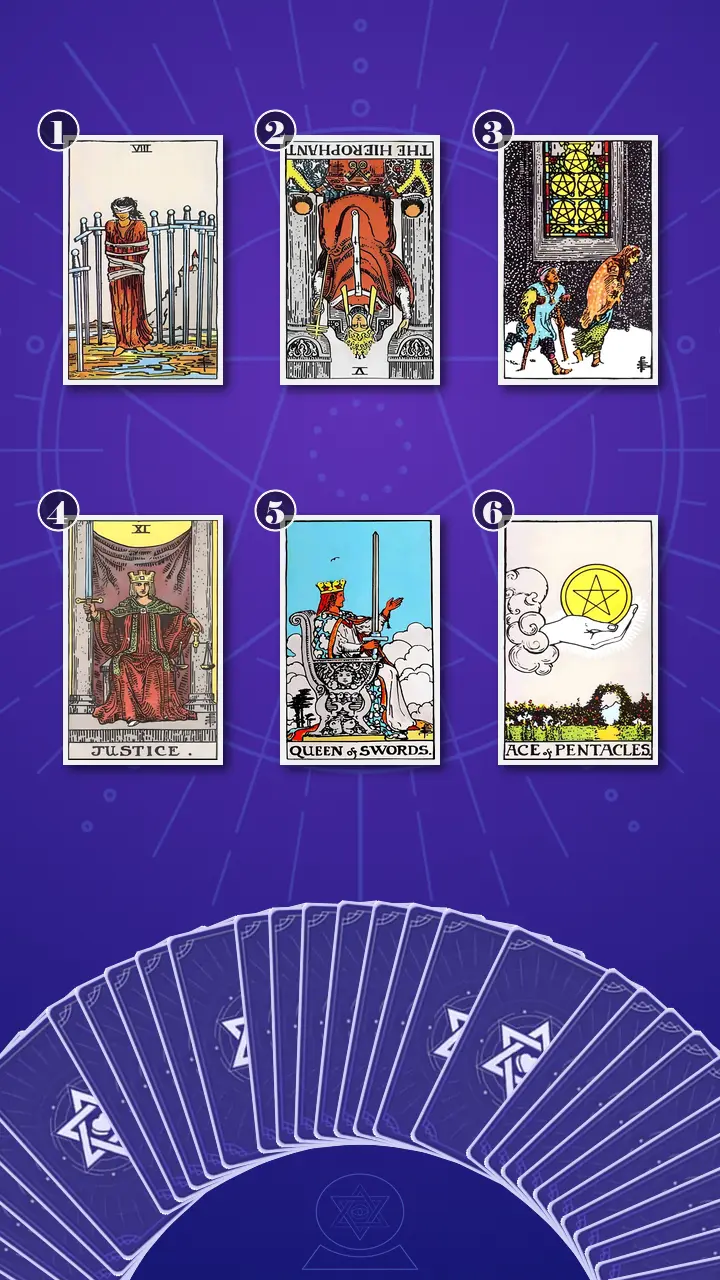
Reading the Map: Family Money Scripts in a Raise Conversation
Position 1: Surface snapshot of the night-before mindset
“Now turning over,” I said, “is the card that represents the surface snapshot of your night-before mindset—the most observable behavior pattern showing up right now.”
Eight of Swords, upright.
Even before I translated it, Maya’s eyes flicked to her laptop like it was going to defend her. The Eight of Swords is a mind that feels cornered—blindfolded, arms loosely bound, surrounded by sharp options that look like dangers. And the modern version of it was already sitting on her couch.
“This,” I said, “is exactly the loop you described: salary-report tabs open, impact doc open, Notes app open. Refining bullet points feels productive. But you won’t practice the one sentence that says, ‘I’m requesting $X,’ because the second you imagine it, your throat tightens and your mind insists there’s no safe way to say it.”
I named the energy dynamic plainly: “This is Air energy in blockage. Thought trying to protect you by shrinking the room.”
Maya let out a small laugh that had a bitter edge to it, like she’d been caught doing something she didn’t want to admit. “That’s… too accurate,” she said. “It’s kind of rude.”
“It can feel rude,” I agreed, “but it’s not judging you. It’s just showing the mechanism. The blindfold is the story. The loose bindings are the clue: you’re not actually trapped—your body just thinks you are.”
Position 2: How the family money story is actively shaping the ask
“Now turning over,” I said, “is the card that represents how your family money story is actively shaping the ask—the internal rule or ‘should’ that distorts your communication.”
The Hierophant, reversed.
“Politeness is not a substitute for clarity,” I said gently, because this card always brings that truth to the surface. “Reversed Hierophant is old rules you never consciously agreed to—default settings.”
I used the scene analogy that usually lands with people who grew up with money as tension or moral language. “Picture your Zoom call tomorrow,” I said, “and behind your manager, there’s an invisible approval committee. Older. Stricter. More moral than the actual workplace. They’re not evaluating your impact—they’re grading your tone.”
Maya’s hand went to her mouth without permission, like she was trying to keep the committee from hearing her. Her eyes unfocused for a second, as if a specific phrase had played on loop in her head. Then she exhaled sharply—one clean, surprised breath. “Oh,” she said quietly. “That’s my mom’s voice. ‘Don’t make it awkward.’ And my dad’s, too—like money was… not for talking about.”
“Exactly,” I said. “You’re not just asking your boss. You’re also trying not to disappoint them.”
I named the conflict contrast, because it’s the heart of her question: “A professional negotiation is about alignment—scope, impact, market range. But the old script turns it into a moral purity test: ‘Am I a good person if I want more?’ That’s why you keep adding ‘if that’s possible’ and ‘no worries if not.’ It’s you trying to earn permission through softness.”
Position 3: The emotional origin beneath the script
“Now turning over,” I said, “is the card that represents the emotional origin beneath the script—what early scarcity or belonging theme makes money feel charged in your body.”
Five of Pentacles, upright.
The image is simple: cold street, two figures limping together, a warm stained-glass window nearby. It’s the nervous system remembering winter.
“This is what happens when the raise talk triggers an old scarcity reflex,” I told her. “Your brain jumps straight to rent, emergencies, the fear of being ‘out in the cold’—even if you’re currently okay. Suddenly the conversation isn’t about fair pay for expanded responsibilities; it feels like a survival gamble. That’s why your stomach hollows out. That’s why your jaw locks.”
I watched Maya swallow, like her body was trying to move the fear somewhere safer. The heat in her condo hummed on, steady and present—warmth literally in the room—while the card showed her what it felt like to be outside it.
“So when you ask me how your family money story is shaping your ask,” I said, “this is the root: not just ‘be grateful,’ but ‘don’t risk safety.’ It’s your system trying to prevent a catastrophe that isn’t actually tomorrow’s meeting.”
Position 4: The key reframe for tomorrow (Catalyst / Key Card)
“Now we flip the turning point,” I said, and I felt the air in the room change the way it does right before a planetarium show goes dark—when everyone goes quiet without being told. “This card is the key reframe for tomorrow—the mindset that converts the ask from shame-based to standards-based.”
Justice, upright.
Here’s what Justice looked like in her real life: walking into the comp conversation with a different lens. Not “please like me,” but “let’s align compensation with scope and market reality.” Three impact bullets. One market range source. One number. A question about next steps.
And I could feel her mind trying to snap back into its old job—protect, protect, protect—by searching for the perfect number and the perfect wording. It’s a familiar trap: if you can make the script flawless, maybe you won’t have to feel exposed.
Stop seeking permission through politeness; start balancing the scales with evidence and speak your number like the upright sword of Justice.
I let the sentence sit between us. No rush. No extra commentary to cushion it—because the whole point was learning that clarity can be safe.
Maya’s reaction came in three small waves. First: a physical freeze—her breath paused halfway in, fingers hovering over her phone like she’d forgotten what she’d picked it up for. Second: a cognitive seep—her gaze slid sideways, unfocused, like she was replaying every time she’d turned a clear ask into a careful apology. Third: an emotional release—her shoulders dropped in a way that looked like gravity returning to normal, and she let out an exhale that sounded almost like relief and almost like grief. “But if I do that,” she said, a flash of heat in her voice, “doesn’t it mean I’ve been doing it wrong this whole time?”
“It means you’ve been surviving with the tools you had,” I said. “And now we’re upgrading the tools.”
This is where I bring in the way I think—half sky mechanics, half tarot symbolism. “In astrophysics, there’s a thing called a gravity assist,” I told her, tapping the Justice card lightly. “A spacecraft doesn’t power itself endlessly. It uses a planet’s gravity—structure, law, predictable force—to change its trajectory.”
“Justice is your gravity assist,” I continued. “Your family money story is emotional weather. But standards are physics. We can simulate the long-term impact of two trajectories: one where you keep asking like it’s a favor, and one where you ask like it’s alignment. The first keeps you in tiny edits and chronic resentment. The second might feel sharp in the moment, but it changes the orbit of your career over time.”
I watched her eyes come back into focus. “So it’s not a confession,” she said slowly, testing the words like they had weight. “It’s… business.”
“Yes,” I said. “A raise ask isn’t a confession. It’s an alignment conversation.”
Then I asked the question that makes the insight land in the body: “Now—with this new lens—think back to last week. Was there a moment when you nearly sent a message, or nearly practiced the number, and your throat tightened? If you’d treated it as fairness alignment instead of character judgment, what would you have done differently in that exact moment?”
She looked at her Notes app and, for the first time that night, didn’t flinch. “I would’ve just… said it. Once,” she said. “Without all the ‘if possible.’”
That was the pivot. Not from fear to fearlessness. From shame-tinged performance anxiety and permission-seeking to standards-based clarity and grounded self-respect—one clean inch forward.
Position 5: How to speak and hold boundaries in the conversation
“Now turning over,” I said, “is the card that represents how to speak and hold boundaries in the conversation—the practical communication stance and micro-behaviors to use.”
Queen of Swords, upright.
“This is ‘send the message, then stop typing,’” I said. “You deliver your ask in one steady sentence—under 20 seconds—then you stop talking. No nervous laughter. No extra paragraph to soften it. You let silence exist long enough for the other person to respond.”
I named the energy dynamic: “Air energy in balance. Clear, not cruel. Direct, not dramatic.”
Maya pressed her tongue lightly to her teeth, like she was already trying not to spill words into the space. “I totally do that,” she admitted. “I talk fast when I’m scared. I make it… smaller.”
“Tomorrow,” I told her, “your body cue is this: after the number, place your palm flat on the desk. Feel the surface. It keeps you in your body while the room catches up.”
Position 6: Integration after the talk
“Now turning over,” I said, “is the card that represents integration—how you ground the results into next steps without tying your self-worth to the immediate response.”
Ace of Pentacles, upright.
“This is the hand offering something real,” I said. “After the meeting, you anchor the outcome in something concrete: a follow-up email recap, a timeline for a decision, a scheduled check-in, or clarity on the compensation band. Even if the answer isn’t immediate, you leave with a seed planted—progress you can track—so the conversation doesn’t become a referendum on your worth.”
Her shoulders lifted once, then settled. “A timeline would actually make me breathe,” she said, like she’d just discovered a simpler definition of success.
From Insight to Action: The Justice Sheet, Cosmic Breathing, and a 20-Second Raise Script
I leaned back and gave Maya the whole story the grid had told—because integration is where tarot becomes usable.
“Here’s the arc,” I said. “Tonight, the Eight of Swords shows you stuck in a tab-switching loop—over-preparing so you don’t have to feel exposed. The Hierophant reversed shows why you soften: inherited money rules are editing your voice, turning a comp talk into a moral test. The Five of Pentacles reveals the nervous-system root: scarcity memory, the old fear of being out in the cold. Justice is the pivot—fairness and evidence, not likability. The Queen of Swords is the delivery—one clean sentence and a held pause. And the Ace of Pentacles is the follow-through—timeline, documentation, next step. Seed, not verdict.”
“Your cognitive blind spot,” I added, “is thinking that if you can make the script perfect, you’ll be safe. But the real safety comes from structure: standards, evidence, and boundaries. That’s the shift—from asking for permission to naming your value with evidence and a clear boundary.”
I also named something I’d learned guiding planetarium crowds for a decade: people relax when they understand the path. “You don’t need certainty,” I told her. “You need navigation.”
Then I gave her a short set of next steps—small enough to do tonight, practical enough to change tomorrow.
- Write your one-page “Justice sheet” (10 minutes)In your Notes app (or on one page), write: 3 impact bullets (measurable outcomes), 1 market range source, 1 clear number request, and 1 next-step question. Keep it open as the first note on your phone for the meeting.Your brain may call this “too blunt.” Treat that as the old rulebook trying to keep you safe. Aim for repeatable, not perfect.
- Do a 7-minute Justice rehearsal (with cosmic breathing)Set a timer. Read your four-line script out loud: Impact → Evidence → Request (number) → Next step question. Read it once slowly, sip water, drop your shoulders, then read it again with the same words and no extra softeners. After the request line, practice a three-second pause.Boundary reminder: you’re not practicing to be fearless—you’re practicing to be clear. If your body spikes, whisper the number once and stop.
- Pick your Queen of Swords “pause line” (30 seconds)Choose one phrase you’ll use after you state the number: “I’ll stop there,” or “I’d like to hear your thoughts.” Practice it once, then physically anchor—palm flat on desk, feet grounded.If you get pushback, use one clarifying question: “What would need to be true for this adjustment to happen, and what timeline are we working with?”
Before we wrapped, I did a quick “constellation alignment” check with her—not mystical, just a fast pros/cons assessment framed as navigation. “Your North Star is fairness,” I said. “Not comfort. Not pleasing an invisible committee. Fairness. Tomorrow, every sentence either points you toward that star—or drifts you back into the fog.”

A Week Later: Ownership, Not Certainty
A week later, Maya messaged me. Not a paragraph. Not a full postmortem. Just: “I said the number. I paused. I didn’t apologize. They didn’t say yes on the spot—but I left with a timeline and a follow-up meeting.”
She told me she celebrated in the smallest, most honest way: she stopped at a café after work, ordered something warm, and sat alone by the window for an hour. The city still moved too fast. The questions didn’t vanish. But her jaw wasn’t clenched around them anymore.
That’s what a real Journey to Clarity looks like most of the time: not fireworks—just a quiet change in posture. A calm spine. A sentence you can repeat. A plan you can track.
When you’re about to name your number and your throat tightens, it’s not because you’re unprofessional—it’s because part of you still believes fair pay will be judged as greed, and a “no” would prove you weren’t worth it.
If you let tomorrow be a fairness conversation instead of a character trial, what’s the smallest, clearest sentence you’d want to say—just once—without apologizing for it?