From PTO deadline pressure to a bounded plan you can follow through

The 8:52 p.m. Tab-Switching Spiral (PTO Decision Paralysis with a Ticking Clock)
You’re a 20-something project manager in Toronto with expiring PTO, and it’s Thursday night—the deadline is tomorrow—so you keep toggling between flight tabs and the payroll policy page like it’s a sport (hello, decision paralysis).
Jordan said it almost exactly like that when we started our call, as if naming it first might make it smaller. They sat curled on the corner of their condo couch, laptop balanced on their knees, phone warm in their palm. Behind them, a kitchen light threw that slightly-too-white condo glow across a stack of mail and a half-empty water glass. Somewhere in their unit, an overhead fixture buzzed faintly—just enough to make the quiet feel like it had teeth.
“My PTO expires Friday,” they told me. “I can either book a solo trip, or cash it out. And I keep… not doing either.”
I watched their jaw work—tight, then tighter—like their face had taken on the job of holding the deadline in place. Their shoulders sat high, braced, the way people hold themselves when they’re waiting for an email that hasn’t arrived yet.
Jordan’s screen-share was a split-screen confession: Google Flights on one side, their company’s PTO policy PDF on the other, and a budgeting app waiting like a third judge just off-camera. Every few seconds they clicked between them, as if motion itself could produce certainty.
“If I cash it out,” they said, “I’m being responsible, but I’ll hate myself for not living. If I take the trip… what if it’s a waste and proves I’m impulsive. I should be able to calculate the best option. If I can’t, that means I don’t have good judgment.”
The pressure in them wasn’t abstract. It had a texture: like trying to swim through grey syrup while someone keeps tapping a stopwatch. Like keeping ten tabs open because closing one feels like losing an option—even though the tabs are what’s overheating your laptop.
“I hear the whole loop,” I said, letting my voice go steady and plain. “We’re not here to grade you as ‘responsible’ or ‘impulsive.’ We’re here to find clarity—real clarity—the kind you can act on without renegotiating it every hour.”
I paused, then asked the question I suspected was already living in the room. “Is this about PTO… or is it about proving you’re a responsible adult?”

Choosing the Compass: How the Decision Cross Tarot Spread Works
I’m Hilary Cromwell—Cambridge emeritus, archaeologist by training, and someone who has spent a lifetime watching what happens when humans meet crossroads with a deadline. In a trench, you don’t get infinite time to debate whether a layer is Roman or Medieval; you make a careful call, document it, and keep moving. Not because you’re reckless—because you respect the reality of time.
I invited Jordan to take one breath that was slower than their usual speed. “Not mystical,” I added, because I could tell they were wary of anything that felt like a performance. “Just a transition. A way to stop the tab-switching brain and let one question hold the center.”
I shuffled while they kept the question in mind: PTO expires Friday—book the solo trip or cash it out?
“For this,” I said, “I’m using a spread called the Decision Cross. It’s built for binary decisions with a hard deadline—exactly your situation. It lays out the present pressure, shows what each option is really doing for you, reveals the hidden driver that’s making it feel personal, and then gives integration guidance: a practical way forward that supports follow-through.”
To the reader who’s ever Googled ‘Should I cash out my PTO or use it before it expires?’ at midnight: this is why a simple A-vs-B spread can be more ethical and useful than a long timeline. When you’re in deadline-driven overthinking, more cards can become more tabs. The Decision Cross keeps the map small enough to use.
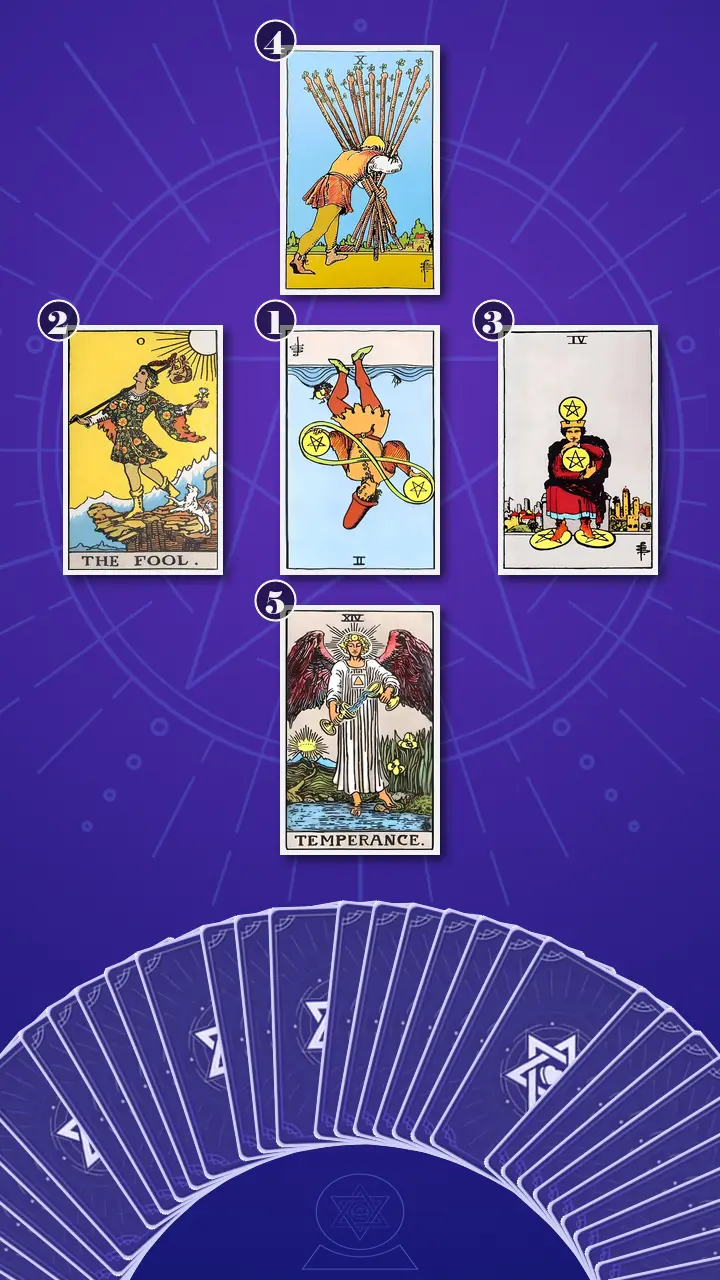
“Card 1,” I told Jordan, “is the current pressure—how indecision is showing up in real life.”
“Card 4 will show us what’s pressing down from underneath—what’s making the needle wobble.”
“And Card 5,” I said, “is where we stop treating this like a verdict and start designing a next step.”
Reading the Map: Five Cards, One Deadline
Position 1: The current decision pressure — Two of Pentacles (reversed)
“Now flipping over,” I said, “is the card that represents the current decision pressure and the concrete way indecision is showing up day-to-day—the ‘juggling’ behavior.”
The Two of Pentacles, reversed.
And I didn’t have to strain to translate it into modern life, because Jordan’s whole screen was already the illustration: It’s Thursday night and you’re doing the frantic multi-task dance: flight checkout page open, PTO policy PDF open, budgeting app open, and you keep switching every 20 seconds. You tell yourself you’re being “practical,” but what you’re really doing is avoiding commitment—because committing means risking future regret.
Reversed, this isn’t flexible juggling—it’s overload. Earth energy (money, time, policy) goes from “manageable” to “choppy,” like the sea behind the figure in the card. The infinity loop around the coins starts to look less like adaptability and more like endless recalculation. The energy here is blocked: you’re trying to keep both outcomes emotionally alive, and the cost is your nervous system never landing.
Jordan made an unexpected sound—one sharp, bitter little laugh that broke into an exhale.
“That’s… honestly rude,” they said. “Like, yeah. If I just keep both open, I’m not wrong yet.”
“Exactly,” I replied, gentle but precise. “You’re not indecisive—you’re over-trying to be un-regrettable.”
I watched their eyes go unfocused for a second, like they were seeing their own week in fast-forward: checkout-start, back out, refresh policy, refresh budget, repeat. Then they nodded once, very small, like someone admitting something they didn’t want to be true.
“There’s a question this position always asks,” I said, keeping it practical. “What’s your most embarrassing juggling behavior this week—starting checkout and backing out, rewriting the pros/cons list, refreshing your bank app—and what are you hoping that behavior will protect you from feeling?”
Jordan swallowed. “Future-me judging me.”
“Good,” I said. “Now we can work with something real.”
Position 2: Path A — The Fool (upright)
“Now,” I said, “we open the card that represents Path A: what the solo trip option is trying to give you psychologically and practically.”
The Fool, upright.
Here’s the modern translation in plain clothes: You choose the simplest, safest-enough version of a solo trip: direct transit/flight, one neighborhood, one place to stay, one anchor plan. You let it be a reset—not a performance. The ‘leap’ isn’t recklessness; it’s clicking book without needing a perfect justification speech for your future self (or your coworkers).
The Fool’s energy is balanced when it’s clean: a single forward motion. But in an over-optimizer’s mind, it can trigger the all-or-nothing reflex: If it’s not epic, it’s not worth it—right?
Jordan’s face did what I’ve seen a hundred times: a quick spark—tiny excitement at the idea of air and distance—then the clamp. Their jaw tightened again, as if even a pleasant feeling had to be controlled.
“The cliff edge,” I said, “isn’t telling you to be chaotic. It’s asking: what’s the smallest leap that still counts? Not The White Lotus fantasy of a vacation fixing your entire personality—just enough space for you to remember you exist outside Slack.”
Jordan whispered, almost embarrassed, “I want… main character energy, but like, in a way that doesn’t wreck my budget.”
“That’s more honest than most historical kings,” I said, and they smiled despite themselves.
Position 3: Path B — Four of Pentacles (upright)
“This next card,” I said, “represents Path B: what the cash-out option is trying to protect or secure psychologically and practically.”
Four of Pentacles, upright.
Modern life, unvarnished: You see the cash-out amount and feel instant relief—like you just did the adult thing. But later, scrolling while still exhausted, you feel a quiet resentment: not at the policy, but at how quickly your life can become ‘work, save, repeat.’ The payout protects your resources, but it can also protect you from risk in a way that shrinks your world.
This is Earth energy that can be wise—stable, conserving resources, protecting future-you. But it can also be excess: grip so tight it becomes identity. In the card, the figure holds the coin to their chest as if money is not just a tool, but emotional armor. Coins under the feet, too—rooted, yes, but also pinned.
Jordan nodded quickly, then their eyes flicked away. That was the sting: the relief is real, and the resentment is real too.
“If you imagine cashing it out,” I asked, “what exactly feels safer—your savings, your reputation at work, or the feeling that you stayed in control?”
Jordan didn’t answer right away. Their shoulders hunched slightly, as if the question itself made them pull inward. “All of it,” they admitted. “And I hate that I care about the optics.”
“Don’t shame the protective instinct,” I said. “Protection kept entire cities alive through winter. The issue is when protection becomes a cage.”
Position 4: The hidden driver — Ten of Wands (upright)
“Now we turn over,” I said, “the card that represents the hidden driver: the underlying load, need, or pressure that is making the choice feel high-stakes.”
Ten of Wands, upright.
The translation landed with weight: The real driver isn’t the PTO decision—it’s the months of being the “reliable one” at work, staying half-on even after hours, and telling yourself rest is something you’ll earn later. Under that load, any choice feels like it has to fix everything, which makes you freeze.
I watched Jordan go still. Not dramatic stillness—more like the quiet drop you feel when an elevator stops at your floor and you realize you’ve been clenching the handrail the whole ride.
“This is the ‘Severance’ feeling,” I said, “even when you haven’t watched it. Work isn’t ‘at work’—it’s in your pocket.”
I named the invisible pile-up the way an archaeologist names layers: not to accuse, but to locate. “Late Slack pings. Hybrid-office ‘quiet’ expectations. The mental load of being the person who remembers everything. It’s like carrying groceries plus a laptop bag plus a wet umbrella—none of it is heavy alone, but together it bends your posture.”
Jordan’s hand went to their stomach, almost unconsciously. “No wonder I can’t decide,” they said, voice lower. “I’m already maxed out.”
Here, the energy isn’t blocked or deficient. It’s overextended. Fire strain. You can’t “optimize” your way out of a system that’s already carrying too much.
“And this,” I added softly, “is why the decision feels like it has to be perfect. When you’re carrying ten wands, you start believing the next choice must compensate for the entire load.”
When Temperance Spoke: Mixing Rest and Reality Without Shame
Position 5: Integration guidance — Temperance (upright)
I let my hands pause on the deck for a beat. The room felt quieter through the screen, as if Jordan’s condo had leaned in with them. “We’ve reached the grounding card,” I said, “the one that stabilizes the whole cross.”
“Now flipping over is the card that represents integration guidance: a practical way to move forward that reduces all-or-nothing thinking and supports follow-through.”
Temperance, upright.
And the modern translation was immediate: You stop trying to prove which option is morally ‘right’ and build an integration plan: a shorter trip with a spending cap and a hard work boundary (or a cash-out paired with a scheduled recovery block you will actually take). The point isn’t perfection—it’s a paced commitment you can stand behind without reopening the debate every hour.
The energy here is balance—not the bland kind, but the engineered kind. The angel pours between two cups: measured transfer. One foot on land, one in water: structure and restoration cooperating instead of competing.
Here’s the historical case matching that lives in my bones: civilizations don’t survive by choosing “adventure” forever or “defense” forever. They survive by building systems that let both exist. A port city that traded without walls was naïve; a walled city that never traded slowly starved. Temperance is that middle intelligence—the kind that isn’t flashy, but keeps you alive.
Jordan’s eyes tightened, as if they were bracing for a moral lecture about responsibility. So I said it plainly: “You’re not choosing a personality; you’re choosing a plan.”
Setup, I thought—because I could see it: it was Thursday night in their body, even though it was Thursday night on the clock. They were still flipping between Google Flights, the PTO policy PDF, and the bank app—like if they stopped moving for one second they’d “mess it up.” The timer was what made it feel personal.
Stop treating the choice like a moral test; start mixing what you need the way Temperance pours—measured, intentional, and sustainable.
Jordan’s reaction came in three small waves.
First: a freeze. Their breath caught mid-inhale, and their hand hovered above the trackpad like it forgot what it was supposed to click.
Second: the thought landing. Their eyes went slightly unfocused, not empty—busy. I could almost see the internal tabs rearranging: “moral test” sliding out of the center, “plan” moving in.
Third: the release. A long exhale. Their shoulders dropped a fraction, then another fraction, as if gravity had negotiated a kinder contract with their spine. Their jaw unclenched in a way that made their whole face look younger. They blinked hard once, then laughed—quietly, but without bitterness this time.
“But… if I stop treating it like a moral test,” they said, and here came the unexpected flare of resistance, “doesn’t that mean I’ve been doing this wrong? Like—this whole time?”
I didn’t rush to soothe it away. “It means you’ve been using the tools you had,” I said. “Over-research is a kind of self-protection. It’s just expensive. It costs you sleep, peace, and time.”
“If this choice feels like a moral test, it’s already rigged,” I added, letting the line hang for a second. “Because no spreadsheet can prove you’re allowed to rest.”
Then I brought it back to something Jordan could do—because insight without a next step just becomes another tab. “Now,” I said, “use this new lens and look back at last week. Was there a moment—one Slack ping, one late-night scroll—when this would’ve helped?”
Jordan didn’t even need to think. “Tuesday,” they said. “I was on the Queen streetcar, scrolling travel TikToks with the volume off. A Slack notification popped up—nothing urgent—and my stomach did that drop. I remember thinking, ‘I haven’t earned a real break.’”
“Temperance doesn’t ask whether you’ve earned it,” I said. “Temperance asks what mix keeps you functional.”
And I named the transformation out loud, so their nervous system could hear it as a direction: “This is you moving from deadline-fueled, guilt-driven optimization to a bounded, values-led decision you can follow through on without constant renegotiation.”
From Insight to Action: The Two-Boundary Temperance Plan You Can Stop Renegotiating
I gathered the whole spread into one story, the way I’d write up a site report after an excavation: not poetry, but something true enough to build on.
“Here’s what I see,” I told Jordan. “Right now, you’re in time-limited choice paralysis: Two of Pentacles reversed—the tab-switching, the ‘I’ll decide tomorrow’ loop. The Fool shows your craving for aliveness and reset—something unproved, but real. The Four of Pentacles shows your protective intelligence—money and work credibility matter, and you’re not wrong to care. But the Ten of Wands reveals what’s really making the choice feel dangerous: you’re already carrying too much, so you’re trying to force this one decision to act like a reset button for an entire season of overextension. Temperance is the bridge: you don’t need a perfect answer—you need an intentional plan that honors both rest and reality.”
“Your blind spot,” I added, “is thinking that the only ‘adult’ choice is the one that can be justified perfectly. That belief turns a normal tradeoff into a character trial. The direction forward is different: move from proving your choice is optimal to choosing a bounded experiment you can stand behind.”
Jordan frowned. “Okay. But I swear I don’t even have ten minutes tonight. I’m behind on everything.”
“That’s the Ten of Wands talking,” I said, not unkindly. “And I believe you. So we’ll make it smaller—and we’ll do it in two calm passes if we need to.”
I used my own method—the way I’d separate layers in soil—as a tool for them. “I call it Time Stratigraphy,” I said. “We separate impulse from lasting value. Not to shame the impulse—just to stop it from running the dig site.”
“Here’s your practical plan,” I said. “It’s a restoration job, not a revolution.”
- The 10-Minute Temperance CheckSet a timer for 10. Write two lines only in Notes: “My money boundary is ___ (a number).” and “My rest boundary is ___ (a rule).” Then choose the smallest trip version that fits both, or choose the cash-out plus one real rest block you’ll actually take.If your chest tightens or you feel flooded, pause for 3 slow breaths and come back later. You’re allowed to make this decision in two calm passes, not one panicked night.
- One-Rule Decision (Reduce Variables)Pick one constraint tonight: a max all-in spend (for example, $600–$1,000) or a max travel time (under 3 hours) or a minimum rest outcome (2 consecutive days with no work apps). Keep that one rule visible while you decide—sticky note or pinned note on your phone.Expect resistance like “This feels arbitrary.” That’s the point—constraints aren’t punishment; they’re how you make freedom usable.
- Minimum Viable Getaway (The Fool, But Practical)If you choose the trip: book the smallest real version—direct transit/flight, one well-reviewed place, and one anchor plan (museum ticket, sauna pass, or a reservation). Then create one “No Itinerary” half-day: walk + coffee + sit somewhere pretty. Stop there.You’ll want to earn rest by overplanning. Try the opposite: remove one thing. If anxiety spikes, scale down (day trip, two nights, one neighborhood).
Before we ended, I offered Jordan one last tool—my Voyage Log Technique, borrowed from ancient navigators. “Write the plan like a ship’s log,” I said. “A bearing and a boundary. ‘I’m sailing north for three days. I will not check email after 6 p.m.’ Not because the sea is predictable, but because the ship needs rules.”
Jordan nodded, slower now. “A plan I can stop renegotiating every hour,” they murmured, as if testing what it felt like in their mouth.
A Week Later: The Quiet Proof
Six days later, Jordan emailed me two sentences and a screenshot.
“Did the Temperance check,” they wrote. “Money boundary: $850. Rest boundary: no Slack on my phone after 6 p.m., and work email deleted for the trip.”
The screenshot was a booking confirmation for a three-night stay in Montreal—direct train, one neighborhood, one museum ticket purchased in advance, nothing else planned. Underneath, a second screenshot: Slack notifications toggled off. Not forever. Just deliberately.
They added, almost as an afterthought: “I woke up the next day and my first thought was still, ‘What if this is the wrong choice?’ And then I laughed. Because it felt like a thought, not a verdict.”
That’s what a Journey to Clarity looks like most of the time: not thunder, not certainty—just ownership. From frantic optimizing to paced commitment. From guilt to a grounded kind of relief that can actually fit inside your week.
When the PTO clock is ticking, it can feel like you’re not choosing between a trip and a payout—you’re choosing between being the kind of person who lives, and the kind of person who never gets it wrong, and your jaw is tired from holding that tension.
If you treated this as a two-week experiment you can stand behind (not a verdict on your character), what’s the smallest money boundary and the smallest rest boundary you’d actually be willing to commit to—today?
Every reading at AceTarot is a Journey to connect with inner wisdom and empower next step.
Learn more about our Journey to Clarity.