When Open to Work Feels Like Failure: Leaving the Inner Courtroom

The 11:40 p.m. Open to Work Loop
I've learned that if you're in your late 20s, working in tech in a city like Toronto, and can spend 45 minutes rewriting your LinkedIn headline after seeing someone your age post a promotion, this is probably career identity shame, not laziness.
When Jordan (name changed for privacy) sat down with me, she did not describe a dramatic collapse. She described a settings menu. She told me about 11:40 p.m. on a Tuesday, on her condo couch downtown, laptop half-warm against her thigh, LinkedIn open to the Open to Work drawer. She would read the difference between "recruiters only" and "all LinkedIn members" twice, switch it on for a second, switch it off again, then spend the next hour changing one line in her headline while the blue screen light hit her face and the fridge hummed in the quiet.
"I know it's just a setting," she said, "but it feels weirdly public." Then she added the real sentence underneath it: "I want options, but I don't want the optics."
I knew the contradiction immediately: wanting to be visible to new employers, while fearing that visibility would look like proof of failure. In her body, it was already loud. She said her throat went tight, her face hot, her stomach dropped the second the choice felt public. The feeling wasn't abstract at all. It was like standing in an elevator with the doors stuck open between floors, suddenly sure that everyone in the building could see you paused there.
I asked her, "What part hits harder for you — old coworkers seeing the badge, or your own inner voice deciding what that badge means?"
She looked down at her hands before answering. "Honestly? My own voice gets there first."
"That makes sense," I told her. "You're not lazy. You're bracing. A settings menu should not have this much power over your self-worth, but for a lot of people, it does."
I leaned forward a little and softened my voice. "So let's not treat this like a willpower problem. Let's treat it like a pattern we can map. That's what we're doing today — finding clarity inside the exact moment that keeps turning you back into draft mode."
Even before I touched the deck, I knew this was the kind of question I like to hold inside a Simple Cross tarot spread: small enough to stay honest, sharp enough to tell the truth.

Choosing the Compass: A Simple Cross for Career Visibility Shame
I asked Jordan to take one slow breath and hold one scene in mind only: cursor hovering over Open to Work, body already tensing before the click. Then I shuffled. Not as theatre. Not as mystique. Just as a way of giving the nervous system a clean handoff from spiral to focus. When people ask me how tarot works in moments like this, my simplest answer is that it turns a blur into sequence.
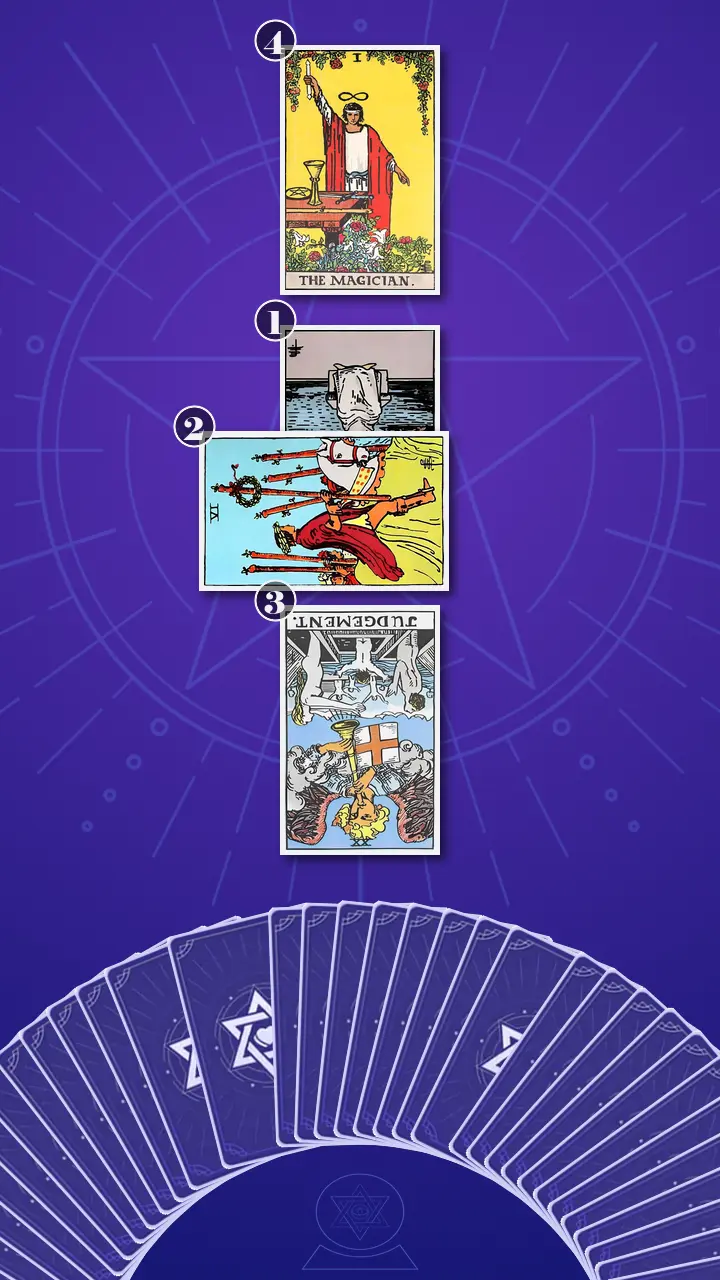
For this reading, I used the Simple Cross · Context Edition. I reach for this spread when someone is stuck at a career crossroads and needs a coherent arc, not a flood of symbolism. It gives me four clean positions: the visible symptom, the pressure crossing it, the deeper root story underneath it, and the integrated next step forward. It is minimal by design, which matters when the real issue is already mentally overcrowded.
This spread also fits the psychology of the problem. The cross shape mirrors the feeling Jordan had been living inside: self-protection pulling one way, self-advocacy pulling the other. At the center, I would look for the hesitation loop itself. The crossing card would show the imagined audience and the status pressure. The card below would reveal the private verdict already running under the surface. And the card above would show the mindset and action shift that could turn visibility from a confession into a practical tool.
Reading the Pressure Point
The Card at the Center: Two of Swords Reversed
I turned over the first card and named its role out loud. "This position presents the visible symptom from the diagnosis," I said, "the hesitation, toggling, and no-win framing around making career visibility public."
Two of Swords, reversed.
I didn't have to stretch for the translation. This card was already living in her Tuesday-night routine. At 11:40 p.m. on the couch, she opens the LinkedIn visibility drawer, rereads "recruiters only" and "all LinkedIn members" twice, clicks one, immediately unclicks it, and then spends the next hour changing her headline as if perfect wording could remove the risk of being seen wanting more. The stall is not really about settings. It is about trying to make a career move with zero emotional exposure.
In energy terms, this is blocked Air gone noisy. Not balance. Not indecision in a neat, elegant sense. This is mental control used so hard that it starts to splinter. The blindfold in the card becomes over-focusing on the mechanics of the toggle so she does not have to fully feel the shame spike underneath. The crossed swords over the chest mirror the physical clamp in the throat and ribs. A choice gets turned into a no-win test, and then the mind calls the delay "strategy."
I said, "This is like having seventeen browser tabs open about the same choice and mistaking tab-management for progress. 'Not yet. Just fix one more line first.' That's the loop."
Jordan gave a short laugh, but there was a sting in it. "That's a little rude," she said, smiling with only one side of her mouth. "Also, yeah. That's exactly what I do." Her fingers had been gripping her mug; then, almost without noticing, she loosened them. Same-frequency recognition has a sound, and sometimes it is that half-laugh that says, oh no, you found the tab.
The Card Across It: Six of Wands Reversed
I moved to the second card. "This position reveals the crossing challenge," I told her, "the social-status pressure, imagined audience, and fear of looking less successful than peers."
Six of Wands, reversed.
I told her this was where LinkedIn stopped being a job-search tool and started feeling like an Instagram feed for her career. She updates one line of her profile during lunch, checks profile views on the TTC ride home, and reads an ordinary flat line like a public ranking. Former coworkers, university friends, and old managers become a silent crowd in her head. So when she imagines turning on Open to Work, she is not imagining a setting. She is imagining being watched.
This is Fire distorted by audience-consciousness. The energy is there, but it is routed outward into status management. Instead of asking, "What does my future need?" the nervous system asks, "How do I avoid looking behind?" That is why visibility feels like status risk instead of useful signal. The audience in your head is usually louder than the audience on your screen.
I watched the sentence land in her body in three small stages. First, her breath paused. Then her eyes unfocused, as if she were replaying promotion posts and profile-view checks in fast cuts. Then came the exhale, long and a little embarrassed.
"I do that," she said quietly. "I picture people I haven't talked to in two years and somehow give them voting rights over my life."
"Exactly," I said. "And that imagined crowd is crossing your actual needs."
The Courtroom Underneath: Judgement Reversed
I turned to the third card. "This position uncovers the root mechanism," I said, "the inner judgement that equates transition with inadequacy and turns a practical move into a verdict on worth."
Judgement, reversed.
The room went noticeably quieter when this card landed. Outside the window, a streetcar bell rang once and faded into the damp Toronto evening, and for a brief second it sounded almost like a gavel. I always pay attention when the environment starts collaborating with the symbol.
I told her this card was the private layer underneath the public one. Past midnight, after one more layoff post and one more peer's "thrilled to announce my next chapter," she starts replaying old career choices like evidence in a case against herself: should have moved sooner, should have pushed harder, should have seen it coming, should have built a cleaner story by now. The search has not even gone public, but internally she is already on trial. A little Severance-coded, I said with a small smile: the corporate system looks cold from the outside, but the harshest performance review is happening inside her own head.
This is not honest review. This is review turned prosecution. Reversed Judgement blocks the awakening by translating it into self-condemnation. The trumpet that should sound like a call forward gets heard as accusation. Career transition is information, not evidence for the prosecution.
That card always gives me a flash of my old life. Years ago, on a trading floor, I watched smart people confuse a changed market with a ruined identity. I learned there that one of the most expensive mistakes in any system is mistaking information for verdict. Seeing Judgement reversed, I felt that old fluorescent memory again: numbers on a screen, shoulders locked, people acting as if context had become character.
Jordan's jaw tightened first. Then it loosened. Then she looked at me with that slightly startled expression people get when the real pain finally gets named.
"So that's why it feels bigger than LinkedIn," she said. "By the time I get to the setting, I've already decided it means something bad about me."
"Yes," I said. "The badge hurts because a private sentence is already in place."
I gave her the first soft reset. "Before you touch LinkedIn next time shame spikes, open Notes and write two headings: 'What changed' and 'What I learned.' Keep it factual. Three bullets under each if you can. One bullet each if that's all you've got. No sentencing language."
She nodded slowly. I could almost see the question shifting shape in her: from What is wrong with me? to What has become true?
When The Magician Raised the Wand Over the Table
The Antidote Above the Cross: The Magician
I turned the final card. "This position defines the integrated way forward," I said, "the mindset and action shift that turns visibility into professional agency rather than confession."
The Magician, upright.
Whenever three reversed cards lead into one upright major arcana, I slow down. The architecture matters. Pressure builds through blockage, then one clear point of conscious agency enters the spread like a door opening. On this card, the wand is raised, the table holds every suit, and the message is not that discomfort disappears. It is that authorship becomes available.
I told Jordan this was the Wednesday-morning version of her life. Same platform. Same profile. Same city, same rent, same Slack notifications waiting off-screen. But different meaning. She opens Notes before stand-up and writes one plain sentence about the kind of content strategy role she wants next. She switches Open to Work to recruiters only for seven days. She sends one direct message to one trusted contact instead of polishing her headline again. Same tools. Different posture. Visibility is not a confession.
She sat very still, caught between the old script and the new one. I could feel the familiar conflict in the room: audience-managed identity versus self-authored direction.
This is not a scarlet label of failure; it is a raised wand over the table of tools, asking you to name what you want and use what is already in your hands.
I let the sentence stay there for a moment.
Then I brought in the lens that is uniquely mine. "When I read The Magician through my Human Capital Valuation framework," I told her, "I don't see someone asking for rescue. I see priced competencies that have not vanished just because the fit has changed. Content strategy. Editorial judgment. Stakeholder communication. Brand narrative. Cross-functional thinking. Markets assess skills; they do not issue moral verdicts. This card is asking you to stop valuing yourself through imagined optics and start signaling your actual assets with intention."
Her reaction came in three waves. First, a visible freeze: breath held halfway in, thumb stopping against the edge of the deck. Then cognitive seepage: her eyes drifted slightly out of focus, like she was replaying every night she had treated a LinkedIn setting like a failing grade. Then the emotional release arrived in a surprising jacket.
"But doesn't that mean I've been making this harder than it needed to be?" she said, and there was a flare of irritation in it. Not at me. At the wasted energy. At the weeks spent bargaining with a badge.
"Only if you confuse self-protection with stupidity," I said. "You weren't being ridiculous. You were bracing. There's a difference. But now we can see the brace, so now we can change the move."
Her eyes shone a little after that. Her shoulders dropped next. Then came that expression I trust more than instant relief: the slight, unsteady smile of someone who has just put down a heavy backpack and feels a little dizzy without it.
"Okay," she said, voice thinner but steadier. "If I had this frame last week, I think I would've treated recruiters-only like a tool. Not like... testifying."
"Exactly," I said. "That is the shift. Not from fear to zero fear. From shame-tightening and audience management to steadier professional agency. From bracing to authorship."
I asked her, "Using this lens, can you see a moment from last week that would've felt different?"
She gave a breathy little laugh. "Tuesday night. Absolutely Tuesday night. I would've stopped acting like I was in a courtroom with a settings menu as Exhibit A."
The Tools-on-the-Table Reset
By the time I gathered the cards back into a stack, the narrative was clean. Two of Swords reversed showed the visible loop: hover, toggle, rewrite, delay. Six of Wands reversed showed the crossing pressure: an imagined audience powerful enough to turn LinkedIn into a status stage. Judgement reversed revealed the deeper blind spot: she had been treating transition as moral evidence instead of changing fit. And The Magician reframed the whole problem from the top down: public job-seeking did not have to mean public failure. It could simply mean clear self-advocacy during a professional transition.
The most painful blind spot was this: Jordan kept acting as if she needed a perfectly flattering explanation before she earned the right to want something new. That is how shame steals agency. It lets one contracted part of you run the whole career decision. So the direction forward was not "be more confident." It was much more practical: separate prediction from data, separate optics from communication, and separate worth from visibility.
I gave her three small next steps. Not life-overhaul moves. Just actionable advice that a real nervous system could actually do.
- Run the Recruiters-Only Reality TestPick one evening this week, cap profile edits at fifteen minutes, then switch Open to Work to recruiters only for seven days. Take a screenshot after you turn it on so your brain cannot keep dragging you back into re-check mode.If seven days feels too exposed, make it three. Keep one short note called "What actually happened" and record facts only: recruiter messages, nothing noticeable, or your own body reaction.
- Send One Optics-Free AskMessage one trusted former coworker, mentor, or industry friend this week and name the role you want in plain language: "I'm exploring content strategy roles with more room for X. If you hear of anything, I'd love to know."Draft it in Apple Notes first if you need to, but send it without apologizing, joking, or calling it "just browsing." One honest contact counts as real movement.
- Use the Profile-as-Prospectus ResetBefore you touch your headline again, open a blank note and write three short lines: what changed, what I learned, and what value I want to create next. Then update your LinkedIn from that note, as if it were a prospectus for your next chapter — not a legal defense of the last one.Keep it factual, brief, and non-performative. If shame spikes, do the one-bullet version and stop there. Clarity first, polish second.
That last one comes from one of my own signature methods, the Profile-as-Prospectus redesign. I built it because so many smart people rewrite their profiles like closing statements for a trial. But a prospectus does something cleaner: it states what is being offered, where the value sits, and what direction is being signaled. That is pure Magician energy. Tools on the table. Meaning chosen on purpose.

A Week Later, the Setting Stayed On
Six days later, I got a message from Jordan at 8:03 a.m. "I did the seven-day recruiters-only experiment," it said. "Nothing catastrophic happened. One recruiter reached out. I sent the message to my old coworker. And the 'What changed / What I learned' note stopped me from spiraling last night."
Then came the line I cared about most: "I still don't love that it feels this charged, but it feels less like I'm admitting I failed and more like I'm being clear."
That is what a real Journey to Clarity usually looks like in career readings. Not a movie montage. Not instant certainty. Just one clean sentence where there used to be static. One choice made from the whole self instead of the ashamed part. One body that no longer treats visibility like a summons.
The next morning, she told me, she had slept properly for the first time in weeks. She still woke with the old thought — what if this looks desperate? — but this time she smiled, checked the screenshot once, and left the setting on.
I've seen this enough times to know something important: sometimes the hardest part of a career change is not the change itself — it's the hot-faced moment when being seen wanting more feels like proof you were never enough where you are.
That is exactly why I keep returning to a Simple Cross tarot spread for career visibility shame and LinkedIn job-search anxiety. It helps me trace the knot from feeling stuck and overediting, down through the private courtroom underneath, and back up into finding clarity, practical self-advocacy, and next steps you can actually take.
If visibility were just one tool on the table, not a confession, what is one sentence you might let your next chapter say out loud?