When Office Hours Feel Like a Verdict: Bring the Draft Into the Room
Why Asking for Help Feels Embarrassing at 11:40 p.m.
If you have ever typed a question into your Notes app at 11:40 p.m., deleted half of it, and told yourself another hour of solo troubleshooting would be less embarrassing than asking for help, you are not alone in that competence-shame loop. That was exactly how Emma (name changed for privacy), a second-year university student in Toronto, arrived in my evening reading.
On my screen, I could see the tiny kitchen table in her shared apartment doing battle with her deadline: lecture slides open, a half-written email waiting in drafts, and three tabs that almost answered the assignment but not quite. The screen light was too blue, the tea beside her had gone cold, the fridge hummed with an irritating steadiness, and every few seconds she edited the wording of the same question instead of sending it.
“I know I need help,” she said, pressing her lips together before the rest came out. “I just hate sounding like I didn’t try.” I heard the real split immediately: she wanted to ask for help and understand the material, but she feared that needing help might somehow prove she was not smart enough. She wanted clarity; she did not want the meaning she imagined other people would attach to her asking. In that kind of moment, shame feels less like an emotion and more like wearing a winter coat you cannot take off indoors: your face goes hot, your throat tightens, your stomach drops anyway, and still you feel left outside your own life.
I have watched that pattern in many forms over the years, from Cambridge supervision rooms to muddy archaeological field schools where students would rather guess wrongly for an hour than admit they had lost the layer. So I met her where she was. “You do want help,” I told her, “you just don’t want what asking might seem to say about you. Let’s not make tonight a private performance review. Let’s make a map for tomorrow, and let’s see whether we can find some clarity before office hours turns into another courtroom in your head.”

Choosing the Short Bridge: The Situation-Obstacle-Advice-Outcome Spread
I asked Emma to put both feet on the floor, take one slow breath, and say the real question without polishing it for me first. Then I shuffled slowly. I have never cared for empty theatrics; the rhythm matters because it gives the mind a way to step out of panic and into attention.
For her, I chose a Situation-Obstacle-Advice-Outcome spread. When a question is this immediate and this intimate—office hours tomorrow, shame tonight—I prefer a short bridge over a sprawling cathedral. A larger spread like the Celtic Cross can sometimes become one more way to overcomplicate what is, at heart, a very specific threshold moment. This four-card line suits office hours anxiety because it moves cleanly from the visible symptom, into the hidden belief underneath it, toward the practical reframe, and then into the likely next state of mind. This is how tarot works at its best: not by making the problem more mystical, but by making the pattern more readable.
I told her exactly what I would be looking for. The first card would show the immediate shame spike that appeared right before she asked for help. The second would reveal the belief about worth and competence that made receiving support feel embarrassing. The third—the pivotal card in the spread—would show the medicine, the reframe that could interrupt her habit of struggling alone. The fourth would show what mental clarity might look like after one honest act of help-seeking. Four cards, left to right, like stepping stones from contraction to clearer footing.
The Cold Outside the Door
Position 1: The Student Outside the Lit Door
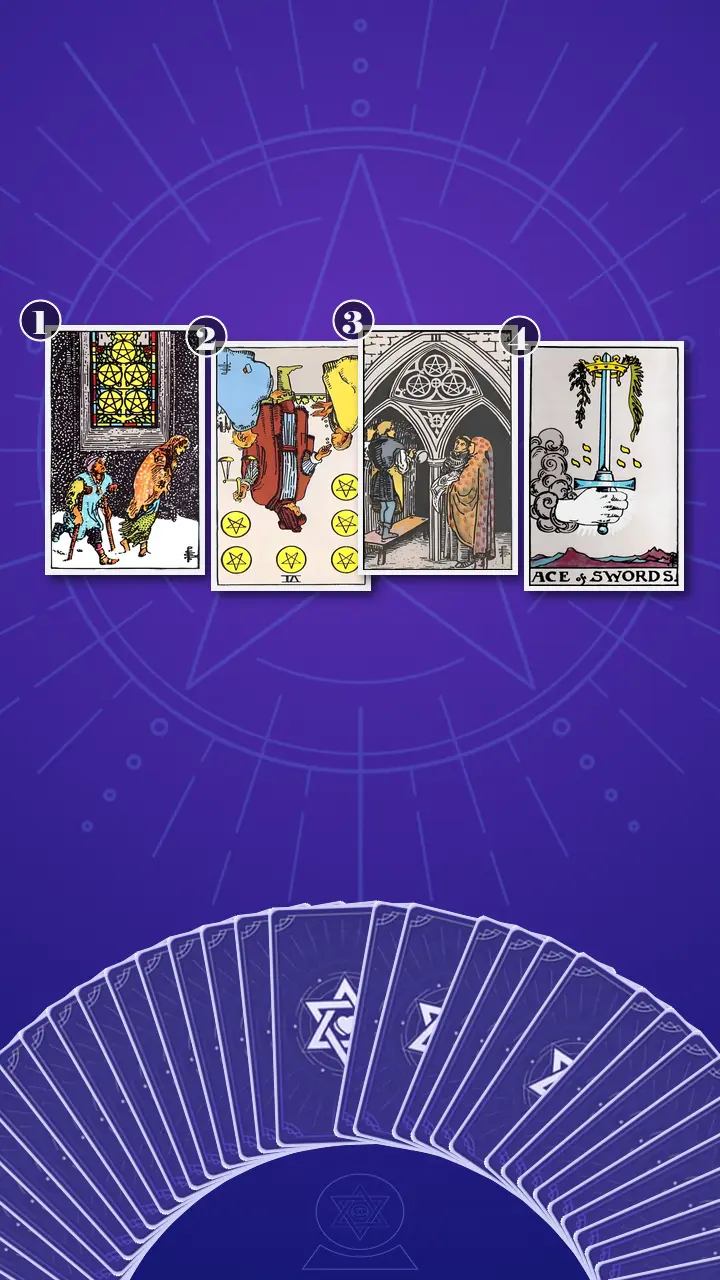
I turned over the first card and named its role plainly. “This card represents the immediate symptom knot from the diagnosis: the specific shame spike that appears when you are about to ask for help.” It was the Five of Pentacles, upright.
I was not surprised. In modern life, this card looks exactly like hovering outside office hours—or over the Zoom link—while telling yourself support is technically available but somehow not meant for you. The real pain begins before anyone answers, because the mind has already turned a normal learning space into proof that you are the student on the outside. The card’s energy is upright, but it is an excess of scarcity: too much focus on exclusion, too much identification with being left out, too much cold made out of a door that is in fact unlocked.
The image on the card has always mattered to me: the lit window, the hard ground, the figures passing beside shelter as if it were not theirs to enter. I asked Emma, “When you picture tomorrow, what happens first? Does the actual concept get clearer—or does your brain start rehearsing how not to sound behind?” She gave a short laugh, the sort that carries a sting in it. “That’s awful,” she said. “Because yes. That is literally the hallway outside office hours.” As she said it, her thumb kept circling the rim of her mug, not drinking, just bracing.
I told her that the Five of Pentacles was naming the outsider story, not endorsing it. Help existed. The door existed. The pain was real, but the story attached to the pain was doing the heavier work.
Position 2: The Invisible Scorecard
I turned to the second card. “This represents the mechanism underneath the behavior: the hidden belief about worth and competence that turns receiving support into something embarrassing.” The Six of Pentacles appeared in reversed position.
Reversed here, the card spoke with painful precision. This is the moment a simple question stops feeling like a practical exchange and starts feeling like a hierarchy scene. The scales in the image become an invisible scorecard. The act of asking starts to feel like kneeling. Instead of information moving between two people, the whole encounter gets distorted into status: professor above, student below; competence above, need below. That is why the draft email becomes padded with disclaimers, context, proof of effort, apologies. If I ask plainly, they’ll hear how behind I am. If I say sorry first, maybe I can cushion the fall.
When I first taught at Cambridge, I used to notice how many students began office hours with apologies for having questions that were, in truth, perfectly ordinary. Seeing this card, I had a swift memory of those old doorways: bright young people framed in hesitation, thinking I was judging their intelligence when in reality I was only grateful they had finally shown me where the teaching needed to begin. That memory moved through me again as I looked back at Emma. “You are not behind because you need a question answered,” I said quietly.
She winced before she nodded. Her shoulders had climbed nearly to her ears; her throat worked once as if the sentence itself had to be swallowed. “I do the apology-email thing every time,” she admitted. “I write things like, ‘Sorry if this is obvious,’ or, ‘I’ve tried a few approaches already.’ I make it sound like a grant application before I ask one normal question.” That was the reversed Six perfectly: receiving help felt costly, exposing, almost humiliating, not because help itself was harmful, but because her inner standards had turned it into a quiet referendum on worth.
When the Three of Pentacles Turned the Room into a Workshop
Position 3: The Antidote in Plain Sight
When I turned the third card, the atmosphere changed at once. The rain against my study window gave a soft ticking sound, and on Emma’s side of the screen the blue kitchen light seemed, for a moment, less harsh than before. “This card identifies the key transformation point,” I said. “The reframe that directly challenges the strategy of struggling alone.” It was the Three of Pentacles, upright.
I smiled the moment I saw it. In practical terms, this card is office hours used the way they were built to be used: laptop open, exact slide or problem visible, unfinished thinking on the table, and another person helping you see the structure more clearly. The energy is balanced and constructive. No dramatics, no rescue fantasy, no self-ranking. Just work. Office hours are a workshop, not a verdict.
Skill Archaeology and the Half-Finished Sentence
In my own practice, I call this Skill Archaeology. It means unearthing a talent that shame has buried so deeply you no longer know it counts as a talent at all. In Emma’s case, the overlooked skill was not dazzling independence. It was the ability to identify the exact point where understanding broke. On an excavation, the novice who says, “The soil changes here,” or, “This shard doesn’t belong to the layer we expected,” is not confessing failure. They are doing real interpretive work. They are showing the team where meaning begins. In academic life, “I understand it until this step, and I lose the thread at this one” is the same kind of intelligence. It is method, not weakness.
It was late, the tea was cold, and the Notes app draft had swollen until it was carrying far more than a question about the material; it was carrying her fear about whether she was smart enough to be there at all.
Stop treating the doorway like a verdict and start treating it like a workshop—the Three of Pentacles says growth begins when you bring the draft into the room.
I let the sentence hang there. Emma’s response came in three clear layers. First came the freeze: her breath caught halfway, and the hand resting near her keyboard stopped moving entirely. Then came the cognitive seep: her eyes drifted slightly out of focus, as though she were replaying half a dozen scenes at once—the office-hours hallway, the Discord posts where other students typed ‘quick q’ like it cost them nothing, the unsent email, the extra hour with YouTube, Reddit, and old notes all open while the real question got blurrier. Then the feeling finally rose. Her jaw loosened. Her shoulders dropped. She gave a disbelieving little exhale and then, unexpectedly, frowned.
“But doesn’t that mean I’ve been turning a ten-minute conversation into a whole courtroom in my head?” she asked. There was a flash of irritation in it—not at me, but at the architecture of the habit itself.
“Yes,” I told her, meeting that reaction without flinching. “And intelligent people do it all the time. Shame loves architecture; it can turn a doorway into a courthouse. But this card is offering you a different building. The embarrassing part is not needing help. The embarrassing part, for your nervous system, is being seen before you feel finished. But learning was never supposed to happen only after you look polished.”
That was the moment I saw the insight actually land. She inhaled again, slower this time, and with that inhalation came the slightly unsteady feeling that often follows real clarity: relief, yes, but also the first clean recognition of responsibility. Once the path becomes visible, one must decide whether to walk it. So I asked her, “Now, with this new angle, think back to last week. Was there a moment this would have changed?” She nodded almost immediately. “Stats,” she said. “I had the exact line open. I just kept trying to make the email sound smart.” There it was: the shift from shame-tightening self-protection toward collaborative clarity and growing self-trust. Not grand, not theatrical—just true.
Position 4: One Clean Sentence Through the Fog
I turned to the final card. “This shows the integration state: what mental and emotional clarity can emerge after one honest act of help-seeking.” It was the Ace of Swords, upright.
I always welcome this card after a pentacles-heavy reading. The spread had begun in dense earth—worth, scarcity, competence, status—and now it lifted into air. In lived terms, this is the walk out of office hours when one correct explanation suddenly closes twenty-seven browser tabs in the mind. One clean concept. One next step. Less buzzing behind the eyes. Less noise in the chest. One clear question can do what another hour of spiraling can’t.
The Ace of Swords is balanced energy: not overthinking, not avoidance, just precision. It does not promise perfection. It promises a straighter line. Confusion is a learning problem, not a character reveal. When I said that, I watched Emma’s jaw unclench so visibly that even through a screen I noticed it. “So the outcome isn’t me becoming one of those people who casually loves office hours,” she said. “It’s just me leaving with one clear explanation.” Exactly. That is the card meaning in context. Not flawless confidence, but a truer sentence: I was stuck here; now I can move.
The 10-Minute Workshop Plan
When I gathered the four cards into one story, the sequence was beautifully direct. The Five of Pentacles showed the immediate pain: support was available, yet shame cast Emma as someone standing outside it. The reversed Six of Pentacles showed the distortion underneath: she had turned asking for clarification into a status test, as if receiving help automatically placed her beneath the person giving it. The Three of Pentacles broke that spell by returning the scene to its proper use—collaborative learning, work in progress, draft-first help-seeking. And the Ace of Swords showed the result of that shift: clearer thought, cleaner language, a more workable next step.
The blind spot was not hidden intelligence or lack of diligence. It was this: Emma kept using self-worth as the measuring stick for a practical learning problem. She believed the danger was not understanding the material yet. In fact, the deeper burden was the meaning she had attached to being the one who asked. The transformation direction was the real medicine of the reading: move from treating help as evidence of failure to treating help as part of the learning process.
Because I am an archaeologist by training, I never ask anyone to lift the whole monument in one heroic heave. Ancient builders moved heavy stones with rollers, ropes, and measured increments. I call that Megalith Transport. So for tomorrow, I gave her a plan small enough to do and clear enough to trust:
- Write the one-sentence stuck pointTonight, open your Notes app for three minutes and type only this: “I understand it up to __, and I get lost at __.” Do it at your kitchen table, on Line 1, or outside the office door—but keep it to one honest sentence.If you feel the urge to make it sound smarter, stop there. Saving the sentence is enough for tonight.
- Bring the artifact, not the autobiographyScreenshot the exact slide, equation, paragraph, or assignment line where the logic breaks. In office hours, show that image and say: “I tried X, I follow it until Y, and I lose the logic at Z.” Delete any opening line like “Sorry if this is dumb.”You do not owe anyone a biography of your effort just to ask for clarification. Precision is more useful than self-protection.
- Treat office hours like a 10-minute workshopPut a start time and exit time in your calendar. Sit near the door if you go in person, or join the Zoom room with your camera off for the first minute if that helps your nervous system settle. If your mind blanks, begin with: “Can I read the exact sentence where I got stuck?”If you freeze tomorrow, send the one-sentence question by email instead. The goal is to interrupt the shame loop, not to perform perfect bravery.
That was my whole practical prescription, and it fit the reading exactly: bring the draft into the room.
A Week Later, the Quiet Proof
A few days later, I received a message from Emma. It was almost comically understated: “Went. Read the note basically verbatim. It took seven minutes.” Her professor pointed to the exact missing assumption in the slide deck, and the assignment stopped feeling cursed. She left with clearer notes, bought a mediocre campus coffee, and sat alone in the student centre for ten minutes—not triumphant exactly, just noticeably lighter.
That is why I trust this kind of reading. The Situation-Obstacle-Advice-Outcome spread did not erase her nerves or transform her into a different personality. It simply restored proportion. Our journey to clarity was not about becoming fearless; it was about moving from outsider mode to participant mode, from status fear to practical learning, from private spiraling to workable clarity.
There is a particular kind of loneliness in sitting with your face hot, your throat tight, and one honest question in front of you—trying to prove you deserve help by not needing it. If tonight you recognize yourself there, remember this: the moment you notice you have turned a workshop into a verdict, you are already one step closer to the room.
So if help stopped meaning “I’m behind” and started meaning “I’m in the process,” what would be the one unfinished sentence you’d be willing to bring into the room?