From Pay-Band Paralysis to a Grounded Ask: Scheduling the Talk

Finding Clarity in the 8:52 p.m. Slack Draft
If you’ve ever typed a raise message in Slack, stared at it for 20 minutes, then deleted it because you didn’t want to “make it awkward,” this is for you.
Jordan sat on her couch in a Toronto condo with her laptop balanced on her knees like it was something fragile. Slack was open to her manager’s DM. The internal pay band doc sat in another tab, quietly devastating in its neat little numbers. A brag sheet—twenty bullets deep—waited in Google Docs like a witness who’d been prepped for court but never called.
The screen glow was harsh against the dry, heated air. Her cursor blinked in an unsent message. Her throat tightened the way it does right before you have to say a name in a confrontation—like the words are queued up behind your teeth, but the door won’t open.
“I found my role’s pay band,” she said, looking at the laptop instead of me. “How do I bring it up?”
I heard the core contradiction immediately: she wanted to advocate for fair compensation, and she was terrified she’d be seen as greedy or difficult for even mentioning it. And underneath that—like a bass line you only notice once it stops—was the fear of being misread. Not denied. Misread.
Jordan swallowed, as if that could un-knot the question. Her nervousness wasn’t abstract; it lived in her body like a drawstring pulled too tight at the base of her throat. Restless energy turned into “research,” which turned into midnight tabs, which turned into nothing sent.
“Okay,” I told her, keeping my voice steady in the way I’d learned to do when I was showing my own work to rooms full of strangers. “Let’s make this less of a performance and more of a process. We’re going to draw a map for finding clarity—one that gives you a clean next step, not a motivational poster.”

Choosing the Compass: The Celtic Cross · Context Edition
I asked Jordan to take one slow breath—not as a mystical ritual, but as a nervous-system handoff. Then I shuffled while she held the question in her mind: I found the pay band. How do I bring it up without blowing up how they see me?
For this, I chose the Celtic Cross · Context Edition.
If you’ve ever wondered how tarot works in a way that’s actually useful: I treat the spread like a structured interview with your patterns. This particular layout is perfect when the issue isn’t yes/no, but a chain reaction—present hesitation, the deeper fear under it, the most practical near-term approach, your inner stance, your environment, and the integration that turns insight into action.
In this spread, the center cross shows the pressure point: where you freeze, and what crosses you. The staff on the right separates what’s inside you from what’s around you—crucial for workplace stuff, because your manager’s incentives are not the same as your inner monologue.
I told Jordan what I’d be listening for: “Card 1 will show the exact moment you freeze. Card 3 will show the deeper power-and-worth dynamic under the salary topic. And Card 10—our integration card—will show the healthiest next chapter if you follow what the reading is pointing to.”
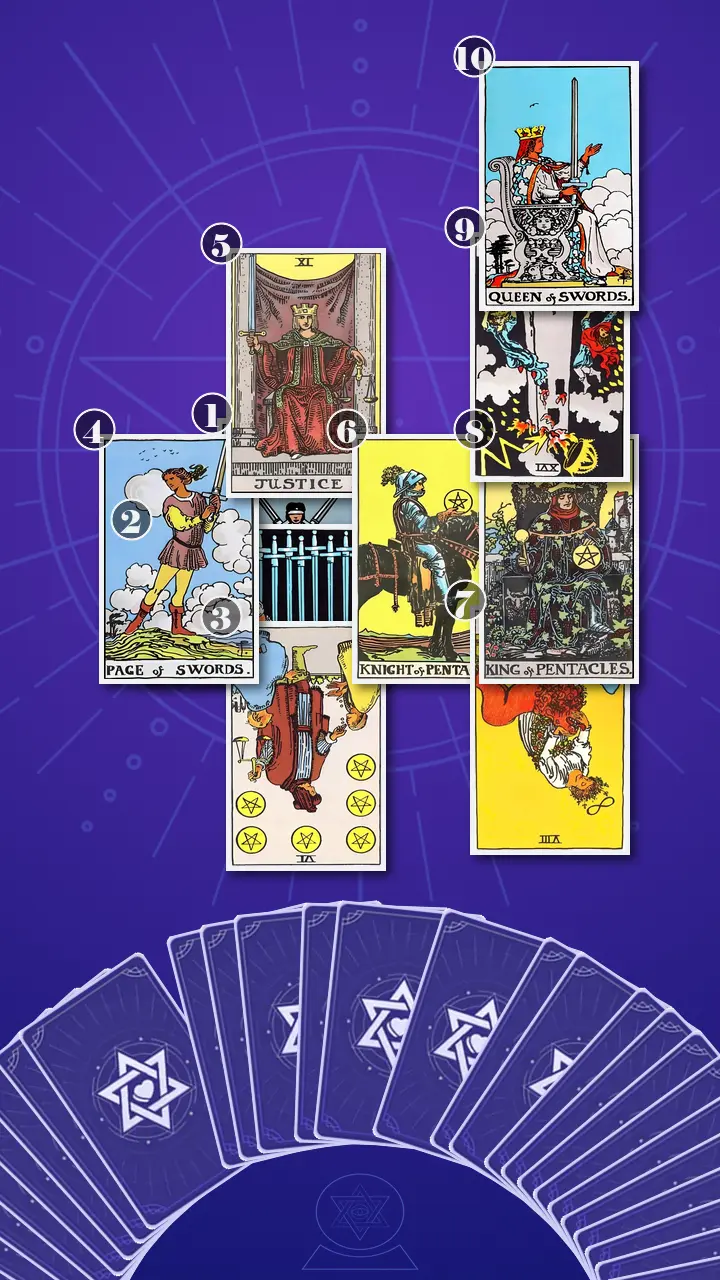
Reading the Map: Salary Negotiation Without the Spiral
Position 1 — Present friction: the exact moment you freeze
“Now flipping over is the card that represents present friction: the exact moment you freeze or hesitate about bringing up the pay band.”
Two of Swords, upright.
I pointed to the blindfold, the crossed blades. “This is you with the pay band tab open, knowing the data matters, and still keeping everything ‘neutral’ in a 1:1. You talk priorities, blockers, Jira tickets—anything that lets you keep the peace.”
The energy here is blocked: not a lack of information, but a self-protective pause. “It’s like keeping your Slack draft in permanent typing mode,” I said. “The cursor blinking is your avoidance with a UI.”
Jordan let out a quick laugh—small, a little bitter. “That’s… kind of brutal,” she said. “Because I’m literally doing that.”
Position 2 — The obstacle: what makes a straightforward ask feel risky
“Now flipping over is the card that represents the main mental/emotional obstacle that makes a straightforward pay conversation feel risky.”
Nine of Swords, upright.
“After dinner, you spiral into night-time brain,” I said, using her own rhythm back to her. “Drafting and deleting. Imagining tone shifts. Imagining your manager’s face. Then you show up tired and nothing is sent. The stress isn’t only ‘they’ll say no’—it’s the imagined judgment afterward.”
The energy is excess: too much Air, too much rehearsal, like your brain running a full incident postmortem for a meeting that hasn’t happened yet.
“You don’t need a perfect case—you need a clear request,” I added, because this is the part people fight me on.
Jordan’s jaw worked once, as if she’d been caught clenching. She looked away from the cards and then back again, like she was re-reading a text she didn’t want to accept.
Position 3 — The root: the deeper power-and-worth dynamic underneath money
“Now flipping over is the card that represents the deeper power-and-worth dynamic underneath the salary topic—what makes receiving feel complicated.”
Six of Pentacles, reversed.
Even reversed, the image hits: scales, coins, one figure above, others below. “This is where ‘fairness’ stops feeling like structure and starts feeling like permission,” I said. “Like you have to be extra grateful, extra helpful, extra low-maintenance to earn what’s already supposed to be aligned.”
I gave her a workplace scene to ground it. “You say yes instantly when someone pings you with ‘Can you just take this on?’ Then later you look at the pay band and feel that hot, quiet irritation—your scope expands, your compensation doesn’t.”
The energy is tilted—a distortion in give/receive. “This is where ‘alignment’ starts sounding like ‘a favor.’ And your language betrays you. You type ‘Sorry’ or ‘Just curious’ or ‘Not sure if this makes sense,’ and those words quietly tip the scales.”
Jordan nodded slowly. “Yeah…” Her voice got smaller. “I keep making it sound optional, and then I’m mad nothing changes.”
Position 4 — Recent past: what triggered this (the discovery moment)
“Now flipping over is the card that represents what recently happened that triggered this—discovering information, hints, or signals about the band.”
Page of Swords, upright.
“This is the research moment,” I said. “You found the band. You screenshot it. You started gathering receipts—kudos, metrics, performance notes—because knowledge feels safer than asking.”
The energy is balanced and alert. The Page isn’t wrong to investigate. “This card supports clean questions over emotional guessing. Your leverage is clarity, not intensity.”
Jordan’s shoulders dropped a millimeter, like her body heard the word clarity and recognized it as something stable.
Position 5 — Conscious goal: the fairest, clearest version of alignment
“Now flipping over is the card that represents what you consciously want from this conversation: the fairest, clearest version of ‘alignment’.”
Justice, upright.
Justice is one of my favorite cards for pay band conversations because it refuses to moralize. Scales in one hand, sword in the other: evidence and decision.
“Fair pay is a process conversation, not a personality referendum,” I told her. “This isn’t ‘Do they like me?’ It’s ‘What’s the process and timeline?’ It’s turning a messy feelings-problem into a clean ticket: scope, evidence, owner, next step.”
I felt my own inner flashback—standing in a gallery once, watching someone stare at my painting like it was judging them. I’d wanted to apologize for taking up wall space. Then a mentor said, Don’t audition for permission. Offer the work clearly. Justice carries that same energy: show the structure, let it do the heavy lifting.
Jordan whispered, almost surprised, “Okay… I can talk about this like a system, not a confession.”
Position 6 — Near future: the most constructive way to bring it up
“Now flipping over is the card that represents the most constructive near-term direction for how to bring it up—tone, format, and pacing.”
Knight of Pentacles, upright.
“This is boring on purpose,” I said, and Jordan cracked a real smile. “Calendar invite. Simple agenda. One-page summary. Less ‘big reveal,’ more ‘workflow.’”
The energy is steady—Earth as an antidote to the Swords spiral. “If it can’t fit in a calendar invite, it’s probably anxiety, not strategy.”
She exhaled through her nose, like she’d been waiting for permission to choose the least dramatic route.
Position 7 — Self: your inner stance when you imagine saying the ask out loud
“Now flipping over is the card that represents your inner stance—confidence, voice, self-trust—when you imagine saying the ask out loud.”
Strength, reversed.
“This isn’t ‘you’re weak,’” I said immediately, because people hear Strength reversed and get cruel with themselves. “This is: your steadiness is folded inward. Your voice shrinks right when you need calm power.”
I named the body moment as precisely as the card demanded. “Dry mouth. Tight throat. Shoulders up. And the inner monologue goes: ‘Say it now—say it now—never mind, pivot.’”
The energy here is deficient access: the courage exists, but you can’t reach it under perceived authority. I watched Jordan’s hands—fingers tucking under her palms, then releasing.
She let out a small exhale and said, “I thought I was being ‘nice,’ but I’m actually disappearing.”
Position 8 — Environment: how the system tends to respond to money conversations
“Now flipping over is the card that represents workplace reality—how the system/manager tends to respond to money conversations.”
King of Pentacles, upright.
“This environment values budgets, stability, stewardship,” I said. “Money is a managed resource here, not a moral judgment. That can actually help you—if you speak the organization’s language: scope, level expectations, process, timing.”
The energy is structured. “Your manager may not be shocked by the topic. They may just need something they can take to HR without ambiguity.”
Jordan blinked, like she’d been treating her manager as a single person with feelings, instead of a person inside a machine with levers and constraints.
Position 9 — Hopes & fears: what you’re trying to avoid
“Now flipping over is the card that represents what you’re hoping to avoid or secretly fearing in the conversation—social fallout, tension, instability.”
The Tower, reversed.
“You’re trying to prevent a blow-up,” I said. “Not even a blow-up—sometimes just preventing the vibe from changing.”
The energy is contained disruption. “You might hope your pay changes without ‘shaking anything.’ But the unspoken issue becomes the real instability. A useful question here is: what’s the smallest controlled shake you can choose—so you’re not waiting until pressure forces it?”
Jordan’s eyes narrowed, not in anger at me—more like resistance to reality. She pressed her lips together and then released them, like she was testing what it would feel like to stop managing everyone else’s comfort.
When the Queen of Swords Lifted Her Blade
I could feel the room quiet in that way it does right before a truth lands. The heater clicked softly; outside, traffic hissed on wet pavement. We flipped the final card—the one that doesn’t “predict” your fate, but shows the healthiest integration if you follow the thread.
Position 10 — Integration: your best next chapter if you follow the guidance
“Now flipping over is the card that represents integration—the healthiest takeaway and best next chapter if you follow the reading’s guidance.”
Queen of Swords, upright.
Jordan stared at the Queen’s direct gaze. “She looks like she doesn’t care if anyone thinks she’s intense,” Jordan said, half admiring, half scared.
That was the setup, right there: it was late; she’d had the band open in one tab and her brag doc in another, still hunting for a sentence that wouldn’t change how she was perceived. She’d been trying to engineer a conversation with zero emotional risk—because her nervous system was treating money like belonging.
Stop hiding behind perfect wording and step into the Queen’s clear blade: one direct sentence, one specific ask, and boundaries that keep the conversation clean.
I let the line sit between us, the way a well-written film line hangs in the air after it’s said. No rush to soften it. No disclaimers.
Jordan’s reaction came in a chain—three tiny beats I’ve learned to watch for in my clients, because it’s the body telling the truth before the mouth can.
First, she froze: her breath caught, and her fingers hovered over the edge of her sleeve like she was about to tug it down and remembered she didn’t need armor.
Second, her eyes unfocused for a second—the mental replay. You could almost see the Slack draft blinking, the “Hey! Quick question…” appearing and vanishing, the imagined manager face, the doom-scripts marching in a row.
Then the release hit, but not as relief at first—as heat. “But if I do that,” she said, voice sharp with a sudden flare of anger, “doesn’t that mean I’ve been making myself small this whole time? Like… I’ve been the one doing it.”
“It means you’ve been protecting yourself,” I said, gently and without letting her dodge the truth. “And it also means you can choose a different protection now—one that protects your self-respect instead of your silence.”
I leaned in a little, like a coach and a friend at once. “Here’s the reinforcement—ten minutes. Not an hour. Set a timer. Draft a calendar invite titled ‘Compensation Alignment (Role Scope + Band)’ with three agenda bullets. If your throat spikes or your hands shake, pause and take one long exhale. Your only job is to get the structure on the calendar—nothing more.”
Jordan’s shoulders dropped like she’d been carrying a backpack she forgot was on. She blinked hard, eyes shining but not quite crying. “Okay,” she said, quieter now. “I can do that.”
“Now,” I asked her, “with this new lens—can you think of a moment last week when this would’ve changed how you felt?”
She didn’t even hesitate. “Friday. The 1:1. When she said, ‘Anything else?’ I could’ve just said the sentence. Instead I did… timelines. Again.”
“That’s the shift,” I told her. “Not from ignorance to knowledge—you already had the band. This is from silence to speakability. From rehearsed worry to grounded steadiness. From treating this like a referendum on you… to treating it like a normal business conversation with clean boundaries.”
From Insight to Action: The One Clean Ask
Here’s the story the spread told, start to finish: you discovered real information (Page of Swords), but your present instinct is to keep things neutral and unspoken (Two of Swords) because your mind turns the conversation into a midnight trial (Nine of Swords). Underneath, you’re treating fairness like permission—like you have to be extra agreeable to deserve it (Six of Pentacles reversed). Justice shows what you actually want: a fair process. The Pentacles (Knight and King) say the system can work with you if you give it structure. And the Queen of Swords ends it by making the facts speakable—cleanly, respectfully, without begging.
The cognitive blind spot is subtle but huge: you’ve been acting like the danger is asking for money, when the real danger is asking to be approved. That’s why you keep overbuilding proof and softening language—because you’re trying to control how you’re perceived.
The transformation direction is clear: shift from hinting and overbuilding proof to making a specific, time-bound request with calm boundaries and documented facts.
To make this practical, I pulled my own artist-brain tool out—the one I use when a canvas feels too emotional to touch: my Mondrian Grid Method. We’re going to turn your messy, living, anxious situation into a few clean blocks: one sentence (Air), one page (Earth), one timeline (Air again). Clean lines don’t remove feeling—they hold it.
- Copy/Paste the Queen’s Two-Sentence AskIn Notes/Notion (or a literal sticky note), write: “Based on my current scope and the pay band for this role, I’d like to discuss aligning my compensation. Can we book 20 minutes this week to review level, band, and next steps?” Read it once out loud—standing up, feet on the floor.If your brain begs for disclaimers, follow the rule: one ask sentence + one process question + stop.
- Send the Calendar Invite (Not a Slack Essay)Send a 20-minute calendar invite titled “Compensation Alignment (Role Scope + Band).” Add three bullets: (1) current scope vs level expectations, (2) band alignment, (3) timeline/process. Attach a one-page summary if you have it; if not, just send the invite.Lower the adrenaline: if hitting send feels like too much tonight, schedule-send it for tomorrow morning.
- Oscars Speech Training (2 Minutes, No Apologies)Record a voice memo where you deliver your “acceptance speech” for fair alignment: the ask, the band, your scope, the timeline question—under two minutes. Listen once. Edit only one phrase for clarity. Then stop.Think of it like rehearsing a film scene: you’re not trying to feel fearless—you’re training your body to stay steady while saying the line.

A Week Later: Ownership, Not Certainty
Six days later, I got a message from Jordan: “I sent the invite.” Nothing dramatic. No big victory speech. Just those four words.
She told me she’d sent it from a coffee shop before work—latte cooling, palms a little sweaty, but her spine less rigid than usual. Then she sat there alone for a while, staring out at the street, feeling both proud and weirdly hollow, like clarity comes with a responsibility you can’t un-know.
That’s the real Journey to Clarity: not a guarantee of the outcome, but a change in posture. From contracted rehearsal to grounded self-respect. From “please don’t judge me” to “here are the facts, what’s the process?”
When you have the facts in your hands but your voice still shrinks, it’s not because you’re unreasonable—it’s because part of you is trying to protect your belonging by staying easy to approve.
If you let this be a process—not a performance—what’s one clean, time-bound next step you’d be willing to try this week?