Feeling Useful Only When Needed—and Learning Ordinary Closeness

The 11:43 p.m. Text and the Feeling of Being Needed
If you’re a late-20s city professional who can ignore your own low battery but bolts upright for an 11:43 p.m. “can you talk?” text, I want to say this gently: the question underneath that reflex is often, “Why do I feel useful only when needed?” In my experience, that is rarely just about kindness. More often, it is emotional labor quietly becoming your place in the friendship.
When Maya (name changed for privacy) described the moment to me, I could see it as clearly as if I were standing in the doorway of her small Toronto bedroom: Netflix still asking whether she was watching, the duvet dragging over her knees as she sat straight up, blue phone light touching the ceiling, restless hands already moving before her mind had caught up. Her chest went tight. Her shoulders lifted. The text was short, but the meaning her body gave it was huge.
At 27, she was a project coordinator, praised all day for fast replies, smooth handling, and keeping things moving. It made perfect sense that her friendships had started running on the same system. “I know how to show up,” she told me. “I just don’t know how to be around when nothing is wrong. Sometimes I can’t tell if I’m being caring or just scared of being forgettable.”
There it was—the whole contradiction in one breath: wanting to be there for a friend, and fearing she had no place unless someone needed something from her. The feeling in her was not vague. It was like her ribs had become a push-notification bar: every hint of somebody else’s distress lit her up, while her own needs sat in dark mode.
I nodded. “That makes sense to me,” I said. “It doesn’t make you dramatic, and it doesn’t make you manipulative. It means your nervous system has learned to treat usefulness as proof of belonging. Let’s draw a map through that fog and see if we can find some clarity.”

Choosing the Stairwell: Why I Used The Shadow Spread
I asked her to place her phone face down on the table, breathe once slowly into the back of her ribs, and shuffle until the cards stopped feeling sharp in her hands. I never treat this part as theatre. It is simply a threshold—the moment the mind stops refreshing the chat and starts listening.
For a question like this, I did not want a predictive spread about what her friends might do next. I wanted a structure that could show how tarot works when the real issue is an inner loop: the visible pattern, the hidden wound, the medicine, and the next embodied practice. That is why I chose The Shadow Spread. For overfunctioning in friendships, therapist-friend burnout, and usefulness-based closeness, it is one of the cleanest tools I know.
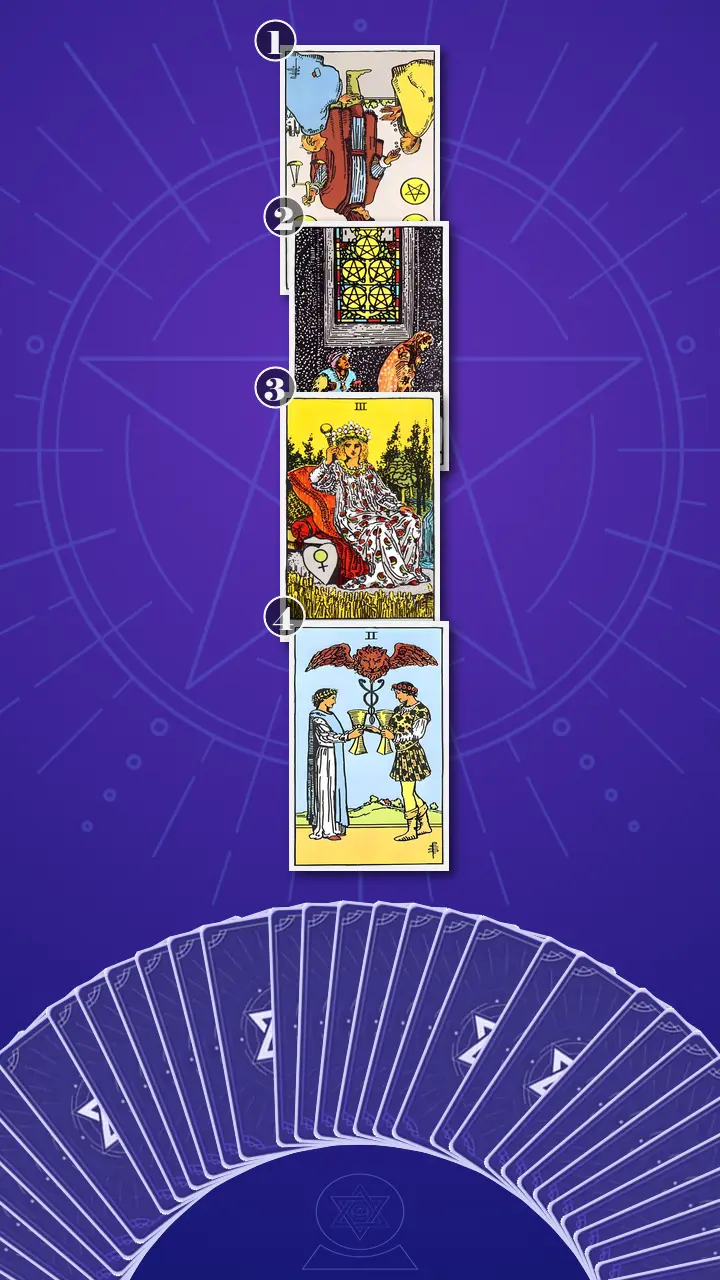
I laid the four cards in a vertical line, like a narrow stairwell opening into a warmer room. I told her the first position would show the caretaking reflex that takes over when a distressed text lands. The second would uncover the deeper belonging wound underneath it. The third—our key card—would reveal the antidote, the truth capable of interrupting the loop. And the fourth would ground everything in real relationship behavior: reciprocity, receiving, and the next step toward mutual connection.
Reading the Cards Beneath the Reflex
The Scales Above the Hand
The first card I turned over was the one representing her visible caretaking reflex—the conscious pattern of becoming instantly available and emotionally useful when someone reaches out in distress. The card was Six of Pentacles, reversed.
In modern life, this card looked exactly like the split-screen reality she already knew: a deadline open at work, Slack still buzzing, and the second a friend texts “can you talk?” she mentally clears the whole room for them. She drafts the most grounded possible response, keeps their notifications on, and stays half-available for the rest of the hour because fast helpfulness feels like the price of staying emotionally central.
Reversed, the Six of Pentacles shows giving in excess and balance in deficit. The raised scales mirrored the invisible measurement happening in Maya’s body: How fast can I answer? How calm can I sound? How useful do I need to be to keep my place? Care begins as generosity and quietly turns into relationship currency. Not because she is cold or calculating, but because her body is trying to pay for security with availability. It is the difference between kindness and running customer support for the group chat.
“So I’m basically an emotional first responder with excellent response times,” Maya said, and then she gave a quick laugh that landed with more bitterness than humor. Her breath caught first. Then one hand rose to her chest. Then her eyes dropped to the card. “I really thought I was just being supportive.”
“You are supportive,” I told her. “And support can still get tangled with fear. Being the first responder is not the same thing as being fully known.”
The Window in the Cold
The next card I turned over was the one representing the deeper shadow driving the pattern—the belonging wound, the fear of becoming forgettable when she is not needed. The card was Five of Pentacles, upright.
This is the quieter, colder scene that usually arrives after the helping. A reply takes too long. The group chat stays still. Friends post park hangs, birthday dinners, or patio photos, and suddenly the phone in her palm feels like evidence. Nobody has said she is outside the friendship, yet her body acts like it has heard a door close. That is the Five of Pentacles exactly: the lit window of warmth nearby, the snow underfoot, the long walk already braced for exclusion.
Upright, this card brings deficiency and survival logic fully online. Neutral silence becomes rejection. A delayed reply feels personal. This is why a friend’s “can you talk?” text can make someone anxious and important at the same time. If somebody needs you, you do not have to sit in the uncertainty of where you fit. You get a role. You get a job. You get a temporary seat.
I felt one of my oldest family teachings rise in me then. In the Highlands, my grandmother used to say that winter fields are deceptive; just because the ground looks bare does not mean life has left it. I still use that wisdom in what I call my Nature Empathy Technique. People, like landscapes, are often misread when fear is doing the observing. “A quiet chat is not automatic proof you’ve been replaced,” I told Maya.
She went very still. First, her fingers stopped worrying the cardboard cup. Then her gaze blurred for a second, as if she were replaying half a dozen unread messages at once. Finally, a long breath left her, slow and shaky. “That line,” she said softly, “nobody said I was outside, but my body heard a door close. That’s exactly it.”
When The Empress Opened the Warmer Room
When I turned the third card—the one representing the medicine, the lesson, the transformative truth that challenges the shadow—the room itself seemed to change. A stripe of late-afternoon light slid across my table and caught the card first, gold touching gold. It was The Empress, upright.
Her posture mattered to me at once. Across the spread we had moved from kneeling, to struggling through cold, to a woman who simply sits and occupies her space. That shift is never accidental. In my work, I read posture the way I read weather. It is part of that same Nature Empathy Technique: before you chase the clouds, you feel the wind on your own skin. Maya’s nervous system had been forecasting social winter from every small silence. The Empress was the first true sign of a different season.
I could see the old equation still gripping her: phone lights up, body snaps to attention, answer quickly, stay calm, stay valuable. She had spent so long asking, “What do I need to do so this bond doesn’t disappear?” that she had barely let herself ask the more honest question: “What if the bond should be able to hold my ordinary self too?”
You are not the kneeling figure trying to matter through service; step into The Empress’s wheat field and let belonging grow from presence, not performance.
I let the sentence stay in the room. The real shift was not learning to care less. It was learning that closeness had to be able to survive her slower reply, her ordinary presence, and the version of her that was not performing usefulness. Maya froze first—mid-inhale, shoulders slightly raised, one thumb caught against the edge of her sleeve. Then I watched the thought move through her. Her eyes lost focus, not blank but busy, as if she were scrolling backward through every night she had answered from bed, from the office, from the TTC, giving steadiness before she had checked whether she had any to spare. Her jaw softened. Her shoulders dropped a full inch. Then came the exhale, trembling a little, and with it that very human second after relief when a person looks almost dizzy, because the burden has shifted and now there is new space to stand in. Her eyes shone. “So I don’t have to prove I’m safe to keep?” she asked.
“Exactly,” I said. “You are allowed to be in the friendship before you are useful to it. Nothing has to be burning for you to count.”
Then I asked her, gently, “Now, using this new perspective, can you think of a moment from last week when this insight would have made you feel different?”
She gave a small, stunned laugh. “Last Thursday,” she said. “My friend texted during dinner and I answered before the pasta water boiled. I thought if I waited, I’d become less important.”
Before we moved on, I asked her to open Notes and write one line: “What am I feeling before I help?” I told her that if the next text spike came, she would have only three choices to consider—wait ten minutes, ask one clarifying question, or send one boundary sentence. And if even that felt too large, she could simply name three sensations and stop there. An experiment, not a test.
This was the hinge of the whole reading: not from caring to coldness, but from alert usefulness and belonging anxiety toward steady self-worth and mutual connection. The Empress brings receptivity, self-nourishment, and worth that exists before the helping begins. That is why she is such a powerful card meaning in context here: she turns usefulness-based closeness into something softer, steadier, and far more true.
Two Cups at Eye Level
The final card I turned over was the one representing integration—the next embodied practice of reciprocity, receiving, and testing mutual connection in real life. The card was Two of Cups, upright.
After The Empress, this card felt almost disarmingly simple. In modern life, it looks like post-work coffee where both people talk, a two-way voice-note thread instead of a one-way crisis hotline, or a friend who still asks, “How are you actually?” when nothing is on fire. Both figures hold a cup. Both stand at the same height. No one is kneeling. No one is doing beverage service for the whole room.
Upright, the Two of Cups is balanced emotional exchange. The next step for Maya was not to care less; it was to notice which friendships still felt warm when she answered a little slower, shared one honest sentence, or let someone care for her without instantly redirecting the focus. The real test was not whether she could rescue the bond. It was whether the bond could hold two real people.
Maya looked at that card longer than the others. Her shoulders stayed down now. “I honestly don’t know who can meet me like that,” she said.
“That isn’t failure,” I told her. “That is information. And information is kinder than fantasy.”
The Seat-at-the-Table Test
When I laid the spread back out from top to bottom, the story became clear. Six of Pentacles reversed showed the visible loop: helping had become relationship currency. Five of Pentacles revealed the wound beneath it: silence was getting translated into exclusion, so ordinary closeness never felt stable enough to trust. The Empress changed the ground itself—worth before performance, battery before output, presence before performance. Only then could Two of Cups become real rather than theoretical: eye-level connection, honest needs, reciprocity.
Even the elemental flow made sense to me. The reading began in heavy Earth—security, usefulness, scarcity, survival—and only ended in Water once worth was grounded differently. That is often the hidden logic in friendship anxiety. The body tries to solve belonging like logistics before it lets feeling move naturally.
The blind spot was this: Maya had been reading urgency as intimacy. But urgency can create contact without creating mutuality. The transformation direction was the one at the heart of the whole reading: shift from proving you deserve closeness by solving distress to testing whether connection can survive slower replies, honest needs, and simple presence.
I said it to her as plainly as I could. “Do not keep paying for closeness with your nervous system. Try presence before performance.”
Then I gave her three practices—small on purpose. When people ask me how to stop overfunctioning when friends vent, I almost never start with grand boundaries. I start with tiny evidence that the bond can survive reality.
- The 10-Minute Presence-First ReplyThe next time one close friend sends a distressed message, do not answer instantly unless it is a genuine emergency. Put your phone face down for 10 minutes, or 3 if 10 feels more workable. Before replying, ask one clarifying question such as, ‘Do you want to vent, be distracted, or think through options?’ If needed, add one warm boundary sentence like, ‘I can talk after 8,’ or ‘I have ten minutes right now and I can listen.’When the guilt voice says this makes you a bad friend, treat that as the old pattern speaking. Warm and brief works better than over-explaining.
- My 3-Minute Bedtime Energy ReviewTonight, and for the next seven nights, spend three minutes before sleep writing one line about a conversation that day: did you feel warm, drained, resentful, purposeful, or oddly flat afterward? Then add three words about your own state before you helped—for example, ‘wired, lonely, annoyed,’ or simply ‘tight chest, buzzing hands, tired eyes.’If naming feelings feels too intense, start with body sensations. You are not grading yourself; you are gathering evidence about whether your care felt spacious or urgent.
- The Reciprocity Check-InPick one friend who feels safer than average and send one non-crisis, low-drama text this week: ‘Small check-in from my side: I’ve had a weird week and could use a little company.’ If your body spikes before sending it, use my walking meditation with environmental sounds first—one block outside, or one slow lap of your apartment, while you notice three sounds such as the crosswalk chirp, the fridge hum, or your own footsteps before you press send.Keep the ask small, specific, and time-bound. You are not testing whether everyone responds perfectly; you are finding out where mutual friendship already has roots.

A Week Later, the Phone Stayed Facedown
A week later, Maya sent me a message just before nine. Not a crisis screenshot. Not an essay. Just this: she had been making dinner when a friend texted “can you talk?” and, for the first time in months, she finished eating first. Then she replied, “I can call in 20—do you want to vent or problem-solve?” Her friend said vent. After the call, the friend asked how she was, and Maya said she actually answered.
She told me the strangest part was not disaster, but the absence of it. The friendship did not collapse. The panic rose, hovered, and passed like weather. She slept a full night afterward, though she admitted the old thought still visited at breakfast—what if I’m being selfish? This time, she noticed it and smiled before it could run the day.
I sat with that message for a while, grateful in the quiet way I always am when a reading becomes something lived. This is what finding clarity often looks like in friendships: not a brand-new personality, not certainty, but the first honest proof that you can move from emergency role to equal presence, from feeling valuable only when needed to being fully known in ordinary life too.
If tonight you are caught in that silent tug-of-war between “I should answer perfectly” and “I wish I could just be here,” remember this: when being useful is the only time your body fully wakes up inside a friendship, even love can start to feel like a seat you have to keep earning.
So when the next screen lights up and your shoulders rise, what would one slightly more honest, slightly less useful reply sound like if you answered from the seat at the table instead of the help desk at the edge of the room?