When 'Too Quiet' Feedback Became a Courtroom, the Clean Sentence Pivot
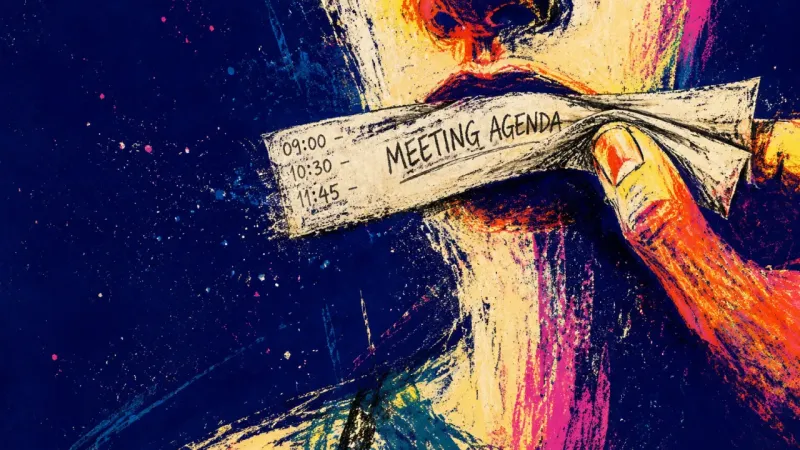
The 8:56 a.m. Calendar Invite, Open Too Early
You open the calendar invite early, read the agenda twice, and still go on mute the second the meeting starts—classic “too quiet” feedback spiral.
Taylor (name changed for privacy) met me over a late-afternoon video call from Toronto, the kind where the sky looks like it’s been rinsed in dishwater and the city feels a little too honest. In her condo kitchen, a kettle hissed while Slack pings stacked up like impatient knocks. She’d already opened tomorrow’s invite. Again. Her thumb kept worrying the trackpad as if she could polish the anxiety off the screen.
“My manager said I’m ‘too quiet,’” she told me. “And now I… hide. I’m in the meeting, but I’m not in the meeting.”
I watched her swallow before she finished the sentence—tight throat, held breath. It was the kind of self-consciousness that doesn’t live in your thoughts first; it lives in your airway, like a hand gently but firmly closing a door the moment you try to speak.
What she wanted was simple: to be seen as competent and valuable. What her body did was equally simple: brace for real-time judgment, then choose silence as armor.
“If meetings feel like a trial, silence starts to feel like legal counsel,” I said, not to excuse the pattern—only to name it without shame. “Let’s make today a Journey to Clarity. We’re not here to make you louder. We’re here to understand why you hide, and find a way for your voice to feel useful instead of dangerous.”
Choosing the Compass: The Four-Layer Insight Ladder for Workplace Visibility
I asked Taylor to take one slow breath—not a mystical ritual, just a nervous-system handrail—and to hold one specific question in mind: After ‘too quiet’ feedback, why do I hide at work? While she did that, I shuffled. The point wasn’t magic. It was focus: letting the mind stop free-associating and start telling the truth in sequence.
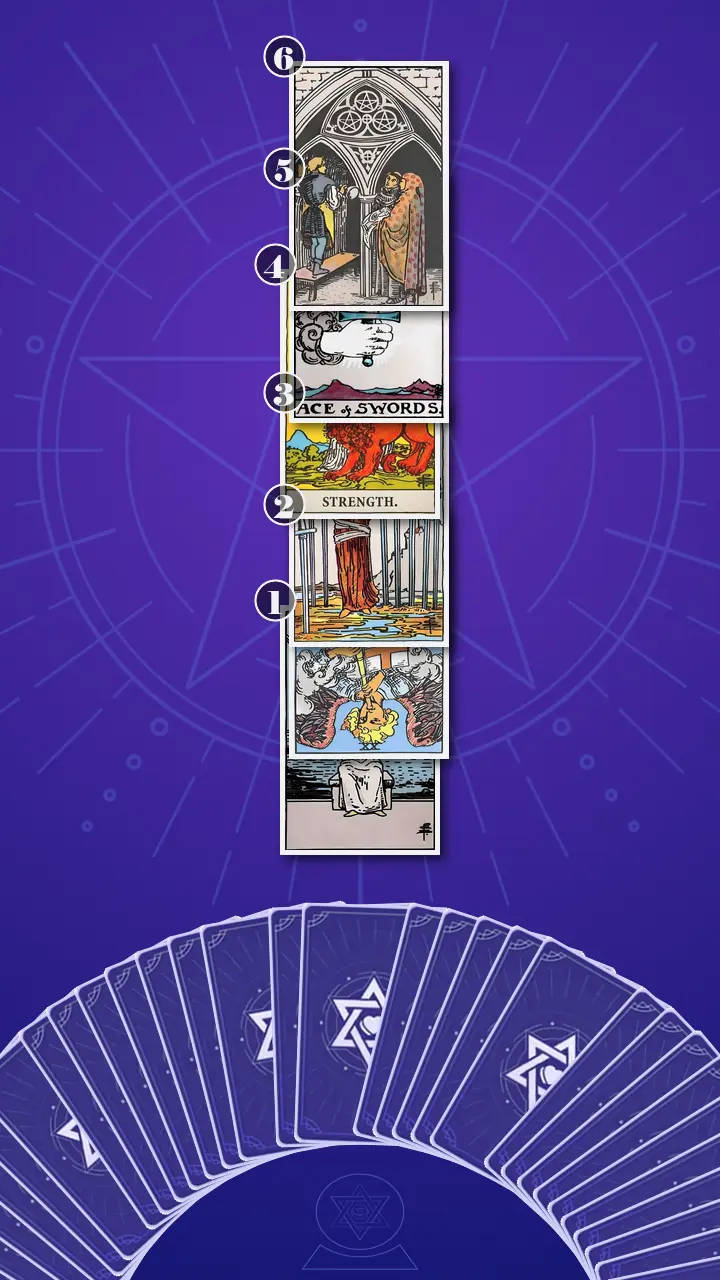
For this, I use a spread I built for modern “feedback anxiety” loops: the Four-Layer Insight Ladder · Context Edition. If you’ve ever Googled “Why do I go silent in meetings after feedback?” you already know this isn’t a simple confidence issue, and it’s not a prediction problem. It’s an inner-pattern loop.
This ladder works because it’s the smallest tarot spread that still shows the full mechanism: the visible behavior (how hiding looks on Zoom/Slack), the trigger (how the feedback lands), the deeper belief (what makes speaking feel risky), and then the resource + pivot + practical integration. Six positions keeps the narrative tight: present symptom → trigger → root block → resource → turning point → next steps.
As we read upward, think of it like archaeology: we don’t yell at the soil for being dense—we sift carefully until the structure is visible.
Reading the Map: From “Read-Only Mode” to Real Participation
Position 1: The Presenting Behavior—How You Hide in Plain Sight
“Now flipped over is the card that shows the specific, observable way you ‘hide’ at work after the feedback,” I said.
Two of Swords, upright.
I nodded toward the image: blindfold, crossed swords held close. “This is protective neutrality. Air energy paused—blocked on purpose. Not because you have nothing to say, but because saying it feels like stepping into a spotlight with no rehearsal.”
And then I used the scene it most often becomes in 2026: It’s 10:02 AM on a Tuesday. You’re on Google Meet with your camera off ‘because bandwidth,’ but really because being seen feels like being graded. You’re taking immaculate notes in a Notion page titled ‘Weekly Sync’… you have a useful point—one risk, one dependency—but you hold it behind your teeth. When the topic moves on, you tell yourself you’ll fix it later in a follow-up message that’s longer than anything you would’ve said out loud.
“That,” Taylor said, and she gave a quiet laugh that had a little bitterness in it, “is… cruelly accurate.”
Her reaction came in a small sequence: her shoulders rose as if bracing for criticism, her eyes flicked away from the screen like she’d been caught, and then she exhaled through her nose—resigned, but relieved to be seen.
“It’s not cruel,” I told her. “It’s data. Two of Swords doesn’t call you incompetent. It calls you protected. You’re in what I’d call ‘read-only mode’—present, tracking, even doing excellent work, but unfindable in public.”
Position 2: The Catalyst—How the Feedback Gets Interpreted in Real Time
“Now flipped over is the card that reveals how the ‘too quiet’ feedback is being interpreted internally and what it triggers in real time,” I said.
Judgement, reversed.
“Judgement is the call, the wake-up, the public prompt,” I explained. “Reversed, that energy gets stuck. Instead of ‘here’s a useful adjustment,’ it becomes ‘this is who I am and it’s bad.’ The recalibration is blocked.”
In modern terms, it looked exactly like her week: After the ‘too quiet’ feedback, every meeting starts with an invisible scoreboard in your head. When your manager says, ‘Any thoughts?’ you don’t hear a normal prompt—you hear a test. You start scanning faces, Slack reactions, and who’s speaking first… defaulting to the safest option: say nothing now, send something polished later, and hope that counts as presence.
She nodded once—tight, contained. “Yes. I treat it like a label, not a data point.”
“Good,” I said, gentle but precise. “Because naming it gives you leverage.” I let a beat pass and then said the line that often snaps the loop into focus: “The feedback wasn’t a verdict—your brain just filed it like one.”
Her eyes softened, like she’d been carrying a legal folder labeled Exhibit A: Me Failing and someone finally pointed out the folder was self-made.
Position 3: The Root Block—The Belief That Turns Speaking into Danger
“Now flipped over is the card that names the underlying fear/belief that makes speaking feel risky,” I said.
Eight of Swords, upright.
“This is the self-made cage,” I told her. “Air energy tightened into constraint. Notice the loose bindings, the open space. The prison is partly imagined consequences.”
Then I anchored it to her daily loop: You’re not quiet because you’re empty—you’re quiet because you’re braced. Your mind runs a whole ‘what if’ thread: what if you stumble, what if they ask a follow-up, what if your sentence becomes the thing people quote later. So you pre-censor… like being trapped inside your own internal PR team: everything must be approved before it can exist.
“That’s the thing,” she whispered. “I’m always trying not to leave evidence.”
“Exactly,” I said. “Eight of Swords is reputational fear dressed up as professionalism. The meeting moves on in thirty seconds, but your brain acts like one imperfect sentence becomes your whole personal brand.”
Her body responded in that three-part way I’ve learned to watch for: first a tiny freeze (breath caught), then a distant look (as if replaying a specific moment), then a slow exhale that finally dropped into her chest. “I’m the one tying my own hands,” she said.
Position 4: The Hidden Resource—Strength That Fits Your Personality
“Now flipped over is the card that identifies a personal strength or supportive approach that fits your personality,” I said. “Not ‘be louder.’ Something truer.”
Strength, upright.
“Strength isn’t hype,” I said. “It’s steadiness. Fire energy that regulates rather than explodes.”
I translated it into her actual gifts: Your strength isn’t hype; it’s steadiness. You’re the person who notices what’s missing in the plan, who can summarize chaos into something workable. The resource here is learning to stay in your body when visibility spikes—feet on the floor, one breath, one sentence—so your nervous system doesn’t yank you into disappearance.
As an archaeologist, I’ve learned you don’t move a fragile relic by gripping harder. You stabilize the surrounding soil first. “Strength says your work voice is already there,” I told her. “We just need to give it a stable nervous system to stand on.”
Taylor’s mouth twitched into the smallest smile. “I could try one sentence,” she said. “Not… a whole new personality.”
When the Ace of Swords Cut Through the Courtroom
Position 5 (Key Card): The Turning Point—A Clean Pivot in How You Use Your Voice
I could feel the room shift—one of those quiet moments where even over video call the air seems to still. “We’re turning over the most pivotal card in your ladder,” I said. “The one that changes the trajectory.”
“Now flipped over is the card that defines the key shift in how you use your voice so you can be seen without feeling exposed.”
Ace of Swords, upright.
Her pattern was so clear it almost hurt: join the call early, scan the agenda twice, watch the first few voices take the air like it’s already booked—mic muted while her best point turns into a perfect draft. She was trapped in “I must sound flawless,” which makes every sentence feel like it carries a verdict.
Stop treating your voice like a verdict on your competence; start using it like a clear blade that cuts through confusion—one honest sentence at a time.
She didn’t relax right away. First, her eyes widened like the sentence had accused her of something. Then her jaw tightened—brief, defensive. “But if I’m not careful,” she said, a flash of anger in it, “doesn’t that mean I’ve been doing it wrong this whole time?”
I kept my voice calm. “Not wrong. Protective. Ace of Swords doesn’t mock the protection—it upgrades it.”
And then I used my own framework—what I call Skill Archaeology. “In a dig, we don’t judge the layers for being layered,” I told her. “We date them. We learn why they formed. Your ‘quiet’ isn’t emptiness. It’s a talent buried under a safety strategy: you can summarize, you can spot risk, you can make decisions cleaner. The Ace is asking you to unearth one usable shard at a time.”
Her reaction arrived in waves: (1) a physical thaw—her shoulders dropped a fraction; (2) a cognitive click—her gaze steadied on the card instead of darting to my face for approval; (3) an emotional release—she exhaled, shaky but real, like she’d been holding her breath since that performance review.
“You don’t need to be louder,” I added, letting it land as simply as possible. “You need to be earlier and cleaner.”
I watched her hand lift to her collarbone, as if checking whether the tightness was still there. It was—just less. “Okay,” she said, voice quieter but steadier. “Earlier and cleaner… that feels doable.”
“Now,” I asked, “with this new lens—voice as a tool, not a trial—can you think of one moment last week where one honest sentence would’ve changed how you felt in that meeting?”
She blinked, then nodded slowly. “When someone asked about blockers. I had one. I just didn’t have the perfect version.”
“That’s the bridge,” I said. “This isn’t about becoming extroverted. It’s about moving from fear-driven hiding to clear, timely participation—and letting steadier self-trust follow behind it.”
Position 6: Integration—How Visibility Gets Built Without Performing
“Now flipped over is the card that gives a grounded, week-level action for participation and visibility that builds trust over time,” I said.
Three of Pentacles, upright.
“This is the workshop,” I told her. “Craftsmanship, collaboration, recognition through building.”
And in her world it looked like this: You bring a rough draft into the room: a one-page timeline, a decision doc, a list of open questions. You share your screen, point to the one part that needs input, and ask, ‘Can I get one reaction from each of you?’ Now your visibility is structured—you’re not performing, you’re facilitating the build.
I gave her the simplest reframe I know for hybrid-office politics: “Stop auditioning in meetings. Start building in them.”
She sat back, like she’d been leaning forward for months. “If it’s about the doc,” she said, “I can do that. I can hold onto something.”
From Courtroom to Workshop: Actionable Next Steps You Can Actually Do
I summarized what the ladder had shown us, the way I might summarize a site report after an excavation: clear layers, clear causation.
“Here’s your story,” I said. “You started with protective silence (Two of Swords). Then one piece of feedback got filed as a permanent judgement (Judgement reversed), which tightened into a self-imposed constraint (Eight of Swords). Strength shows you already have the steadiness to stay present through discomfort. Ace of Swords gives you the pivot: speaking is not a performance—it’s a small, useful contribution. And Three of Pentacles grounds it: you become visible through structured collaboration, not charisma.”
“Your cognitive blind spot,” I added, “is that you’ve been treating real-time speaking as an identity test. That makes you over-prepare and hide, which ironically keeps the ‘too quiet’ feedback alive. The transformation direction is the opposite: shift from ‘speaking must be flawless’ to ‘speaking is a useful tool for the shared work.’”
I brought in one of my most practical strategies—Megalith Transport. “In prehistory,” I said, “people moved stones that looked impossible to move. They didn’t do it with one heroic heave. They did it with rollers, leverage, and small coordinated pulls. We’re going to move your visibility the same way.”
- The 10-Second Unmute (One Clean Sentence Rule)Before one meeting this week, write one clean sentence that would help the work move forward (a question, a risk, or a decision summary). When that topic shows up, unmute within 10 seconds and say only that sentence—then stop.If your throat spikes, do one longer exhale than inhale first. The win is the rep, not sounding smooth. Afterward, write one neutral fact: “I spoke once.”
- Draft-First Collaboration (Visibility with Structure)Bring a rough artifact into one meeting (a one-page timeline, decision doc, or open questions list). Share your screen for 2 minutes, point to the one section that needs input, and ask: “Is this the decision to make today, or do we need one more data point?”Make it structural, not emotional. Set a boundary like, “I’m going to take 60 seconds to summarize where we are,” then actually stop at 60 seconds.
- Retire the Director’s Cut Follow-UpAfter the meeting, don’t send a three-paragraph “perfect” follow-up unless it adds new information. If you want to send something, keep it to three lines: (1) what we decided, (2) next step, (3) owner.If you feel the urge to over-explain, ask yourself: “Am I adding clarity—or trying to erase evidence of being human?”
A Week Later, a Small Proof in a Small Voice
A week later, Taylor messaged me: “I did the 10-second unmute thing. My voice shook. I said the one sentence anyway. No one died. Someone actually said, ‘Good catch.’”
Her update wasn’t triumphant. It was quieter than that—more honest. She’d done the meeting, then sat alone in a café afterward for half an hour, not celebrating exactly, just letting her nervous system learn the new fact: visibility can be contained. The next morning, the first thought was still, What if I mess up again?—but this time she smiled a little as she made coffee.
That’s the work I trust most: not a personality rewrite, but a repeatable shift. Tarot, when it’s done well, doesn’t hypnotize you into confidence. It shows you the mechanism—then hands you a lever. In this case, the lever was clarity: one honest sentence at a time.
When you want to be seen as capable but your body locks up in real time, it can feel like you’re watching your own value disappear behind a muted mic and a held breath.
If you treated your next meeting like a shared workshop—not a performance—what’s one clean, low-stakes sentence you’d be willing to say out loud, even with a little shake in your voice?
Author Profile