From Offer-Call Anxiety to a Fair Ask: Choosing Salary vs Equity

Finding Clarity in the 8:52 PM Offer-Math Spiral (After the Offer Call)
You’ve built the spreadsheet, ran the vesting calculator, checked Levels.fyi… and you’re still asking three different people what they would do because you don’t trust your own read.
Jordan (name changed for privacy) said it like they were confessing to a crime. They were 28, a product manager in Toronto, and the offer call had happened earlier that day—the kind where the recruiter says, “Take your time, but we do need an answer soon,” in a tone that pretends it’s casual while your nervous system hears a countdown.
When they showed me their screen, it looked like a tiny command center for anxiety: a vesting schedule PDF pinned on the left, a Google Sheet titled “Offer Math v6” in the middle, and a half-written Gmail draft to the recruiter on the right. The condo was quiet in that specific Wednesday-night way—fridge humming, dishwasher doing its steady churn—while the laptop glow felt too bright, like it was bleaching all nuance out of the room.
Jordan kept alt-tabbing with restless, practiced fingers. Cash now. Upside later. Cash now. Upside later. Their jaw was clenched so hard I could see the muscle jump once at the hinge, and the tightness in their chest showed up in the way they kept taking shallow breaths, like they were trying not to disturb a volatile equation.
“I don’t want to leave money on the table,” they said. “But I also don’t want to look like I don’t know what I’m doing. If I take salary, am I proving I don’t believe in myself? If I take equity, am I being reckless and pretending I’m a founder?”
Their anxiety wasn’t an abstract feeling—it had the texture of being stuck in a hallway with two doors, trying to predict the entire future of the building before touching either handle. The more they modeled, the more their brain demanded another model, like refreshing a stock chart every minute and calling it “research.”
I nodded, letting the silence hold what they couldn’t say out loud: this decision feels like it could become evidence. Evidence that they’re smart, or naive. Strategic, or impulsive. Senior enough, or not.
“We can absolutely talk numbers,” I told them, keeping my voice calm and practical. “But first, let’s make a map of what’s actually happening—because right now you’re trying to maximize upside while also trying to never look like you misread your own value. Our whole journey today is about finding clarity you can act on, not the illusion of perfect certainty.”

Choosing the Compass: The Decision Cross Tarot Spread
I asked Jordan to take one slow breath in through the nose, out through the mouth—nothing mystical, just a way to pull their attention back from the comment section of the internet and into their own body. Then I shuffled the deck slowly on the table between us, the soft rasp of cardstock cutting through the condo’s hum like a metronome.
“Today we’ll use something called the Decision Cross,” I said. “It’s a 5-card spread built for either/or choices under deadline pressure—exactly the ‘higher salary vs more equity’ situation.”
For you reading this: this is why I like it for offer decisions. A big, sprawling spread can accidentally encourage more rumination. The Decision Cross stays lean. It compares Path A and Path B side-by-side, surfaces the hidden driver behind the stuckness, and then lands on a grounded next move—something you can do today without pretending you can predict valuation, exits, or what your future self will want.
Here’s the structure we followed:
Card 1 sits in the center and names the current stuck point—the exact shape of the paralysis. Cards 2 and 3 go left and right as the two paths: salary-first and equity-first. Card 4 sits above as the hidden influence—what’s steering you beneath the “rational” story. Card 5 sits below as guidance: a decision framework and negotiation stance that’s clean enough to send.
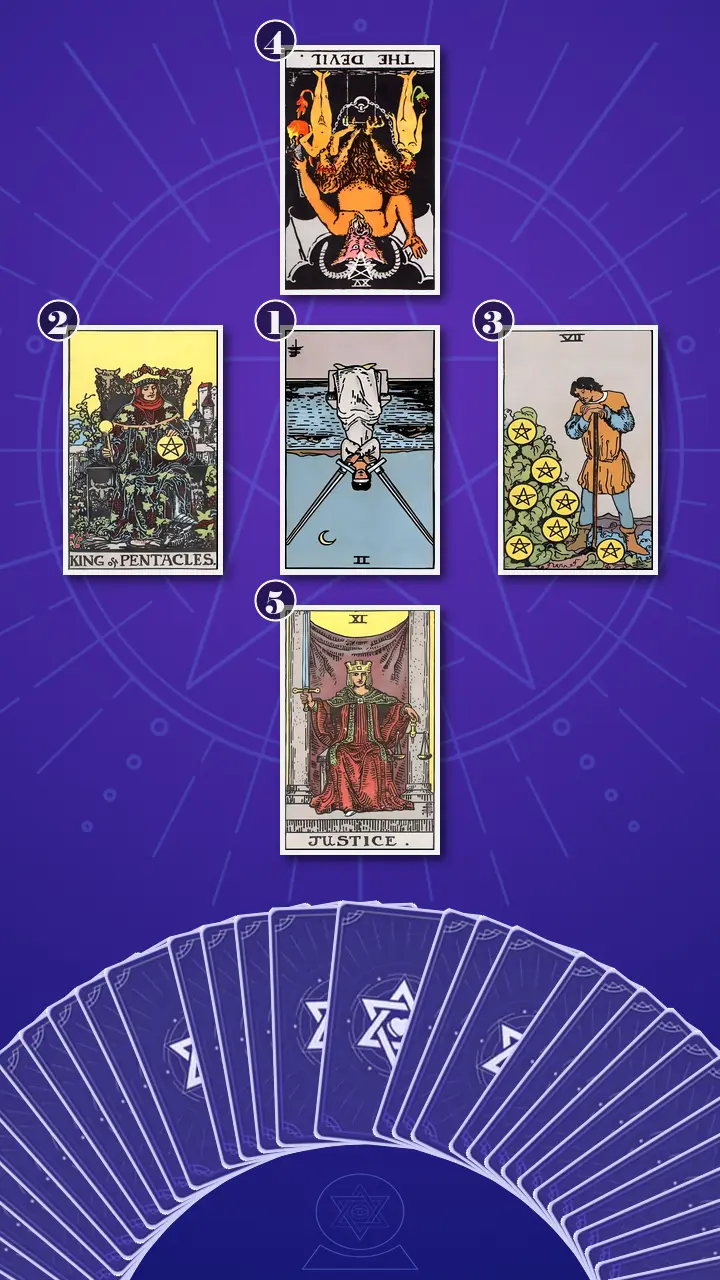
Reading the Map: The First Four Cards (What’s Really Driving Salary vs Equity Decision Paralysis)
Position 1: Current decision pressure — Two of Swords (reversed)
“Now we’re turning over the card that represents current decision pressure and the specific way the choice is getting stuck,” I said.
Two of Swords, reversed.
I didn’t need to dramatize it. Jordan’s eyes flicked to the card, then back to their open tabs, like the card had just named their browser history.
“This is the tab-hopping loop,” I said, and I made it concrete on purpose. “Google Sheets open. Levels.fyi thread. Vesting cliff screenshot. Half-written recruiter email. Notes app. New tab, new tab, new tab. It looks like clarity, but it’s actually anesthesia.”
The reversed Two of Swords is Air energy in a blockage state—thinking so hard it becomes a blindfold. The ‘objective’ stance turns into a protective freeze: if you don’t choose, you can’t be wrong. But under a deadline, that stalemate doesn’t stay calm—it breaks into overwhelm.
Jordan gave a small laugh that had no humor in it. “That’s… brutal,” they said, rubbing their forehead with two fingers. “Like, accurate. But brutal.”
“I’m not here to roast you,” I said, a little wry. “I’m here to name the mechanism so you can stop letting it drive.”
I tapped the card gently. “Two things matter here. First: staying neutral is still a decision—especially when it makes your negotiation reactive. Second: if you can’t say what you’re optimizing for, you’ll optimize for looking smart.”
I offered them a mini-experiment—something the reversed Two of Swords responds to because it’s not asking for life certainty, just a 24-hour decision rule. “For one day only,” I said, “try on two identities like you’re A/B testing a metric. Version A: ‘I’m optimizing for cash stability.’ Version B: ‘I’m optimizing for long-term upside.’ Say each one out loud. Then do a body check: jaw, chest, hands. Which one drops your shoulders even five percent?”
Jordan’s shoulders shifted, almost involuntarily, like their body wanted to answer faster than their spreadsheet could.
Position 2: Path A — King of Pentacles (upright)
“Now we’re turning over the card that represents Path A: what choosing higher salary supports in your real life,” I said.
King of Pentacles, upright.
This is Earth energy in a balanced state: stability, stewardship, predictable resources. The King doesn’t apologize for wanting the tangible. He holds the pentacle like cash-in-hand certainty—money that shows up in your account, your budget, your choices, now.
“This card is what your body does when the paycheck feels breathable,” I told Jordan. “Higher base salary isn’t just ‘safe.’ It can be freedom in disguise: rent that doesn’t feel like a monthly jump scare, an emergency fund that grows without self-punishment, the ability to say no to overtime without fear.”
Jordan looked down at their spreadsheet, and their grip on the phone loosened a little.
“But,” I added, because the King can have a shadow, “the risk is turning ‘cash stability’ into ‘proof I’m valuable.’ It’s subtle. It sounds like: ‘If I’m really senior, I should get the higher base.’ That’s not a negotiation strategy—that’s an identity demand.”
I asked them the question that brings this card into lived reality: “Over the next 12 months, what would higher cash unlock in your actual week? Not as a flex. As logistics.”
Position 3: Path B — Seven of Pentacles (upright)
“Now we’re turning over the card that represents Path B: what choosing more equity requires and rewards,” I said.
Seven of Pentacles, upright.
This is Earth energy too, but in a different mode: cultivation. The pentacles on the vine are the perfect modern translation of vesting schedules—value that accrues slowly, and only if you stay long enough for it to mature.
“Equity isn’t just upside,” I said. “It’s a timeline you have to emotionally tolerate. This card asks: can you live with ‘not knowing yet’ without resenting the job, constantly scanning for proof, or turning every company update into a referendum on whether you chose wrong?”
I watched Jordan’s hands—how they hovered, ready to reopen the vesting PDF. Restless, like their fingertips were trying to feel the future through glass.
“If the company does well,” I continued, “this can be meaningful. But the Seven of Pentacles doesn’t do fantasy. It does long-range thinking. It wants realistic time horizons: cliff, vesting, engagement. It rewards patience. It also demands it.”
Jordan nodded once, slow. “I can do ambiguity at work,” they said. “But money ambiguity feels… personal.”
“That’s the honest data,” I said. “Not the internet’s hot takes.”
Position 4: The hidden driver — The Devil (reversed)
“Now we’re turning over the card that represents the hidden driver shaping your preference,” I said. “This is what’s steering you under the surface.”
The Devil, reversed.
Reversed Devil energy is the moment the chain goes slack. Not because life gets easy, but because you notice the chain is partly a story—one you’ve been gripping so tightly you forgot you could set it down.
“This isn’t you choosing between salary and equity,” I told Jordan. “This is you choosing between two stories about who you are.”
I made the modern trigger explicit, because that’s where this card lives now: “LinkedIn ‘I’m thrilled to announce…’ posts. Startup equity brag threads. Blind hot takes. Slack communities where the loudest person sounds like they have a perfect model. And suddenly your decision feels like it has to be optimized and publicly justifiable.”
Jordan’s face went still in a three-beat sequence: first, a tiny freeze in their breath; second, their gaze unfocused like a memory replaying; third, a long exhale through their nose, almost annoyed at themselves.
“Yeah,” they said quietly. “I keep imagining the post. Like… what would look impressive a year from now.”
“A package can fund your life,” I said, letting the words land without judgment. “It can’t be your identity proof.”
The Devil reversed is a release state. It suggests you can step out of the compulsive need to prove you’re the smartest negotiator in the room. It also warns about the overcorrection: taking a risky package just to prove you’re not controlled by money. Freedom isn’t the dramatic choice. Freedom is being able to name your needs without shame.
Jordan swallowed, then asked, “So… if I’m still comparing, does that mean I’m doing it wrong?”
“It means you’re human,” I said. “And it means we can separate ‘practical needs’ from ‘status desires’ before you send anything.”
When Justice Spoke: The Sentence That Changed the Negotiation
Position 5: Next move — Justice (upright)
“Now we’re turning over the card that represents your next move: a decision framework and negotiation stance you can act on immediately,” I said. “This is the anchor point underneath the whole cross.”
The room felt quieter when I flipped it—like even the fridge hum stepped back.
Justice, upright.
Scales and sword. Air and structure. Not vibes—criteria. Justice doesn’t ask you to predict the future. It asks you to define what’s fair, then to communicate it cleanly.
And right on cue, I saw Jordan’s mind try to turn this into a performance again—like they were already drafting the perfect explanation to convince an imaginary panel of judges that their decision was the smartest possible move.
Here’s the setup I named out loud, because it matters: if you’ve been staring at a vesting calculator at midnight, flipping between tabs until your jaw hurts, it’s usually not because you’re bad at math—it’s because you’re trying to make the future prove you made the right choice.
Not more spreadsheets—more standards; set your scales, then use the sword to decide.
I let a beat of silence hang there on purpose.
Jordan’s reaction came in layers. First, their eyebrows lifted like something just clicked into place. Then their mouth tightened—not in anxiety, but in a brief flash of resistance. “But if I stop modeling it,” they said, voice sharper for a second, “doesn’t that mean I was wasting time? Like I should’ve already known?”
I’d seen that exact moment on trading floors years ago—when someone realizes the market isn’t going to give them a clean answer and they have to choose a risk posture anyway. Justice always reminds me of a term sheet: not romantic, not comforting, but clarifying. Fairness isn’t a feeling; it’s a structure.
“It doesn’t mean you were wrong,” I said. “It means you reached the edge of what modeling can do. Beyond that edge, you need a standard. And you’re allowed to pick that standard like an adult, not like someone begging the internet for permission.”
I leaned in slightly. “This is where my old finance brain and my tarot brain agree: you’re not trying to find the ‘winning’ package. You’re trying to price your own value under uncertainty.”
“In my work, I call this Human Capital Valuation,” I added—my way of turning feelings into a defensible framework. “We don’t price a role with one number. We price it with a model: your present-day impact, your growth curve, and the risk you’re absorbing. Salary pays for impact now. Equity pays for risk and patience. Justice says: set your pricing model first, then negotiate terms that match it.”
Jordan’s shoulders dropped—finally. Their hands, which had been twitching toward the trackpad, rested flat on their thighs. Their eyes went glossy, not with tears exactly, but with that sudden vulnerability that comes right after clarity: the part where you realize you can act, and acting means owning consequences.
I asked them softly, “Now, with this new lens—standards instead of spreadsheets—can you think of a moment last week when you felt that tight chest, and this could’ve changed how you moved?”
Jordan stared at the Justice card for a few seconds, then said, “Yesterday. I was going to send a simple question about the equity details, and then I went to Blind instead. I didn’t even notice I was doing it until right now.”
That was the shift, right there: from anxious uncertainty and spreadsheet-fueled decision paralysis to the first taste of calm self-trust—self-trust based on clear fairness criteria and owned trade-offs, not on pretending you can forecast everything.
From Standards to Send: Actionable Next Steps for Salary vs Equity
I pulled the whole cross together for Jordan in one clean narrative—because the point of tarot in a career crossroads moment isn’t poetry; it’s traction.
“Here’s what your spread says,” I summarized. “You’re stuck (Two of Swords reversed) not because the offers are impossible, but because you’ve been using ‘objectivity’ to avoid the emotional risk of being judged. Your two real options are both valid Earth choices: salary as immediate stability (King of Pentacles), equity as patient cultivation (Seven of Pentacles). The hidden force isn’t math—it’s comparison and identity performance (Devil reversed). Justice resolves it by giving you a standards-first negotiation posture: define what’s fair, choose a trade-off on purpose, then communicate one clean message.”
“Your cognitive blind spot,” I said gently, “is the belief that there’s a single correct financial move—and if you don’t find it, it proves something about you. Justice is the opposite. It says: clarity isn’t certainty. Clarity is choosing your metric.”
Then I gave Jordan what they’d actually come for: actionable advice they could do with shaky hands and a deadline.
- Build the 3-Criteria Fairness Rubric (10 minutes)Open Notes and write three criteria: (1) cash comfort for the next 12 months, (2) risk tolerance for uncertainty, (3) role growth/optionality. Score each offer 1–5 quickly. No extra research while scoring—no Levels.fyi, no Blind, no new tabs.If your brain says, “This is too simple,” that’s the Two of Swords talking. Justice is standards, not endless inputs. Set a timer and stop when it ends.
- Write the One-Sentence Decision Anchor (2 minutes)At the top of your email draft, write: “I’m choosing X because I’m optimizing for ___, and I’m accepting ___ as the trade-off.” Use that sentence as the spine of your counter or acceptance call.If it starts sounding like you’re auditioning to be the smartest negotiator, simplify. One metric. One trade-off. That’s it.
- Send One Clarifying Equity Question Within 24 HoursIf equity details are fuzzy, send one short, factual message asking for what you need in plain terms: grant type, number of shares/options/RSUs, strike price, vesting schedule, and any acceleration terms. Keep it clean—no apology paragraphs.Treat your message like a mini prospectus: gratitude + your standard + your ask + your timeline. You’re negotiating an offer, not the internet.
Jordan hesitated—because of course they did—and then gave me the most honest obstacle: “But I literally can’t stop checking threads. It feels like if I don’t, I’ll miss the one comment that changes everything.”
“That’s the Devil’s chain,” I said, not unkindly. “It promises permission. But permission doesn’t come from a forum. For 24 hours, you’re not negotiating with a comment section. You’re negotiating with terms.”

A Week Later: The Quiet Proof
Five days later, Jordan emailed me a screenshot—nothing dramatic, no victory post, just a sent message with a time stamp. Four lines. Grateful tone. One standard. One ask. One deadline.
They wrote: “My jaw was still tight when I hit Send. But I didn’t rewrite it ten times. I didn’t open Blind. I just… sent it.”
In a follow-up note, they told me they’d gone to a café near King station afterward and sat alone for an hour, sipping coffee that tasted slightly burnt, watching the streetcar glide by the window. The decision wasn’t magically easy. But it was theirs.
That’s the actual journey to clarity I care about: not perfect prediction, not a package that guarantees a future—just the shift from frantic optimization to a grounded standard you can live inside.
When you’re stuck between higher salary and more equity, it’s not just numbers—it’s that tight-chest fear that one choice will later “prove” you didn’t really understand your own value.
If you let “fair to me” be enough for one conversation, what’s the smallest, cleanest sentence you’d want to send today—without trying to predict the whole future first?