The 60-Minute Final Pass That Helped Me Publish: From Editing to Sending

The “Ten-Minute” Edit That Eats Your Evening
If your “quick edit” turns into a two-hour Figma spiral and you resurface with a tight jaw and zero applications sent, yeah—this is that pattern.
Taylor showed up on my screen from a Zone 2 flatshare in London, framed by a tiny desk and a window that looked out onto a wet, ordinary streetlight glow. She kept one hand wrapped around a mug like it was a heat source, not a drink. Somewhere off-camera, a radiator clicked. Her laptop fan had that thin, stressed whine you only notice when the room goes quiet.
“It’s basically done,” she said, and the words landed with the tired precision of someone who’s said them every night for weeks. “I just need to polish it. If I send it like this, they’ll see the weak parts immediately.”
I watched her shoulders rise a fraction as she spoke—like her body was bracing for impact that hadn’t happened yet.
Perfectionism doesn’t feel like laziness in moments like this. It feels like standing in front of a door you want to open while your hand keeps wiping fingerprints off the doorknob, over and over, until your skin is raw. A restless urge to fix tiny things—spacing, wording, order—followed by that heavy drop when you realise hours passed and the world didn’t change.
“You’re not broken,” I told her. “You’re caught in a loop that’s trying to protect you. Let’s see if we can map it—so you can get out of edit mode and into forward motion. This is a Journey to Clarity, not a trial.”

Choosing the Compass: A Celtic Cross for Feeling Stuck
I had Taylor take one slow breath—not as a ritual for luck, but as a hard reset for the nervous system. Then I shuffled while she held the question in mind: My portfolio’s “almost ready” again—how do I work with perfectionism?
“I’m going to use a Celtic Cross · Context Edition,” I said. “Because this isn’t one single decision—it’s a repeating perfectionism loop. The Celtic Cross is great for showing the chain: what’s happening now, what’s blocking you, what’s driving it under the surface, and how to build an integration that actually holds in real life.”
For anyone reading who’s ever googled how tarot works in a career crossroads moment: this is what I love about it. Tarot doesn’t hand you a fate. It gives you a structured way to see your own pattern—your inputs, your pressure points, and your next steps—so you can make different choices on purpose.
“We’ll start with the center,” I explained, tapping the space where Cards 1 and 2 form the cross. “That’s the current loop and the main friction. Then we’ll drop to the root, climb through the goal and the near-future direction, and finish with integration—what makes progress sustainable.”
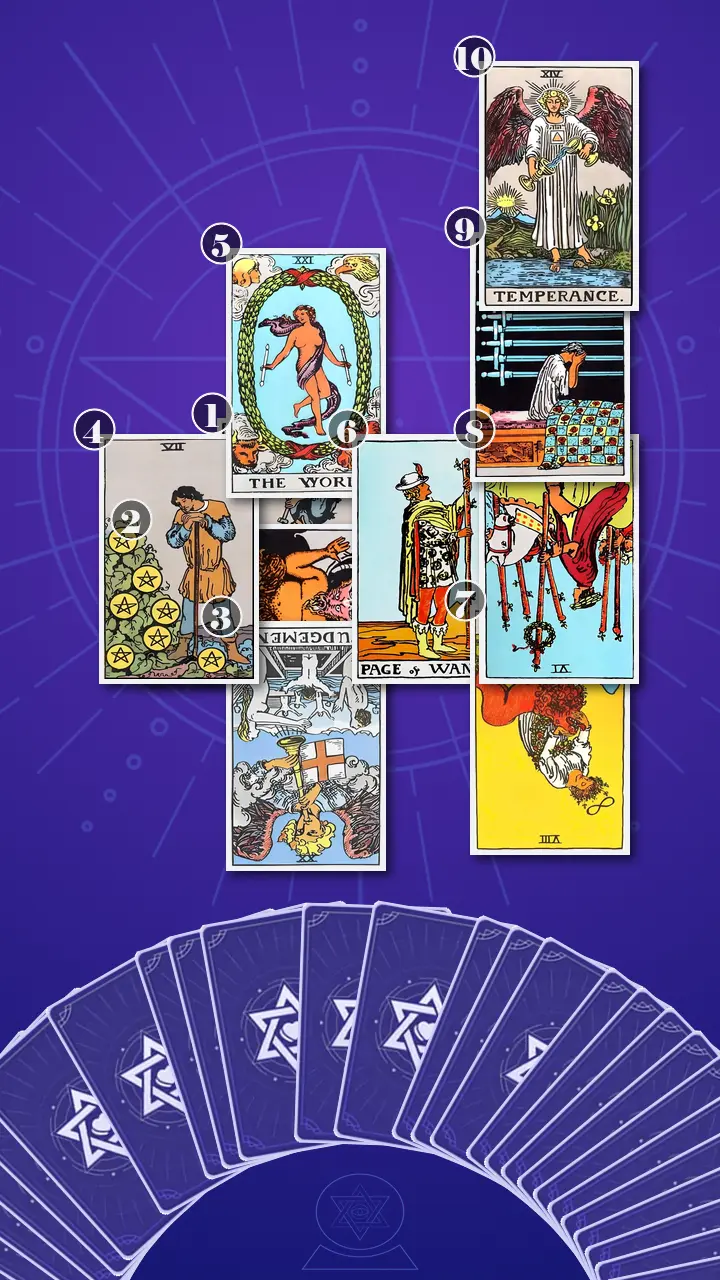
Reading the Map: Card Meanings in Context
Position 1: The current loop — Eight of Pentacles (reversed)
“Now we’re turning over the card representing the current loop: how perfectionism shows up in your portfolio behavior right now.”
Eight of Pentacles, reversed.
“This is 9:30 PM you,” I said, keeping my voice simple. “You open your portfolio site ‘just to tidy up.’ You adjust spacing, rewrite headings, tweak the same case-study intro again—tiny improvements that look like work, while the actual publish/send step stays untouched.”
In terms of energy, Eight of Pentacles is craft. Reversed, it’s blocked craft—skill trapped in repetition. The same way Google Docs version history can show 47 edits to the same paragraph… but no one outside the doc has ever read it.
“Editing can be craft, or it can be avoidance wearing craft’s outfit,” I added. “The card isn’t calling you lazy. It’s showing you where the finish line keeps moving.”
Taylor let out a short laugh—sharp, almost embarrassed. “That’s… brutal,” she said, rubbing her jaw. “Like, you even got the 2px thing.”
Position 2: The main friction — The Devil (upright)
“Now we’re turning over the card representing the main friction: what blocks completion and keeps ‘almost ready’ repeating.”
The Devil, upright.
“Your portfolio becomes a contract you didn’t mean to sign,” I said. “I can only apply when it’s flawless. So you scroll job listings and other designers’ portfolios until the pressure spikes—LinkedIn ‘Open to work’ posts, polished carousel case studies—and then you compulsively edit to feel safer.”
The Devil’s energy is excess attachment: approval tied to worth, control used as coping. And the symbol that matters most here? The chains are loose. They’re not welded. They’re not HR. They’re not a recruiter standing over you. They’re a rule that feels external… but lives inside your head.
I heard my own New York art-school brain flash a cinematic reference, the way it always does when something feels like a power dynamic: in Wall Street, Gordon Gekko doesn’t just want money—he wants the feeling of being untouchable. That’s what perfectionism is selling you: not a better portfolio, but the illusion of being unjudgeable.
I leaned in. “Can we do a quick ‘imagined audience’ monologue? Just for ten seconds.”
I lowered my voice, like a recruiter living in the walls of her flatshare kitchen. “Strong portfolio required. Hmm. Is she senior enough? Why is this project framed like that? Does she even know what she’s doing?”
Taylor’s eyes flicked away from the screen. Her shoulders crept up toward her ears. And then—very quietly—she nodded, like she’d been caught listening to a familiar, unwanted podcast.
Position 3: The hidden driver — Judgement (reversed)
“Now we’re turning over the card representing the hidden driver: the deeper fear or belief underneath the perfectionism.”
Judgement, reversed.
“This is the hover,” I said. “You draft an application email. Cursor on Send. And suddenly your brain runs a full simulation of being judged—recruiters noticing gaps, silent rejection, you being ‘found out’ as not senior enough. So you close the tab and go back to editing, because editing lets you delay being seen.”
Judgement is a call. Reversed, the energy is blocked response—like the notification sound in your head is an alarm, not a normal career step.
“You’re treating sharing like a trial,” I told her, “not like a conversation.”
She exhaled, and it wasn’t relief yet. It was recognition. Like the moment you finally name a background hum and realise it’s been there the whole time.
Position 4: Recent shaping — Seven of Pentacles (upright)
“Now we’re turning over the card representing what has been shaping this pattern recently: your recent history with effort, patience, and feedback.”
Seven of Pentacles, upright.
“You’ve genuinely put in work,” I said. “And lately you’ve been stuck in assessment mode: Should I add another project? Is this narrative cohesive enough? You keep reviewing the garden instead of choosing a harvest date.”
This is balanced effort sliding into over-evaluation. Notion ‘Portfolio v2’ pages multiplying like gremlins. Are.na rabbit holes that start as “inspo” and end as comparison fatigue. The pause replaces the publish.
Taylor’s mouth tightened—an irritated little line. “I keep telling myself I’m being responsible.”
“You are,” I said. “And also: responsibility without a deadline becomes a hiding place.”
Position 5: What you think you need — The World (upright)
“Now we’re turning over the card representing what you think you need: the ideal outcome you’re aiming for with the portfolio.”
The World, upright.
“You want a finished chapter,” I said. “A clean, cohesive reveal. The kind of portfolio that feels like it proves you belong at the next level.”
The World is integration—and it’s beautiful. But paired with Judgement reversed, it becomes a trap: completion starts to mean perfection, like this version has to be your permanent identity.
“The wreath is a boundary,” I told her. “It can say: this version is complete. Not: my life is complete.”
Position 6: The next workable direction — Page of Wands (upright)
“Now we’re turning over the card representing the next workable direction: what happens when you move from polishing to publishing and iterating.”
Page of Wands, upright.
“This is prototype energy,” I said, letting the tone lighten on purpose. “One application sent. One case study shared. One message to a recruiter. Done with curiosity rather than a need to be unbreakable.”
Page of Wands is healthy Fire—not the panic-flare of visibility pressure, but the pilot-light of experimentation. It’s the opposite of decision fatigue. It’s: Let’s run a tiny test.
“Think ‘tiny pilot,’” I said. “Prove vs learn. This card is firmly on the learn side.”
Taylor’s face softened—barely—but it was the first sign her nervous system believed movement might be possible without a personality transplant.
Position 7: Your inner stance — Strength (reversed)
“Now we’re turning over the card representing your inner stance: self-talk, confidence, and how you hold pressure while creating.”
Strength, reversed.
“Under pressure, your self-trust wobbles,” I said. “So you try to ‘be tougher’—late-night grind sessions, harsher self-talk, more proof. But the more force you use, the more frozen you feel at the moment of sharing.”
Strength reversed is deficiency of gentle leadership. The lion isn’t your talent. The lion is the fear that says, if they judge the work, they’ll judge me. And your current strategy is to wrestle it at midnight under blue light.
“Strength isn’t force,” I reminded her. “It’s steadiness.”
Position 8: External pressure — Six of Wands (reversed)
“Now we’re turning over the card representing external pressure: visibility, comparison, and what your environment reinforces.”
Six of Wands, reversed.
“Your environment is a spotlight machine,” I said. “Polished posts. Announcements. Visible wins. And you start believing that if you share and don’t get a strong reaction, it means the work isn’t good.”
Six of Wands reversed is distorted feedback loops. It’s the crowd becoming louder than any actual hiring manager you could DM. It’s the design Twitter-to-Threads migration vibe where everyone has a hot take on what’s ‘senior,’ and your portfolio starts trying to win an argument instead of tell a story.
“This card is basically saying: stop auditioning for the internet,” I said. “Start talking to real humans.”
Position 9: Hopes and fears — Nine of Swords (upright)
“Now we’re turning over the card representing hopes and fears: what you secretly want sharing to give you, and what you fear it will cost.”
Nine of Swords, upright.
“At night, your mind turns into a courtroom,” I said. “You replay wording, imagine critique, forecast worst-case outcomes until your body feels wired and heavy at the same time.”
Nine of Swords is excess Air—thoughts multiplying faster than reality. The hope is relief. The fear is that one public moment could ‘prove’ you’re not enough.
“If it’s not data, it’s drama,” I said gently. “And this card is pure drama—your brain trying to protect you with rehearsals.”
Taylor pressed her fingertips to her temple, like she could physically hold the thoughts in place. “I literally do that,” she admitted. “I re-read my own case study copy like I’m marking it.”
Position 10: Integration — Temperance (upright)
“And now,” I said, and even I felt the room go still on my side of the screen, “we’re turning over the card representing integration: the most empowering way to stabilize progress and keep perfectionism workable.”
Temperance, upright.
“Temperance is the alchemist,” I began. “Pouring between two cups. One foot on land, one in water. It’s measured integration: publish one coherent version, collect a small amount of real feedback, make targeted updates—without reopening your entire portfolio universe.”
Setup: Taylor was right back in that familiar moment: late, alone, opening the portfolio ‘for ten minutes,’ then two hours deep in tiny fixes—because editing feels safer than being seen. Her brain had been treating ‘publish’ like a single irreversible launch.
Stop treating your portfolio as a final verdict on you, and start treating it as an alchemist’s blend—Temperance asks for steady mixing, not endless polishing.
The sentence landed, and Taylor’s reaction came in layers.
First, her breath stopped—just a tiny freeze, like someone hit pause on her chest. Her eyes went slightly unfocused, as if she was replaying a week of nights in fast-forward: the radiator clicks, the laptop fan, the cold tea, the tab with the application sitting untouched behind the portfolio editor.
Then her jaw unclenched. I watched it happen. Her shoulders dropped a few millimeters, like she’d been carrying a bag she forgot she could set down. She swallowed, and when she spoke her voice had a small tremor—not sadness exactly, more like the vulnerable edge of relief.
“But if I stop polishing,” she said, and the resistance flared, quick and honest, “doesn’t that mean I’ve been… doing it wrong? Like I wasted so much time?”
I shook my head. “It means you’ve been surviving with the tools you had. Temperance doesn’t shame the craft. It gives it a container.”
This is where my own work as an artist always comes back to me: in jazz, you don’t ‘perfect’ a solo in private until it can’t be judged. You learn the structure—then you improvise in public, responding to what’s actually happening in the room. Temperance is that kind of musicianship. Craft plus responsiveness, not craft as hiding.
“Now,” I asked her, “use this new lens and look back at last week. Was there a moment—maybe that Tuesday night—when you could’ve stopped at ‘clear enough’ and sent one small message instead?”
Her eyes watered, but she didn’t cry. She just nodded once, like she’d found the exact hinge where her week could have swung differently.
“Yeah,” she whispered. “On Sunday. I had the link ready. I just… couldn’t press send.”
“That’s the shift,” I said. “Not from doubt to total confidence overnight—but from self-doubt running the schedule to a process that can hold you. From ‘publish as judgement’ to ‘publish as a conversation starter.’”
From Insight to Action: A Version 1.0 That You Can Actually Ship
Here’s the story the spread told, cleanly: your craft is real (Seven and Eight of Pentacles), but it’s gotten stuck in a loop where polishing gives short-term relief and long-term stagnation. The Devil and Judgement reversed show the hidden contract—be flawless before you’re allowed to be seen—and that turns visibility into a courtroom (Nine of Swords) under the harsh spotlight of modern design culture (Six of Wands reversed). The World shows you’re aiming for coherence, not chaos. And Temperance offers the way through: a repeatable rhythm where you ship a cohesive version and iterate with real data.
The cognitive blind spot is subtle but common: you’ve been treating your portfolio as if it must prove you’re exceptional, instead of letting it simply introduce you. That’s why every detail feels high-stakes. The transformation direction is to move from “final verdict” to “living document,” from fear-driven micro-edits to bounded iteration and real conversations.
When I feel someone drowning in infinite options, I use what I call my Mondrian Grid Method. Like a Mondrian painting, your portfolio needs strong boundaries more than more paint: clear rectangles, clean lines, a limited palette. Not because you’re limiting yourself—but because structure creates freedom.
- The 60-Minute Final PassThis week, set a timer for 60 minutes. You’re only allowed to fix three pre-defined items (example: one typo, one alignment issue, one unclear sentence). When the timer ends, you stop—even if it itches.A timer is a boundary you can actually keep. If 60 minutes feels impossible, do a 20-minute version and fix only one item—then still do the send.
- Write Your “Version 1.0” DefinitionOpen your to-do list and write one sentence at the top defining what “publishable” means today. Example: “3 case studies + about + contact + working links.” That’s your wreath boundary.If you feel yourself negotiating with it, that’s The Devil trying to reopen the contract. Put a sticky note on your laptop: “Stopping is part of the process.”
- Schedule One Small Send (Within 24 Hours)Put one calendar block within 24 hours of the final pass: “Send portfolio to one person.” It can be a recruiter, a mentor, a trusted designer friend. Direct sharing counts—no public post required.If you start spiralling, close the editing tab and do the send from your phone with a simple message. Anxiety isn’t a veto.
- Use an Oscars-Style 2-Minute PitchDraft a two-minute, three-sentence note to attach to your link: who you are, what kind of roles you’re targeting, and one specific thing you’re proud of in Project X. Then reuse it—don’t rewrite it every time.This is my “Oscars Speech Training”: you don’t win by improvising a new identity at the mic each time. You win by showing up with a clean message.
Taylor blinked at the list and gave me the most honest pushback: “But I genuinely don’t have time. Work is chaos. Flatshare noise. I barely get five minutes.”
“Then we go full Page of Wands,” I said. “Embarrassingly small.”
“Tonight,” I suggested, “write the Version 1.0 sentence. That’s one minute. Tomorrow, draft the message. Don’t send it yet if that’s too much—saving the draft still counts as building the pathway.”

A Week Later: The Quiet Proof
Eight days later, I got a message from Taylor with a screenshot of her calendar. One block, highlighted: Wednesday 12:30 PM — Send portfolio link. Under it, a short line: “Did the 60-minute pass. Stopped. Jaw clenched, hated it. Sent anyway.”
Then a second message: “I asked one narrow question like you said. They replied in six lines. No verdict. Just helpful.”
She didn’t tell me she was suddenly fearless. She told me she slept a full night, then woke up with the same first thought—what if it’s not enough?—and for the first time, she laughed a little, like she’d caught her brain trying to run the old script.
That’s the real Journey to Clarity: not erasing fear, but shifting your relationship to it. From tightening and hiding to mixing and moving—steady, measured, human.
When you’re alone at night nudging tiny details with a tight jaw, it’s rarely about the pixels—it’s that split-second fear that if the work gets judged, you will too.
If your portfolio only had to be a snapshot that opens one conversation this week—not a final verdict—what’s the smallest ‘send’ you’d feel willing to try?