Training the New Hire While Still Labeled Junior—and Naming the Gap

The Slack Before Breakfast
When Maya (name changed for privacy) sat down with me, I heard myself name a pattern I see constantly in young professionals in Toronto: if you're training the new hire before you've even finished your coffee, but your title still says junior, the knot in your body is not random.
She described Tuesday, 8:07 a.m., from her condo kitchen so clearly that I could almost smell the slightly burnt coffee. Slack notifications were stacking up, the kettle had just clicked off, and she was still in socks, thumb tapping through a new hire's questions while recording a quick Loom and fixing an onboarding checklist at the same time. The laptop fan whirred. Her phone ran warm in her hand. Her jaw locked before breakfast.
'I don't want to sound difficult,' she told me. 'But this is getting ridiculous. Why am I proving myself to people I'm already training?'
There it was: wanting her title to match the responsibility she already carried, while staying quiet because the paper label still made her doubt her right to challenge it. Being trusted with the work and denied the label is not a small mismatch. Her frustration didn't feel abstract to me; it felt like swallowing steam and trying to call it air.
I nodded and kept my voice gentle. 'You're not here because you need permission to feel this. You're here because the pattern has become clear enough that we can map it. Let's make this less like fog and more like a route toward clarity.'

Choosing the Horseshoe for Career Title Clarity
I asked her to take one slow breath and keep the question simple in her mind: what am I already carrying, and what needs to be named? Then I shuffled slowly, not as theater, but as a way of helping both of us move from emotional static into focus.
For this reading, I chose the Horseshoe Spread. When people ask me what tarot spread works best for a promotion question or a workplace title mismatch, this is one of the clearest tools I know. It is lean enough for a focused work dilemma, but broad enough to show the whole arc: earned competence, unequal exchange, self-censoring fear, distorted authority, team misrecognition, direct guidance, and grounded next steps.
I like it especially for unofficial leadership without official recognition because it reads the problem as an archway, not a verdict. The left side shows how the pattern formed. The top center shows the structural bottleneck. The right side shows how finding clarity becomes actionable advice instead of wishful thinking.
I told Maya I would pay closest attention to four places: the present-state card, which would show the visible mismatch between her work and her title; the central obstacle, which would show where authority became vague or gatekept; the guidance card, which would show how to ask for title clarity in a 1:1 without sounding difficult or entitled; and the final card, which would show what concrete progress could look like if she followed through.
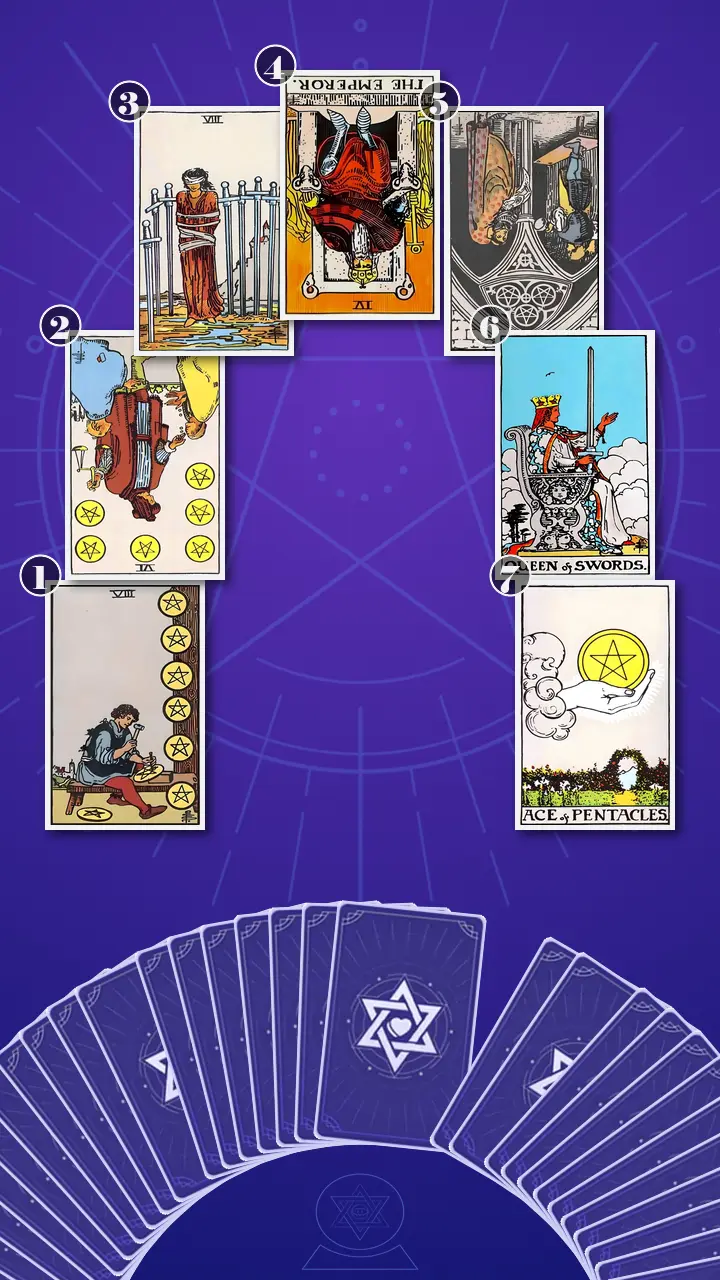
Reading the Archway of Pressure
Position 1: The Craft That Outgrew Its Label
Now I turned over the card showing how diligent apprenticeship and over-reliability became Maya's entry point into being trusted with more than her title. It was the Eight of Pentacles, upright.
I wasn't surprised. This is the card of learning a system one careful repetition at a time, and it fit her life almost too neatly: the color-coded checklists, the buried workflow fixes, the quiet mastery that makes everyone think, Ask Maya, she'll know. In modern work terms, this is how someone becomes the default admin in every shared doc while the org chart still lists them as a viewer.
Energetically, the Eight of Pentacles is balanced Earth: real skill, real craft, real reliability. But in her case that healthy apprenticeship had quietly outgrown the title attached to it. The problem was never lack of competence. The problem was that visibility and structure lagged behind the work itself.
Maya gave a small nod and tucked one sleeve over her hand. 'That part, yes,' she said. 'I really did earn their trust.'
Position 2: The Private Ledger of Helpfulness
Next I turned the card showing the current visible mismatch between the work Maya gives and the recognition she receives. Six of Pentacles, reversed.
This was the private-ledger card. I told her I could see the exact scene: answering Slack questions before breakfast, walking a new hire through workflows, getting called a lifesaver, then going back to a calendar that still leaves her out of the rooms where ownership gets assigned. She keeps giving knowledge, time, training, and stabilizing labor while formal recognition stays in someone else's hand. Helpful starts sounding suspiciously close to compliant.
Reversed, this card shows an imbalance of Earth. The exchange is blocked: responsibility flows down fast, recognition flows back slowly or not at all. Private resentment is often a job description with no signature. The card was asking where being helpful had quietly become agreement to keep the arrangement vague.
She let out a short laugh that had more bite than humor in it. 'Wow,' she said, glancing away from the card. 'That's accurate enough to be rude.'
Position 3: The Notes App Cage
Then I turned the card revealing the self-restricting belief and anticipated backlash that keep her from naming the mismatch. Eight of Swords, upright.
The second Eight mattered to me immediately. In the Rider-Waite-Smith pattern, the same disciplined force that built mastery can harden into self-confinement. I told her I saw the Sunday-night scene without needing her to explain it: the Notes app draft called something like promotion convo, the bullet points, the screenshots, the rehearsed replies to objections nobody had even spoken yet. Like having seventeen tabs open for one email you still cannot send.
This is blocked Air. Nothing in the card says the question is forbidden; it says the fear of asking has been rehearsed so many times that it now feels like fact. Underneath it I could hear the script: if I still have to explain it, maybe I'm not actually there yet. I leaned in a little and said the line I most wanted her to hear: 'You do not need a flawless case to ask a factual question.'
Her breathing paused for half a beat. Her gaze softened and lost focus, as if she had just reopened that blue-lit notes screen in her head. Then she looked back at me and whispered, 'That is exactly what I do.'
Position 4: The Hidden Settings Page
At the top of the horseshoe, I turned the card identifying the structural authority problem and gatekeeping dynamic keeping the junior label in place. The Emperor, reversed.
Here the reading stopped being only personal and became structural, which mattered. This wasn't just self-doubt. This was title politics, vague criteria, and approval chains that get weirdly slippery the second someone asks how level changes actually happen. It felt like the org-chart version of Severance: the system knows exactly how to use your labor, but suddenly nobody can find the settings page where recognition gets assigned.
Reversed, The Emperor is blocked authority. Rules are either too rigid, too vague, or too convenient for the people above them. Through my Jungian lens, I always notice how quickly the inner judge borrows the voice of an institution; vague management language becomes a private law inside the body. Maya had been treating the hierarchy as neutral when, in truth, ambiguity was serving someone.
She exhaled so fully that her shoulders dropped. 'Yes,' she said. 'The second I ask what the process is, everything turns into timing or headcount.'
Position 5: Inside the Blueprint, Missing from the Credit
I turned the card showing how the team benefits from Maya's competence while still framing it as support rather than ownership. Three of Pentacles, reversed.
I told her this was the blueprint card, upside down. In ordinary form it shows collaboration with named builders; reversed, it shows contribution being used without being fully credited. I could see her at a downtown hot desk, screen-sharing in a Slack huddle, teaching a workflow she basically built by repetition while someone says, 'Maya's great at helping with this stuff.'
Energetically, this is a deficiency of recognition inside a real team structure. She is clearly inside the cathedral, helping hold it up, but still oddly absent from the official plan. Praise is being offered instead of scope. Helpfulness is swallowing ownership.
Maya pressed her lips together and gave one slow nod. 'That's the part that makes me the angriest,' she said. 'They're not wrong that I help. It's just not the whole truth.'
When the Queen Raised Her Sword
Position 6: The Adult-to-Adult Ask
When I reached for the sixth card, the room seemed to settle. Outside the window, a streetcar bell rang and then everything went oddly still, as if the noise had stepped back to let the next sentence land. This was the card offering the key behavioral shift from silent proof to direct, fact-based self-advocacy. It was the Queen of Swords, upright.
The Queen is not cold to me. She is clean. She takes the emotional fog out of a conversation without stripping it of truth. In work language, she is the person who walks into a 1:1 with three bullet points instead of a speech: here is the scope, here is the mismatch, here is my question.
By this point Maya was still treating the conversation as if it had to begin with a defense of her worth. Her whole body was bracing for a courtroom scene when what she actually needed was a role-clarity conversation.
Your silence is not proof of professionalism; raise the Queen's sword of clarity and name the gap between the work you do and the title you carry.
I let the sentence sit between us for a moment.
The Imposter Syndrome Audit
Then I did something I often do in career readings. I used my Imposter Syndrome Auditing lens. I asked her to separate two columns in her mind: objective professional competence, and the old fear of exposure. In the first column were verifiable facts: onboarding teammates, owning recurring process knowledge, answering cross-team workflow questions, holding the team wiki in her head. In the second column was the terror that if she named the mismatch out loud, someone would finally reveal she had misread her own level.
Her reaction came in three clear waves. First, she went very still; even her fingers stopped moving against the edge of her sleeve. Then her eyes drifted past me, not dissociating exactly, more like replaying every unsent draft and every Friday 4:58 p.m. conversation in fast-forward. Then the feeling broke across her face at once—anger first, then grief, then the smallest loosening around the mouth.
'But if I have to say it that plainly,' she asked me, voice thin with resistance, 'doesn't that mean they should have noticed already?'
'Maybe,' I said. 'But their failure to name your scope is not evidence that your scope isn't real. The Queen separates performance from permission. That's the whole move.'
I asked her, 'Now, with that distinction in place, think back over last week. Was there a moment when this would have changed how you felt?'
She answered immediately. 'Wednesday. I trained the new hire on a workflow, then answered a manager-level Slack question right after. I felt furious, and then I told myself I was being dramatic. If I'd thought about it this way, I would've just written it down as scope.'
That was the hinge. Not a magical confidence surge, but a precise inner shift: from resentful overfunctioning and self-doubt to grounded self-respect and clear professional language. I could see it in her body. Her shoulders dropped, yes, but there was also that strange little dizziness that comes when a burden lifts and responsibility returns at the same time.
Position 7: Value Leaving Draft Mode
Finally, I turned the card showing the grounded professional path that opens when resentment becomes documented terms and concrete asks. Ace of Pentacles, upright.
I smiled when I saw it. After all that distorted Earth in the middle of the spread, here was Earth restored. Not fantasy. Not a promise dropped from the sky. A practical opening: a written growth plan, a title review, clearer boundaries around unofficial labor, compensation clarity, or even an external opportunity that actually matches the work she already does.
The Ace of Pentacles always asks the same sober question: what becomes possible once value leaves draft mode? The garden path on the card is beautiful, but it is still a path. It has to be walked. If your value is real, it can survive being written down.
Maya looked at this card longer than the others. The expression on her face wasn't giddy. It was steadier than that. 'That,' she said softly, 'feels a lot less impossible.'
Paperwork for Reality
When I laid the whole Horseshoe tarot spread for career title mismatch and workplace recognition back into one sentence, the story became clean. Maya built real trust through disciplined skill. That trust turned into unequal exchange: more responsibility, no matching label. Her mind tried to solve the mismatch by becoming even more prepared, which only tightened the cage. Meanwhile, a vague hierarchy and a team culture of calling expertise 'helpfulness' kept benefiting from the blur.
The cognitive blind spot was subtle but powerful: she had been treating recognition as something that should arrive automatically once her effort became undeniable. But silence had been doing administrative work for the system. It kept her in child-to-parent energy around authority, waiting to be told who she was, instead of adult-to-adult language around scope, title, and criteria.
The transformation direction was just as clear: move from silent proof to factual self-advocacy. Clarity is not aggression; it is paperwork for reality. I told her we didn't need a dramatic confrontation. We needed cleaner terms, a smaller ask, and a paper trail.
She looked at me and said, 'My problem is I'll turn this into a TED Talk the second I get nervous.'
I laughed softly. 'Then don't give a TED Talk. Give them a document and two questions.'
- The Competence Anchor Before your next 1:1, do my Competence Anchoring Exercise in a notes app, Notion page, or one-sheet doc. Make three columns: responsibility, business impact, and where your current title mismatches the work. Start with only three recurring items: onboarding teammates, owning process knowledge, and answering cross-team workflow questions. Give it ten minutes, max. Tip: write in outcome language, not self-praise—'trained X,' 'reduced confusion around Y,' 'became point person for Z.'
- The Plain-Language Ask Send one agenda line before the meeting: 'I'd like to spend 10 minutes on role scope and title alignment based on my current responsibilities.' In the meeting, use one factual sentence: 'I'm currently onboarding teammates, owning recurring process knowledge, and answering cross-team workflow questions, so I'd like to talk about how that scope maps to my title.' Then ask: 'How is role level defined here?' and 'What criteria or timeline would move this from vague to concrete?' Tip: if embarrassment spikes, ask just the first question. One clean question beats ten minutes of overexplaining.
- The Written Follow-Through After the 1:1, send a brief recap by email or Slack: 'Thanks for discussing role scope today. My understanding is...' Then list any criteria, timeline, or next steps. If nothing concrete is offered, spend 20 minutes comparing your real scope to two external job descriptions or salary bands at the next level. Tip: stop after two examples. The goal is grounding, not a LinkedIn doom-scroll spiral.
She stared at the list for a second and said the practical thing I knew was coming. 'And if they say timing again?'
'Then the meeting has still given you useful data,' I told her. 'Repeat the criteria question once. Ask for the answer in writing. If the structure stays vague, you stop arguing with yourself about whether the mismatch is real and start deciding what to do with the information.'

A Week Later, the Quiet Proof
A week later, I got a message from Maya while I was between sessions. It was short enough to make me smile: 'Sent the agenda line. Asked who actually approves level changes. Got a follow-up meeting and, for the first time, actual criteria instead of vibes.'
That night she slept straight through, then woke with the old thought—what if they still stall?—and laughed because the email had already been sent.
That is the Journey to Clarity I care about most. Not a perfect ending by sunrise. Not tarot as a magical approval stamp. Just the moment a person stops confusing silence with professionalism and starts speaking about their life in workable terms. The cards did not make Maya more competent. They helped her stop handing her competence over to ambiguity.
This is why I return to a Horseshoe spread when someone is doing senior-scope work under a junior title or asking how tarot works for career recognition problems. It lets the pattern unfold without shame: visible frustration, hidden mechanism, structural blockage, clean self-advocacy, next steps. It gives the reader back their hands.
Sometimes the hardest part is not doing the bigger job; it is feeling your chest tighten every time you consider naming it, because being brushed off can seem to say something unbearable about your worth. It doesn't. It only tells you that the question has finally reached the place where clarity belongs.
So if you stopped waiting for your extra effort to translate itself, what is one plain, low-drama question—your own Queen-of-Swords sentence—you would want answered in your next check-in?
Every reading at AceTarot is a Journey to connect with inner wisdom and empower next step.
Learn more about our Journey to Clarity.