Hiding Notes at Robarts—and Letting One Honest DM Go Through

Finding Clarity for Effort Shame in the Robarts Fluorescent Glow
If hearing “lol I winged it” makes you instantly edit your own story, you are probably dealing with try-hard shame, not a lack of discipline.
When Maya (name changed for privacy) sat with me, I could already see the whole scene she was carrying: 8:47 p.m. at Robarts Library, fluorescent lights buzzing, phone warm in her palm, a half-cold oat latte beside a plain beige folder swollen with highlighted notes. The second a classmate from tutorial appeared at the end of the table, she slid the notes under her laptop sleeve, opened a clean PDF, and rearranged her face into casual. It was effort shame in performative low-effort culture in one tiny motion: embarrassed to admit she studied, hiding effort, making ambition look accidental. She wanted the work to count. She just did not want the wanting to show.
She was twenty, commuting across Toronto, juggling undergraduate deadlines with café shifts, and exhausted in a very specific way. Not only from studying, but from managing how studying looked. Shame had settled in her body like a hot coin dropped into the stomach—small, bright, impossible to ignore—while her shoulders held the rest of it as if bracing for a collision. “If I admit I worked hard,” she told me, “it sounds like I’m compensating.” Then, quieter: “I hate that I hide the part of me that actually wants things.”
I nodded. “The shame is real. It just is not proof that your effort is wrong. Let’s make a map for it. Our whole journey today is about finding clarity, not a cooler script.”

Choosing the Compass: How Tarot Works for Comparison Fatigue
I asked her to put her phone face down, take one full breath, and hold one exact moment in mind: the hallway outside class, right after an exam, when somebody says they barely studied and her whole body rushes to edit the truth. Then I shuffled slowly. For me, that pause is never about theatrics. It is about helping the nervous system stop doom-scrolling for a second and name the real question.
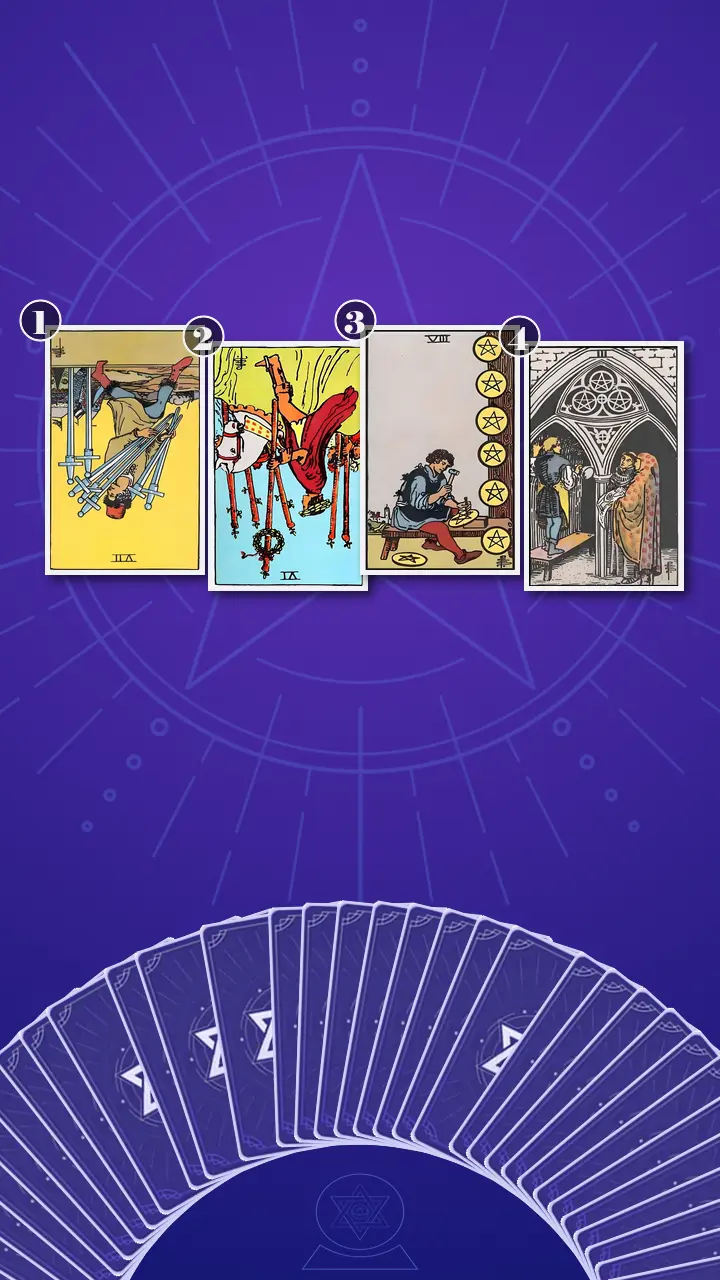
I told her I was using a four-card Situation-Challenge-Advice-Outcome · Context Edition tarot spread for effort shame and academic self-worth. I use it when someone wants more than reassurance and less than prediction, because it follows a clean logic chain: the visible symptom, the belief underneath it, the corrective shift, and the way that shift can show up in real life. Four cards are enough here. The problem is already loud; what we need is structure.
I pointed to the layout from left to right. The first card would show the presenting problem: the pattern of studying seriously and then disguising it when campus coolness rewards detachment. The second would reveal the deeper challenge: the approval-based fear that visible effort means you are less naturally impressive. The third, placed as the visual pivot, would name the medicine. The fourth would show what integration looks like when effort becomes visible in small, socially survivable ways.
Reading the Left Side of the Hallway
Position 1: The Notes Under the Sleeve
I turned over the first card. “This position shows the presenting problem from the diagnosis: the specific behavior of studying seriously but disguising it when peers perform casualness.”
Seven of Swords, reversed.
I felt the accuracy immediately. In card meanings in context, this looked exactly like staying at the library until the battery is low, then hiding the highlighted notes the second someone from class sits nearby. It looked like having a real study system—Quizlet decks with names like midterm-final-actual-final, Google Calendar blocks, a whole revision plan—and then sending, “I was so unprepared lol,” to the post-exam chat because sounding casual feels safer than sounding invested.
Reversed, the energy was still strategic, but cramped. Not clean strategy—self-protection that had started to curdle into self-betrayal. The figure in the card glances over one shoulder while carrying the swords away, and that was exactly Maya’s split attention: half on the material, half on the social scan. Act normal. Don’t make it a thing. That kind of audience-surveillance makes concentration leak out of the body.
Maya let out one short laugh that landed bitter at the edges. “Wow,” she said. “That’s accurate enough to be kind of rude.”
I smiled. “Rude, maybe. But useful. This card is not accusing you of being fake. It is naming the cost of hiding effort so often that your ambition starts feeling like contraband.” I watched her thumb rub once across the cardboard edge of the table, then go still.
Position 2: When the Crowd Becomes the Scoreboard
I turned to the second card. “This position reveals the internalized challenge behind the shame: the underlying fear that visible effort exposes a lack of natural worth or social ease.”
Six of Wands, reversed.
This was the hallway after the test in one image. Wet coats. Coffee breath. Tote strap on the shoulder. Someone laughing, “I literally barely studied,” and suddenly Maya is not answering from her own experience anymore—she is reading the room first. This card works a lot like checking how a post is landing before deciding how confident you are allowed to feel. The laurel wreath becomes imagined social approval. The crowd becomes the invisible audience she carries in her head every time her effort could become visible.
Here the energy showed a deficiency of internally anchored confidence and an excess of external monitoring. The real obstacle was not studying. It was letting the room act like the authority on what studying meant. An effortless image can protect you socially and still betray you academically. When self-worth rises and falls with the first three post-exam reactions, effort starts to feel humiliating, not because it is, but because it has been strapped to belonging.
I asked her, softly, “When you imagine saying, ‘I put a lot of time into this,’ what is the worst part—looking needy, not naturally smart, or trying hard and still not standing out?”
Her breath caught first. Then her eyes unfocused, like she was replaying a hallway she had walked through too many times. Then came the answer, quiet and immediate: “The last one.” Her hand moved to her stomach. “If I try and I’m still just… normal, it feels like that says something bad.”
I have spent a decade guiding people through artificial night skies in Tokyo, explaining that what looks brightest is not always what is nearest or truest. Human self-worth works that way too. “That,” I told her, “is the wound under the script. Not laziness. Not lack of discipline. Fear that the crowd gets to grade your worth.”
When the Eight of Pentacles Became a Workbench
Position 3: The Practice-Not-Persona Shift
When I turned the third card, the room changed tempo. The first two cards had felt like fluorescent heat and hallway noise. This one felt like a desk lamp, a timer, a pen in a steady hand. “This position names the key shift,” I said, “from image management to grounded, self-respecting practice.”
Eight of Pentacles, upright.
After hours at the library, the hardest part is often not the studying. It is the ten seconds afterward, when someone asks how much you prepared and your whole body wants to edit the truth before it leaves your mouth. Maya had been living inside those ten seconds for a long time.
Stop using an effortless mask as your armor; build one pentacle at a time and let practice, not posturing, define you.
I let that sit between us for a beat. Rain ticked once against the window. Somewhere in the building a pipe clicked, and the quiet after it felt almost physical.
Then I showed her what I call Black Hole Focus. At the planetarium, when I explain an event horizon, I tell people this: whatever becomes the center of gravity will pull everything else into its orbit. Maya had been letting the crowd become the gravity well. One “lol I winged it,” one ironic caption, one performatively chill group chat, and her attention crossed the social event horizon. Eight of Pentacles asked for a different center. Not the audience. The workbench. The timer. The flashcards. The actual rep in front of her. Practice is not a confession that you are behind. It is evidence.
Your effort is not embarrassing proof that you lack talent. It is the most honest way self-trust gets built.
She froze first—full stillness, even her fingers hovering above her cup lid. Then I saw the thought land: her gaze drifted past me, not avoidant, more like she was replaying old footage with new subtitles. Then the feeling came in hot. “But if that’s true,” she said, and there was real anger in it now, “doesn’t that mean I’ve been hiding for no reason?”
“Not for no reason,” I said. “For a reason that made sense in rooms with weird rules. You built a shield. I’m not interested in shaming the shield. I’m asking whether you still want to wear it every time you care.”
Her jaw unclenched. Her shoulders dropped a fraction, then more. Her eyes shone, not dramatic, just suddenly unguarded. She exhaled like she had been keeping a backpack clenched to her chest for months and had finally set it on the floor. Even then, I could feel the second wave that often follows relief—the tiny dizziness of having a clearer path and realizing it belongs to you now.
I slid her phone back toward her. “Within the next ten minutes, open your Notes app and make two headers: ‘What I practiced’ and ‘What I performed.’ Put one item under each from this week. If it feels safe, send one trusted person a single honest sentence about your prep. If your body spikes, stop there. The noticing still counts.”
Then I asked, “Now, with this new lens, think back to last week. Was there a moment when this would have changed how you felt?”
She laughed again, but this time the laugh had air in it. “At Robarts,” she said. “I hid my Anki cards when this guy from tutorial sat down. I wasn’t even embarrassed by the cards. I was embarrassed that it mattered to me.”
“Exactly.” I tapped the Eight of Pentacles. “This is the first step from shame-driven concealment and audience-surveillance into grounded pride and process-based confidence. Not overnight confidence. Just self-trust built through reps.”
Position 4: Letting One Safe Person See the Workbench
I turned the last card. “This position grounds the target state into observable action: letting effort become collaborative, visible, and less shame-charged in daily academic life.”
Three of Pentacles, upright.
This card always feels like a relief after a reading like this. In real life, it is not a big speech about ambition. It is smaller than that. Office hours with a real question. Telling a project partner what you already prepared. Comparing study methods honestly with one classmate instead of pretending you improvised. It is the move from private draft mode to shared Google Doc mode—still grounded, still practical, just less secret.
Energetically, this was balance. The Earth of the last two cards replaced the warped Air and Fire of the first two. Less scanning. More building. Less performing. More participation. The card did not ask Maya to become the loudest person in the room. It asked her to let one prepared thing be seen and survive it.
Her shoulders stayed lower this time. She looked at the card and said, “I could probably do that with one person. Not everyone. But one.”
“That’s enough,” I said. “You do not need to make your effort louder. Just less secret.”
Visible Effort, Small Dose
When I laid the whole spread back out for her, the story was clean. First came the hidden self-protector: studying hard, then editing the evidence. Then the approval-seeking performer: handing her internal gradebook over to the room. After that, the repair cluster arrived. The craftsperson replaced the performer. The collaborator replaced the isolating script. The whole reading moved like walking down a tense post-exam hallway and then stepping into a workshop where the only question was what her hands were making.
The blind spot was never that Maya cared too much. It was that she had been letting an effortless image stand in as proof of worth. That is why the shame felt so sticky. The transformation direction was the Practice-Not-Persona Shift: from looking chill to feeling steady, from hiding effort to showing up with it, from asking “How did I sound?” to asking “What did I practice?” Self-trust grows from reps, not from looking chill.
I gave her three small next steps—low drama, low friction, high truth.
- Shooting Star NotesAfter your next study block, open your Notes app and spend 30 seconds under one plain header: “What I practiced today.” List one to three specific reps—one concept, one problem set, one page of revision—while you are still at the library or on the TTC ride home.Keep it ugly. No aesthetic formatting, no branding. Evidence beats vibe. If 30 seconds feels long, do 10.
- One Safe Witness DMAfter your next quiz, presentation, or lab, send one trusted classmate, roommate, or friend a single sentence: “I put real time into that one.” Say it in a DM, not the group chat, and stop there.Choose the safest person, not the coolest audience. If your body spikes, that does not mean you failed; it usually means the old protection pattern got interrupted.
- The Hour-Later Hallway BufferMute the post-exam group chat for one hour and put one line on your lock screen before the next test: “My job is to practice, not to look naturally fine.” If you need more structure, make one 25-minute calendar block with a topic name, like “BIO quiz — cellular respiration questions 1–5,” instead of the vague word “study.”If an hour feels impossible, start with 15 minutes. The point is not to ban comparison forever; it is to stop outsourcing the first meaning of your effort.
I told her I was not asking for a personality transplant. Just one tiny break in the loop. Shame had linked effort with humiliation. These steps were how we relinked effort with evidence, and then with support.

A Week Later, the Noise Was Still There—Just Not in Charge
Five days later, Maya messaged me during her commute. “I sent the DM,” she wrote. “I said I put real time into the quiz. She just replied, ‘Same lol, want to compare notes for next week?’” Then another text: “It felt awful for like eight seconds. Then weirdly normal.”
I could picture it: Line 1 rattling north, screen glow in the window, the old reflex still tapping at the glass. Clear, but a little vulnerable. She had a plan now and slept better that night, though the next morning her first thought was still, what if I’m still average? This time, she smiled at the thought, put her phone in her pocket, and went to class anyway.
That is what a real Journey to Clarity often looks like when I read for effort shame in college. Not a brand-new identity. A quieter nervous system. A truer sentence. One less hidden folder. One more moment where practice gets to be real.
When your face goes hot just for admitting how much you cared, the pain is not only about studying. It is the ache of wanting something honestly while fearing that visible effort will make you look less impressive, less safe, or both.
If effort did not have to orbit the crowd this week, what is one small way you would let your preparation be real—maybe only in a note on your phone, maybe in one DM, maybe by letting one safe person see the workbench?