From High-Functioning on Paper to Supportive-Not-Impressive Routines

High-Functioning on Paper at 11:47 p.m.
When Mia (name changed for privacy) sat down across from me in the back corner of my café, I told her something I have said to more students than I can count: if the hour after submission makes you feel less relieved than exposed, like now the room, the dishes, the admin, and your own body are all waiting for you, this is the burnout-after-the-deadline loop. She let out one short laugh, the kind that means I had landed too close to the bone.
She described Tuesday night in her shared apartment near campus in Toronto with the kind of precision people use when they are tired of pretending they are fine. It was 11:47 p.m. The Quercus upload confirmation was still open on her laptop. Blue screen light hit a chair buried in clean clothes. The fridge hummed from the kitchen. Her phone warmed in her hand as three overdue texts lit up the screen. She meant to answer one. She opened TikTok instead. Her shoulders went tight, her stomach dropped, and the finished assignment somehow made the rest of her life look louder.
Then she said it plainly. “I can be responsible when it counts, so why am I such a mess the minute no one is checking?” Under that question sat the real contradiction: she wanted the rest of life to feel as manageable as schoolwork, and she was terrified that if laundry, meals, messages, and money tasks still slipped without deadlines, it meant she was failing at adulthood.
What I heard in her voice was not laziness. It was overwhelm with a private undertow of shame, like twenty-four browser tabs opening at once and one of them starting to auto-play audio in the dark. High-functioning on paper can still feel like quietly falling apart off the clock. I wrapped both hands around my espresso cup, looked at her with all the softness I could manage, and said, “We are not here to grade you. We are here to make a map through the fog, and maybe find the kind of clarity that actually helps.”

Choosing the Compass: A Five-Card Cross for Student Burnout
I asked her to take three slow breaths while the last of the milk steam faded behind the counter. Then I shuffled. I have never believed the ritual needs to be theatrical. The point is simpler than that: give the nervous system one small bridge from panic into attention.
For her, I chose the Five-Card Cross · Context Edition. I use this spread often when someone asks a question that sounds practical on the surface but carries a deeper wound underneath it. It is one of the best tarot spread formats for student burnout and everyday life imbalance because it does not drown the moment in ten different symbols. It gives me a clean chain: what is happening now, what is crossing it, what is underneath it, what can restore alignment, and what kind of rhythm might hold if the insight is actually used.
I told her how tarot works in a situation like this. The center card would show the obvious mismatch between her polished assignments and the scattered state of her real life. The crossing card would reveal the work mode that gets results but eats the bandwidth meant for food, rest, home care, and communication. The lower card would name the root fear. The upper card would carry the medicine. The card to the right would show the next stabilizing arc, not a fantasy transformation, just the next honest direction.
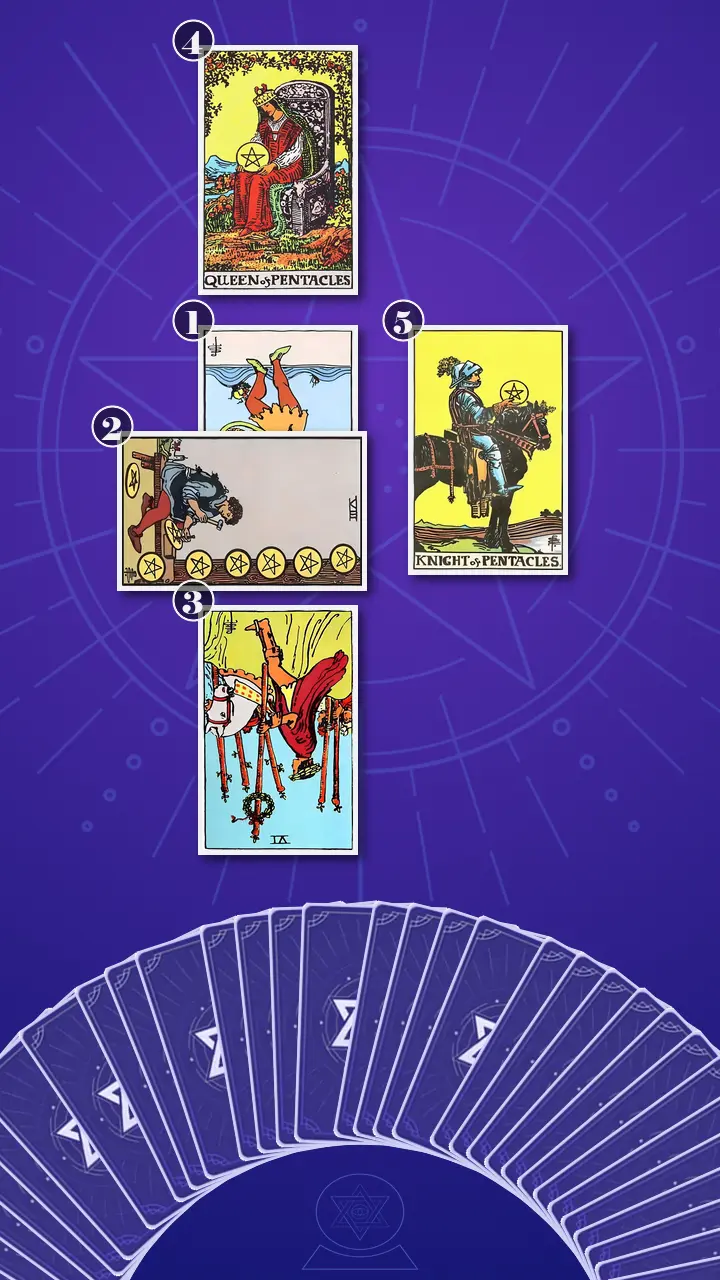
The Cards That Named the Life Admin Crash
The Laundry Chair and the Open Tabs
I turned over the first card, the one representing the observable mismatch between finishing assignments and letting everyday maintenance scatter. It was the Two of Pentacles, reversed.
I did not have to reach far for the translation. This was the exact post-submission hour she had just described: clothes on the chair, low groceries, unread texts, and random admin all demanding attention at once. Nothing in that pile was individually impossible. But her brain could not hold one more moving part, so scrolling or avoidance felt easier than deciding what counted first. The infinity loop around the pentacles became all those never-closed mental tabs. The figure’s raised leg and unstable footing mirrored the way one extra demand could throw off her whole balance.
Reversed, the card showed dysregulated Earth: not a lack of ability, but too many practical needs being held in the head with no rhythm underneath them. It was like carrying a tote bag, a coffee, a phone, and a TTC card through a rushed transfer and knowing something is going to get dropped. I told her, “This card does not say you are bad at life. It says you have been forced to juggle too much of life in real time.”
She looked down at the card and gave me a small, bitter smile. “That’s annoyingly accurate,” she said. Her fingers tapped once against the ceramic cup, then twice, then went still. That reaction matters. It is the moment a person stops arguing with the scene because the scene is already theirs.
The Useful Strength That Turned Into a Tunnel
Then I turned over the card crossing the center, the one revealing the work mode that wins grades but consumes the bandwidth needed for food, rest, home care, and communication. It was the Eight of Pentacles, upright.
This card was Mia in Robarts Library at 3:21 p.m., zoomed to 300% on one paragraph because the rubric was clear, while her water bottle sat empty, her stomach went acidic, and a banking notification about delivery spending and a small late fee got swiped away. The craftsman bent over his bench showed exactly what I needed her to see: competence narrowed to whatever is measurable, gradable, and finishable. In the crossing position, the card did not become bad. It became over-specialized.
Looking at that worker, I had one of those little inner flashes I get from years behind an espresso machine. A good shot can turn bitter if I over-extract it, not because the beans are weak, but because too much is being pulled through too tight a channel. That was her nervous system. Strong attention. Strong effort. Too much pressure through one lane.
I told her, “This is why you can do four clean hours of schoolwork and then feel like groceries, showering, or texting back are somehow impossible. Your best structure is going to the assignment. The rest of life gets mentally cropped out. It’s a little Severance-coded, honestly. Your competent student self is fully online, and your home life barely makes it onto the screen.”
She dragged her thumb along the paper sleeve of her cup and stared past my shoulder for a second. Not disagreement. Recognition with a little grief in it.
The Grade Portal as a Self-Worth Ticker
I turned over the third card below the center, the one naming the fear that competence only counts when it is visible, rewarded, or externally measured. It was the Six of Wands, reversed.
At the root, this card looked exactly like what she had been living: an A- notification can create a clean burst of relief in the chest, but folding one load of laundry feels weirdly flat by comparison. The public victory symbols in this card mattered. Upright, they celebrate witnessed success. Reversed, they show what happens when the mind begins to trust worth only when it comes with proof, a score, or witnesses. Like checking the grade portal the way some people check a stock app, waiting to see if your value is up today.
I leaned back and said it as simply as I could: “If it only counts when it is graded, the rest of life will keep feeling fake.” Then I added the harder part. “That means groceries, sleep, money calm, and one honest reply can all be genuinely important and still fail to emotionally register as success inside your current system.”
Her reaction came in three tiny waves. First her breath caught and held. Then her eyes unfocused, as if she were replaying ten private moments at once: unanswered texts, emergency DoorDash, clean laundry living on a chair. Then she straightened and said, a little sharper than before, “So what, I only know how to care if someone claps?”
I shook my head. “No. I think your brain learned the wrong notification settings. It has been trained to ping for graded tasks and stay silent for private care. That is a measurement problem, not a character flaw.”
That landed. I watched the defensiveness loosen in her jaw by a millimeter. Quiet embarrassment turned into something more useful: understanding.
When the Queen of Pentacles Changed the Standard
The Card Above the Noise
When I reached for the fourth card, even the café seemed to cooperate with the moment. The grinder had gone quiet. The window held only soft streetlight and a blur of passing headlights. By then Mia was back in that 11:47 p.m. room in her head: the paper uploaded, the laptop shut, the fridge humming, the laundry chair in the corner, her own body suddenly loud because the one thing with a grade was finally done.
Your life does not steady by squeezing harder like a machine; it steadies when you hold your needs like the Queen holds her pentacle—close enough to matter before they become a crisis.
I let the sentence sit between us.
Then I brought in one of the lenses I use in both coffee and tarot, what I privately think of as Knowledge Filtration. In coffee, the filter decides the cup before the first sip. It determines what gets through and what gets left behind. Mia had been living with a brutal inner filter: grades, rubrics, and deadlines passed through as real competence, while groceries, clean socks, a filled water bottle, a prescription refill, or one honest text reply were getting trapped on the wrong side as if they were optional residue. The Queen of Pentacles was not asking her to become more impressive. She was asking her to change the filter.
Her reaction unfolded exactly the way deep insight often does. First she went physically still, chin slightly lifted, like her body had forgotten the next instruction. Then her gaze drifted away from me and fixed on nothing, the look people get when old memories start re-captioning themselves. Then her shoulders dropped so suddenly it was almost a collapse. “But if I count that stuff,” she said, and now there was a flash of resistance in it, “doesn’t that mean the bar is embarrassingly low?”
“No,” I told her gently. “It means the old bar only measured performance. Care is not the reward after the real work. Care is part of the real work.”
I watched her eyes redden just slightly. Not tears exactly. More like the dizziness that comes when a burden is lifted and your body has to relearn how to stand without it. She looked at the Queen holding her pentacle close to her body, then at her cooling coffee, then back to the card. I asked, “Think back to last week. Was there a moment when this would have changed how you felt?”
She nodded almost immediately. The night she submitted a paper, opened Uber Eats, ignored Sam’s text for the fourth day, and told herself she would become a better person tomorrow. That was the hinge. So I made the Queen practical. “Tonight,” I said, “choose one make-tomorrow-easier move and do it at 20% effort. Put clothes in the hamper. Leave oats and a bowl on the counter. Fill your water bottle. Send one honest text that says, ‘Late reply, thinking of you.’ Set a five-minute timer and stop when it ends. If your body resists, pause. The goal is contact, not perfection.”
That was the real crossing point of the reading: not from mess to perfection, but from overwhelm and shame after deadlines toward grounded self-trust and steadier everyday care.
The Ordinary Rhythm That Holds
The fifth card went to the right, the one showing the kind of practical rhythm that can make life feel held without relying on panic or deadlines. It was the Knight of Pentacles, upright.
I always love this card because it refuses drama. This was not a 1 a.m. life-reset montage. This was the same grocery slot after Thursday seminar. The same laundry window on Sunday. The same easy breakfast cue. The same tiny reply habit. The still horse told the truth immediately: competence here is pace, not speed. The cultivated field behind the knight said that what steadies a life is repetition, not intensity.
I translated it for her in the plainest language I had. “This card asks one question: can you make support ordinary enough that you still do it on a bad week?” That is the Knight’s whole philosophy. Build the version you can still do on a bad Tuesday.
She gave a slow nod and pulled her phone out, not to disappear this time, but to type. “That,” she said, “sounds way less impossible than getting my whole life together.”
Supportive, Not Impressive: Your Next 48 Hours
Once all five cards were on the table, the story was clean. The visible problem was not that Mia could not handle basic life stuff. The center card showed overload. The crossing card showed task tunnel vision. The root card showed the hidden rule: only what is seen, graded, or praised feels real enough to deserve full energy. That was the hidden hinge. Once that hinge was named, the advice stopped sounding like generic adulting tips and started making psychological sense.
I told her her blind spot was not poor character. It was this: she had been treating ungraded parts of life as optional leftovers and then reading the inevitable crash as evidence against her competence. She kept trying to solve a support problem with performance energy. The reading’s direction was much steadier than that. It asked her to move from performance-based competence to embodied self-stewardship, from panic-driven productivity to supportive-not-impressive routines.
So I gave her a plan small enough to survive finals, part-time shifts, TTC delays, and a tired nervous system. I also gave her one of my café tools, a softened version of my Latte Memory Technique, because a cue that lives next to coffee usually survives a rough morning better than a perfect app.
- Supportive-Not-Impressive Check-InAt about 4 p.m., leaving class, sitting on the TTC, or just before you open a delivery app, ask: What would make tonight materially easier? Choose one answer only: buy two easy groceries, fill your water bottle, clear one desk corner, or send one honest text. Give it five minutes, not an hour.If your brain says this is too basic to count, I would treat that as the pattern speaking, not the truth.
- Two-Anchor WeekFor the next seven days, choose exactly two daily anchors, such as eating within 90 minutes of waking and doing a 10-minute room reset before doomscrolling at night. Track them on one sticky note, in a paper planner, or on a simple phone widget. Do not build a full Notion dashboard for this.If one anchor gets missed, restart at the next one. A routine that shames you is just another deadline in disguise.
- Bad-Tuesday Routine with a Latte Memory CueGive one recurring life task a boring home in your week, like groceries after Thursday seminar or laundry Sunday at 1 p.m. Then tie one tiny care action to the coffee you already make: when the kettle starts, put oats and a bowl on the counter, pack one snack, or move clothes to the hamper. Let the smell of coffee become the cue instead of waiting for motivation.The goal is repeatability on an ordinary Tuesday, not a cinematic reset. If the routine starts feeling punitive, shorten it and keep the cue.

A Week Later, the Quiet Proof
A week later, I got a message from her while I was opening the café. It said, “Did bad-week groceries after seminar. Left oats out before bed. Room still kind of chaotic, but I ate before class and finally texted Sam back.” I smiled into the first espresso of the morning because that is how real change usually arrives: not with a perfect routine reel, but with one less emergency and one more act of self-trust.
She was not transformed into some impossible version of adulthood. She had simply stopped using panic as her only project manager. She slept a full night, woke with the old thought — what if I slip again? — and this time she laughed, made coffee, and put bread in the toaster anyway.
When I think about that session now, I think of what this kind of reading does at its best. A Five-Card Cross tarot spread for student burnout and everyday life imbalance cannot hand someone a new personality. What it can do is show where the shame loop lives, why ungraded tasks start feeling fake, and what kind of next steps create finding clarity without turning care into another performance.
When the assignment is done and the room gets quiet, a lot of us know that jaw-tight, chest-drop moment where laundry, groceries, and unanswered texts suddenly feel like evidence against our whole adulthood.
If one ungraded part of your life got to count as real competence this week, which part would you want to hold like the Queen held her pentacle — close enough to make just 10% easier to care for?