Group Chat Word Count Anxiety—and the Honest Scoreboard Shift

The 9:14 p.m. Group Chat Spiral
I know this pattern on sight: if you can type 'about 1,100 today' into a cohort chat faster than you can write the next paragraph, you are already inside the fake-almost-there loop. Emma (name changed for privacy) joined me from Toronto and, almost before we had finished saying hello, said, 'I lie by rounding up, then I spend the rest of the night trying to earn the lie.' As she described the scene, I could practically sit at that small kitchen table with her at 9:14 p.m.—the WhatsApp ping, Google Docs open to three messy paragraphs, the laptop fan humming, the phone warm in her hand, the radiator hissing behind her. She typed her update wanting to sound calm and dependable while knowing the draft was still mostly scaffolding.
Then came the part that told me exactly where the wound lived: she muted the chat, reopened it twice, and spent forty minutes fixing headings she had not meant to touch. Sometimes the update becomes the work. What looked like productivity from the outside was really performative productivity under pressure, the kind that turns a normal weeknight into a private progress review. Shame, in her telling, was not a vague feeling. It was a hot-screen flush in the face, a chest cinched tight like a drawstring bag, a stomach drop timed perfectly to the notification sound.
I told her I was not interested in scolding the rounded-up number or making her confess anything. I wanted to understand why reporting progress made her panic, why group chat word count anxiety had more power than the page itself, and how we could draw a map from that moment of contraction toward something steadier. 'Let's not chase a better mask,' I said. 'Let's look for the point where your attention leaves the work and starts performing for the room.'

Choosing the Compass: The Shadow Spread for Group Chat Word Count Anxiety
I asked Emma to put both feet on the floor and take one slow breath before we began. While I shuffled, I asked her to hold the question exactly as she had lived it: why do I pretend I am on track when the group chat asks for a number? For me, that ritual is never about theater. It is a way of helping the nervous system stop spiraling long enough to notice its own pattern.
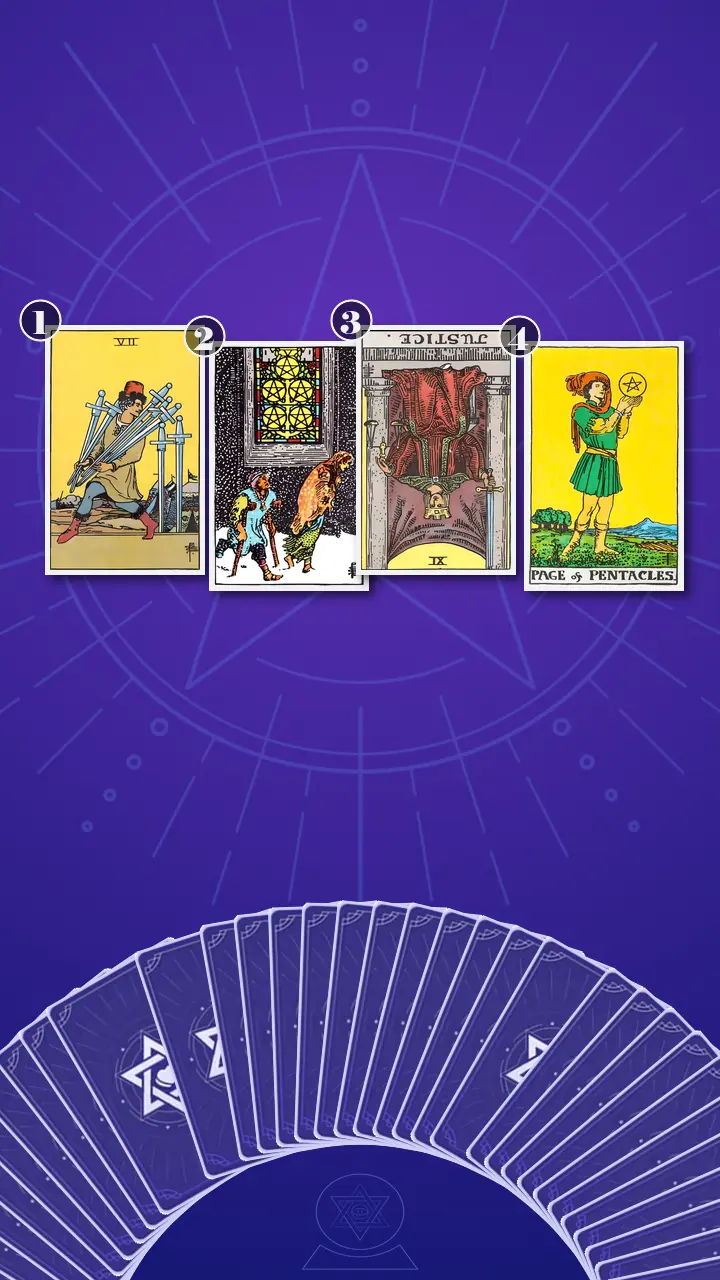
I chose a four-card line called The Shadow Spread · Context Edition. People often ask me how tarot works when the problem is not romance or fate but something as modern as a WhatsApp accountability thread and a Google Docs word count. This is one of the clearest answers I know: tarot works by revealing card meanings in context. I was not using the spread to predict whether Emma would hit a deadline. I was using it to expose the hidden motive beneath a repeated social behavior, because this problem was not really about scheduling. It was about the chain from surface performance, to belonging fear, to distorted measurement, to practical repair.
As I laid the cards from left to right, I told her what I would be watching for. The first card would show the visible coping pattern that appears when accountability becomes social and concrete. The second would reveal the fear underneath it. The third would expose the shadow distortion that keeps the loop repeating. The last card—the antidote—would point to the grounded next step, the move from protecting an image to naming the real starting point and working from there.
Reading the Corridor from Mask to Verdict
Position 1: The Mask That Looks Like Progress
I turned over the first card, the one representing the visible coping pattern from her diagnosis. It was the Seven of Swords, upright.
I told her exactly what I saw in it: the backward glance, the split attention, the nervous strategy of managing exposure. In real life, this card looked almost painfully specific. At 9:14 p.m., the cohort chat asks for numbers. Emma highlights a few rough paragraphs, estimates generously, sends 'about 1.1k today,' and then keeps checking how the message lands while polishing headings she was not even planning to touch. The update is functioning less like communication and more like social camouflage. It had real BeReal-with-retakes energy: technically posted, not actually candid.
Energetically, I read this as an excess of strategic air. Too much mental positioning. Too much attention on how the message will be received. Not enough contact with the task itself. The behavior makes perfect short-term sense—it buys relief. But I told her the cost was steep. The lie buys ten minutes of relief and an evening of distance.
She let out a short, embarrassed laugh and leaned back from the screen. 'That is weirdly specific,' she said. 'Like... rude levels of accurate.' I smiled, because that bitter little laugh is often the first softening. Recognition matters. Once a pattern is visible, it stops getting to masquerade as personality.
Position 2: The Cold Outside the Warm Room
Now I turned over the card representing the hidden belonging fear beneath the polished update. It was the Five of Pentacles, upright.
I slowed down here. Beneath the strategy, this was the cold card. I told her the image always reminds me that shame is not satisfied with saying, 'You are behind.' Shame says, 'You are outside.' In her life, this card appeared the morning after a shift, reopening the chat on the TTC, wet coats and coffee breath in the carriage, fluorescent light making the phone screen look harsher than it should. Other people reply quickly with their numbers, and suddenly she feels as if everyone else is inside the warm room of competence while she is out in the snow trying to look normal.
Energetically, this was deficiency and scarcity. Not a scarcity of talent, but a scarcity story. The deeper fear was not that her word count was low. It was that a low number might quietly cost her belonging. That is why performative progress feels safer than honest progress. The polished update is trying to protect her from the pain of imagined exclusion.
She did not nod right away. Instead, her jaw tightened, then loosened, and she looked down toward her desk as if she had forgotten I could still see her. When she finally spoke, her voice had dropped. 'Yes,' she said. 'I can handle being behind. I hate people knowing I am behind.' That was the card landing where it needed to.
Position 3: Justice Reversed and the Private Courtroom
Then I turned over the card representing the limiting pattern, the shadow distortion that keeps the cycle repeating and turns a neutral number into a personal verdict. It was Justice, reversed.
This was the hinge of the reading, the main blockage. I told her that Justice reversed appears when measurement is no longer serving clarity; it is serving punishment. In her day-to-day life, the word count stops behaving like data and starts acting like a courtroom. Three hundred and twelve words no longer means three hundred and twelve words. It means undisciplined. Unserious. Falling behind again. The scales become a mental spreadsheet weighing whether her day was respectable, and the sword becomes the sentence she passes on herself within seconds.
Whenever I see Justice reversed, I think of the nights I spent calibrating star fields under the planetarium dome. If the projector lens is even slightly off, Orion looks warped across the ceiling—not because the constellation failed, but because the instrument is distorting what it sees. That is what was happening here. Her measuring tool was not the issue. The panic wrapped around it was. A low number is data, not a confession.
I watched that line reach her. First came the visible exhale. Then the stillness. Then the faint narrowing of her eyes that told me her mind was replaying specific evenings all at once. 'The private courtroom part got me,' she said. So I pressed the reframe gently. 'What is true on the page,' I asked, 'without turning it into a sentence about who you are?' Same document. Same number. Different reading. Less courtroom, more lab notebook.
When One Honest Pentacle Held Its Ground
Position 4: Page of Pentacles, Upright
When I turned over the final card, the energy of the reading changed. Even through the screen, I felt the room settle. This was the position pointing to the key shift and the next-step integration—how to move from image protection to one honest, measurable action. The card was the Page of Pentacles, upright.
I told her this was the antidote. Not glamorous. Not cinematic. Almost boring on purpose. In real life, the Page of Pentacles says: report the real count, name one subsection, set a timer, write the next honest paragraph before touching formatting. More Duolingo streak energy than genius montage energy. The Page does not care whether you look advanced in the chat. The Page cares whether you have one real unit of contact with the work. In that sense, the message was simple and exact: a real number is more useful to your growth than an impressive one.
Before I said more, I let the moment breathe. She was still caught in that 9:14 p.m. reflex, where the message started to matter more than the draft and sounding dependable felt safer than being measurable.
Stop defending the image of progress; hold one honest pentacle at a time and let real effort, not performance, rebuild your self-trust.
I let the sentence sit between us for a beat, then added, 'An honest number may feel less flattering for a minute, but it gives you something a polished fiction never can: a real place to stand.'
Her reaction came in a clear three-step wave. First, she froze—breath suspended, fingers hovering above the mug by her keyboard. Then her gaze drifted slightly off-screen, unfocused in that way that tells me someone is replaying a memory frame by frame: the WhatsApp bubble, the hot face, the edit spiral, the quiet promise to catch up tomorrow. Only after that did the feeling break open. Her shoulders lowered, but not all at once; it was the careful unclenching of someone who has been bracing for impact so long that relief feels almost suspicious. 'But if I send 312,' she said, and there was a flash of resistance in it, almost anger, 'doesn't that prove exactly what I'm afraid of?'
That was where I brought in the lens I use most often in readings like this, the one I call Black Hole Focus. After ten years guiding people through the night sky, I have learned that attention follows gravity. When shame becomes the singularity, everything bends toward the audience—other people's replies, imagined rankings, the performance of competence. Nothing reaches the actual work. The Page of Pentacles asks for a new event horizon: one subsection strong enough to keep your attention from escaping into comparison. 'No,' I told her. 'Three hundred and twelve proves only that three hundred and twelve words exist. That is not a verdict. That is a coordinate.' Then I asked, 'Using this new lens, can you think of a moment last week when the night would have felt different if the number had been allowed to stay just a number?'
That was the breakthrough of the reading. Not certainty—something better. A small movement from notification dread and shame-driven image management toward grounded self-respect and steady self-trust. I told her that she could test the card within the next ten minutes, privately if needed: open the document, write down the exact word count in her notes app, add one neutral context line such as 'worked a shift, got stuck on methods, rewrote the intro twice,' then set a ten-minute timer and write only the next paragraph or even the next three sentences. No formatting. No heading fixes. No backspacing into the first page. If her body felt flooded, two minutes would still count. The point was not to impress the chat. The point was to return to reality.
The Honest Scoreboard Method
Once all four cards were on the table, the story they told was clean. The Seven of Swords showed the performance mask: sounding on track instead of being on track. The Five of Pentacles showed why the mask felt necessary: the fear that slower progress might mean social exile. Justice reversed revealed the engine under both: a neutral metric had fused with identity, so the count itself felt unsafe. And the Page of Pentacles offered the repair: honest tracking, modest effort, repeatable contact.
The blind spot was not laziness. It was the belief that a more polished impression would create more safety. In practice, it was doing the opposite. The transformation direction was clear: move from protecting a competent image to naming the real starting point and taking one measurable step from there. You do not need a better mask. You need an honest scoreboard. Real progress is usually less pretty and more useful.
When Emma told me, 'But I don't always have twenty-five clean minutes after my shift,' I did not widen the plan. I shrank it. The Page of Pentacles never asks for a heroic rescue. It asks for a repeatable rep. This was the method I gave her:
- Context-Plus-Count Check-InAt the end of each writing session, record the exact word count once in your notes app or a plain spreadsheet. If the chat asks for numbers, send the real count plus one neutral context line, such as '312 today, got stuck on the transition after my shift.'Check the count only at the end of the session, and if public honesty feels too activating, keep the number private for a few days first.
- One-Pentacle Writing BlockBefore you begin, choose one subsection only—methods paragraph 2, lit review transition 1, or the next three sentences of a rough section. Set one draft-only timer for 10 to 25 minutes and write forward without fixing headings, references, or the first paragraph.If your brain says the block is too small to matter, that is the sign it is the right size. Use a simple phone timer or a Forest-style focus app and let small count as real.
- Private Courtroom ResetAfter every count this week, add one neutral sentence about the conditions and one next smallest step: 'worked 4 to 8,' 'got stuck choosing sources,' or 'drafted but did not edit; next is the methods transition.'Keep it weather-report neutral, not defensive. If you feel the urge to tidy instead of draft, use my Shooting Star Notes trick: take 30 seconds to capture the next raw sentence before touching the formatting.
I told her these were not productivity hacks in disguise. They were a way to separate facts from self-judgment and stop giving the best of her attention to the performance of being okay.

A Week Later: The Quiet Proof
A week later, she messaged me: 'Sent 347 after my shift. Felt sick for thirty seconds. Then I wrote the transition.' She slept properly that night; in the morning the old thought returned—'what if I'm behind?'—but this time she smiled and opened the draft anyway.
I loved that update because it was small and therefore trustworthy. No miracle, no overnight reinvention. Just the first visible proof of the journey we had mapped together: from performance mask to honest progress, from private courtroom to neutral tracking, from shame-managed image to steadier self-respect.
When a tiny word-count check makes your chest feel like it is being measured too, of course the safer number can seem easier to say than the true one.
If tonight's real number did not have to prove anything about you, what would the next honest paragraph ask from you?