From 1 a.m. Compile Panic to One-Hypothesis Debugging at Night

The 1 a.m. Build That Felt Like a Verdict
If you’ve ever told yourself “one last build before bed” and then looked up to realize it’s 2 a.m. and you’re deep in a debugging spiral, you know the specific kind of panic that comes with a compile error.
Jordan (name changed for privacy) slid into the corner chair in my café like they’d been carrying a laptop in their ribcage all day. Outside, the street was quiet in that downtown-Toronto way—condo lights still on, but the city holding its breath. Inside, my espresso machine hissed softly, the kind of steady sound that makes your nervous system unclench even when your brain refuses to.
“It was 1:03 a.m.,” Jordan said, eyes flicking down like they could still see the terminal glow. “Laptop on my knees, the fan ramping up, cold coffee that tasted like regret. I ran the same build command again. And again. And then I started… tweaking. Tiny edits. No plan.”
They held their jaw like it was bracing for impact. Shoulders tight. Fingers restless—keyboard to trackpad, trackpad to phone, like their body was trying to keep the panic moving so it wouldn’t pool anywhere.
“It won’t compile,” they said, and the words landed heavy. “And at 1 a.m. it stops being about code. It turns into… ‘If I can’t fix this fast, I’m not actually good at this.’”
I’ve watched people do this with a dozen different life problems—relationships, rent, careers. But late-night debugging has its own particular cruelty: the screen is bright, the room is dark, and your mind starts treating uncertainty like a personal threat. Panic, in that moment, isn’t a feeling. It’s like your thoughts become a swarm of tiny wasps under your skin—no single sting is lethal, but you can’t find the off switch.
“Okay,” I said gently, letting my voice stay practical. “We’re not going to fix your worth tonight. We’re going to find you a method. Let’s make a map through this—your own Journey to Clarity—so the next time code won’t compile at 1 a.m., you have a next step that isn’t spiraling.”

Choosing the Compass: The Transformation Path Grid for a Real Next Step
I asked Jordan to take one slow breath—not as a mystical thing, just as a context switch. Then I shuffled my deck on the worn wooden table near the pastry case. The air smelled like toasted almonds and dark roast; it’s hard to catastrophize at full volume when your senses have something warm and real to hold onto.
“For this,” I said, “I want to use a spread I call the Transformation Path Grid (6) · Context Edition.”
To you reading this—especially if you’re here because you’ve searched some version of ‘code won’t compile and I’m panicking at 1am’—here’s why this spread works. This isn’t a yes/no question, and it’s not about predicting whether you’ll ‘figure it out.’ It’s about interrupting a late-night compile error debugging spiral and restoring a clean, repeatable debugging method. The grid format helps because it reads like a small incident-response board: diagnose what’s happening, name the blocker, find the root driver, then install a stabilizer and a boundary.
“Top row,” I told Jordan, tapping the table as if laying out a Kanban: “what the spiral looks like, what jams you, what’s driving it underneath. Bottom row: the stabilizing pivot, the one thing you can do tonight, and how to integrate a better mindset going forward.”
Jordan nodded, but I could tell they were still half in last night’s terminal window. That’s normal. When your nervous system is still acting like the build is an emergency, you don’t need more motivation. You need containment.
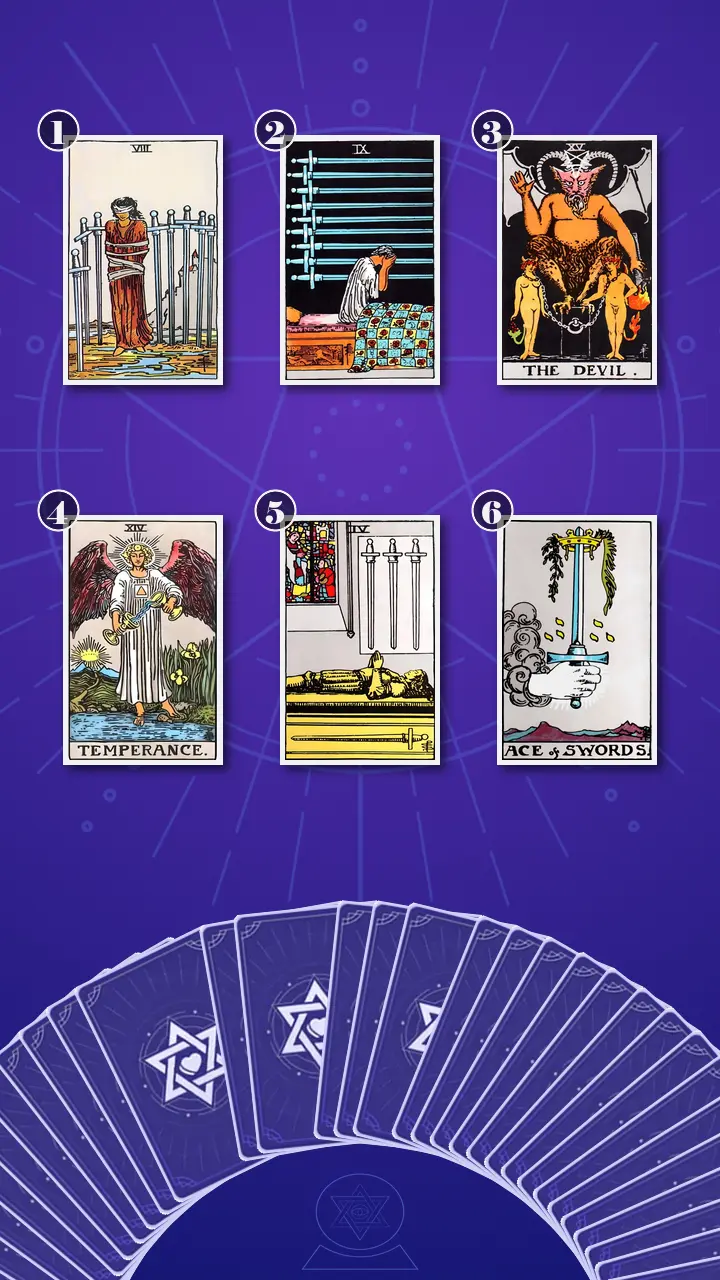
Reading the Map: Many Swords, Many Tabs, and the Moment You Can Choose One Line
Position 1: What the Spiral Looks Like on Screen and in Self-Talk
“Now we’re turning over the card that represents what the spiral looks like right now—your observable behavior and the sentence your brain repeats when the code won’t compile at 1 a.m.”
Eight of Swords, upright.
The image is a person surrounded by swords, blindfolded, loosely bound. I watched Jordan’s eyes narrow, like they recognized it before I said a word.
“This is exactly that 1:05 a.m. moment,” I said, using the card’s modern translation because it fits like a glove: “You keep staring at the same error line, convinced there’s only one acceptable move: fix it tonight. You know you could revert the last commit or create a tiny repro, but your brain labels those as ‘wasting time’ or ‘admitting you’re stuck,’ so you stay trapped in tiny edits and reruns.”
In energy terms, Eight of Swords is blockage—not because you have no options, but because panic narrows the menu until the only thing that feels ‘safe’ is more pushing.
I leaned in a little. “The blindfold is tunnel vision. The loose bindings matter. They’re not tight. They’re just… convincing.”
Jordan let out a small laugh—sharp, almost bitter. “That’s messed up,” they said. “It’s true, but it’s messed up. Like… I’m doing it to myself.”
“Not on purpose,” I replied, steady. “Your brain is trying to protect you from a feeling: ‘What if I’m not competent enough?’ Eight of Swords is where we name the pattern so it becomes interruptible.”
Position 2: The Immediate Jam That Turns Debugging into Rumination
“Now we’re turning over the card that represents the immediate blocker—the jam where reasoning turns into spiraling.”
Nine of Swords, upright.
This card always feels like a cinematic close-up: darkness, someone sitting upright in bed, nine swords hanging like a threat you can’t turn off. And in this context, it’s painfully literal.
“You’re not just debugging,” I said. “You’re doom-looping. The screen glow feels harsh, your eyes are dry, and each failed build triggers a new storyline: deadline, team judgment, ‘I’m behind.’ You reread logs like punishment and open more tabs because stopping feels unbearable—even though your reasoning quality is actively dropping.”
The café’s HVAC clicked on, that low hum like a distant server room. For a second, it made the moment feel even more real—like the environment was co-signing what the card was saying.
“More tabs isn’t more clarity—it's more noise,” I added, because sometimes the simplest sentence is the one that lands.
In energy terms, Nine of Swords is excess—too much mental pressure in a body that’s already out of fuel. It’s your mind escalating the stakes and calling it problem-solving.
Jordan swallowed. Their gaze slid away from the card and then back, like they were watching themselves at 2:10 a.m. from across the room. “It’s like I’m… punishing myself,” they said quietly. “And I keep telling myself I’m being responsible.”
“That’s the jam,” I said. “At night, responsibility can get hijacked by anxiety. The card isn’t shaming you. It’s naming the moment your brain stops being a reliable narrator.”
Position 3: The Root Driver Underneath the Spiral
“Now we’re turning over the card that represents the deeper root driver—the attachment or fear that keeps you glued to the laptop.”
The Devil, upright.
Jordan’s fingers curled in a reflex, like they wanted to close a laptop that wasn’t even open.
“The Devil is about chains,” I said, “but notice: they’re loose. The trap is partly an illusion—and that’s not a moral judgment. It’s a diagnostic.”
I used the card’s modern scenario because Jordan had basically spoken it already: “Under the spiral is an attachment: ‘If I fix it now, I’m safe; if I can’t, I’m not cut out for this.’ So you keep compiling like it’s a test of your legitimacy. You’re exhausted, you know you’re making it worse, but you can’t let go because the compiler has become the thing you’re chasing for self-esteem.”
In energy terms, this is over-attachment—the build passing as emotional permission to feel okay. The compiler as approval. A dopamine loop dressed up as diligence.
I kept my voice quiet and direct. “This isn’t about code quality—it’s about what you think passing the build proves.”
Jordan flinched—just a tiny recoil—then exhaled through their nose. “Yeah,” they said. “If it doesn’t compile, it feels like I don’t exist.”
I’ve pulled espresso for two decades. I know what compulsion looks like. It’s the customer who says, ‘Just one more,’ not because they love the taste, but because they’re trying to outrun a feeling. The Devil is that moment in tarot form: your body moving, your mind bargaining, your worth on the line.
Position 4: When Temperance Poured Between Two Cups
“Now we’re turning over the card that represents the key stabilizing shift—the process pivot that changes how you relate to the problem.”
Before I even flipped it, the space felt different. Like the café got a little quieter, like the espresso machine decided to listen.
Temperance, upright.
Temperance is an angel pouring liquid between two cups—slow, deliberate, exact. One foot on land, one in water. A path toward sunrise. It’s not ‘calm down’ energy. It’s regulated energy.
“Here’s the pivot,” I said, and I could feel Jordan trying to brace—like method might mean admitting last night was out of control. “Instead of thrashing, you switch to calm incident-response mode. You open one note and split it into two columns: Evidence and Experiments. One hypothesis, one test. One build. Record the result before touching anything else.”
In energy terms, Temperance is balance—the shift from chaotic motion to controlled iteration. Debugging as measured experimentation, not emotional negotiation.
Jordan’s eyebrows lifted, but their mouth tightened. “That sounds… slow,” they said, and there was a flash of anger under it. “Like, if I slow down, I fall behind. People expect me to just know.”
That was the unexpected reaction I always listen for—the part of someone that doesn’t want the medicine because it’s afraid the medicine confirms something. I didn’t argue with it. I named it.
“Of course it sounds slow,” I said. “Spiral-speed feels like control. But it’s fake control. It’s like doomscrolling: the more you scroll, the less coherent your feed becomes. Same with your hypotheses.”
Then I let my own café-brain step in—my Knowledge Filtration skill, the way I think in filters because I’ve watched coffee and information behave the same way. “When you have grounds floating everywhere, you don’t fix it by stirring harder,” I told Jordan. “You fix it by filtering. A coffee filter doesn’t add more coffee. It removes noise so the flavor becomes readable.”
I nodded toward the card. “Temperance is your filter. Evidence stays evidence. Experiments stay experiments. Anxiety doesn’t get to pour itself into both cups.”
Jordan’s body went through a three-beat shift as it landed: first, a tiny freeze—breath held, eyes fixed on the angel’s hands. Second, cognition seeped in—their focus softened, like they were replaying last night’s fifteen-tab chaos. Third, emotion released: a long exhale that lowered their shoulders by a full inch.
And then I delivered the line that matters most—word for word, because it’s the hinge of the whole reading:
Stop treating the compiler like a judge and start treating your next change like Temperance’s careful pour—one measured transfer between evidence and experiment at a time.
The sentence hung there. Even the milk steamer sounded gentler for a second, like the room was agreeing to a ceasefire.
Jordan blinked fast, eyes a little bright. Their hands—still restless—finally settled flat on the table, palms down, like they were anchoring themselves in something solid. “Okay,” they said, voice quieter. “So… one doc. Not fifteen tabs.”
“Yes,” I said. “Many tabs is many swords. Temperance is one calm checklist.”
I leaned in and asked the question that turns insight into something personal: “Now, with this new lens—think back to last week. Was there a moment where you kept rerunning the build because you couldn’t name your hypothesis? If you’d had the ‘two cups’ then, what would you have written under Evidence, and what would your single next Experiment have been?”
Jordan stared past the card for a moment, like their brain was scrolling backward through time. “Wednesday,” they said. “I kept thinking… if I don’t fix it tonight, I’ll look incompetent tomorrow. But honestly? If I’d snapped the error and stopped, I’d have solved it in the morning in like… twenty minutes.”
That was the emotional transformation beginning to turn: from panic-driven late-night urgency toward grounded curiosity. Not because the problem disappeared—but because their identity stopped being the battlefield.
Position 5: The Permission Slip That’s Actually an Engineering Move
“Now we’re turning over the card that represents the most workable next step you can do tonight—the action that prevents spiraling while protecting tomorrow’s success.”
Four of Swords, upright.
This card is stillness. Rest. A sword held in reserve. And in a developer’s life, it’s not ‘self-care’ as a moral. It’s containment.
“Four of Swords reframes stopping as skill,” I said. “Tonight’s move is to stop on purpose, not crash from exhaustion. You paste the error into a note, write what you last changed, list one next test for the morning, then close the laptop. The boundary is the method.”
In energy terms, this is balance through pause—turning Air-chaos into Air-clarity by creating recovery space. Like freezing the state before a risky deploy.
I heard the little click of a customer’s laptop lid closing across the room—an accidental sound cue, perfectly timed. Jordan looked toward it like it was permission embodied.
“No hypothesis, no heroics,” I said, giving them a rule simple enough to use while tired.
Jordan’s shoulders trembled with a half-laugh. “That… is extremely my problem,” they admitted. “I keep trying to hero it.”
“Heroics are expensive at 1 a.m.,” I replied. “Four of Swords is how you rotate off duty.”
Position 6: Morning Light and One Clean Sentence
“Now we’re turning over the card that represents integration—how to carry this forward into a repeatable mindset.”
Ace of Swords, upright.
One sword. One crown. Clear sky. After all those earlier swords—eight, nine—this is the opposite of a wall of output. It’s one line of truth you can actually use.
“In the morning,” I said, “you come back with fresh eyes and rewrite the problem in one sentence. You pick the smallest test that could disprove your top hypothesis, run it once, and suddenly the ‘wall of output’ becomes a solvable puzzle again—because the work is defined, not fought.”
In energy terms, Ace of Swords is clarity—not the kind that arrives from pushing harder, but the kind that arrives after you stop mixing anxiety into the method.
Jordan nodded slowly. “It’s like… I don’t need a miracle,” they said. “I need a method.”
From Insight to Action: The Two-Cup Debugging Protocol (and the Snapshot-Then-Sleep Boundary)
I slid the cards into a neat rectangle again—top row, bottom row—like an incident panel you can actually run when you’re tired.
“Here’s the story your spread tells,” I said. “At 1 a.m., Eight of Swords shows you trapped in tunnel vision: only ‘keep pushing’ feels safe. Nine of Swords shows the immediate jam: the tired brain turning an error into a catastrophe and calling it responsibility. The Devil names the engine underneath: competence-based self-worth—passing the build as emotional approval. Temperance is the bridge: a regulated process pivot that separates evidence from experiments. Four of Swords makes the pivot real with a boundary—freeze the state, stop on purpose. And Ace of Swords is what you regain: one clean sentence, one falsifiable test, one clear next step.”
“Your blind spot,” I continued, “is believing that urgency equals competence. It doesn’t. The transformation direction is exactly what we saw in Temperance: stabilize first, then debug with one hypothesis and one controlled change.”
I pointed at the espresso bar. “In my world, if I’m dialing in a new bean and I change grind size, water temperature, dose, and timing all at once, I can’t learn anything. I’ll just feel busy. Temperance says: don’t do that to your code.”
Then I gave Jordan the next steps—small enough to do tonight, structured enough to stop the spiral.
- Two-Cup Debugging Note (7 minutes)Open ONE note titled “Two-Cup Debugging.” Make two sections: Evidence (exact error, command run, branch/commit, last known good state) and Experiments (ONE hypothesis + ONE test).If your brain says “this is too slow,” that’s the spiral protecting itself. Lower the bar: three bullets is enough.
- One-Sentence Hypothesis (or Stop)Write: “I think the build fails because ___.” If you cannot fill the blank in one sentence, your next action is not another build—it’s a snapshot and stop.Use the rule: No hypothesis, no heroics. It’s a stopping rule, not a personality critique.
- One Controlled Change, One Build, One NoteChoose ONE controlled change (revert the last commit, comment out one import, pin one dependency version), run the build once, and record the result before you touch anything else.If you feel the urge to open a new tab, delay it by 5 minutes. Run one local test first; then allow one targeted search query with the exact error in quotes.
- Stop Rule Snapshot + Laptop Lid ClosePaste the exact error, write “Next test tomorrow:” and list ONE experiment. Then close the laptop and move it out of reach.Treat it like incident containment: you’re preserving signal for tomorrow’s brain, not “giving up.” Snapshot it, then let tomorrow’s brain take the next shift.
Jordan hesitated at the “close the laptop” part—like their nervous system wanted to argue.
“Can I ask something practical?” they said. “What if I’m too wired to sleep anyway?”
“Real question,” I said. This is where my café-life and my tarot-life overlap. “This is also where my Focus Period Diagnosis comes in. Your brain has a caffeine-sensitivity window. At 1 a.m., the problem isn’t that you need more focus—it’s that your focus is chemically and emotionally overdrawn.”
I kept it simple and harm-reducing. “So if you can’t sleep right away, don’t punish yourself with more tabs. Do the snapshot. Then do three phone-free minutes: water, bathroom, lights low. Let your nervous system get the memo that the incident is contained.”
Jordan nodded, and I watched something shift from self-judgment to self-leadership. Not perfect. Not dramatic. Just… usable.

A Week Later: The Quiet Proof
Five days later, just after my morning rush, I saw Jordan’s message pop up.
“I did the Two-Cup note,” it read. “At 12:58 a.m. I wanted to keep going, but I wrote the snapshot and stopped. In the morning, I opened the note before the browser. One sentence. One test. Fixed it in 18 minutes. I still felt the ‘verdict’ feeling for a second… but it didn’t run the show.”
I stood there behind the counter, coffee grounds on my hands, and I felt that familiar satisfaction—the kind I get when a regular tries a new blend and realizes their taste buds can trust themselves. Clarity isn’t a lightning bolt. It’s a repeatable process you can do even when your brain is tired.
That’s what this Journey to Clarity was really about: not forcing a compile error to surrender at 1 a.m., but shifting from panic-driven urgency into grounded curiosity and quiet confidence—because you have a method that doesn’t require you to gamble your self-worth on a single build.
When it’s 1 a.m. and the build won’t compile, it can feel like the error isn’t in your code—it’s in your worth, and that’s why your hands keep moving even after your brain stops seeing straight.
If you trusted—just for tonight—that your competence isn’t decided by a single build, what would be the smallest “snapshot and stop” move you’d let yourself take?