From Instant Slack Panic to Sustainable Responsiveness: The 60-Second Pause

Finding Clarity in the 8:47 a.m. Slack Ping
You’re a hybrid tech PM in a big city and a single Slack DM—“quick call?”—turns your whole day into a live competence test (instant-message performance pressure).
Jordan appeared on my screen from a small Toronto condo kitchen, shoulders angled toward two monitors like she was bracing for impact. Slack was open on the left. Google Calendar on the right—solid blocks of color, no white space. The radiator clicked in that dry, impatient way radiators do, and her coffee sat ignored, already going lukewarm.
“It’s the vagueness,” she said, voice flat but eyes too alert. “If there’s no agenda, my brain fills in the worst one. My body hears ‘quick call?’ as ‘test.’”
I watched her jaw tighten on the word test, like her teeth were trying to hold a door closed. Her hand hovered near the keyboard, fingers slightly curled—half ready to type “sure,” half ready to run.
“So the question you’re bringing,” I reflected back to her, “is why that two-word ping flips a switch—why you say yes instantly, jump on without scoping, and then you do a whole second shift afterward trying to make it bulletproof.”
Jordan nodded once. Not agreement—recognition. “I don’t even know what I’m agreeing to,” she said, “but I say yes anyway.”
The dread in her wasn’t abstract. It sat like a tight band across her chest, a buzzy urgency under the skin—like a push notification her nervous system treated as an emergency alert. And under it, I could hear the core contradiction humming: she wanted to be seen as reliable and on top of things—but she feared that any pause, boundary, or clarifying question would make her look incompetent or replaceable.
“Okay,” I said gently, letting my voice be the hand on the rail. “Let’s not argue with your nervous system today. Let’s map it. We’re going to do a Journey to Clarity—figure out the pattern, the root driver, and the smallest real-time interrupt that actually works in a Slack-driven workplace.”

Choosing the Compass: The Celtic Cross · Context Edition
I asked Jordan to take one slow breath—not as a mystical ritual, but as a clean transition between reacting and observing. On my side of the call, in Tokyo, it was late; the planetarium dome I work under by day was long dark, but I still felt that familiar comfort of timed cycles—things moving in patterns, not personal attacks.
I shuffled slowly, the way I do when I’m trying to give someone’s mind a softer landing. “Today we’ll use a spread called the Celtic Cross · Context Edition,” I told her.
And for you reading along: I chose this version because Jordan’s question isn’t “Which option should I pick?” It’s “Why does this loop keep running?” The Celtic Cross is one of the best maps for a self-reinforcing pattern—moving from the immediate trigger, to the pressure that crosses it, to the unconscious driver underneath, and then forward to an actionable pivot point. In this context edition, the last two positions are tuned ethically: position 9 reveals what the overwork is trying to protect, and position 10 becomes an integration direction rather than a fixed prediction.
“We’ll read from the center outward,” I said, “like walking from a crowded notification hub to a higher vantage point.” I tapped three points on the table as I spoke: “First card is the exact trigger response. The card beneath shows the root ‘why.’ And the near-future card shows the smallest pivot that can interrupt the chain reaction.”
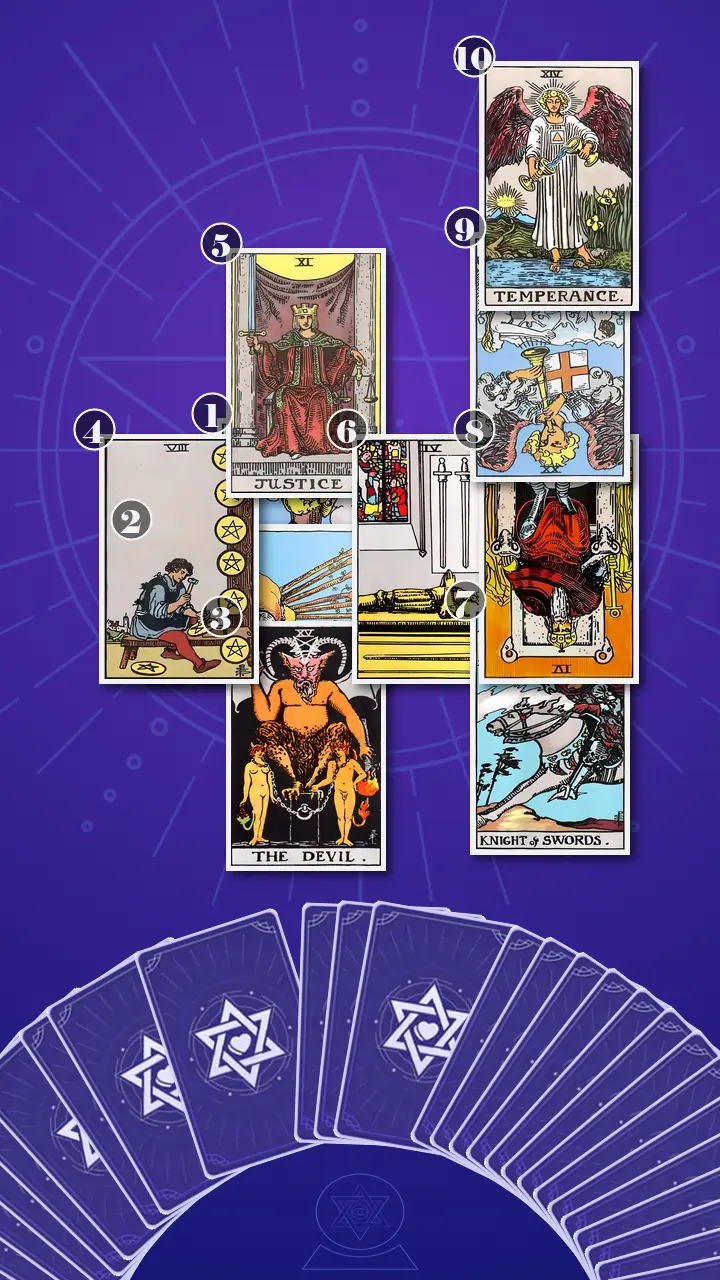
Reading the Map: How Tarot Works in a Slack-Driven Loop
Position 1 — The trigger you feel in the first three seconds
“Now flipped,” I said, “is the card that represents the exact present-moment trigger and your immediate internal reaction to ‘quick call?’.”
Page of Swords, upright.
“This is the notification posture,” I told her, and I angled my camera slightly so she could see the image clearly: the Page standing in wind, sword raised—not attacking yet, but ready. “In modern life, it’s exactly what you described: you see ‘quick call?’ and instantly sit up straighter, open five tabs, and start drafting an answer before you even know the question.”
Energy-wise, the Page is Air in excess: alertness tipped into hypervigilance. The mind decides that speed equals safety. And the moment that belief clicks, your body responds like it’s on call for an emergency.
I asked, “Think of the last time it happened. In the first three seconds, what did you assume was at stake?”
Jordan didn’t hesitate. “Credibility,” she said. “Like—if I’m not instantly helpful, I’m failing.”
Her fingers flexed once, then went still. That tiny movement told me the Page wasn’t just a card—it was her nervous system doing its job too well.
Position 2 — Where the 10-minute ask turns into a two-hour drain
“Now we’re looking at what crosses the situation: the immediate block that turns a small request into an overwork spiral,” I said.
Ten of Wands, upright.
“This,” I told her, “is when a ‘quick call’ becomes a bundle added to your arms.” And I used the translation that fits her life: “Call ends → Slack recap draft → Jira tickets → ‘just one more clarifying message’ → and suddenly it’s 9:47 p.m.”
Jordan let out a laugh—one sharp little sound, half disbelief, half grief. “That’s… kind of brutal,” she said. “But yeah. I’ve turned ten minutes into two hours. More than once.”
That laugh was the moment her shame loosened enough to become information. The Ten of Wands is Fire in excess: responsibility and effort without a container. The more you carry, the less you can see. The card literally shows a blocked line of sight—arms full, head down—like overwork narrowing your perspective until everything feels urgent and personal.
Under her laugh I could hear the inner operating system line: If I close the loop perfectly, no one can poke holes in it.
“And what does it cost you?” I asked softly.
She swallowed. “Everything that’s not work gets pushed to late night,” she said. “And then I hate my laptop… and I open it again.”
Position 3 — The root driver: why you feel like you can’t pause
“Now flipped is the hidden root driver of the overwork loop—the ‘why it keeps happening’ layer,” I said.
The Devil, upright.
In my work at the planetarium, I teach people to recognize the difference between a star and a satellite: one is a fixed light with its own gravity; the other looks urgent because it’s moving fast across your view. The Devil is that kind of illusion—something that feels like an external force, but is often an internalized rule with a loose chain.
“The chains here are the giveaway,” I told Jordan. “They’re not welded shut. They’re self-imposed rules about responsiveness. Worth equals availability. Safety equals being indispensable.”
And translated into her Slack life: “This is like when you know you could ask for an agenda, but your fingers type ‘sure!’ anyway because not being instantly helpful feels dangerous.”
Energy-wise, this is attachment—a compulsion loop. Not because you’re weak, but because the loop pays out a short-term reward: you avoid awkwardness, you avoid silence, you avoid the terrifying possibility of being seen as ‘not on top of it.’
“If you didn’t respond instantly,” I asked, “what’s the feared outcome your mind paints?”
Jordan stared at the card a second too long. “That they’ll think I’m… behind,” she said. “Or that I’m not good. And then it’ll snowball.”
Her jaw clenched again—Devil chain, tightened.
Position 4 — The conditioning: how ‘good work’ turned into ‘endless work’
“Now we’re looking at the recent conditioning that trained the pattern,” I said.
Eight of Pentacles, upright.
“This is the grind that built your competence,” I told her—no sarcasm, because I respect this card. “It’s craftsmanship. It’s the part of you that cares. It’s also the part of you that learned: effort equals worth.”
In her life translation: “You have a strong work ethic and you genuinely care about quality, but it also makes you default to ‘I’ll just handle it’ whenever something pops up.”
Energy-wise, this is Earth in balance—until it gets recruited by the Devil and Ten of Wands. Then it becomes over-functioning: you try to carve your way to safety, one more pentacle, one more artifact, one more recap message.
I nodded toward her Notion window peeking behind Slack. “Notion pages titled something like ‘Meeting Notes (please don’t judge)’—that’s Eight of Pentacles energy trying to control perception.”
Jordan’s mouth twitched. “I literally have one called that,” she said, and her shoulders dropped a millimeter—the tiniest relief in being accurately seen.
Position 5 — The standard you’re trying to live up to
“Now flipped is the conscious standard you’re trying to live up to when you over-respond,” I said.
Justice, upright.
“You want clear standards,” I told her. “Fair expectations. A sense that you’re doing the right thing.”
And the modern translation landed easily: “This is like wanting a simple, fair operating system for Slack requests—so you don’t have to guess what ‘good enough’ looks like every time.”
Justice is Air in balance when it’s healthy: discernment. But under pressure, Justice can become rigid—an inner rulebook that says: Be correct. Be responsible. Don’t give anyone a reason to doubt you.
“Here’s the thing,” I said. “Justice can’t deliver certainty in an ambiguous system. So you try to earn certainty with effort.”
Jordan looked down, then back up. “Yeah,” she admitted. “I’m trying to be perfectly accountable for… messy inputs.”
Position 6 — The pivot: the smallest interrupt that works in real time
“Now flipped is the near-future pivot—the smallest change that can interrupt the loop in real time,” I said.
Four of Swords, upright.
I felt the whole reading exhale here. “This is your medicine,” I told her. “Not a week off in Bali. A deliberate pause—small enough to actually do—right at the moment you get pinged.”
I described it the way the body understands: “Like putting your phone face down before you answer a tough text. Slack chime hits. Screen glow feels harsh. And instead of snapping your fingers into ‘sure,’ you take one breath. You unclench your jaw. Your shoulders drop.”
Then I said the line I wanted her to keep: “Clarity is not pushback. It’s scope.”
“In Toronto tech Slack,” I added, “a normal, non-defensive script can be: ‘Happy to chat—what’s the goal for the call, and can we timebox 15 minutes? I can do 2:30 or 4:00.’ That’s not you being difficult. That’s you being a PM.”
Jordan’s eyes softened, like she’d been offered a third door besides drop everything or ghost them. “Oh,” she said quietly. “There’s a move here.”
As she spoke, I noticed her hand finally rest flat on the table instead of hovering. That’s what Four of Swords does—it creates a protected pocket of time where your mind can regain perspective before acting.
Position 7 — Your default move under pressure
“Now flipped is your role in maintaining the loop—your default move when pressure hits,” I said.
Knight of Swords, upright.
“This is the part of you that charges,” I told her. “You move fast. You prioritize immediacy. You treat conversation like a problem to solve live.”
Her modern translation was almost word-for-word her life: “You accept the call instantly, talk fast, volunteer solutions, and only afterward realize you committed to more than was necessary.”
Energy-wise, this is Air in excess again: speed as identity. The Knight is impressive—and exhausting. In a Slack-triggered loop, the Knight keeps winning battles that were never declared wars.
Jordan rubbed her temple. “I can feel myself doing it,” she said. “Like my brain is trying to be the fastest thinker in the room.”
“Exactly,” I said. “And speed becomes a form of reputation insurance.”
Position 8 — The context: why your workplace makes it worse
“Now flipped is the workplace context that fuels the pattern—signals, culture, authority dynamics,” I said.
The Emperor, reversed.
“This is the part that’s not ‘all in your head,’” I told her immediately, because I could feel her trying to make it purely personal. “Reversed Emperor is unreliable structure: unclear authority, shifting expectations, rules that are implied but not stated.”
I painted the contrast like an A/B test: “In one workplace, calls come with an agenda, a timebox, and an async-first norm. In the other, ‘quick call?’ is a summons, and you’re expected to read between the lines while playing calendar Tetris and somehow still shipping.”
Jordan’s expression changed—not relief exactly, more like validation. “It’s… the second one,” she said. “The rules change depending on who’s asking.”
“And here’s the compensation move,” I said. “When structure outside feels inconsistent, you try to become the structure yourself—by over-documenting, over-prepping, and over-following up.”
She nodded slowly, like something clicked into place that wasn’t self-blame, just system logic.
Position 9 — What you’re protecting: the hope/fear under the reflex
“Now flipped is what you’re trying to protect by overworking—the inner hope/fear underneath the reflex,” I said.
Judgement, reversed.
I let the word Judgement sit between us for a beat. In the Rider-Waite image, there’s a trumpet—a call. In Jordan’s life, the trumpet is a Slack ping.
“This is tender,” I said. “Because reversed Judgement isn’t ‘you’re being judged’—it’s that you’re running an inner courtroom after every interaction.”
And I slipped into the echo technique on purpose, so she could feel the loop rather than intellectually label it:
You hear the trumpet blast—‘quick call?’—and you don’t just hear a request. You hear a summons. You stand up inside yourself like you’ve been called to the stand. You start gathering evidence: extra notes, extra follow-ups, a recap that reads like a mini-PRD. You want a verdict—‘I’m safe.’
But the verdict never comes. So you keep working, because working feels like adding more proof. Clarity becomes confused with closure, and closure becomes a thing you chase through more output.
Jordan’s reaction came in a quiet chain: first her breathing paused (a tiny freeze), then her gaze unfocused like she was replaying three specific calls, and then she exhaled—slow, tired, accurate.
“You’re not lazy,” I said, using the phrase I knew she needed to hear. “You’re stuck in an inner performance review that never ends.”
She pressed her lips together, fighting tears she didn’t want on a Monday. “That’s… yeah,” she whispered. “Even when the call was fine, I’m still on trial afterward.”
When Temperance Spoke: Turning “Quick Call?” Into a Call Container
Position 10 — The integration direction (your most supportive outcome)
I slowed my hands before flipping the last card. Even over video, the room felt quieter—like the radiator had decided to listen too.
“We’re turning to the most important card in this reading,” I said. “Not a prediction of what will happen to you, but the direction your system can stabilize into if you practice the pivot.”
Temperance, upright.
Temperance is the angel pouring between two cups. One foot on land, one in water. A path leading toward a rising sun. It’s not dramatic. It’s repeatable. It’s regulation that you can actually live inside.
And right away, I framed it the way she’d respect—as a workflow, not a personality lecture. “Think of it like product thinking,” I said. “Input: a vague ping. Constraint: a pause plus a container. Output: a scoped call and a clean next step. This is structured responsiveness—not reactive availability.”
Setup (30–50 words): Jordan was still stuck in that moment she’d described—the calendar already packed, the DM landing anyway. Chest tight. Jaw clamped. Fingers typing ‘sure’ before her brain catches up, because it feels like a live test she can’t afford to fail.
Delivery (the line that changes the frame):
Stop treating every ‘quick call’ like a verdict you must pass, and start mixing urgency with calm—like Temperance pouring between two cups—so your yes is intentional, not automatic.
I let silence do its job.
Reinforcement (100–200 words): Jordan’s body answered before her mouth did. First, her breath caught—like she’d stepped too close to the edge of a pool and realized she could either jump or back away. Her eyes widened a fraction, then softened as if something in her finally stopped arguing. Her shoulders, which had been lifted toward her ears like a defensive shrug, dropped with a small, involuntary release. One hand came up to her jaw—almost embarrassed—and she massaged the muscle like she’d just noticed she’d been clenching for hours. A flicker of resistance passed across her face, then moved through.
“But if I pause,” she said, voice sharper for a second, “won’t I look slow? Like I’m… not on top of it?”
I nodded. “That’s the inner courtroom talking. Temperance isn’t slowness. It’s pacing. It’s you choosing the rhythm instead of letting Slack choose it.”
This is where I brought in my own diagnostic lens—my planetarium work translated into something she could feel. “I use a technique I call Pulsar Breathing,” I told her. “Pulsars are stars that send out signals in steady, precise pulses. Not frantic. Not random. Consistent. Your pause is a pulse.”
“For the next week,” I said, “let your default be a 60–90 second pulse before you answer. Hand on your chest or jaw—notice what’s tight. Then reply with a container.”
I looked at her closely and asked the question that turns insight into memory: “Now—with this frame—think back to last week. Was there a ‘quick call?’ moment where a 60-second pulse could have made you feel different?”
Jordan blinked hard. Then she nodded, once, slower than before. “Tuesday. 3:18,” she said. “I could’ve asked what the decision was. I… didn’t have to volunteer two follow-ups.”
“Exactly,” I said. “This is the shift from a jolt of alarm to grounded self-trust. From ‘I must prove myself live’ to ‘I create clarity with structure.’”
Temperance didn’t ask her to care less. It asked her to mix two truths—helpfulness and boundaries—without losing either.
The Call Container Protocol: Actionable Advice for the Next 48 Hours
I pulled the whole spread together for her, the way I’d summarize a star map for a crowded planetarium audience.
“Here’s the story the cards are telling,” I said. “A vague Slack ping hits (Page of Swords), your system treats it like a competence test and you respond fast (Knight of Swords). Because your workplace has unclear structure (Emperor reversed), you try to create structure by yourself—after the fact—through extra artifacts (Eight of Pentacles). The burden expands (Ten of Wands). Underneath, there’s a compulsion to buy safety through being instantly impressive (Devil), and an inner performance review that never closes (Judgement reversed). What you consciously want is a fair standard (Justice). The pivot is a deliberate pause (Four of Swords). The integration is Temperance: structured responsiveness.”
“Your cognitive blind spot,” I added, “is thinking that clarifying will be read as pushback, so you skip clarity and pay for it with overwork. The transformation direction is simple but powerful: instant compliance → 60–120 seconds of pause → purpose + timebox → intentional yes.”
Then I gave Jordan steps that were small enough to actually do on a Tuesday afternoon.
- 60-Second Scope CheckFor the next “quick call?” ping, don’t reply for 60–90 seconds. Read the thread, check your calendar, and name the first body cue (tight chest, clenched jaw, buzzing hands) before you type.Tip: Use my Pulsar Breathing cue—one steady inhale/exhale cycle, like a consistent signal. Your pause is your professionalism, not your delay.
- Boundary-First Reply SnippetSave this as a Slack snippet: “Happy to chat—what’s the goal/decision for the call? Can we timebox 15 min? I can do 2:30 or 4:00.” Use it verbatim once this week.Tip: If proposing times spikes fear, lower the bar—ask only the purpose question first (“What do we need to decide?”). Clarity is scoping, not refusing.
- Three-Line ClosureAfter the call, send only three lines: “Decision: … / Next step: … / Owner + due date: …” Then stop. No paragraph #3.Tip: Set a 6-minute timer. If you start drafting extra context, paste it into a private note instead of the channel—practice closure without chasing a verdict.
Before we ended, I offered one of my more grounded “space nerd” strategies—because Jordan works best with something physical. “If you’re home and you feel that post-call adrenaline,” I said, “put on a steady background sound—laundry, a dishwasher, even a washing machine. I know it sounds silly, but consistent noise gives your nervous system a ‘cosmic hum’ to settle into. Let it be your signal that the trial is over.”
Jordan smiled—small, real. “I actually do laundry during meetings sometimes,” she admitted.
“Great,” I said. “Then let the washing machine be your new courtroom adjournment.”

A Week Later: The Quiet Proof of Intentional Responsiveness
Six days later, I got a message from Jordan.
“I did it,” she wrote. “Someone DMed ‘quick call?’ and I waited one minute. I asked what decision we needed. They said it was just a quick yes/no. We did 12 minutes at 4:00. I sent the three-line recap. Closed my laptop.”
Then a second text: “My jaw still clenched while I waited, not gonna lie. But it unclenched. Like… halfway.”
I pictured her in that same kitchen, same harsh screen glow—only this time, the glow didn’t own her whole nervous system. (A small shift. Not a new personality. A new rhythm.)
She added one more detail that stayed with me: she celebrated by walking to a café alone after work, sitting by the window with an iced coffee, phone face down. She still felt a flicker of “What if I messed up?”—but she didn’t open Slack to soothe it. She just let the feeling pass like weather.
That’s what this Journey to Clarity looked like in real life: not becoming someone who never feels urgency, but becoming someone who can hold urgency inside a container.
When a vague “quick call?” hits and your chest tightens, it’s not that you’re bad at boundaries—it’s that part of you is trying to buy safety by being instantly impressive, because silence feels like evidence against you.
If you gave yourself a 60-second pause next time—just long enough to ask for the goal and set a timebox—what kind of ‘professional’ would you get to be in that moment?