Feeling Unneeded in Relationships: From Helper Role to Mutuality

When ‘I’m Fine’ Feels Like Emotional Demotion
When Maya (name changed for privacy) sat across from me, I recognized a pattern I see all the time in late-20s city professionals: if you hate feeling needy, you become useful instead. By day she was a customer success manager in Toronto, fluent in Zoom crises, voice notes, and calendar Tetris. By night, one calm text saying they’d handled it could make her feel emotionally demoted in a relationship.
She told me about 11:38 p.m. on a Tuesday, lying in bed in her downtown condo while the HVAC hummed and her phone lit her face that cold aquarium blue. She was still editing the perfect supportive reply to a friend’s stressful day: validating opener, practical link, soft close, a ‘no pressure to reply’ she absolutely meant and absolutely didn’t. Then the same friend posted an Instagram Story from a bar, laughing, fine, already recovered. Maya’s thumb froze over the screen. Her chest pulled tight. Her stomach dropped with the sharp little lurch of missing a stair in the dark.
‘The second they seem fine without me, I start doubting everything,’ she said. ‘I want to feel chosen for who I am, but my body reacts like I matter less the minute I’m not useful.’
I nodded. ‘That makes sense to me. Your nervous system can mistake not needed for not loved. We’re not here to shame that reaction. We’re here to make a map of it — and then find the point where the map starts changing.’

Choosing the Shadow Spread
I asked her to plant both feet on the floor, take one slower breath than she wanted to, and hold the question in her mind while I shuffled. I’m never after theatre for theatre’s sake; the ritual matters because it helps the body stop doom-scrolling long enough to tell the truth.
For this session, I chose The Shadow Spread, a four-card shadow-work spread I use for relationship triggers like feeling unneeded in relationships or spiraling after a slower reply. This wasn’t a case of too many external variables. It was one clean pain point with roots: present trigger, deeper template, corrective truth, and the practical next step. That’s how tarot works best for me — not as fortune-telling, but as a psychologically coherent map.
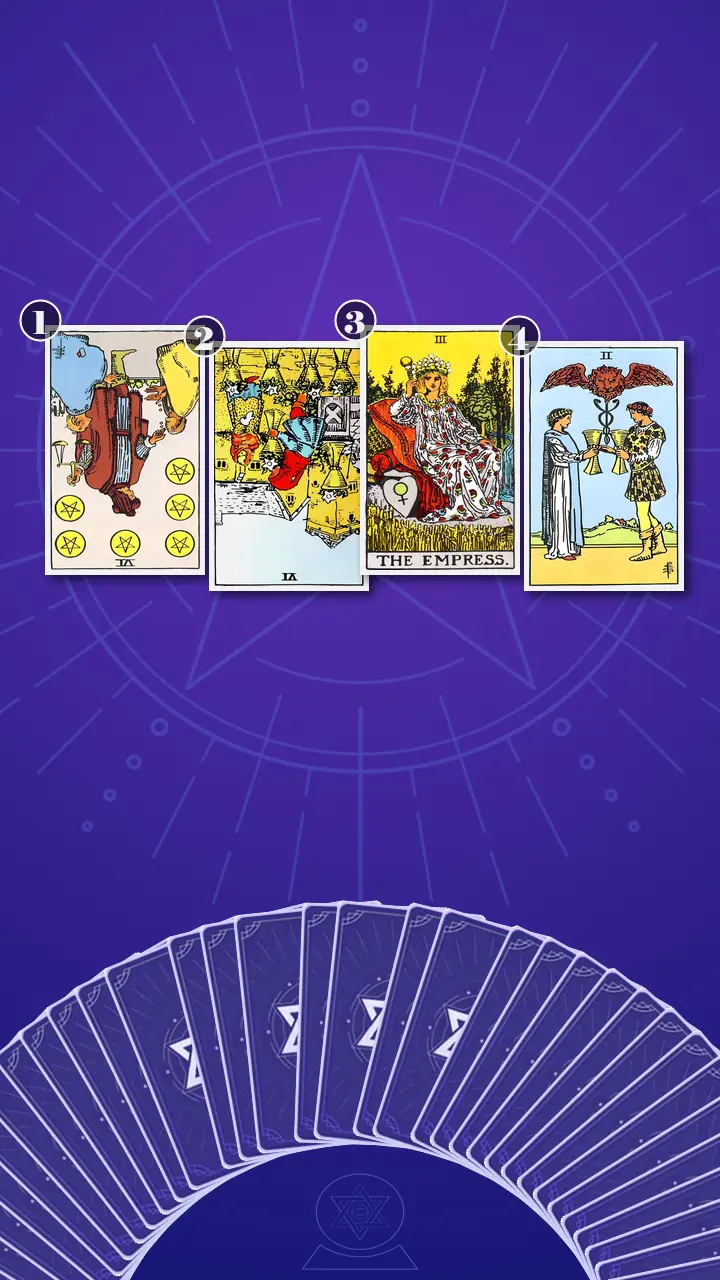
I laid the cards in a straight line from left to right like stepping stones. The first would show the visible trigger: the moment someone else’s independence gets translated into ‘I matter less now.’ The second would show the older relational script beneath it. The third — the hinge card — would reveal the antidote to usefulness-based belonging. And the last would tell us how to practice mutuality in real life, not just understand it in theory.
The Two Sixes That Keep Score
The Tilted Scales in the Text Thread
I turned over the card for the visible relationship trigger in her diagnosis: the moment feeling unneeded gets translated into feeling less loved. Six of Pentacles, reversed.
In modern life, this card is painfully specific. A friend mentions a hard day, and before they’ve even said what they want, you’re already building the full response package — the validating text, the link, the plan, the follow-up check-in. Then they reply that they already sorted it, and something in you doesn’t just feel unnecessary for a second. It feels subtly demoted. The tilted scales on the card show the hidden math: worth getting weighed by usefulness.
Reversed, the energy here is imbalanced and contracted. Giving isn’t flowing freely; it’s trying to buy certainty. Support becomes a quiet bid for security, like treating every relationship like a customer-retention account where you have to keep proving value. I told Maya, ‘This is the part where help stops feeling like generosity and starts feeling like a performance dashboard.’
She let out a short laugh that had more sting than humor in it. ‘Wow,’ she said, looking at the card. ‘That’s accurate enough to be rude.’
‘I know,’ I said. ‘But the card isn’t insulting you. It’s showing you the transaction your body starts when it gets scared.’ I mirrored back the late-night scene and the TTC kind of moment that follows it: I know this is small. So why does my body feel dumped? Her fingers moved to the rim of her tea mug, then went still. That tiny freeze told me the card had landed exactly where it needed to.
The Courtyard Behind the Current Chat
I turned to the card representing the old relational template and limiting belief underneath the reaction. Six of Cups, reversed.
This is the current chat window opening onto an older emotional courtyard. A shorter reply, a calm ‘I’m good,’ someone leaning on another friend — and suddenly the moment carries emotional weight that doesn’t belong to today alone. The card’s child with the flower-filled cup shows the younger self who learned some version of: be warm, be easy, be useful, and maybe you stay close.
Reversed, the water is pulled backward. The energy isn’t balanced memory; it’s memory hijacking perception. Part of Maya knew she was reacting to a normal adult message. Another part was reacting like she had been here before. I could feel the doubled Sixes tightening the story: one six was the adult behavior, the other the older script underneath it. When I see a pair like that, I always think of classic film editing — two scenes spliced so tightly together you swear they’re one. Present fact. Old story. Same emotional soundtrack.
‘That’s why it feels so big,’ I said softly. ‘A normal text doesn’t stay a normal text. It becomes evidence in a private case file about whether you matter.’
Her eyes unfocused for a beat, as if she were replaying old conversations against newer ones. Then her jaw loosened. ‘I know it looks small,’ she said, ‘but my body reacts like it’s big.’ Outside, a streetcar bell sounded faintly through the window, and the room felt briefly wider. That was the first loosening. Usefulness can create closeness, but it cannot prove belonging.
When The Empress Refused the Transaction
The Wheat Field Where Nothing Has to Hustle
When I turned over the third card — the antidote, the corrective experience that challenges the fear that worth depends on usefulness — the room went noticeably quiet. It was The Empress, upright.
Nothing in this image is hustling. She sits. The wheat grows anyway. The Venus shield rests at her side. Value is everywhere, and none of it is begging to be justified. In Maya’s life, this is the moment someone offers something simple and soft — a bought coffee, a warm check-in, a hand on the back, a sincere compliment — and she lets it land without instantly converting it into a task, a repayment plan, or a proof problem.
This is where I brought in one of my Classic Movie Models. Some people learn a Casablanca version of love: stay useful, save the scene, make yourself essential to the plot. The Empress is not that. She is closer to Roman Holiday — two people sharing a real, unperformed moment in borrowed time, where tenderness matters even though no one is rescuing anyone. Presence, not function, carries the scene.
I asked Maya to picture the 11:30 p.m. version of herself under the blue phone light, typing the perfect supportive reply and feeling her chest clamp down the moment it turned out her friend was fine without her. She was stuck in that old panic of having to do the right thing or lose her place.
The issue is not that you care too much. It is that your body keeps translating not needed into less loved. The Empress interrupts that equation: your worth does not disappear when your hands are empty.
You do not have to pay for closeness with constant care; let The Empress root you in the wheat-field truth that being loved and being needed are not the same thing.
I let that sit between us for a second.
Her hand stopped halfway to her sleeve, fingers suspended as if the sentence had caught them mid-habit. Then came the second beat: her gaze slid off the table and somewhere past my shoulder, the look people get when memory starts re-cutting itself in real time. I watched recognition move through her face before relief did. Her eyes shone first, then narrowed, almost offended. ‘So all this time,’ she said, voice thin at the edges, ‘I’ve been trying to secure something that was never mine to earn that way?’ The anger flashed and passed. After that came the release — a breath from deep in her chest, shoulders finally dropping, the tight line of her mouth giving way. There was grief in it too, the slight dizziness that comes when you set down a bag you forgot you were carrying. The lamp beside us threw a warmer circle across the cards, and even the steam from her tea seemed to slow. I said, ‘Now, with this lens, think back to last week. Was there a moment when this would have changed how the whole thing landed in your body?’ She nodded before she spoke. ‘My friend bought me coffee on Friday,’ she said. ‘I thanked her, and then immediately offered to edit her presentation. I couldn’t just let it be care.’
‘Let care land before you try to repay it,’ I told her. ‘That is Empress work.’
That was the real hinge. This wasn’t only about one text thread. It was the first step from spiraling over replaceability to feeling chosen without performing a helper role — from auditioning for love to inhabiting connection.
Not Above. Not Below. Beside.
Two Cups at the Same Height
The final card showed the integration step — the behavior that turns insight into a different way of relating. Two of Cups, upright.
This card is the visual answer to the first one. In the Six of Pentacles reversed, one figure stands above and gives downward; in the Two of Cups, both people stand at the same level. In real life, this looks like letting a conversation stay adult-to-adult instead of turning it into a rescue mission. It sounds like this: ‘I don’t need to fix this — I just want to stay connected.’
Upright, the energy is balanced and mutual. Not above them as the helper. Not below them, quietly begging to be chosen. Beside. Like a shared Google Doc instead of one person carrying the whole project plan, or two chairs pulled level at the kitchen table instead of manager-direct report energy in a friendship.
Maya gave me the smallest nod — the kind people do when they’ve already decided to screenshot the sentence later. ‘That feels scarier,’ she admitted. ‘But also cleaner.’ Exactly. Rescue can feel powerful in the moment. Mutuality feels simpler, and much more exposed.
Small Proofs for a New Script
By the time I reached the practical section, the spread had told a clean story. The doubled Sixes showed why a present-day trigger hits so hard: relationship math and old memory lock together, so another person’s independence gets misread as emotional rejection. Maya’s blind spot wasn’t that she cared too much; it was that she kept treating independence like a review of her worth. The shift was clear: separate worth from usefulness, and let closeness become something she enters rather than auditions for.
When I suggested doing less, she gave me the immediate objection I expected. ‘Doing less feels rude,’ she said. ‘And I do customer-success energy all day. By night, helping is basically muscle memory.’ I smiled. ‘Then we make the next steps small enough that your nervous system doesn’t call it abandonment.’
I gave her a version of my Gallery Communication rule: when you stand in front of a painting with someone, you don’t jump into the frame and start rearranging it. You stand beside them long enough to see what is actually there. Ask before you rescue. Let care land before you try to repay it.
- Boundary-First Support Check This week, with one friend you already trust, reply to a stress text with: ‘Do you want comfort, brainstorming, or just company?’ Then wait for their answer before you send a plan, link, or fix. Keep the whole experiment to one conversation. It may feel weirdly cold to do less at first. That discomfort is the old role protesting, not proof that you’ve become uncaring.
- Current Fact / Old Story Split After the next trigger — an ‘I’m good,’ a slower reply, plans made without you — open your Notes app and write only three bullets total under two headings: ‘Current fact’ and ‘Old story.’ End with one line: ‘What would being beside them look like here?’ Set a 3-minute timer and stop when it rings. If you feel flooded, name one fact and one body sensation. One honest line still counts.
- Let It Land Pause Once this week, if someone buys your coffee, checks in, or compliments you, reply only with ‘Thank you.’ Wait ten minutes before paying it back, fixing anything, or turning the moment into labor. If that feels too exposed, do a 90-second version at home or in a park and notice what it feels like to have empty hands. Receiving is not a debt. Start tiny; small, non-dramatic moments train the body faster than big emotional ones.

A Week Later, the Quiet Proof
Five days later, Maya texted me: ‘I asked the question first. She said just company. I sent one voice note and didn’t offer a fix. I slept through the night; in the morning I still thought, what if I got it wrong? — but I smiled instead of spiraling.’
That is what a real Journey to Clarity usually looks like from my chair. Not a personality transplant. Not perfect certainty. Just one clean interruption in the old script, repeated until the body begins to believe what the mind is learning.
If someone’s ‘I’m fine’ still makes your chest drop tonight, remember that your body may be bracing against an old fear that if you’re not useful, you’ll become optional. If you didn’t have to prove your place in this connection tonight, what is one small way you might let yourself be beside someone — empty hands, two cups level — instead of useful for them?