"Be More Strategic" at Work—and How to Turn It Into Criteria

Finding Clarity in the 10:32 p.m. Slack Draft
If you're the reliable person at a fast-growing tech company who always keeps the project moving, but one vague performance review phrase sends you straight into Performance Review Anxiety because nobody will say what it actually means, I know that look before a word is spoken. Maya (name changed for privacy) walked into my café in London with it written all over her face.
Before we even touched the cards, she told me about Tuesday, 10:32 p.m., on the sofa in her East London flat: review doc open on one side, a Slack draft to her boss on the other, radiator ticking in the background, laptop heat trapped on her thighs, the blue-white screen glow making the whole room feel colder than it was. She typed the sentence she actually needed: 'Could you give me a concrete example of what more strategic would have looked like?' Then she deleted it. Then retyped it softer. Then deleted it again until all that survived was a polished little ghost of a message: 'Thanks for the feedback.'
Her problem was simple and brutal in the way modern work problems often are. She wanted clear expectations so she could grow at work. But the second she imagined asking for specifics, her body read it as danger, as if one clean question might make her look less capable, less senior, less ready than she wanted to be seen. 'What does strategic even mean in this job?' she asked me. 'If I ask for examples, will that make me sound like I missed the point?'
The feeling wasn't abstract. It sat in her like a Jira ticket marked urgent with no acceptance criteria attached: everything lit up, nothing was actually clear, and the alarm kept going off in her throat and stomach every time she saw a 1:1 invite. I could hear the embarrassment under the frustration, and the resentment under that. She could handle hard work. What she couldn't handle was being asked to read minds in polished corporate language that had a faint, eerie Severance quality to it.
I slid a small espresso toward her and said what I have said to many smart people across this same marble table: needing clearer feedback is not the same as needing hand-holding. A vague review comment can turn growth into mind-reading. 'Let's not spend this session trying to sound impressive,' I told her. 'Let's make a map through the fog. Our whole journey today is toward clarity.'

Choosing the Corridor, Not the Maze
I asked Maya to place both feet on the floor, take one slow breath, and hold the exact review line in her mind: 'be more strategic.' Around us, the after-work rush had thinned; cups cooled on nearby tables, the grinder had gone quiet, and the smell of dark roast still hung warm in the room. I shuffled slowly, not as theatre, but as a way of helping both of us move from reaction into focus.
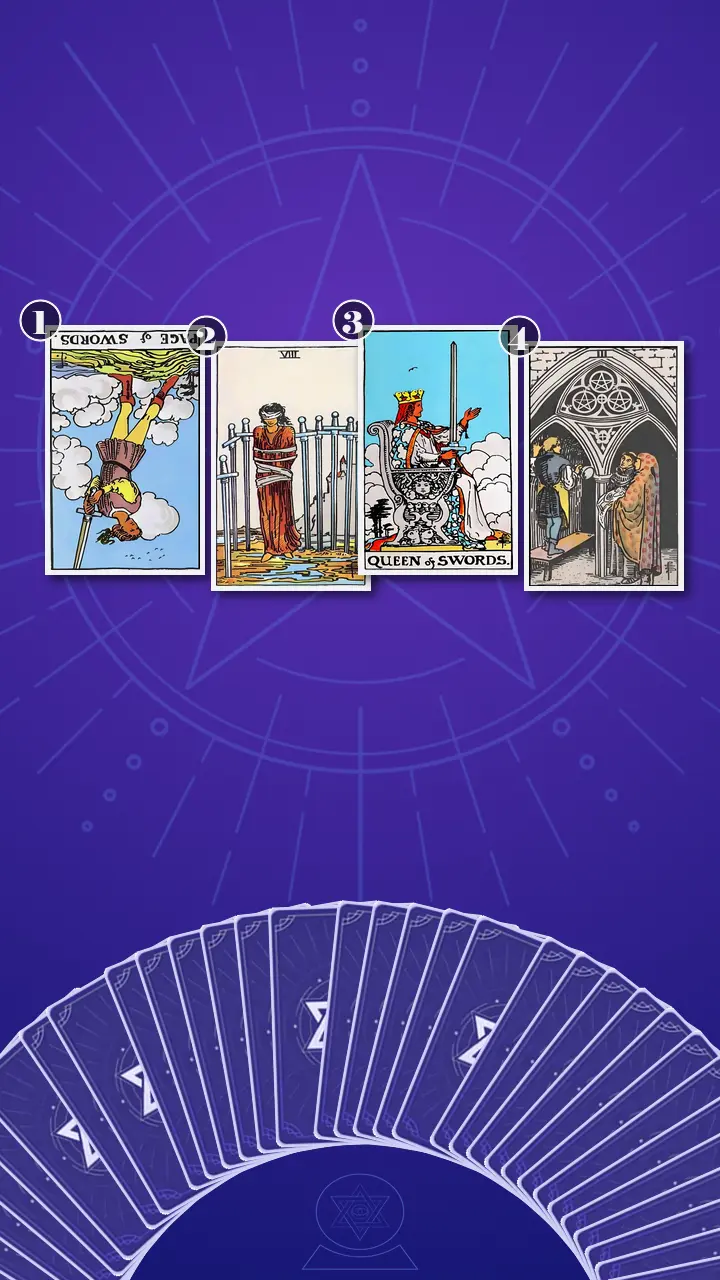
For a question like this, I do not use a sprawling spread. When someone is searching for how tarot works in a career situation, this is the answer I give: tarot is most useful when it turns a messy emotional knot into clear parts you can actually work with. So I chose a four-card line I use often for workplace feedback clarity: the Situation-Obstacle-Advice-Outcome · Context Edition.
I like this spread because it respects the real shape of the problem. Maya did not need a mystical lecture. She needed a focused path from overthinking to shared criteria. Four cards were enough: the first would show the visible symptom, the second the hidden bind underneath it, the third the corrective energy and communication shift, and the fourth the grounded next step that could turn vague feedback into something discussable, measurable, and useful.
'Think of it as a short corridor,' I said, laying the cards left to right. 'The first two show why you're stuck. The last two show how you get out without pretending you were never confused in the first place.'
Reading the First Knots
The Draft That Got Too Polite to Help
I turned the first card. 'Now we're looking at the position that presents the concrete symptom from the diagnosis: the overthinking, self-editing, and delay that show up after hearing “be more strategic.”' The card was Page of Swords, reversed.
I smiled a little, because the image was painfully exact. 'This is you at 10:30 p.m., still on the sofa, toggling between the review doc and a half-written Slack message. You trim every sentence until the actual question disappears. What remains is polite, careful, and useless. The draft has stopped being a request for clarity and turned into a tone-management exercise.'
In energy terms, this is distorted Air: intelligence that should help you ask a sharper question gets pulled into self-surveillance instead. The Page's sideways gaze becomes you watching your own wording from the outside. The raised sword becomes the blinking cursor in a draft that never lands. Rather than saying one simple thing, you start building a whole case file—gratitude, context, proof of effort, reassurance that you're not difficult—until the ask is buried alive.
'So basically,' Maya said, giving a short laugh with a bitter edge, 'I've been editing myself into HR-safe wallpaper.' She dropped her eyes to the card and ran one finger around the rim of her cup. 'That is... annoyingly accurate.'
'Yes,' I said gently. 'And it's common. Especially for people who are competent enough to think they should already know. But since when did asking for usable criteria become less professional than guessing?'
The Private Rule Hiding Under the Review
I turned the second card. 'This position reveals the underlying psychological block, especially the fear that not already knowing what the feedback means equals not being capable enough.' The card was Eight of Swords, upright.
'Here is the deeper bind,' I told her. 'This is what happens when one vague sentence starts behaving like a verdict.' I described the scene I could already feel in her body: the Victoria line before an 11:00 a.m. 1:1, burnt coffee smell in the carriage, dry air, train brakes screaming into the station, her thumb reopening the calendar invite while the thought loop kicks in on cue: If I have to ask, I'm already behind.
That is the private rule of the Eight of Swords. Not a real policy. Not a law of professional maturity. A private rule. The blindfold is not lack of intelligence; it is the moment fear turns one vague comment into the whole story. The loose bindings matter too. So does the open gap between the swords. The conversation is available. It just doesn't feel available, because self-doubt has tightened around it first.
'This is like standing at King's Cross thinking there are no trains,' I said, 'when the next step is actually on the board. You're treating one line in a review like it rewrote your whole job description.'
She went very still. First her breath caught, almost invisibly. Then her hand rose to her throat, like her body had recognized itself before her mind did. Then her eyes drifted past me, unfocusing for a second as if she were replaying every pre-manager conversation she'd ever white-knuckled through. When she finally exhaled, it came out sharp and quiet. 'Yes,' she said. 'That's the exact rule. If I have to ask, they'll think I shouldn't need to.'
'And that,' I told her, 'is why trying to decode “be more strategic” leaves you feeling stuck. The issue isn't just vague feedback. It's that you've been carrying an undefined standard as if it were fixed truth.'
When the Queen Lifted Her Sword
Clarity Is Not the Same as Defensiveness
By the time I reached for the third card, the café had gone unusually quiet. A spoon clicked against a saucer somewhere behind us and then stopped. Even the yellow streetlight outside seemed to steady itself against the window. I have been reading cards over coffee for twenty years, and I know that little change in the air: the moment before the card that doesn't flatter you, but frees you.
'This position identifies the key shift in mindset and communication style needed to move from self-protection to precise inquiry,' I said, turning the card. It was Queen of Swords, upright.
I always feel a small internal click when I see her, the same clean certainty I feel when a portafilter locks into place properly before a shot pulls. Pressure is not the problem. A blocked channel is. The Queen never asks you to become louder, harder, or more intimidating. She asks you to become clean.
'This is what mature clarity looks like in modern work life,' I told Maya. 'Not a 12-line justification. Three clean questions in your Notes app. Not trying to sound more strategic. Defining what strategic looks like here.' In the card's everyday language, I could already see her in the follow-up 1:1 asking: 'What would more strategic have looked like on the Q2 launch?' 'Which decisions or behaviours would signal it at my level?' 'What's one thing I can practice on the next project?'
This was where I brought in a method I use in the café, something I call Conflict Sedimentation. When espresso is still swirling, you can't taste it clearly. Fear, embarrassment, resentment, ambition—they all cloud the cup. But if I let the sediment settle, what is at the bottom becomes obvious. 'Right now,' I told her, 'your fear says, “If I ask, I look junior.” Your resentment says, “Why wasn't this clear already?” Your ambition says, “I want to get better.” Once those settle, the bottom of the cup is not incompetence. It's one clean request.'
She stared at the Queen while I gave the setup plainly. 'You're back on that sofa at 10:30 p.m., laptop warm against your legs, review doc on one tab and an unsent Slack on the other, cutting words until only “thanks for the feedback” survives—because somehow asking the real question feels riskier than staying confused.'
Stop treating vague feedback like a verdict; lift the Queen's sword of precision and ask for the examples that turn "strategic" into something you can actually practice.
I let the sentence sit there between us.
'Vague feedback is not a mind-reading test,' I added. 'The strategic move is to ask for the missing criteria.'
Her reaction came in waves. First her thumb froze against the tiny handle of the espresso cup, as if her body had hit pause. Then her face changed in that unmistakable way people do when an idea reaches a memory before it reaches language; her eyes widened, but not with relief yet—more like the sting of recognition. Then came the resistance. 'But if I ask that directly,' she said, and there was a flash of anger inside the fear now, 'doesn't that basically mean I've been wrong about this the whole time?'
'No,' I said. 'It means you've been trying to survive ambiguity by yourself. That's different. Maturity isn't pretending invisible criteria are visible. Maturity is helping define the standard with the person who is evaluating the work.'
That landed. I watched the tension travel through her in reverse: jaw unclenching first, then shoulders dropping a fraction, then a longer breath finally making room in her chest. She looked back at the Queen and gave the smallest half-laugh. 'I do not need a speech,' she murmured, almost to herself. 'I need criteria.'
'Exactly.' I leaned in a little. 'Now, with that new lens, think back to last week. Was there a moment when this would have changed the feeling in the room?'
She nodded almost immediately. 'The campaign debrief. If I'd just said, “Can you show me where strategic thinking would have shown up earlier or differently?” I probably would've left with something usable instead of spiralling all night.'
'That's the move,' I told her. 'This is the first real step from self-editing under invisible standards to professional self-trust through clear dialogue.'
Where the Fog Turns Into a Shared Document
I turned the fourth card. 'This position grounds the transformation in a collaborative next step, showing how to turn vague feedback into shared examples, criteria, and developmental markers.' The card was Three of Pentacles, upright.
'Good,' I said, because it was exactly the landing I wanted for her. 'This is Earth after all that Air. This is where the issue stops living in your head and starts living in the work.'
I pointed to the card's blueprint and the three figures in conversation. 'This is you, your manager, and an actual project in the room together. Not personality language. Not vibes. A real launch, a real brief, a real decision point. This card says the relief doesn't come from finally sounding senior enough. It comes from both of you pointing at the same example and naming the same markers.'
In modern terms, I translated it for her: leaving the meeting with one shared note, one example from a recent campaign, two markers of stronger strategic thinking, and a plan to revisit them next month. The feedback stops floating around like a mood and starts behaving like a framework. I could see the shift on her face then. Not full certainty. Better than that. Orientation.
From Vibe to Criteria
When I laid the whole spread out for Maya, the story was clean. First came distorted Air in the reversed Page of Swords: hyper-analysis, tone-monitoring, unsent drafts, the overthinking follow-up message to her boss that never actually asked the question. Then trapped Air in the Eight of Swords: the private rule that if she needed clarification, she must already be behind. Then clarified Air in the Queen of Swords: discernment, brevity, concise truth-telling. And finally Earth in the Three of Pentacles: shared standards, visible examples, actionable advice, next steps.
'So why does this keep happening?' she asked.
'Because you're reliable,' I said. 'People trust you with execution, so they hand you broad developmental feedback and assume you'll reverse-engineer it alone. Your blind spot is that you've been treating an undefined standard like a fixed truth and a comment about work like a statement about worth. The transformation here is not from tactical to magical. It's from trying to prove you already understand to co-defining what “strategic” looks like in your role and your real projects.'
She glanced at her phone. 'My boss is back-to-back all week.'
I laughed softly. 'Then don't ask for a summit. Ask for ten minutes and one example. Small is strategic too.' I set my cup down and gave her the framework I wanted her to carry out of the café. 'You do not owe a performance of confidence to ask for clarity.'
In my café, I sometimes joke about Cup Bottom Divination: after the foam, after the chatter, after the flourish, what is actually left at the bottom? For this conversation, I wanted only three things left in Maya's cup: one example, one marker, one next project. That became our practical plan.
- Send the Clarity-First Follow-UpBefore end of day Wednesday, send a two-line Slack or email to your boss: 'Thanks again for the review note. Could we do a 20-minute follow-up this week so I can get specific on what more strategic would look like in my role?' If Slack feels too exposed, send it by email. If writing feels awkward, put the same sentence into a short calendar invite for a feedback sync.Keep it brief. Do not pad it with apology, gratitude paragraphs, or proof of effort. If 20 minutes feels like too much, ask for 10 minutes and one concrete example. The minimum version still counts.
- Bring Three Clean QuestionsBefore the meeting, open your Notes app and write these three questions: 'What would more strategic have looked like on the Q2 launch?' 'What behaviours or decisions would signal it at my level?' 'What's one thing I can practice on the next project?' Read them out loud once while you're making tea, walking to the station, or waiting for Zoom to connect so your mouth knows the words before your nervous system starts editing them.If you feel the urge to over-explain first, pause. The goal is clarity, not self-defence. If three questions feel like too much, bring just the project-specific one.
- Use the One Example, One Marker MethodTake one recent campaign, launch, or cross-functional project into the meeting as a shared reference point. Ask where stronger strategic thinking would have shown up earlier, differently, or more visibly. While you're talking, open a shared doc, notebook, or notes app and capture three residues at the bottom of the conversation: one example, one marker, one next-project action to revisit in your next check-in.If the discussion drifts back into abstract language, gently bring it down to the work again with: 'Can we attach that to a concrete example?' You are not asking for permission to exist at your level; you are asking for observable criteria.
'Ask for one example, one marker, one next step,' I said as she typed the headings into her phone. 'That is how you turn a vibe into a standard.'

A Week Later, the Quiet Proof
A week later, Maya sent me a message while I was steaming milk for the morning rush. It said: 'Sent the note. Had the meeting. We used the Q2 launch. “More strategic” apparently meant surfacing trade-offs earlier and tying channel decisions to business goals before execution kicked off. I left with two markers for the next campaign.'
She added one more line a minute later: 'Still felt shaky after. Sat alone with a flat white for twenty minutes. But at least I wasn't guessing anymore.'
That is what I call a real Journey to Clarity. Not a perfect ending. Not a personality transplant. Just the honest first proof that the fog has somewhere to go once language gets precise. Tarot did not give Maya a script to perform confidence. It helped me show her the shift from guessing under invisible standards to professional self-trust through clear dialogue.
When one line in a review can close your throat for days, the pain is rarely just the feedback—it's the feeling that asking for clarity might put your competence on trial. I have watched too many capable people mistake that feeling for truth. If you did not have to prove you already understood, what would be the first clean question you would want answered about your role?