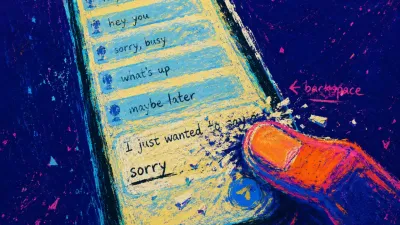
Reopening the Thread After 'We're Fine': From Alarm to Self-Trust

The 6:28 Streetcar and the Post-Reassurance Spiral
If you’re a 20-something in a fast-paced client-facing job who can read a room in seconds but still spiral on the TTC after a ‘we’re fine’ text, I knew exactly why Mia (name changed for privacy) had booked me for a five-card Shadow Spread tarot reading. She wasn’t asking me to predict whether the relationship was doomed. She was asking about post-reassurance text spiraling and reassurance-seeking in relationships—why reassurance never lands, and why a calm ‘yes’ can still leave her body acting like the conversation is unfinished.
When she described the ride home, I could see it as clearly as if I were on the King streetcar with her: 6:28 p.m., brakes screeching, winter air slipping in every time the doors opened, her thumb reopening the same iMessage thread before Bathurst, the phone warm in her hand under those too-bright overhead lights. She told me she had typed ‘just making sure we’re good’ twice, deleted it twice, then watched the empty top of the screen like it might suddenly confess the truth.
‘I know they said we’re fine,’ she said, staring at the table, ‘but why does it still feel off?’ The contradiction was brutal in its simplicity: she wanted to know they were okay, and she was equally terrified that ‘yes’ did not actually mean they were okay. Her anxiety wasn’t abstract. It sat in her like a dropped elevator—tight chest, hollow stomach, hands buzzing as if fifty browser tabs were open inside her ribs and none of them would stop autoplaying.
I nodded. ‘That makes sense to me,’ I said. ‘We’re not here to prove you’re too much. We’re here to map what happens in the space between the reassurance and the spiral, and to find where your clarity actually lives.’

Choosing the Compass: A Five-Card Shadow Spread for Text Anxiety
I asked her to take one slow breath with both feet on the floor while I shuffled. I never use ritual to manufacture mystery; I use it to help the nervous system cross a threshold. A reading works better when the body knows we’ve stopped reacting long enough to look.
For this session, I chose the Shadow Spread, a five-card shadow tarot spread I use when the real question is not ‘What will happen?’ but ‘Why does this keep happening inside me?’ For readers who wonder how tarot works in a moment like this, the logic is simple: this spread follows the chain from visible symptom, to hidden wound, to protective habit, to medicine, to a grounded next step. It is especially useful for relationship reassurance anxiety because it stays focused on self-awareness, emotional regulation, and actionable advice instead of adding unnecessary external noise.
I told Mia what I most needed her to expect from the layout. The first card would show the post-reassurance spiral exactly as it appears in daily life. The middle cards would reveal what deeper belonging wound gets activated and what shadow strategy keeps the loop alive. The fourth card—our turning point—would show the medicine. The last card would answer a practical question: what small pause can exist between the trigger and the next text?
Reading the Thread Beneath the Thread
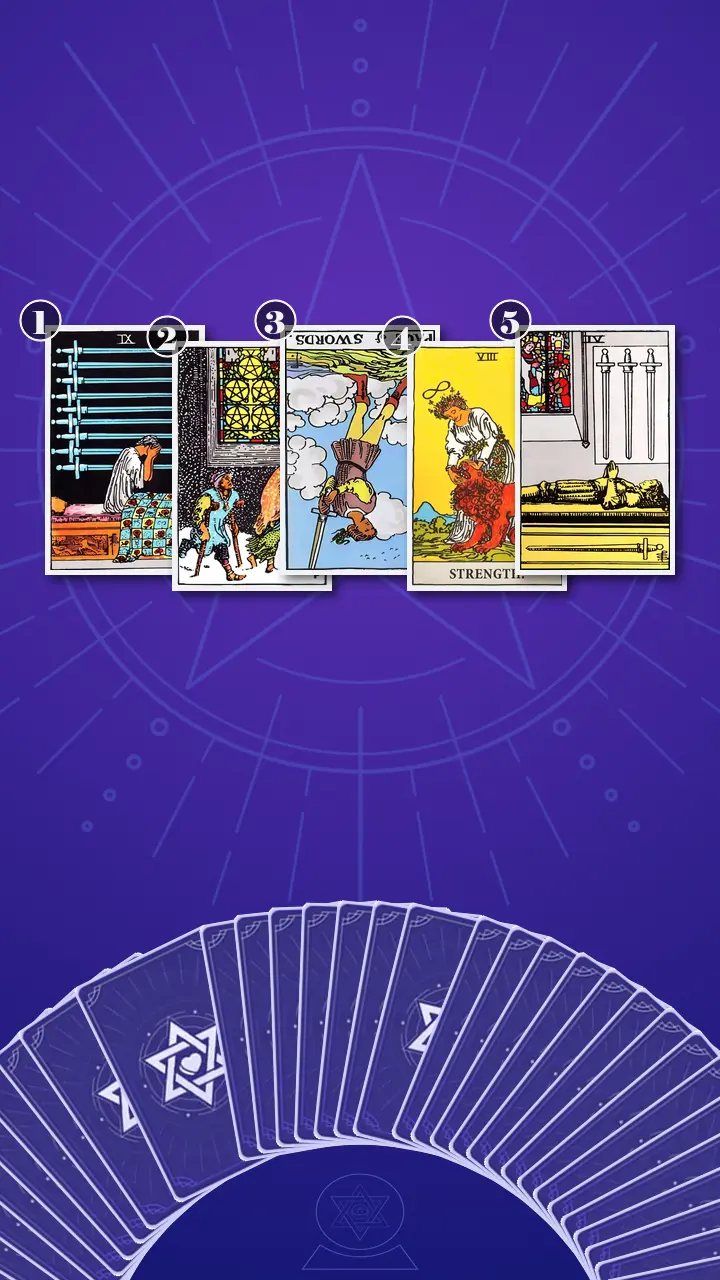
I laid the five cards left to right in a straight line. The whole spread looked like a nervous system diagram: activation on the left, diagnosis in the middle, then a softer path out. Outside, the late Toronto light was thin and cold against the window. On the table, the colors moved from dark to warm, and I already knew the reading was going to ask her to stop treating every inner alarm like breaking news.
Position 1: When the Conversation Ends but the Nervous System Doesn’t
Now I turned over the card representing the visible symptom from the diagnosis: the post-reassurance spiral itself, the rereading, the mental replay, the inability to let a reassuring answer settle. It was the Nine of Swords, upright.
This card could not have been clearer. In modern life, it is the moment you get the reassuring text on the commute home, and instead of settling, your brain throws a private afterparty of worst-case thinking. By bedtime, you’re doing wording comparisons, reply-time math, tone analysis—why was it shorter, why no extra warmth, why am I still awake if we’re fine? The conversation ended; the nervous system did not. It is the relationship version of turning your Messages app into a late-night Black Mirror episode in your head.
Energetically, this is excess Air: thought multiplying faster than reality. The mind is trying to create safety through analysis, but all it produces is more suspended swords, more what-ifs hanging over one ordinary exchange. I looked at her and said the sentence I wanted her to keep: ‘A tight chest is not a text analysis tool.’ Feeling activated after a reassurance conversation is real. It just is not the same thing as fresh evidence.
Her reaction came in three beats. First her breath caught. Then her eyes went slightly unfocused, as if she were already back under the blue phone glow at 12:41 a.m., rereading ‘yeah, we’re good.’ Then she gave a short laugh that had no real amusement in it. ‘Okay,’ she said, rubbing her eyebrow, ‘that’s accurate enough to be rude.’
I smiled. ‘Not rude. Precise. And precision is kinder than shame.’
Position 2: The Cold Outside the Warm Window
Then I turned over the card representing the deeper wound beneath the spiral: the fear that small signs of distance mean loss of belonging. It was the Five of Pentacles, upright.
This is where the reading dropped below behavior and into ache. The everyday translation is painfully familiar: an ordinary lull after a hard conversation feels less like neutral space and more like emotional exile. They may still care. They may still be there. They may even be active online. But your body reacts as if warmth is visible through glass and somehow no longer fully yours. I could feel the card’s old winter in the room—the lit window, the cold street, the private belief: I can see the warmth, I just don’t know if it still includes me.
Energetically, this is scarcity-driven Earth. Not grounded Earth, but cold Earth: the kind that makes one short text feel like a status update on whether you are still chosen. This is why reassurance does not stick. The spiral is not only about what they meant. It is about what a pause seems to say about your place in the bond.
As I said it, sleet tapped the window beside us so softly I almost missed it, and Mia’s fingers tightened around her mug. Her throat moved before her voice did. ‘That part,’ she said quietly. ‘That’s the part I hate. It makes everything feel bigger than it is.’
‘Yes,’ I told her. ‘Because the text is current, but the cold underneath it usually isn’t.’
Position 3: Detective Mode in the Messages App
I turned over the card representing the shadow strategy that maintains the loop: hypervigilant monitoring, decoding tone, and treating ambiguity like evidence to investigate. It was the Page of Swords, reversed.
If the Nine of Swords is the panic, this is the habit that keeps feeding it. In real life, this card looks like screenshot zooms in the office kitchenette, last-active checks, comparing today’s message length to yesterday’s, asking a friend whether that period after ‘okay’ feels cold, and drafting a softer second text because maybe this wording will finally calm you down. It is full Charlie Day conspiracy-board meme energy, except the corkboard is one iMessage thread.
Energetically, this is blocked and distorted Air. The Page’s natural sharp perception has tipped into surveillance dressed up as clarity. The mind never fully stands down; it stays sideways, sword raised, ready to defend against a threat that may only exist in interpretation. I heard my own years at sea echoing in me then—on quiet cruise decks after midnight, strangers would confess the same pattern in different costumes: the details changed, but the body language never did. Same lifted shoulders. Same bargaining eyes. Same hope that one more clue would buy relief.
So I said it plainly: ‘You are not missing data. You’re in alarm.’ Then I added, ‘This is the moment where your fear becomes the analyst and the text becomes the data set.’
She folded forward a little, half cringing, half smiling. ‘The punctuation thing got me,’ she said. ‘I hate how real that is.’
‘Of course it’s real,’ I said. ‘It’s protective. But protection and accuracy are not always the same thing.’
At that point, the pattern was unmistakable to me: reassurance can’t land in a body that’s still bracing for impact. The cards were not accusing her of being needy. They were showing me a younger, sharper part of her that would rather stay on alert than risk being surprised by distance.
Position 4: When Strength Put a Hand on the Lion
Then I turned over the card representing the integrating medicine, the key transformation of the whole reading: learning to regulate the alarm and build self-trust before seeking more reassurance. It was Strength, upright. The room went strangely still when that card appeared. A strip of late sunlight caught the gold background, and for the first time in the spread, the energy felt warm.
I told her to picture the 6:28 ride home again: the reassuring text already there, her thumb reopening the thread, her chest still tight, the city noise fading because her brain is searching the message for a crack it can explain. That is the exact moment this card enters. Not before the urge. In the middle of it.
In my work, I use something I call an Attachment Audit. It helps me separate three things that get fused in anxious intimacy: what actually happened, what the nervous system inferred, and what action fear demanded next. Here, the facts were simple: she asked, ‘Are we okay?’ They said yes. Her body heard, ‘Maybe not.’ Fear demanded, ‘Investigate harder.’ Strength does not shame any of those layers. It simply puts them back in order.
Your turning point is not getting a cleaner yes from them. It’s becoming able to steady the part of you that hears uncertainty as abandonment.
Stop prying the lion’s jaws open for certainty and place a steady hand on your fear instead, because trust grows through calm strength, not one more interrogation.
She didn’t exhale. Not at first. First came the freeze: her fingers stopped on the rim of the mug, and her shoulders lifted as if bracing for a hit. Then came the cognitive seep, that faraway look people get when a sentence walks backward through a week of memories and relabels them one by one. When she finally spoke, it wasn’t relief. It was resistance. ‘But doesn’t that mean,’ she said, voice suddenly sharper, ‘that I’ve been making it worse?’
I met that without flinching. ‘It means you’ve been trying to protect yourself with the only tool that felt available,’ I said. ‘And now you have another one. That’s different.’
Her jaw worked once. Then her eyes shone, not with collapse but with the shock of being understood in a place she had only judged herself. Her shoulders lowered by degrees. One breath. Then another, longer one. She pressed her palm lightly to her chest as if testing whether her own body could be part of the solution. There was even a flicker of dizziness in the release—the strange, vulnerable feeling that comes when the job you’ve been overperforming is suddenly not yours in the same way.
‘So I can feel unsafe,’ she said slowly, ‘without making the relationship the emergency.’
‘Exactly.’ I nodded. ‘That is the shift. From hypervigilant meaning-making and repeated checking toward self-trust, emotional steadiness, and tolerating uncertainty. Not perfectly. Just enough that fear doesn’t get your phone by default.’
I gave her one more invitation. ‘Now, with that lens, think back to last week. Was there a moment when this would have changed what you did?’
She stared at Strength a second longer. ‘On the streetcar,’ she said. ‘I would’ve put the phone down before typing the second text.’
Position 5: The Screen-Down Exit
Finally, I turned over the card representing the grounded embodiment, the practical next step that interrupts the limiting pattern and helps reassurance become receivable. It was the Four of Swords, upright.
This card is not glamorous, which is why I trust it. In modern life it looks like this: phone face down, chat unopened, no Instagram story checks, maybe a tea mug in your hand or a quick walk around the block, maybe just standing by an open window until your breathing stops tripping over itself. It is airplane mode for your nervous system, not a passive-aggressive move. The issue is not the existence of uncertainty. The issue is the lack of an internal resting place once uncertainty appears.
Energetically, this is balanced Air at last. Thought stops serving rumination and starts serving recovery. The upright figure in the Nine of Swords sat in involuntary activation; this figure rests by choice. That visual dialogue mattered to me immediately. Rest is not avoidance here. Rest is the condition that allows reassurance to register.
Mia looked at the card, then at her own phone beside her. ‘That sounds so simple it’s annoying,’ she said.
I laughed softly. ‘The nervous system loves to call medicine pointless when medicine doesn’t look dramatic. But this is the exit path.’
From Alarm to Steadiness: Actionable Advice That Can Start Tonight
By the time I looked across the full line of cards, the story was clean. The Nine of Swords showed why one reassuring answer turns into an all-night internal debate. The Five of Pentacles showed the older ache underneath it: the fear of being left outside the warmth of the bond. The Page of Swords reversed showed the protective script that tries to prevent that pain by rereading, decoding, checking, and asking again. Then Strength interrupted the whole chain by offering a different kind of power—self-trust, emotional steadiness, compassionate restraint. The Four of Swords turned that insight into behavior.
The blind spot was just as clear: Mia had been treating body activation as relationship truth. In Jungian terms, the shadow strategy had stolen the microphone. In plain language, she was thinking her feelings instead of feeling and soothing them first. There was almost no Water in the spread, which told me something important: her emotions were being processed as theories instead of being felt and regulated. Her transformation direction was not ‘never need reassurance again.’ It was far more humane: treat uncertainty as a body state to regulate before deciding whether more contact is actually needed. Trust builds through patterns, not punctuation.
I also told her something important about boundaries. A healthy relationship can absolutely make room for honest conversation. But honest conversation and emotional forensics are not the same thing. If she truly needed connection, she could ask directly for connection. What the cards were asking her to stop doing was outsourcing nervous-system regulation to one more microscopic analysis of a text thread.
So I gave her three concrete practices. I framed the first two through my Trigger Management strategy, and the last through a Connection Audit, because insight only matters if it survives contact with real life.
- Trigger Management: The Seven-Minute Send DelayAfter any reassurance conversation this week, I asked her to place her phone face down and set a 7-minute timer before reopening the thread. During that pause, one hand goes on the chest, one on the stomach, and she names three sensations out loud or in Notes—tight chest, buzzing hands, dropped stomach, hot face, whatever is true.If seven minutes feels impossible on the TTC or between meetings, do 90 seconds. No rereading, no story checks, no last-active checks during the timer.
- Trigger Management: Three Neutral ExplanationsBefore sending any follow-up reassurance text, I asked her to write down three neutral explanations for the short reply, delay, or flatter tone: busy, tired, distracted, in transit, low battery, practical mood, nothing is wrong. If she still needs contact later, she can send one specific message such as, ‘Do you have bandwidth to talk later?’ instead of another ‘are we okay?’The goal isn’t zero uncertainty. It’s not letting uncertainty run the keyboard. If three explanations feel annoying, write one.
- Connection Audit: Pattern Over PunctuationI asked her to make a private note called Pattern Over Punctuation and list five real examples of consistency from this person: times they followed through, checked in, repaired after tension, showed warmth, or stayed connected over time. The next time she feels triggered, she reads that note before checking story views, last active, or old chat history.Keep it honest. This is not fake positivity. It is a way to measure the bond by patterns of care instead of one cold moment filtered through fear. Lowest bar: list two examples.
When I mentioned the seven-minute pause, she made a face. ‘But I can’t always find seven minutes,’ she said. ‘Sometimes I’m literally walking into a client meeting or standing on a platform.’
‘Then don’t make the practice so big that your shame eats it,’ I said. ‘Do the small version. Ninety seconds. One sensation. The point is not to win a nervous-system marathon. It’s to interrupt the automatic checking loop long enough for choice to come back.’
That is what I love about a five-card Shadow Spread tarot reading for post-reassurance relationship spiraling: it does not ask the cards to save you from ambiguity. It helps you regulate before you text, pause the checking loop, and begin moving from decoding signals to receiving care.

A Week Later, the Proof Was Quiet
A week later, I got a message from Mia. It was short, which made me smile. She told me she had used the 90-second version on the streetcar after a ‘we’re good’ exchange. She still felt the buzz in her hands. She still wanted to send the softer second text. But she didn’t. ‘Nothing got fixed,’ she wrote, ‘but I didn’t hand the fear my phone.’
She also told me something beautifully ordinary: one night she slept all the way through after a trigger, then woke with the old thought—what if I’m wrong?—and laughed softly instead of reopening the thread. Clear, but still tender. Steadier, not superhuman.
I sat with that for a moment. This is the real journey to clarity as I understand it. Not perfect certainty. Not becoming the kind of person who never feels the drop in the stomach again. Just becoming someone who can hear reassurance, notice the body’s protest, and let trust build through consistency instead of one more interrogation.
Sometimes the hardest part is not hearing that you’re okay—it’s feeling your chest stay tight anyway and wondering whether trusting the moment will make you the person who missed the warning sign.
So the next time your thumb hovers over a soft little just-checking message on the ride home, what tiny lion-taming pause—90 seconds, one hand on your chest, three named sensations—might you let happen before you ask the relationship to carry what your body is shouting?
Every reading at AceTarot is a Journey to connect with inner wisdom and empower next step.
Learn more about our Journey to Clarity.