From Family Dinner Freeze to Adult Voice: One Calm Sentence First

The Water Glass at 7:26
If you’re a mid-20s office worker who can present a campaign deck on Monday but goes weirdly quiet at Sunday dinner when your mom answers a dating question for you, I can tell you immediately: that is not random. When Chloe (name changed for privacy) said it to me on a video call from Toronto, I recognized the pattern before I even reached for the cards. It was family role regression, and it was landing in her body fast.
She gave me the scene with a precision that told me she had replayed it too many times. It was 7:26 p.m. in her family’s North York condo dining room. Her aunt asked if she was seeing anyone. Her mother leaned in with an answer before Chloe had even opened her mouth. Chloe had both hands around a cold water glass. Ice clicked against the side. Roasted garlic hung in the air. Her throat went tight, her jaw locked, and her stomach dropped just enough to make the chair feel farther away from the table than it was.
Then she said the line I hear from so many capable women: ‘I know I’m an adult, so why do I go mute around my family?’ All week, she could manage deadlines, client calls, and the low-grade chaos of a marketing job. But at dinner, she was split between two instincts: speaking for herself about dating, or protecting the mood by letting her mother speak first. Her embarrassed frustration had the texture of swallowing an ice cube wrapped in static—cold, sharp, and impossible to hide for long.
I nodded and let her see I was not shocked by any of it. Going quiet doesn’t mean you have no boundary. It often means the old script got there first. ‘Let’s not force a perfect version of you tonight,’ I told her. ‘Let’s make a map for the exact moment your voice leaves the room, and see how to bring it back. That’s our journey to clarity.’

Choosing a Map for the Family Dinner Boundary
I asked Chloe to take one slow breath and hold only one question in mind: how do I speak up when Mom answers for me about dating at dinner? Then I shuffled. In my practice, that pause is not stage dressing. It gives the nervous system one clean beat to stop rehearsing and start noticing.
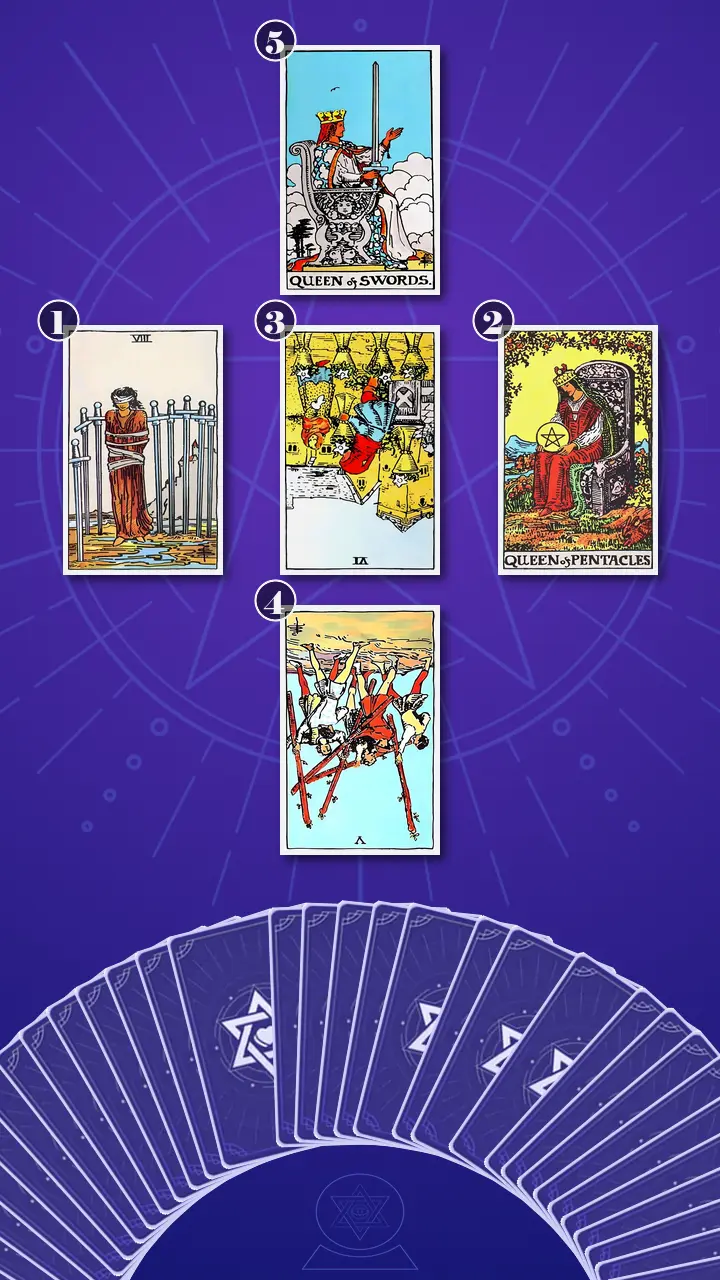
After a decade of guiding strangers through constellations under a planetarium dome, I prefer maps to pronouncements. So I chose a five-card Relationship Spread · Context Edition. For anyone who has ever wondered how tarot works in a moment like this, this is exactly why I use a relationship spread: the problem is not abstract destiny. It is a live interaction between two people inside a repeating pattern. This layout lets me read Chloe, her mother, the family script between them, the specific blockage that closes Chloe’s throat, and the most actionable next step for speaking up without turning dinner into a courtroom scene.
I showed her the structure as I laid the cards into a cross. The first card would show her freeze response. The center card would reveal the shared script that gets switched on at the table. The card below would name the tension she swallows to keep the room smooth. The card above would show the adult voice that can rise over the old habit. Read together, the spread formed a small bridge over an old reflex. Tarot is most useful to me when card meanings are read in context, and this spread keeps the context honest.
Reading the Small System That Forms at Dinner
The Eight of Swords: Five Tabs Open, No Sentence Sent
I turned the card representing Chloe’s immediate internal reaction when her mother answers for her. The card was the Eight of Swords, upright.
I told her exactly what I saw. This card is what happens when a relative asks about your dating life, your mom answers before you do, and your brain instantly opens five tabs: be honest, be vague, be funny, be polite, do not make it weird. It is like typing and deleting three versions of a text until the conversation window closes. The blindfold on the card is the mental fog of that moment. The loose bindings are the part most people miss: you are not actually out of options, even though your body feels trapped. This is blocked Air—thought working so hard that speech cannot get out in time.
It even has that nervous-system spike people use The Bear family-dinner scenes as shorthand for: everyone is still talking, nothing has exploded, but your words have somehow vanished anyway. ‘A lot of adult daughters aren’t bad at speaking up,’ I said. ‘They’re just very practiced at protecting the room.’
Chloe let out a quick laugh that carried a little sting. ‘Okay,’ she said, rubbing her thumb against the condensation on her glass, ‘that’s accurate enough to be rude.’ I smiled. ‘Good,’ I said. ‘Because the point of this card is not that you’re helpless. It’s that your mind is over-editing in real time. If perfection is the requirement, the moment will always outrun you.’
The Queen of Pentacles: Love That Starts Steering
I turned the card showing her mother’s relational stance in the moment. The card was the Queen of Pentacles, upright.
This was important, because it kept the reading truthful without flattening her mother into a villain. The Queen of Pentacles is caring, competent, practical, and deeply invested in keeping people comfortable. In real life, that can look exactly like Chloe’s mother hearing a personal question, sensing exposure, and stepping in with a neat answer because she believes she is helping both Chloe and the table. The pentacle held close tells me the care is real. It also tells me the care is being held so tightly that it starts to become management. This is balanced Earth tipping into excess Earth: warmth turning into control through habit.
‘So the problem isn’t that she means harm,’ I said. ‘It’s that support and steering have gotten fused together.’ It is the same energy as a helpful friend quietly becoming the admin of a story that still belongs to you.
Chloe’s jaw flexed, then softened. ‘That’s the worst part,’ she told me. ‘She probably thinks she’s making it easier.’ I nodded. ‘Exactly. Seeing the care underneath the overstep will help you answer clearly instead of only reacting to it.’
The Six of Cups Reversed: The Room Gets Older Than It Is
I turned the center card, the one revealing the shared family script that gets activated at the table. The card was the Six of Cups, reversed.
This was the hinge of the whole reading. I told Chloe that the real event at dinner was bigger than one comment about dating. One ordinary question makes the whole room feel older than it is. She is no longer Chloe, twenty-six, marketing coordinator, fully adult in the city all week. She is pulled back into the earlier role where her mother interprets and she adapts. The conversation looks current, but the script is not. Reversed Water here does not flow toward intimacy; it pulls backward into memory, into inherited tone, into the version of herself the family still recognizes fastest.
When I read this card, I had a brief flash of standing beneath the planetarium dome, tracing old orbital paths for a school group. From inside a stable orbit, repetition can feel like fate. Family systems do that too. They auto-load an old operating system before the present-day self has time to log in.
‘The room is not just asking about dating,’ I told her quietly. ‘It’s asking who gets to define you here.’
She went very still. First her breath paused. Then her eyes slipped slightly out of focus, as if she were replaying a dozen dinners at once. Then her shoulders dropped a fraction. ‘So it’s not that I secretly turn into a child,’ she said. ‘It’s that the room knows an older version of me.’ ‘Yes,’ I said. ‘That recognition is the beginning of self-blame letting go.’
The Five of Wands Reversed: Three Seconds Treated Like Disaster
I turned the card below the center, the one pinpointing what closes Chloe’s throat in the moment. The card was the Five of Wands, reversed.
I told her this is not a card of huge conflict. It is a card of conflict swallowed before it can become manageable. At the table, what scares her is not a screaming match. It is the tiny spark that says, if I correct Mom now, everyone will feel it. So she exits herself before disagreement has even properly begun. It is like spotting a wrong message in the group chat, deciding not to correct it because you are already bracing for the whole thread. Reversed Fire here is withheld participation. The peace stays visible. The cost gets carried home privately.
I said the hard part plainly: ‘The problem isn’t your tone. It’s that you’ve been treating three seconds of tension like a total rupture.’ Her face tightened first, then opened with a long exhale. ‘I always thought I was being mature,’ she said. ‘Not scared.’
‘That makes sense,’ I told her. ‘People-pleasing often disguises itself as maturity because it protects everyone else’s comfort first. But if the dinner stays smooth and you go home replaying the whole meal on the TTC, that isn’t peace. That’s self-erasure with good manners.’
When the Queen of Swords Cleared the Air
The Card Above the Pattern
When I reached for the final card, the light from my desk lamp caught the printed blade before I had even named it. The room sharpened. Even through the screen, Chloe seemed to feel it.
This position offers the clearest boundary voice and the most useful next-step posture for Chloe to speak up without over-explaining. The card was the Queen of Swords, upright.
I asked her to picture the Sunday table again: the question about whether she was seeing anyone, her hands around the water glass, her mother filling the silence before she could, the salad already moving by the time her adult voice finally arrived.
You do not have to disappear to keep the peace; let the Queen of Swords raise one clear sentence like a blade and cut through the old habit of being spoken for.
I let that line sit between us for a moment.
Then I gave her the practical heart of the card. ‘The goal is not to win dinner. It is to stay in your own seat long enough to say one true sentence. A calm boundary spoken early often creates less damage than the resentment you carry home.’
This is where I brought in the diagnostic lens I use most often with family patterns: Galactic Gravity Analysis. At the planetarium, I explain that a large body can keep smaller bodies in a familiar orbit for years, not because they are weak, but because the field is real. Family dinner has gravity too. The old orbit is simple: someone asks, her mother speaks, Chloe adapts. The Queen of Swords does not ask her to create dramatic escape velocity or deliver some viral clapback. She asks for one precisely timed course correction. Put the glass down. Speak early. Change the orbit by a degree. In space, that is how a destination changes. At a dinner table, it is how authorship returns.
Chloe’s reaction came in layers. First she froze, fingertips suspended on the glass as though her body had paused the scene for review. Then her gaze unfixed and drifted slightly to the side, the way it does when a memory is replaying in real time. When she looked back at me, her eyes were brighter and her jaw had finally unclenched. But the first thing she said was not relief. It was resistance. ‘But if I do that,’ she said softly, ‘everyone will know I mean it.’
‘Yes,’ I answered. ‘That is the part you have been trying to avoid. Not the sentence itself—the visible fact that it belongs to you. But that is also the step from embarrassed self-erasure at the table to steady adult self-definition under mild tension. This spread is not asking child versus parent. It is asking one Queen to answer another.’
I leaned in a little. ‘Now, with that new lens, think about last Sunday. Was there a moment when one clean sentence would have changed how you felt, even if it did not make the room perfect?’
She did not have to search long. ‘When my mom said I was too busy for dating anyway,’ she said. ‘I wanted to say, “Actually, I can answer that.”’ I nodded. ‘There it is. Start with the sentence, not the explanation.’
From Orbit to Voice: The Boundary-First Dinner Script
When I stepped back from the spread, the story was clean. Chloe begins in the Eight of Swords, where her mind edits faster than her mouth can move. Across from her sits a loving but managing Queen of Pentacles, someone whose care can blur into control. At the center, the reversed Six of Cups shows the real engine: an old family script that makes the room feel older than it is and pulls her backward into a younger role. Below it, the reversed Five of Wands shows the blind spot—she has been waiting for a perfectly calm tone and a perfectly calm moment, as if a boundary only counts when nobody feels it. So she swallows herself to keep dinner easy. Above it, the Queen of Swords offers the transformation direction in one line: from protecting harmony by self-silencing to tolerating a few seconds of tension so her own voice can arrive first.
I told her the missing piece was not a better personality, and not a longer explanation. It was a better threshold. She did not need to feel completely calm before speaking. She needed enough grounding to survive the awkward beat without handing over authorship. You can stay warm without handing over authorship.
To make that practical, I gave her my Solar Eclipse Mediation version for family tables—a three-step boundary tool I use when old relational gravity is strong. In an eclipse, one body does not destroy another; it briefly changes what is visible. That is all Chloe needed to do at dinner: interrupt the old light, not the whole relationship.
- Preload the line Before the next Sunday dinner, open the Notes app in the elevator, the kitchen, or even in the bathroom mirror light and save three short options: ‘I can answer that.’ ‘I’d rather answer for myself.’ ‘Mom, I’ve got it.’ Then say the shortest one out loud twice in your normal voice. If your body spikes, shorten the line instead of polishing it. The job is availability, not perfection.
- Claim the beat When the question about dating lands, put your water glass down first and say your line before deciding how much you want to share. After you speak, take one full inhale and let the pause exist for three to five seconds. Treat the awkward beat like weather, not disaster. A pause is not proof you were rude.
- Repeat once, then redirect If your mother keeps going, repeat the boundary one time: ‘Yeah, I want to answer that myself.’ Then either give one present-tense answer—‘I’m keeping that private’ or ‘Nothing I want to report right now’—or redirect with, ‘Anyway, how was your week?’ No courtroom defense. If the room stays prickly, end with ‘That’s all I want to say about it,’ and let that be enough.

A Week Later, the Quiet Proof
A week later, Chloe messaged me just before the TTC ride home. ‘Used it,’ she wrote. ‘I said, “I can answer that.” There were three weird seconds, then my uncle asked for more potatoes.’ She added one more line a minute later: ‘I was shaky after, but I wasn’t furious at myself on the way home.’
That was the whole proof I wanted for her. Not a transformed family. Not a flawless dinner. Just the first clean shift from silent resentment to self-definition. That is what this Journey to Clarity looked like in the Relationship Spread · Context Edition: not certainty, but a steadier adult voice returning under pressure.
When your throat tightens at the table and you smile so nobody else has to feel the awkward beat, it can start to feel like belonging is only safe if you let someone else tell your story. I have watched too many good people mistake that old reflex for their personality.
If you only had to protect one sentence next time—not the whole mood—what would you want that sentence to be?