When 'Where Are You Going?' Turns You 12 Again: One Clean Boundary

Finding Clarity in the 6:17 Doorway Drop
When Maya (name changed for privacy) sat across from me, I recognized a pattern I hear from so many twenty-something city adults in Toronto, London, New York, Sydney—people who can handle client notes, transit delays, and group-trip logistics without blinking, yet still go word-small at the front door when their mom asks, ‘Where are you going?’ If you have ever wondered why a parent check-in feels controlling even though you are an adult, this is exactly the kind of adult child boundary anxiety tarot can name with eerie precision.
She described a Thursday in her North York condo entryway so vividly I could almost hear it: 6:17 p.m., one sneaker on and one off, keys digging into her palm, her phone buzzing with a group chat message—‘we’re here’—while the vent hummed and the hallway light looked too white, too exposing. Then her mother called from the kitchen, ‘Where are you going?’ and before Maya had even turned around, her throat tightened. Not later. Not after a fight. Before the answer.
“I know I’m an adult,” she told me, looking down at her hands, “so why do I feel twelve for two seconds?” She laughed once, without much humor. “It’s not even the question. It’s what the question does to me.”
I nodded, because I knew the shape of it. She wanted autonomy over where she was going, and at the very same time she was afraid of being pulled into that old feeling of being questioned, assessed, or quietly asked to prove that her plans were reasonable. Her defensiveness wasn’t abstract. It was like an invisible seatbelt locking across her chest before the car had even moved—tight throat, clenched stomach, one half-second pause that turned a simple answer into a survival edit.
“You can be fully adult and still get younger in one hallway,” I said. “That doesn’t make you childish. It makes you activated.” I could see some of the shame leave her face at that. “Let’s not guess at your mother’s motives. Let’s map what wakes up inside you when the question lands. That’s our journey to clarity today.”

Choosing the Compass: The Shadow Spread for Family Triggers
I asked her to take one full breath with both feet on the floor while I shuffled. Nothing theatrical—just a nervous system transition, the way I might ask someone to smell a strip of vetiver before making a decision in my perfume work. Attention has to land somewhere before insight can.
I told her I was using The Shadow Spread, a four-card tarot spread for old fear around family questions. Whenever someone asks me how tarot works in moments like this, I answer plainly: the cards do not read the other person’s mind. They organize the pattern. In this case, the pattern mattered more than the logistics of where she was actually going.
This spread was right for her because the issue was compact and specific. We did not need a huge diagnostic layout. We needed the cleanest path possible: the live trigger, the older wound under it, the protective strategy built around it, and the mature response that could begin changing the moment. It is one of my favorite structures for adult child boundaries while living at home, because it keeps the reading ethical and practical. We stay with self-awareness instead of turning the mother into a villain.
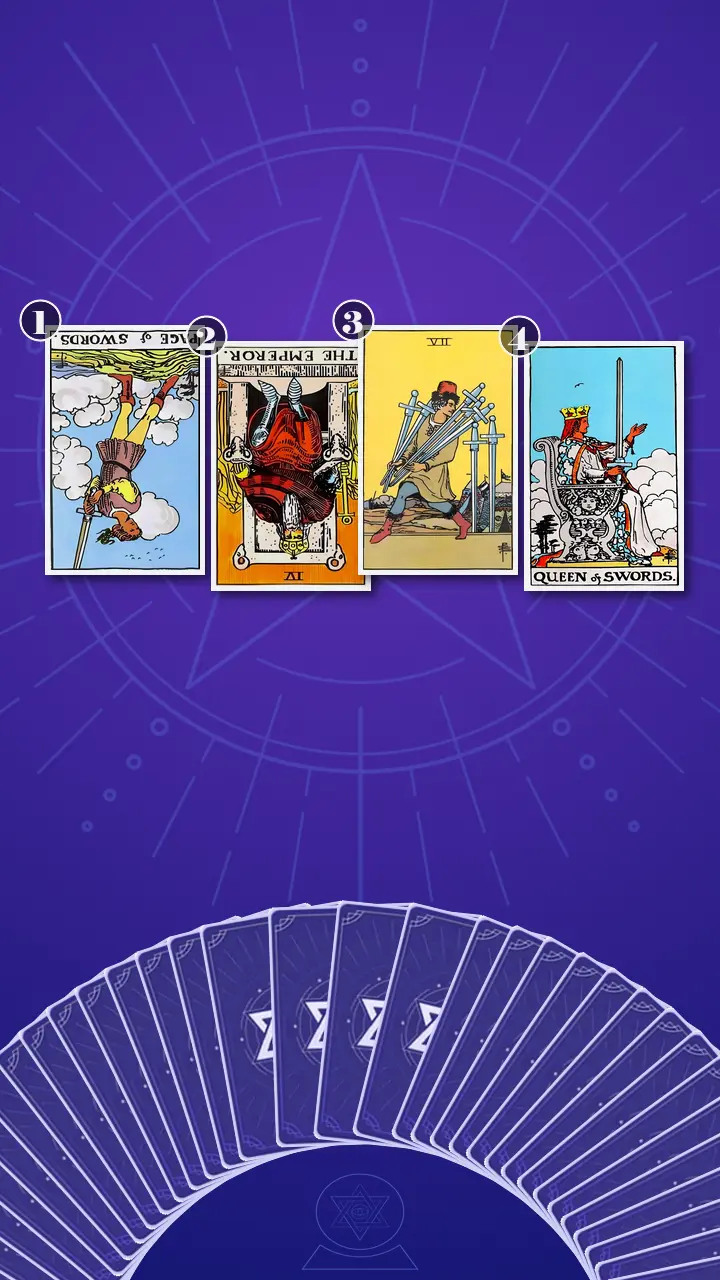
I laid the cards in a straight line from left to right, like four connected doors in a hallway. The first would show the exact doorway reaction. The second would reveal the old authority wound underneath it. The third would show the coping pattern that had tried to keep her safe. The fourth—the key card—would point to the adult boundary and next-step response that could help her stop overexplaining to parents without going cold or vague.
Reading the Hallway: What Gets Activated Before the Facts Arrive
The Question Before the Answer
I turned over the first card and said, “This position shows the exact surface trigger and nervous-system reaction that appears when your mom asks where you’re going.” The card was Page of Swords, reversed.
I felt an immediate click. This was the exact front-door split second she had described—the moment her mind outran the moment itself. Before answering, she was already scanning tone, predicting follow-up questions, and editing her wording so it sounded least likely to trigger scrutiny. By the time the elevator doors closed, she was replaying the exchange as if it had been a mini argument, even if nothing overtly happened. The raised sword in the card became a ready defense in the throat; the wind-whipped clouds mirrored how fast her mind moved before the facts even had a chance to settle.
“This is defensive air,” I told her. “Not because you’re dramatic. Because the mind has gone into excess alertness and blocked trust. It hears contact and translates it into interrogation.”
I gave her the everyday mirror of it: the way a manager can Slack ‘Got a sec?’ and your body reacts before you even open the message, or the way you can rewrite a two-line text five times because you’re bracing for subtext that may not be there. The card meanings in context were painfully clear here. Her internal notifications were all set to urgent before she had even opened the message.
“Keep it short,” I said, almost like I could hear her mind. “Don’t sound weird. Don’t open the door to follow-ups.” Then I looked up at her. “That is not you responding to the actual sentence. That is you responding to the courtroom it activates.”
She didn’t nod first. She let out a quick laugh with a bitter edge and pressed her lips together. “Okay,” she said. “That is horribly accurate.” Her fingers froze around her tea cup, then tapped once against the ceramic. “That’s literally what happens in my head.”
“Exactly,” I said. “The question is current. The panic is old.”
The Permission Check Hidden Inside the Hallway
I turned to the second card. “This position reveals the old fear or authority wound being reactivated beneath the simple question.” The card was The Emperor, reversed.
In perfumery, top notes are what hit first, but the base note tells me what is really holding the whole composition together. The Emperor reversed felt like the base note of this entire trigger. Under the surface, the question was landing like a hidden permission check. Her body reacted as if she might be corrected, overruled, or made to prove that her plans were responsible enough. That is why ordinary adult movement—dinner, a date, drinks with friends, coming home late—started to feel like something that had to be presented carefully to authority.
“This is distorted fire,” I told her. “Authority energy that has become rigid inside you. Not balanced structure. Blocked self-direction. Like your nervous system is still auto-connected to an old Wi-Fi network called permission.”
I watched the line land. Her shoulders, which had been subtly lifted since we began, rose another half-inch and then dropped. I kept my voice steady. “The real fear isn’t ‘my mom is asking a question.’ The real fear is ‘if this turns into scrutiny, I lose my footing in my own life.’ That is why your tone gets careful. That is why your stomach tightens before the conversation has even become a conversation.”
She looked away from the cards and toward the window behind me, where the late light had gone from warm to silvery. “I thought I was just irritated,” she said quietly. “But it’s more like… I’m bracing to be managed.”
“Yes,” I said. “Autonomy versus control. That’s the real contradiction.”
The Strategy That Gets You Out the Door Fastest
I turned over the third card. “This position shows the protective strategy this fear built, including how it tries to keep you safe.” The card was Seven of Swords, upright.
This one made me smile—not because it was trivial, but because it was intelligent. Here was Maya giving the version of the truth that got her out the door fastest: ‘just downtown,’ ‘meeting a friend,’ ‘back later.’ Not exactly lying. Not fully sharing. Just strategically low-detail. I told her the picture on the card was almost cinematic: the backward glance, the carried swords, the body angled toward the exit. It was the exact nervous-system move of answering while simultaneously checking whether another question was coming.
“This is adaptive intelligence,” I said. “Not pathology. The energy here isn’t wrong—it’s protective. But it has tilted into stealth. Privacy has started traveling in incognito mode because saying ‘I want privacy’ has felt riskier than editing the facts.”
I gave her the modern translation: sharing the headline of her plans without opening the full tab. It kept the evening intact in the short term. It let her avoid escalation. But it also kept the whole dynamic emotionally loaded, because secrecy still leaves the old fear in charge.
Then I said the line I knew she needed: “Privacy is not secrecy when you choose it on purpose.”
Her expression softened immediately. It was small—a slower exhale, a half-smile that looked equal parts relief and embarrassment—but it mattered. “That’s why I go vague,” she said. “It’s not random. I’m trying to get out without turning it into a thing.”
“Of course you are,” I said. “Seven of Swords is the trickster-protector. The habit makes sense. It’s just no longer the cleanest tool for the adult you’ve become.”
When the Queen of Swords Ended the Courtroom
One Calm Sentence, No Defense Brief
By the time I reached the fourth card, the room had gone noticeably quieter. Even the radiator gave one last tick and stopped, as if the space itself knew we were at the hinge point of the reading. “This position,” I said, “points to the adult boundary, self-trust, and next-step response that can loosen the trigger.” I turned the card over: Queen of Swords, upright.
I always pay close attention when a spread opens with a young sword figure in reaction and closes with a mature sword figure in command. Same element. Same sharp mind. Entirely different ownership. This was not a story about Maya becoming less sensitive. It was a story about her growing from defensive alertness into discerning speech.
I also felt my own professional lens click into place. In my Social Pattern Analysis work, I look for the hidden role assignment inside an interaction—the invisible casting that makes contact break down before either person has said very much. Here was the barrier in one line: mother becomes authority, daughter becomes defendant. The Queen of Swords did not ask Maya to become colder. She asked her to stop auditioning for innocence.
I asked Maya to picture the moment again: keys in her hand, one foot already pointed toward the hallway, her mom asking a basic question, her throat tight, stomach clenched, brain drafting the safest version of the truth.
You are not stuck in the old courtroom anymore; one clean boundary, like the Queen’s upright sword, cuts through the reflex to justify yourself.
I let that sit between us for a breath, then I said it even more plainly. “The trigger is not proof that you are still a child. It is proof that your body still hears an old permission system. You do not need to earn freedom by sounding harmless; you need one clear adult sentence.”
Her reaction came in three waves so visibly that I could almost time them. First, a full-body stillness: her breath caught, and her thumb stopped moving against the edge of her phone. Then the cognitive hit: her eyes lost focus for a second, as if she were replaying a hallway scene only she could see, maybe last Saturday, maybe a dozen Saturdays at once. Then the feeling broke through. Her jaw tightened—not with relief at first, but with anger. “But if that’s true,” she said, voice low and a little sharp, “doesn’t that mean I’ve been cross-examining myself before anyone else even does?”
“Not because you failed,” I said gently. “Because you adapted fast. There’s a difference. A younger part of you learned that explanation equals safety. The Queen is simply showing you that the adult version of safety sounds different.”
Her eyes brightened. Not tears exactly—more that sudden glassy look that comes when a person feels both seen and slightly undone by being seen. Her shoulders lowered, but with that lowering came a flicker of vulnerability, the mild disorientation that follows any real clarity. It is one thing to realize you are not powerless. It is another to realize you now have a choice.
“Now,” I asked her, “with this new lens, can you think of a moment last week when this would have changed how you felt?”
She nodded slowly. “Saturday. I said ‘just downtown’ like I was smuggling the truth out of the building.” She took one longer breath. “If I’d had this… I could have just said, ‘I’m meeting a friend and I’ll be back later,’ and stopped.”
That was the crossing. Not from conflict to perfection, but from reflexive defensiveness and teenage regression toward steady self-trust and calmer boundaries. From courtroom mode to clear contact. This is why I love the Queen of Swords for boundaries with parents: she does not demand a speech. She asks for concise truth without a defense brief.
Privacy Without Performance: The Next 48 Hours
Once all four cards were on the table, the story became clean. A neutral question hit the live wire of hyper-vigilant interpretation. Underneath that sat an older authority wound—the fear that being asked meant being managed. To cope, Maya had built a smart but costly workaround: selective disclosure, edited answers, getting out the door fast. Her blind spot was this: she kept trying to solve an old permission-system fear with better explanations, when the real transformation direction was toward one clear adult boundary.
“A clear sentence can do what a perfect explanation never does,” I told her. “It doesn’t control the other person’s reaction. It keeps you from abandoning your own footing.”
She made a face that was half amused, half overwhelmed. “But the question happens so fast,” she said. “I don’t exactly have five minutes in the hallway to become enlightened.”
I laughed softly. “Good. Then we won’t train for enlightenment. We’ll train for one breath.”
I gave her a practical plan—actionable advice, not abstract encouragement:
- One-Sentence BoundaryOpen your Notes app tonight and write one factual line you could actually use this week: ‘I’m heading out to meet a friend and I’ll be back later.’ Tomorrow, practice saying it once while holding your keys at the door, in the exact posture where your body usually tenses. When the real question comes, give that one sentence first and stop for two beats before deciding whether you want to add anything else.Tip: The first discomfort will be the silence after you answer. Let it exist. A short answer is not rude just because it does not sound apologetic.
- Permission-System CheckPut a tiny cue where you can see it before leaving—your lock screen, a sticky dot near the door, even a note in your phone that says, ‘Question is not permission.’ After one interaction, make two quick columns on the TTC or in the elevator: ‘What was actually asked’ and ‘What my body predicted.’Tip: If you forget in the moment, do it afterward. The goal is not to become unbothered overnight. The goal is to catch the jump between the sentence and the old meaning attached to it.
- Doorway Reset with a Woody Base NoteBecause I work with scent as well as symbolism, I added one of my own strategies: keep a subtle cedar- or vetiver-leaning spray by your keys and use one close-to-skin mist before you leave. Not as magic. As anchoring. Woody accords support professional presence because they register in the body as steadier, lower, less eager to explain. Pair the spray with the thought, ‘I’m answering from the adult in the room.’Tip: Keep the sillage soft and close. This is first impression calibration for your nervous system, not an announcement to the whole apartment.
When I finished, I added one last distinction I did not want her to miss: “Seven of Swords protected your privacy through stealth. Queen of Swords protects it through choice. Privacy without secrecy. That’s the move.”

A Week Later: The Quiet Proof
Four days later, I got a text from Maya while she was on the westbound TTC: ‘Used the line. “I’m meeting a friend and I’ll be back later.” My stomach still dropped, but it passed by the second stop.’ That was all. No grand reconciliation. No cinematic breakthrough. Just a quieter body by the second stop.
For me, that is what a real journey to clarity often looks like. Not solving family dynamics in one reading, but creating a sliver of space where the adult voice arrives before the defense brief. That is enough to begin. That is enough to repeat.
Sometimes the hardest part is not leaving the house but feeling your throat tighten in your own doorway because one ordinary question still brushes the old fear that your life can be overruled. If that old courtroom still flickers on in you when a parent asks a simple question, what one calm sentence could the adult in you say before the explanation starts?