From the Good Kid Role to One Honest Sentence Back Home

Finding Clarity in the 10:41 p.m. Good Kid Spiral
When Maya (name changed for privacy) sat down with me, I recognized the pattern before she finished her first sentence. She was twenty-nine, a Toronto content strategist, the kind of woman who could lead a client call without blinking and still spend the night before a family visit drafting safer replies in her Notes app before she even opened the family group chat. In search-bar language, people call it “why do I become a teenager around my parents?” In my reading room, I call it family-role regression.
She described Thursday at 10:41 p.m. in her west-end apartment: a half-zipped weekender on the bed, the fridge humming from the kitchen, the radiator clicking dry heat into the room, blue phone light spilled across her hands while she rewrote “Work is good, just busy” into softer and softer versions. She wanted to stop slipping into the good kid role, but she was just as afraid of what might happen if she showed up at home as the fuller adult she had become. The feeling sat in her chest like a seat belt locked one notch too tight; by the time she finished describing it, her shoulders were nearly touching her ears.
“I know I’m an adult until I get around my family,” she told me. “Then I start shrinking before I even get there.” There was guilt in the sentence, and resentment tucked underneath it, like two tabs she had stopped noticing were still open. I nodded and told her the truth gently. Home can make an adult nervous system reach for an old costume. My job was not to shame the costume. My job was to help her see when it slid on, why it had once felt protective, and how we could make a map back to her own voice.

Choosing the Shadow Spread for the Old Script
I asked Maya to put both feet on the floor, take one slow breath, and picture the moment just before she opened her parents’ front door. Then I shuffled. I have never needed tarot to be theatrical; the ritual matters because it gives the mind a clean threshold between spiraling and noticing.
For this question, I chose The Shadow Spread, a five-card spread for hidden family patterns, inherited scripts, and adult boundaries at home. This is how tarot works best for a problem like the good kid role: not as prediction, but as pattern recognition. We were not asking whether the weekend would go well. We were asking why her body kept auto-loading an earlier version of herself, and where choice could re-enter that sequence.
I told her why this spread fit so well. The first card would show the visible people-pleasing relapse at home. The second would reveal the hidden family rulebook underneath it. The third would show the trigger that flips her from adult competence into anticipatory self-editing. The fourth—the key card in this reading—would offer the medicine. The fifth would show how connection and self-respect could live in the same room.
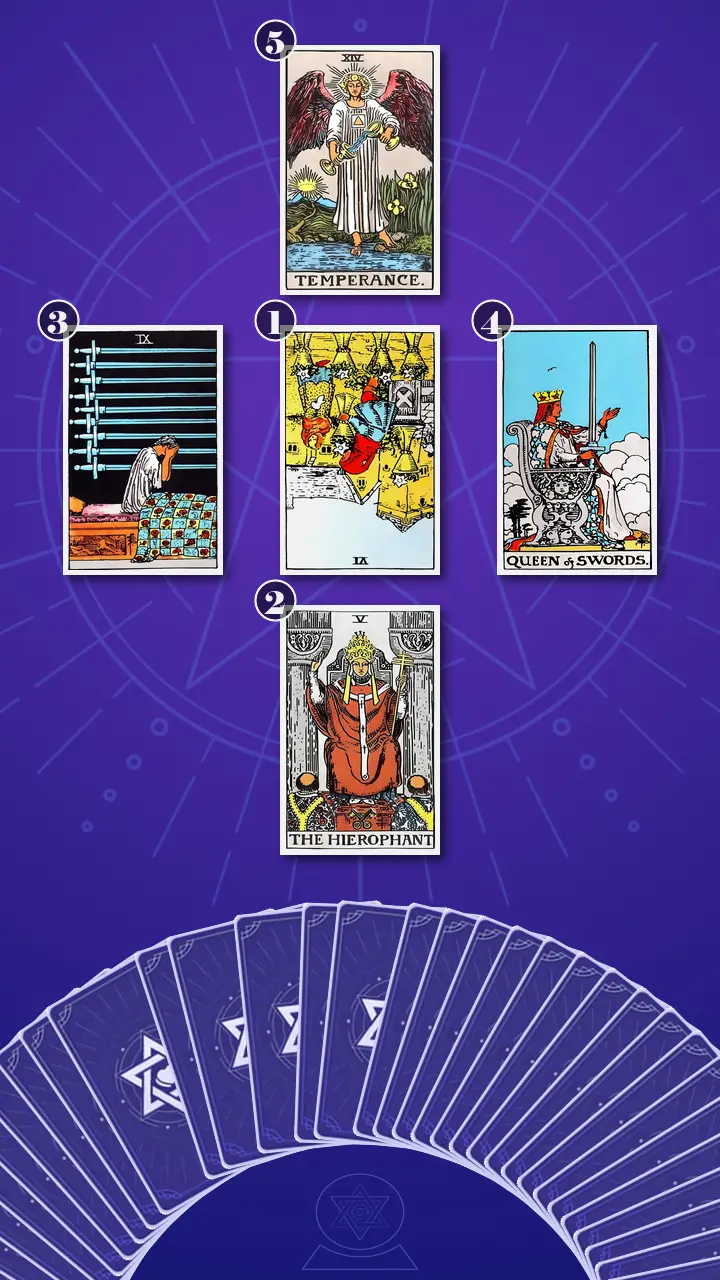
Reading the Old Script
Position 1: The Version of Her That Waits Outside the House
The first card I turned over was the one that shows the visible “good kid” regression and the concrete behavior loop that appears as Maya prepares to go home. It was the Six of Cups, reversed.
I translated it in plain life language. As the trip home approaches, Maya is not just packing clothes—she is auto-loading an earlier version of herself. A family text comes in, her tone goes sweeter, and by the time she walks into the old house she is volunteering help, answering too fast, and editing out anything too complex, like her adult self has been left back in Toronto with the plants and the rent payment. Reversed, this card is a blockage in the flow of time. Memory is supposed to inform the present, not impersonate it. Instead, the old courtyard of the card becomes the old house layout: the same stairs, the same kitchen light, the same nervous-system shortcut back to being the easy child.
I told her it was like a phone auto-connecting to old Wi-Fi and old behavior at the same time. She let out a short laugh that caught on the way out. “That feels a little brutal,” she said, rubbing her thumb against the edge of her mug, “but yes.” I thought of the childhood bedroom she had described, the closet door that still stuck, the faint smell of old laundry detergent, the way a capable woman can walk in and feel her opinions arrive half a beat slower. Kindness is not the problem. Disappearing is.
Position 2: The Family Terms and Conditions
The next card I opened was the one that reveals the internalized family rulebook that taught Maya to stay lovable by being easy, grateful, and non-disruptive. It was The Hierophant, upright.
This card reads like the invisible house manual she absorbed years ago: be polite, be grateful, do not be difficult, do not make the room adjust to you. Upright here, its energy was not balanced wisdom but an excess of borrowed authority. Nobody had to say the rules out loud at dinner; her body already acted like there was an approval rubric running in the background. The crossed keys on the card felt, to me, like access codes for staying inside the family story without losing points for being too complicated.
Seeing The Hierophant, I had one of those small professional flashbacks I still get from my years working on transoceanic cruise ships. At formal captain’s dinners, grown adults would straighten, edit themselves, and speak more carefully before anyone in power had even addressed them. Social systems do that. They train posture first and language second. I told Maya, “Your family may ask questions in the tone of practical concern, but your nervous system still hears them as an exam.” Her eyes dropped to the table and she gave me a tight nod. “That makes sense,” she said quietly. “I say yes before I even know what I want.” A fake yes keeps the room smooth and leaves you behind.
Position 3: The Night Before the Visit Starts
The third card was the one that identifies what flips Maya from adult self-possession into anticipatory self-editing before and during the visit. It was the Nine of Swords, upright.
This card could not have been more literal. At 1:13 a.m. in her Toronto bed, Maya is running mock interviews in her head—if they ask about money, say this; if they ask about dating, smile and pivot; if they ask what’s next, make it sound calm, not defensive, not too ambitious, not too vague. Upright here, the air element is in excess. It is not discernment yet; it is overdrive. Like having fourteen browser tabs open for conversations that have not happened, the mind starts the visit hours before real life does.
I slowed my voice and named the loop exactly as I saw it: the duvet twisted around her legs, jaw tight, screen brightness low, her bed turning into a planning room. “If they ask X, say Y. If they push, smile. If it gets weird, redirect.” By morning, I told her, compliance does not feel like self-abandonment; it feels like relief because she is already exhausted. She went very still—first her breath paused, then her gaze unfocused as if replaying a night she knew too well, and then a long exhale left her all at once. “Yes,” she said. “This starts before I even get there.”
When the Queen of Swords Cut a Doorway
Position 4: Queen of Swords, the Medicine of One Clear Sentence
When I turned the fourth card, the room changed. A pale strip of winter light slid across the table and caught the printed blade first, so for a second the Queen seemed to appear before the rest of the card. This was the position that points to the corrective energy that can interrupt automatic compliance and support an adult voice with boundaries. The card was the Queen of Swords, upright.
I explained it in modern terms. At the table, a relative asks a loaded question about work or relationships. The old pattern reaches for a cushioning paragraph, the verbal equivalent of a five-paragraph apology email. The Queen of Swords replaces that with one clean, adult line: “I’m still figuring that out, and I’d rather not workshop it over dinner.” Upright, this is balanced air—clarity without cruelty, warmth with a clear limit. The sword is the sentence. The open hand is the tone.
I leaned in a little. “Right now,” I said, “you are on the GO train with your Notes app open, editing a perfectly harmless answer for the third time, because somewhere between Union Station and home your body has decided that honesty is risky and smoothness is safer.” I let that land for a beat.
You are not here to remain the child who keeps the peace at any cost; lift the Queen of Swords' clear blade and let one honest sentence cut a doorway for your adult self.
Then I gave her the deeper truth. The pattern is not that she is weak around family. The pattern is that her nervous system still treats self-erasure as the quickest route to belonging—and the first interruption can be one calm, honest sentence.
I use a framework with clients called Social Role Switching. We all have modes. At work, Maya already knows strategist mode. With a hurting friend, she knows supportive mode. At home, the house keeps auto-selecting Good Kid Mode before she has consented to it. The Queen of Swords was not asking her to become icy. She was asking her to consciously activate Assertive Mode: eye contact, slower speech, one line, then no scramble to manage the room. A clear sentence can be warmer than a practiced agreement.
Maya’s reaction did not arrive as instant relief. First, she froze so completely that even her fingers stopped moving against the mug. Then her face tightened, a flash of resistance passing through her eyes before it turned into a small, angry laugh. “But if I do that,” she said, “the whole mood changes. And doesn’t that basically mean I’ve been doing this wrong the whole time?” I answered her carefully. “No. It means the strategy was old, not stupid. It kept you inside the room. We’re just checking whether connection can survive when you stop shrinking to pay for it.” Her jaw unclenched. Her shoulders dropped a fraction. Then another fraction. By the time she looked back at the card, her eyes were damp, not with collapse but with recognition—the slightly dizzy feeling that comes when a door opens where a wall used to be. “So the pattern isn’t that I’m weak around them,” she said slowly. “It’s that I erase myself fast because it feels safer.” I nodded. “Exactly. Now, if you look back at the last visit, where would one honest sentence have changed the feeling?” She did not hesitate. “In the kitchen,” she said. “When they asked about my timeline. I could have said, ‘I’m still thinking about that, and I’m not workshopping it tonight.’” That was the moment the reading moved—from belonging-through-compliance to warm, adult self-trust at home.
Position 5: Temperance and Warmth Without Shrinking
The fifth card was the one that shows how Maya can return home without abandoning connection or abandoning herself. It was Temperance, upright.
I loved this as the closing card. Later in the visit, Maya notices the urge to instantly smooth things over, takes one slower breath, keeps her voice warm, and chooses a paced response instead of the old automatic yes. Upright here, Temperance is balance in motion. One foot stays on land, one in water: grounded in her own body, still in relationship. This is not a dramatic confrontation card. It is the art of adjusting the thermostat instead of setting off the fire alarm.
I told her that the goal was not to win the weekend or deliver some movie-scene boundary speech. It was to stay present for one moment at a time: a sip of water before answering, a two-second pause, a quick step onto the porch, a warm tone that does not shape-shift. She breathed deeper when I said that. “That I can do,” she said. And I believed her. You do not have to win the visit to stay with yourself.
From Insight to Action: The Front-Door Reality Check
When I laid the whole spread back in sequence, the story was clean. The Six of Cups reversed showed the visible family-role regression: the old school uniform of sweetness and manageability sliding on before the front door. The Hierophant showed why: somewhere deep in the nervous system, love had become tangled with being easy to handle. The Nine of Swords showed the activator: the visit starting in the mind first, with self-editing, rehearsal, and decision fatigue long before anyone actually asked a question. Then the Queen of Swords changed the air itself, turning anxious looping into clear discernment, and Temperance showed how that clarity becomes sustainable through pacing and regulation.
The blind spot, I told Maya, was thinking the solution was a better performance—better wording, better tone, better emotional management. It wasn’t. The deeper shift was from earning closeness through compliance to testing whether connection can hold when she tells one smaller, honest truth in real time. In other words: from managing the room to staying present inside it.
Because I spent years teaching social navigation on cruise ships, I gave her one of my favorite practical tools: a home version of what I call Maritime Social Protocol. On a ship, the wisest crew members do not step onto a crowded deck and instantly react to the weather, the noise, and the nearest demand. They orient first. At home, the protocol is simple: locate yourself, choose your mode, then answer. That is how Warmth Without Shrinking becomes real.
The Next Visit, in Three Small Moves
- The Adult Voice Rehearsal Before you leave this week, put three one-line responses in Notes for the exact topics that usually hook you—work, dating, money, or timelines. Use lines like: “I’m still figuring that out,” “I’d rather not get into that tonight,” and “I’ll tell you when I know more.” Then stand up and read each line once in your normal speaking voice for less than two minutes. If it feels cold or weirdly formal, assume that reaction belongs to the old rulebook. Keep the line short, warm, and non-defensive. If three is too much, practice one.
- The Front-Door Reality Check When you are five minutes from the house—on the GO train, in the car, or on the sidewalk—say three present-day facts out loud: your age, your city, and one adult choice you have made for yourself. Save them as a lock-screen note or a quick voice memo, then take one full exhale before you walk in. The point is not to feel profound. The point is to interrupt autopilot by one beat and remind your body who is arriving now.
- Pause-Before-Yes Practice Once during the visit, use a deliberate five-second pause before answering a plan, request, or practical question. Keep your feet flat, take a sip of water or hold your mug, and try a bridge line such as: “Maybe—let me think for a second,” or “Not tonight, maybe tomorrow.” The silence after a pause can feel louder than it is. If five seconds feels impossible, count to two. The smallest version still counts.

A Week Later, the Quiet Proof
A week later, Maya sent me a message from the ride back to Toronto. “I used the sentence,” she wrote. Her uncle had asked a practical-sounding question about when she planned to make her next big work move, and she said, “I’m still thinking about that, and I’m not workshopping it over dinner.” Then she added: “My heart was absolutely sprinting. But nobody exploded. It got quiet for a second, and then we kept eating.”
She told me the strangest part was not the silence. It was staying in her body through it. She slept a full night after the visit, though her first thought the next morning was still, Was that rude? This time she smiled, made coffee, and did not send a repair text.
That is the journey I trust most in tarot: not a perfect ending, but a small piece of evidence. In this Shadow Spread reading for hidden family patterns, Maya did not solve her whole history. She proved that one-sentence boundary, one front-door breath reset, and one honest pause could begin moving her from self-erasure to self-trust.
When home makes your chest tighten and your voice go polite before you have even decided what you actually think, the deepest fear is not just an awkward moment—it is that being fully yourself might cost you your place in the room. I never treat that fear lightly.
If you are heading toward your own front door soon, and the old script is already warming up in your Notes app, what might one smaller honest sentence sound like in your own voice?